Tag: Irish Saints

  • The Character of Saint Finnian

    The Character of Saint Finnian

    Finian died at Clonard, in A.D. 552. An old writer has left us the following sketch of his character: — “He was full of wisdom, as a scribe most learned to teach the law of God’s commandments. He was most merciful and compassionate, and sincerely sympathised with the infirmities of the sick, and the sorrows of the afflicted; and in every work of mercy he was most ready with his assistance. He healed with mildness the mental and bodily ills of all who came to him. Towards himself he exercised the strictest discipline, to leave to others a good example. He loved all from a pure heart. He abhorred all carnal and mental vices. His ordinary food was bread and herbs, his drink water; but on the festivals of the Church, he ate bread made of corn, and drank a cup of ale, or whey. When obliged to take moderate repose, he slept not on a soft and easy couch, but rather on the bare ground, with a stone for his pillow. In a word, he was full of compassion toward all other men, but of strictness and severity to himself.”

    Vita St. Finian,— Colgan’s AA. SS. p. 397.

    W. G. Todd, A History of the Ancient Church in Ireland (London, 1845), 31.

    Content Copyright © Omnium Sanctorum Hiberniae 2012-2022. All rights reserved.
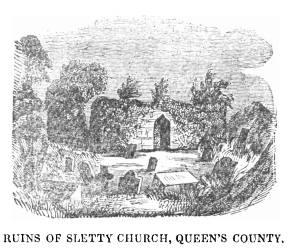
  • The Old Age of Saint Fiacc of Sletty

    October 12 is the feastday of Saint Fiacc of Sletty, a bard converted by Saint
    Patrick and later made a Bishop. A paper detailing his life can be read at the blog here. Below is a beautiful tribute to the saint in his old age when, despite
    his advancing years, there was no lessening of his ascetic discipline:

    …Fiacc in his old age lived a life of extraordinary austerity. At the
    beginning of Lent he usually left his monastery unattended, taking with
    him only five barley loaves, and these strewn with ashes. He forbade any
    of his monks to follow him, but he was seen to go to the hills to the
    north-west of Sletty, a wild and solitary district. In one of these,
    called Drum Coblai, he had a cave which sheltered him. The hill itself
    has been identified with the Doon of Clophook, which is just seven
    miles to the north-west of Sletty. Its eastern slope ‘which is steep and
    beetling’ rises abruptly to the height of 150 feet; at its base is the
    cave thirty-six feet deep by twelve in width. Close at hand there was an
    ancient church and cemetery, doubtless founded there in honour of the
    saint. Local tradition still remembers him; but as he was not seen
    coming or going to his church at Sletty, the wise people came to the
    conclusion that he had an underground passage through the mountains all
    the way to his own church. The fame of his sanctity and austerities
    still clings like the mists of morning to the mountain sides of Slieve
    Margy, where he spent his last and holiest days.

    The poet-saint
    sleeps amid many miracles with kindred dust in his own church of Sletty,
    within view of the spires of Carlow. An ancient stone cross still
    standing is said to mark the spot on the right bank of the river where
    his holy relics rest. He was one of the earliest of our native prelates,
    he led an austere and humble life, he was deeply attached to the person
    and to the memory of his beloved master St. Patrick, and his influence
    has been felt for many ages in all the churches of Leinster. His poetic
    Life of St. Patrick, to which we have already referred, is beyond doubt
    an authentic poem; and if so it is the earliest and most authentic of
    all the Lives of the Saint. In any case it is an invaluable monument of
    the history, the language, and the learning of the ancient Church of
    Ireland….

    Most Rev. Dr. J. Healy, The Life and Writings of Saint Patrick (Dublin, 1905), 399-400.


    Content Copyright © Omnium Sanctorum Hiberniae 2012-2020. All rights reserved.

  • The Nativity of Saint Colmán Elo, October 3

    On October 3, some of the Irish calendars record the feast of the nativity of Saint Colmán Elo. The marking of the birth of this saint as a separate feast is perhaps a reflection of his importance as a scholar and monastic founder. He lived c.560–611 and the most important work ascribed to his authorship is the ascetical poem the Apgitir chrábaid (the alphabet of piety). Some modern scholars have also suggested that Saint Colmán may have been the author of the hymn in praise of Saint Patrick, traditionally attributed to Secundinus (Sechnall). I have written about this hymn, Audite omnes amantes, and reproduced a translation of it at my blog dedicated to the three patrons here. Interestingly, genealogical sources record that Colmán Elo of the moccu Béognae was a relative of Saint Colum Cille of Iona, who also has the feast of his nativity listed on the calendars at December 7. Indeed, Saint Colmán features in the Life of Columba by Adamnan and left Iona after the death of its founder in 597 to establish his own monastery at Lann Elo, modern Lynally, County Offaly. The primary feast of Saint Colmán Elo is on September 26 and a post on his life can be read at the blog here

    Content Copyright © Omnium Sanctorum Hiberniae 2012-2022. All rights reserved.