Tag: Irish Saints

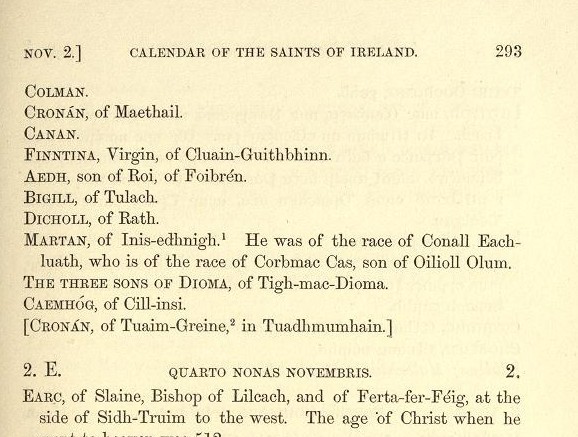
  • Saint Erc of Slane, November 2

    November 2 is the feast of Saint Erc (Erk, Herc) of Slane, County Meath, a saint who features in the hagiography of Saint Patrick. In the account below, taken from his diocesan history of Meath, Father Anthony Cogan gives us the story of the saint’s life beginning with a summary of the famous episode of the kindling of the Paschal Fire at Slane. Saint Erc is a particularly attractive figure as he straddles both the old world of pre-Christian Ireland and the new Christian world of Saint Patrick:

    The first ecclesiastical notice we have of Slane is the kindling of the Paschal fire by St. Patrick on its hill, within view of the palace of Tara. This fact is noticed in all the lives of St. Patrick, and we take the following condensed report from Dr. Lanigan’s Ecclesiastical History [Vol. i., pp. 222, 223, 224]:

    “On the following day, which was Easter Eve or Holy Saturday, St. Patrick continued his journey, and arrived in the evening at a place called Ferta-fer-feic, now Slane. Having got a tent pitched there, he made preparations for celebrating the festival of Easter, and accordingly lighted the Paschal fire about nightfall. It happened that at this very time the King Laogaire and the assembled princes were celebrating a religious festival, of which fire-worship formed a part. There was a standing law that, at the time of this festival, no fire should be kindled for a considerable distance all around, until after a great fire should be lighted in the royal palace of Temoria or Tara. St. Patrick’s Paschal fire was, however, lighted before that of the palace, and being seen from the heights of Tara, excited great astonishment. On the king’s inquiring what could be the cause of it, and who could have thus dared to infringe the law, the magi told him that it was necessary to have that fire extinguished immediately, whereas, if allowed to remain, it would get the better of their fires, and bring about the downfall of his kingdom. Laogaire, enraged and troubled on getting this information, set out for Slane with a considerable number of followers and one or two of the principal magi, for the purpose of exterminating these violators of the law. When arrived within some distance from where the tent was, they sat down, and St. Patrick was sent for with an order to appear before the king and give an account of his conduct. It was arranged that no one should show him any mark of respect, nor rise up to receive him. But, on his presenting himself before them, Herc, son of Dego, disobeyed the injunction, and standing up, saluted him, and receiving the saint’s blessing, became a believer. He was afterwards Bishop of Slane, and celebrated for his sanctity”.

    ST. ERK.

    Erk, “the sweet spoken judge”, was, in all probability, a native of Munster, and is said to have been page to King Laogaire at the time he showed this respect to St. Patrick. He was consecrated some time before the year 465, and was the first bishop of the ancient diocese of Slane, and abbot of the monastery which was erected there by St. Patrick. He is said to have been the preceptor of St. Brendan, and was an intimate friend of St. Brigid. At the synod of Mag-Femyn, in Tipperary, it is related that Erk spoke highly of the great abbess of Kildare, and of the miraculous favours with which she was endowed by the Almighty. He assisted at the consecration of Conlaeth, first bishop of Kildare, and took an active part in all the ecclesiastical movements of the age.

    In his declining years he retired from the active duties of the mission, and founded a hermitage on the banks of the Boyne, where in solitude, mortification, prayer, and the practice of every virtue, he prepared himself for eternity. The Four Masters say he died on the 2nd of November, 512.

    “His age was four score years and ten when he departed. This Bishop Erk was judge to Patrick. It was for him Patrick composed this quatrain:

    Bishop Erk,
    Everything he judged was just;
    Every one that passes a just judgment
    Shall receive the blessing of Bishop Erk”.

    That St. Erk was a man of great sanctity and usefulness, the respect in which he was held by St. Patrick, the honourable mention made of him in our annals, and the veneration with which the people of Slane still regard his memory after the lapse of thirteen hundred years, are a sufficient testimony. In the Martyrology of Donegal, his festival is marked at the 2nd of November. Colgan says that, in the old calendars, Ercus is treated of on 2nd of October and 2nd of November. Probus, writing of him in the tenth century, says: “Hercus, filius Dego, cujus reliquiae nunc venerantur in civitate, quae vocatur Slane”.

    Rev. A. Cogan, The Diocese of Meath Ancient and Modern. Vol. I. (Dublin and London, 1862), 59-61.

    Content Copyright © Omnium Sanctorum Hiberniae 2012-2015. All rights reserved.
  • Saint Finntina of Cluain Guithbhinn, November 1


    The Irish calendars record the name of yet another of our obscure female saints on November 1. Alas, the earliest of these, the Martyrology of Tallaght, has a hiatus in the surviving manuscripts and the entire month of November plus the first sixteen days of December are missing. The name of Saint Fintinna, Virgin, of Cluain Guithbhinn, is however recorded in the later calendars. The  Martyrology of Gorman,  compiled in the late twelfth century lists the saint and her day as does the seventeenth-  century Martyrology of Donegal.  The 1857 edition of The Martyrology of Tallaght produced by Father Matthew Kelly supplements the missing entries with those from the Martyrology of Donegal. It therefore lists: Nov. 1 Finntina Ogh o Cluain Guithbinn and the index identifies Cluain Guitbinn with Cloongefin, County Roscommon.  I can find out no further information on this holy lady but it pleases me to be able to record her name on the day when we celebrate the memories of all the saints. Saint Finntina, intercede for us!

    Content Copyright © Omnium Sanctorum Hiberniae 2012-2015. All rights reserved.

  • Saint Colman of Cammus Comghaill, October 30

    October 30 presents us with the feast of yet another Saint Colmán and thus with yet another mystery as to his precise identity, location and feast day. The Martyrology of Donegal records:

    30. B. TERTIO KAL. NOVEMBRIS. 30.


    COLMAN, Abbot, of Cammus Comghaill, on the brink of the Bann; or of Lann Mocholmog: and he was maternal brother to Mocholmog of the Lann.

    Bishop Reeves’ mid-nineteenth century account of the northern dioceses of Down, Connor and Dromore, identified ‘the Lann’ as the parish of Magheralin, County Down:

    Lan.—Now the parish of Magheralin. The church was founded by St. Colman or Mocholmoc, whose death Tigernach records at the year 700: “Colman Linduacaill obit”. “Colman of Lin-duacall died”. Or, as the Four Masters, a year earlier: “Colman Linne Uachaille decc. an XXX Marta”. “Colman of Linn-uachaill died on the 30th of March”. Hence it is sometimes called Lann-Da-Cholmoc, or Lann-Mocholmoc, which both signify ‘ the church of Colman’; for the syllables Da or Do, in the sense ‘your’, and Mo, in the sense ‘my’, were prefixed to saints’ names, as Colgan observes, “honoris et singularis observantiae causa”.

    Rev. W. Reeves, Ecclesiastical Antiquities of Down, Connor and Dromore (Dublin, 1847), 110.

    This identification was challenged, however, by another Anglican cleric who placed the location of Saint Colmán’s foundation at Annagassan, County Louth:

    Monastery or Linn Duachaill.—It is in the townland of Linns, close to the village of Annagassan, that we find the first trace of an ecclesiastical establishment in the Parish of Gernonstown. St. Colman MacLuachan is said to have founded a church or monastery here in the seventh century. It was known by the name of Linn Duachaill (i.e.. Duachaill’s pool), or Linn Uachaill from a demon named Duachaill, who is said to have infested the place and terrified the neighbourhood until destroyed by St. Colman. Duachaill’s pool is still pointed out at the junction of the Clyde and Dee before they enter the sea at Annagassan. Dr. O’ Donovan once thought that Linn Duachaill was Magheralin. Co. Down, and at first Bishop Reeves seems to have had the same opinion. But both those antiquaries found it necessary to correct their opinion on becoming acquainted with the topography and traditions of Annagassan. For Linn Duachaill was on the banks of the river called Casan Linne (Martyr. Doneg., Mar. 30, p. 91, cp Colgan Acta SS., pp. 792-703), and this river is mentioned in the “Circuit of Ireland ” as lying between the Vale of Newry, or Glen Righe, and Ath Gabhla on the Boyne. The name ” Casan”=”paths” survives in Annagassan. According to Joyce (Names of Places, p. 373) “Casan ” was originally joined with “Linne Duachaill” and became shortened to ” Casan linne,” which is preserved in Annagassan=Ath-na-gcasan, “the ford of the paths.” Dr. Todd, who has an important note on the subject in ” Wars of the Gaedhil with the Gall,” p. lxii., says, Annagassan=Aonach g Casain, i.e., the ” Fair of Casan.” Joyce’s interpretation is, I think, to be preferred, as the people still speak of the “Pass of Linns ” and this pass, as pointed out, lay further up the River Glyde, about a quarter of a mile from Duachaill’s pool, and near the spot where the monastery founded by St. Colman is believed to have stood.

    Colgan has collected all the traces of this Saint Colman Mac Luachan (in his Acta SS., p. 792-3). From Colgan we learn that his mother’s name was Lessara, and that he and another Colman were uterine brothers and living at the same time, but his father was of the Hi Gualla or Gaillfine, an Ulster race, while the father of the other Colman was of the royal family of Meath. It appears that he had two or three churches — Camus-juxta-Bann, Lann Mocholmoc, or Linn Duachaill, and perhaps Lann Abhaic and Lann Ronain in Down and Dromore. In his churches he was commemorated on March 30 and October 30, and he is held eminent for his sanctity. The other Colman was commemorated on June 17. There is in the Annals some confusion between these Colmans; but St. Colman of Linn Duachaill, called also Mocholmoc, died on March 30, 699.

    Rev. J. B. Leslie, History of Kilsaran Union of Parishes in the County of Louth, (Dundalk, 1908), 89-91.

    Thus it seems, and not for the first time, that the problem of distinguishing homonymous saints named Colman has left us with a question mark over the relationship between the saint commemorated on October 30 and the saint commemorated on March 30.

    Content Copyright © Omnium Sanctorum Hiberniae 2012-2015. All rights reserved.