Tag: Irish Saints

  • Saint Temnióc of Clonfert, December 23

    23. The passion of eight hundred fair martyrs with sixty noble ones who were slain: with my Temnióc of the king-folk of truly good Clúain fertae.

    Thus does the Martyrology of Oengus read for December 23. The scholiast tells us a little more about ‘my Temnióc’:

    23. Temneóc i.e. from Clúain ferta Molua, i.e. the cook of Molua of Clúain ferta.

    Saint Molua was the founder of a monastery at Clonfert-Molua or Clonfert-Mulloe as it is also known. There is an entry for his life here. Our saint was a member of the monastic household. Archbishop John Healy in his classic survey of the monastic schools of Ireland has this to say about Saint Temnióc’s domain – the monastic kitchen:

    One of the most necessary buildings for a laura or monastery was the kitchen — the cuicin in Irish, or culina in Latin. St. Patrick’s ‘kitchen’ at Armagh was seventeen feet long,and is spoken of as one of the principal buildings within the lis, or monastic enclosure. The Tripartite Life of the Saint in the same place tells us that the Great House was twenty- seven feet in length, and consequently much longer than the ‘ kitchen’ with which it seems to have been connected. The Great House—if not the church—was in all probability the refectory or dining-room, which is more generally and appropriately called in Irish, the proinn-teach, or dinner-house. It is doubtful if we have any specimens of the Refectories or Kitchens of our earliest monasteries still surviving, because as a rule they were composed of perishable materials…..

    The ordinary meal for the ‘family’ was barley or oaten bread, with milk when it could be had, and a little fish, perhaps sometimes eggs. Flesh meat was rarely allowed except on high festival days or when distinguished strangers came to the monastery. The brethren were then allowed a share of the good cheer provided for the strangers. There was, however, except for those labouring in the fields, only one meal in the day — the Columban Rule borrowed from Bangor expressly says that the fare was to be plain and taken only in the evening, that is, after noon. Vegetables, porridge, and baked bread are the principal items mentioned as allowable, and barely as much as would support life. Excessive abstinence from food, however, was to be deemed a vice, not a virtue; but to some extent a monk was to fast every day. The ‘order of refection, and of the refectory,’ is one of the most interesting portions of the Rule of St. Carthach of Lismore. He allows an ample meal for the workman and special delicacies for the sick. On Sundays and other festivals of the year, especially on the greater festivals, meals were increased.’ From Easter to Pentecost was also a season of full meals “without fasting, heavy labour, or great vigils.” The Summer and Winter Lent are more bitter to laics than to monks, for to the latter all seasons should be as Lent. The meal was to be at vesper time only, except from Easter to St. John’s Day, when a refection was also allowed at noon. The bell was to be the signal for the meal, but first there was a Pater with three genuflections in the church; then the meal was blessed. Alleluia was sung, and a benediction pronounced by the Senior, who said, “God bless you.” The meal was followed by thanksgiving, after which all retired to their cell for private prayer preparatory to vespers. Wednesday and Friday were generally fast days.

    Insula Sanctorum et Doctorum or Ireland’s Ancient Schools and Scholars by the Most Rev. John Healy (6th edition, Dublin, 1912), 96, 101-2.

    Content Copyright © Omnium Sanctorum Hiberniae 2012-2015. All rights reserved.
  • Saint Ultan Tua of Clane, December 22

    December 22 sees the commemoration of an Irish saint with an interesting Lenten discipline – Ultan Tua ‘the Silent’ of Clane, County Kildare. The Martyrology of Oengus records:

    22. May Tua’s prayer which is not speech, protect us (and) Itharnaisc, with bright Emene from the brink of silent Berbae.

    to which entry the scholiast has noted:

    22. May Tua’s prayer protect me, i.e. Tuae from Tech Tuae in Hui Faelain, the same as Ultan of Tech Tuae. Idea Tua ‘silent’ dicitur etc.

    The later Martyrology of Donegal records the ascetical practice Saint Ultan pursued during Lent which gave rise to his reputation as the quiet man:

    22. F. UNDECIMO KAL. JANUARII. 22.
    ULTAN TUA, and IOTHARNAISC, two saints who are at Claonadh, i.e., a church which is in Ui Faelain, in Leinster. This is the Ultan Tua who used to put a stone in his mouth in the time of Lent, so that he might not speak at all.

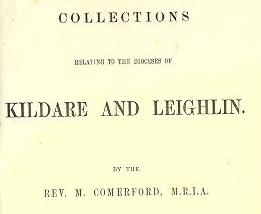
    Father Michael Comerford, in his diocesan history of Kildare and Leighlin, records something of the locality in which these saints flourished, and notes a tradition that they were brothers to another monastic, Maighend, abbot of Kilmainham. He claims though that the Martyrology of Donegal gives their feast at December 23, but as we have seen above, they are listed at December 22:

    PARISH OF CLANE.

    THE Parish now so called comprises the ancient parochial districts of Clane, Mainham, Dunadea, Timahoe, Dunmurghill, Ballynefah, and Balrahen.

    CLANE.

    In ancient records the name of this place is given in two forms; Claen-Damh, i.e., “the field of oxen;” and Claen-Ath, i.e., “the field of the Ford.” It is referred to in the Forbais Edair, “The Siege of Howth,” an ancient historic tale, which Professor O’ Curry treats of in his 12th Lecture (MS. Materials of Irish History). This passage is summarized in the Loca Patriciana, (note p.113). The Ford of Clane was in the first century the scene of the tragical death of Mesgegra, King of Leinster, who fell here in single combat with Conall Cernach, the champion of Ulster, who had pursued him hither whilst flying from the siege of Howth. Aithirne, the Ultonian poet, surnamed Ailghesach, or the Importunate,-so called from the fact that he never asked for a gift or preferred a request but such as it was especially difficult to give or dishonourable to grant,-had been sent to the court of the King of Leinster at Naas, for the purpose of picking a quarrel with the people of that Province. He had been hospitably received by King Mesgegra, and had many gifts bestowed on him; but this only made him the more importunate, and at last he insisted on getting 700 white cows with red ears, a countless number of sheep, and 150 of the wives and daughters of the Leinster nobles to be carried in bondage into Ulster. To these tyrannical demands the Leinster men apparently submitted; but having pursued Aithirne to Howth, they rescued their women. The Ulster men, however, having been reinforced, the Leinster forces were routed. Conall Cearnach, the most distinguished of the heroes of the North, pursued Mesgegra to take vengeance for the death of his two brothers who had been slain at Howth. He overtook him at the Ford of Clane, where a combat ensued between them in which Mesgegra was slain and beheaded. Conal placed the king’s head in his own chariot, and, ordering the charioteers to mount the royal chariot, they set out northwards. They had not, however, gone far, when they met the queen of Leinster, attended by 50 ladies of honour, returning from a visit to Meath. “Who art thou, O woman?” said Conall. “I am Mesgegra’s wife,” said she. “Thou art commanded to come with me,” said Conall. “Who has commanded me?” said the queen. “Mesgegra has,” said Conall. “Hast thou brought me my token?” said the queen. “I have brought his chariot and horses,” said Conall. “He makes many presents,” said the queen. “His head is here, too,” said Conall. “Then I am disengaged,” said she. “Come into my chariot,” said Conall. “Grant me liberty to lament for my husband,” said the queen. And then she shrieked aloud her grief and sorrow with such intensity that her heart burst, and she fell dead from her chariot. The fierce Conall and his servant made there a grave and mound on the spot, in which they buried her, together with her husband’s head, from which, however, he extracted the brain. This queen’s name was Buan, or the Good (woman); after some time, according to a very poetical tradition, a beautiful hazel tree sprung up from her grave, which was for ages called Coll Buana, or Buan’s hazel. The Tumulus beside the river at Clane is supposed to mark the grave of King Mesgegra and his queen. (O’ Curry, p. 170, & seq.)

    A Monastery was founded at Clane at a very early period. Colgan refers to a Church having been here before the middle of the sixth century. It is recorded that St. Ailbe of Emly, whose death is assigned in our Annals to have taken place in the year 527, resided here for some time, and, on leaving, presented his cell to St. Senchell, who afterwards founded a monastery at Killeigh, and died there on the 26th of March, 549.

    The Martyrology of Donegal, at May 18th, records “Bran Beg of Claenadh, in Ui-Faelan, in Magh-Laighen,” and at Decr. 23rd, “Ultan-Tua and Jotharnaise, two Saints who are at Claonadh, i.e. the Church which is in Ui-Faelain, in Leinster. This is the Ultan-Tua who used to put a stone in his mouth at the time of Lent, so that he might not speak at all.” Fr. Shearman, Loca Pat., remarks that Taghadoe, i.e. Teach Tua, or “Tua’s house,” near Maynooth, would mark his connexion with that locality rather than with Clane; but he might have been, as then was usual, abbot of both communities. These two Saints were brothers of Maighend, Abbot of Kilmainham, and were sons of Aed, son of Colcan, King of Oirgallia, vivens A.D. 518. Aed became a monk at Llan Ronan Find, where he died, May 23rd, 606. These dates throw some light on the Monastery of Clane. (Note, p.114.)

    A.D. 702. A battle (was fought) at Claen-ath, by Ceallach Cuallann, against Fogartach Ua Cearnaigh who was afterwards King of Ireland, wherein Bodhbhehadh of Meath, son of Diarmid, was slain, and Fogartach was defeated. (Four Masters.) In the Annals of Ulster this event is thus recorded:-“A.D. 703. Bellum Cloenath, ubi victor fuit Ceallach Cualann, in quo cecidit Bobhcath Mide mac Diarmato. Fogartach nepos Cernaig fugit.”

    A.D. 777, (recte 782) Banbhan, Abbot of Claenadh, died. (Four Masters.)

    A.D. 1035. Clane was plundered by the foreigners; but the son of Donnchadh, son of Domhnall, overtook them, and made a bloody slaughter of them. (Id.)

    A.D. 1162. A Synod of the clergy of Ireland, with the successor of Patrick, Gillamaclaig, son of Ruaidhri, was convened at Claenadh, where there were present twenty-six Bishops, and many Abbots, to establish rules and morality amongst the men of Ireland, both laity and clergy. On this occasion the clergy of Ireland determined that no one should be a lector in any Church in Ireland who was not an alumnus of Ard-macha (Armagh) before. (Id.) The following is a passage from Colgan on this subject:- “Concilium Cleri Hiberniae, praesidente Comorbano Patricii, Gelasio Roderici filio, servatur in loco Claonadh dicto; in quo comparuerunt viginti-sex Episcopi, et plurimi abbates; et praescriptae sunt tam clero quam populo Hiberniae constitutiones, bonos mores, et disciplinam concernentes. Illa etiam vice clerus Hiberniae sancivit ut nullus in posterum in ulla Hiberniae Ecclesia admittatur Faerleginn (id est, Sacrae Paginae seu Theologiae Professor) qui non prius fuerit alumnus, hoc est, Admachanam frequentaverit Academiam.” (Trias Th., p. 309.)

    A more recent writer has commented on the locality Tech Tua:

    Taghadoe (Tech Tua), however, is named for another saint, Ultan Tua (the Taciturn Ulsterman). The Taghadoe settlement had strong links with Clane and at one time shared its abbot with the Clane monastery.

    Hermann Geissel, A Road on the Long Ridge-In Search of the Ancient Highway on the Esker Riada (Newbridge, 2006), 12.

    Content Copyright © Omnium Sanctorum Hiberniae 2012-2015. All rights reserved.

  • The Life of the Holy Virgin Samthann

    December 19 is the feast of Saint Samthann of Clonbroney and last year’s post on her life can be found here. The Life of Samthann is known mainly from an early 14th-century manuscript, Rawlinson B.485. Richard Sharpe, who has studied the various collections of Irish saints’ Lives argues that the ‘Oxford group’ in which the Life of Samthann is included may have originated in the Longford/Westmeath region. Saint Samthann’s monastery of Clonbroney was in County Longford, so this may explain why her Life forms part of that collection. Unusually among the monastic saints, Samthann was not the founder of her community and I looked at the circumstances in which the leadership of Clonbroney was passed to her in last year’s post. Furthermore, the Life does not include an account of her birth and early years, as one usually finds in other saints’ Lives. Dorothy Africa, who has published a translation of the Life of Saint Samthann, comments on some of the text’s other unusual features, the first of which we will now turn to:

    Except for the omission of an account of her early life, the Life of St. Samthann follows the general pattern of Irish saint’s Lives. It has, however several distinctive features worthy of comment. Few saints Lives display such an opening sequence as this one, with the protagonist entering her own life sound asleep and hurtling within a few sentences into full dramatic action. It is common, however, in the Lives of women saints for the saint to struggle heroically to avoid a marriage forced upon her by parents and kin. Fosterage was a common practice in Ireland for children of both sexes. Usually a woman’s own family, not her foster father, would make arrangements for her marriage, but if they were distant, as appears to be the case here, responsibility might pass to a fosterer.

    Dorothy Africa, trans., Life of the Holy Virgin Samthann, in T. Head, ed., Medieval Hagiography – An Anthology (Routledge, 2001), 99.

    So, here is that dramatic beginning to the Life of Saint Samthann, taken from a translation made by two Irish priests, Fathers Diamuid O’Laoghaire and Peter O’Dwyer:

    Samthann’s father’s name was Diamramus, and her mother’s Columba. As she matured her foster-father, Cridan, king of the Ui Coirpri, gave her in marriage to a nobleman. Before the marriage solemnities were celebrated, the nobleman saw at midnight something like a ray of the sun extended through the roof of the house onto the bed in which Samthann was sleeping with the king’s two daughters. Amazed by the unusual vision of light at such an hour, he rose immediately and, advancing toward his spouse’s bed, found that her face was illumined by that ray. He was very happy that he was gifted with a spouse who was surrounded by heavenly light.

    The following night, when the solemnities had been celebrated, both were entering the marriage bed, as is customary, when her husband said to her, “Undress yourself so that we may become one”. But she replies, “I ask you to wait until all who are in this house are asleep.” Her husband agreed. After a short time tiredness overcame him. Then Samthann gave herself to prayer, knocking at the doors of divine mercy so that God might keep her virginity unblemished. And God heard her prayer, for about midnight that town in which they lived seemed to outsiders to be on fire. A flame of extraordinary magnitude was seen ascending from the mouth of the holy virgin to the roof of the house. A mighty cry was raised outside in the town and those who were asleep within were awakened. Together, they hastened to extinguish the fire.

    In the meantime the holy virgin Samthann hid herself in a cluster of ferns nearby. The fire vanished immediately without doing any damage to the town. When morning came, her foster-father, the king, set out to look for her. When he found her, she said to the king, “Was your town burned last night?” The king replied, “No.” She said, “I thank God that it was not burned.” Then she spoke to the king again, “Why did you wish to give this poor servant of the Almighty God to any spouse without her consent?” The king replied, “All right, I will not give you to a man, but let you be the judge.” Samthann said, “This is not my decision: as of now you give me as a spouse to God and not to man.” Then the king said, “We offer you to God, the spouse whom you choose.” Then she, with her husband’s permission, entered the monastery of the virgin Cognat where she remained for a time.

    ‘Samthann of Clonbroney” in E.C.Sellner, Wisdom of the Celtic Saints (Indiana, 1993), 194-5.

    Content Copyright © Omnium Sanctorum Hiberniae 2012-2015. All rights reserved.