
Tag: Irish Saints

  • Saint Ercnat, January 8

    On January 8 the Irish calendars record the name of a female saint, Ercnat ( Ercnat, Eargnat, Earcnad, Ergnata) known primarily from the hagiography of Saint Patrick. There she is depicted as one of the high-born female converts who receives
    the veil from the national apostle himself. Her father, Daire (Darius), is the local chieftain who grants the site of what later becomes the ecclesiastical capital of Armagh to Saint Patrick. Furthermore, Ercnat fulfills a
    designated role within the ‘household of Saint Patrick’, as one of his three embroideresses, according to the list found in the Tripartite Life.  The calendar entry in the Martyrology of Oengus records her as ‘Ercnat, chosen to the inheritance’ while the Martyrology of Donegal reads:

               8. A. SEXTO IDUS JANUARII. 8.
    EARGNAT, Virgin, of Dun-da-en in Dal-Araidhe.
    In the entry for Saint Ergnat in Volume I of his Lives of the Irish Saints Canon O’Hanlon depicts Ercnat as a pious nun whose admiration for the beautiful voice of another member of the
    Patrician household, Benen, the psalmist, leads to a case of unrequited love with potentially disastrous spiritual consequences. Fortunately, both the psalm-singer and his master are able to save Ercnat from herself:
    Article III. ST. ERGNAT, VIRGIN, OF TAMLACHT, COUNTY OF ARMAGH, AND OF DUNEANE, COUNTY OF ANTRIM [Fifth Century.]
     
    …This noble lady flourished in the very dawn of Christianity in our island, and about the year of Christ, 460. The places of her veneration are called Clauin-da-en or Dun-da-en, in the Feevah or wood of Dalaradia, and also in the Church of Tamlacht-bo. The parish of Duneane is situated in the diocese of Connor. Its church was an ancient one, standing within Lisnaclosky townland. We, find in the Martyrology of Donegal, as having a feast on this day, Eargnat, Virgin, of Dun-da-en, in Dal-Araidhe. This holy penitent’s acts have been written by Colgan. Her place is now called Duneane, in the county of Antrim. There is a St. Herenat, Virgin, of this same locality, entered at the 30th of October. It appears most probable, they are identical; in which case, this virgin had a double festival in the year. One of the Irish saints introduced to us this day, in the Felire of St. Aengus, is the present St. Ercnait. The etymology of Dun-da-en, contracted to Duneane, has been interpreted to signify “the fort of the two birds.” The four towns  of Duneane on one of which the Protestant church stands are surrounded by that part of Lord O’Neill’s property, known as ” the estate of Feevah.” From the Irish Apostle’s Lives, it would seem, that Ercnata was the daughter of Darius, and that she flourished as a contemporary of St. Patrick. Darius, surnamed Derga, was the son of Finchod, son to Eugene, son to Niell. This latter seems to have been the distinguished founder, from whom the family and territory of Hy-Niellain, near Armagh, derived origin. Colgan thinks the charming and celebrated locality, known as Drumsailech belonged to him, and that afterwards it was made over to the great Irish Apostle, St. Patrick, to found the noble city of Armagh, the Ecclesiastical Metropolis of Ireland. Among the noble ladies, who received the veil from St. Patrick, St. Ercnata or Ergnata is enumerated. Her love of God was earnest and sedulous. Her pure-mindedness and observance of charitable and pious works served to single her out from among other pious women, to make and keep in repair, as also to wash, the sacred vestments. These offices accorded with the tastes and zeal of St. Ergnat, while nothing on her part was left undone to promote that splendour and decency becoming the Divine Mysteries. At these she attended with rapt devotion. But her love for sacred music furnished an opportunity to the enemy of her soul to excite a momentary feeling, which soon developed into a strong temptation. Her admiration for the exquisite voice of St. Benignus, who sang sacred music with great pathos, presented a dangerous occasion of sin. Thus, even the holiest mortals may have reason to fear the unguardedness of a spiritual friendship, contracted through the purest motives. But, the Almighty saves from the blast of temptation those who fondly love Him, and so was the holy virgin Ergnat rescued from a temporal and spiritual death, through the instrumentality of St. Patrick  and St. Benignus. Rendered more cautious by her escape from a great danger,and increasing her labours with sole trust in the sustaining grace of God, she bewailed with abundance of tears in after-life the frailty of a short time. As a penitent, she afterwards obtained that Divine aid, which caused her perfectly to regard only the love of God and to despise that towards created beings. Her closing years were rendered illustrious by signs and miracles. About the middle of the fifth century she is thought to have flourished; but the exact year when or place where she died does not appear to have been discovered. She was buried at Tamlachta-Bo.  Probably her death took place about the close of the fifth century. Our hagiographers assign two different festivals to honour her. One of these occurred on the 8th of January, and the other on the 30th of October. The first denotes the day of her natalis; the other feast probably marks some particular event during her life, or a translation of her relics after death. In the Lives of the Saints, nothing engages more our human sympathies than a fall from grace and a subsequent return to its Divine Author; while our own trembling hopes of salvation are encouraged, when so many feeble mortals have bravely resisted the assaults of Satan and escaped from his wiles. The remote occasions of guilt are to be dreaded, since the fires of deceitful passion are seldom wholly extinguished. Sometimes transforming himself into an angel of light, the devil designs our destruction the more dangerously, because his approaches are insidious. He does not desire to sound the note of alarm, when his unseen snares are drawn closely around us.

    The Martyrology of Donegal gives some further detail on how Ercnat was saved from her inappropriate doomed love, in its entry for the feast of Saint Benen on November 9:

    The holy Benen was benign, was devout; he was a virgin without ever defiling his virginity; for when he was psalm-singer at Ard-Macha along with his master, St. Patrick, Earcnat, daughter of Daire, loved him, and she was seized with a disease, so that she died suddenly; and Benen brought consecrated water to her from Patrick, and he shook it upon her, and she arose alive and well, and she loved him spiritually afterwards, and she subsequently went to Patrick and confessed all her sins to him, and she offered her virginity afterwards to God, so that she went to heaven; and the name of God, of Patrick, and of Benen, was magnified through it.

    Archbishop John Healy, shares Canon O’Hanlon’s relief that Ercnat’s love for Benen was transformed from the earthly into the spiritual, commenting:

    It is a very touching and romantic story, which has caught the fancy of our poets and chroniclers, and, as the scribe in the Martyrology declares, gave glory to Patrick and to Benen after God: but none the less is the holy maiden’s name glorified also, whose young heart was touched by human love, which, in the spirit of God, was purified and elevated to the highest sphere of sinless spiritual love in Christ. It has often happened since.

    Most Rev. J. Healy, The Life and Writings of St. Patrick, (Dublin, 1905),  p. 578.
    Modern scholar, Pádraig Ó Riain in his 2011 Dictionary of Irish Saints notes ‘Earcnad (Latin Archanta/ Ergnata) of Dál nAraidhe, who was associated with the Antrim parishes of Doagh Grange  (29 October) and Duneane (8 January)’ but does so within the entry for yet another member of Saint Patrick’s household, ‘Bishop Earc, his judge’. Earc of Slane , feast day November 2 was an important early saint who may have been commemorated in the form of various namesakes, for example at 27 October as Earc of Donaghmore. Ó Riain therefore suggests that our saint Ercnat could be this same Saint Earc ‘in female guise’. 
    Note: This post on Saint Ercnat, first published on January 8 2105 has been revised and republished on January 8, 2022.
    Content Copyright © Omnium Sanctorum Hiberniae 2012-2022. All rights reserved.
  • Saint Maedóc of Lismore, December 29

    December 29 is the feast day of a saint of the monastery of Lismore, Saint Maedóc. In the Irish annals the successors to Saint Carthage of Lismore are sometimes styled as abbots and sometimes as bishops. The Martyrology of Donegal gives our saint the latter title:

    29. F. QUARTO KAL. JANUARII. 29.

    MAEDHOG, Bishop, of Lis-mór.

    Here is a brief reminder of the history of Lismore and its founder:

    The church and monastery of Lismore, which grew to be one of the renowned centres of ancient Irish learning and piety, owed its foundation to St. Mochuda of the 7th century. Mochuda, otherwise Carthage, was a native of Kerry, and he had been abbot of Rahan in Offaly. It is probable that there had been a Christian church at Lismore previous to the time of Mochuda, for in the Saint’s Life there is an implied reference to such a foundation. Be this as it may, Mochuda, driven out of Rahan, with his muintir, or religious household, migrated southward, and, having crossed the Blackwater at Affane, established himself at Lismore in 630. In deference to Mochuda’s place of birth the saint’s successor in Lismore was, for centuries, a Kerryman. Lismore grew in time to be a great religious city, and a school of sacred sciences, to which pilgrims from all over Ireland and scholars from beyond the seas resorted. The rulers of the great establishment were all, or most of them, bishops, though they are more generally styled abbots by the Annalists. Among the number are several who are listed as Saints by the Irish Martyrologies, scil:

    Maedoc, bishop of Lismore … . .. Nov. 29.

    Rev. Patrick Power, Waterford & Lismore – A Compendious History of the United Dioceses (Cork, 1937), 5-6.

    Not for the first time I notice that Father Power’s quotation of the feast days from the Martyrologies seems to be out, for in both the Martyrology of Donegal and in the Martyrology of Gorman our saint is listed at December 29 and not November. I assume this is a typo.

    Content Copyright © Omnium Sanctorum Hiberniae 2012-2015. All rights reserved.

  • Saint Iarlaithe of Tuam, December 26

    Although his feast is now celebrated on June 6 in Ireland, the Irish calendars record the commemoration of Saint Iarlaithe (Iarlath, Jarlath) of Tuam at December 26. The Martyrology of Donegal makes mention of his reputation for ascetic
    spiritual practices as well as for prophecy. The entry ends with an
    intriguing prediction that ‘three heretical bishops’ would be among his successors before Mael, ‘the first powerful man’ would make things right once again:

    26. C. SEPTIMO KAL. JANUARII. 26.

    IARLAITHE, Bishop, of Tuaim-da-Ualann, in Connacht. He was of the race
    of Conmac, son of Fergus, son of Ross, son of Rudhraighe, from whom the
    Clanna-Rudhraighe are called; and Mongfinn, daughter of Ciordubhan, of
    the Cinel Cinnenn, was his mother. He used to perform three hundred
    genuflexions every night, and three hundred genuflexions every day, as
    Cuimin, of Coindeire, states. Thus he says :

    ” The noble Iarlaithe loves,
    A cleric who practised not penury,
    Three hundred genuflexions each night,
    Three hundred genuflexions each day.”

    It was Iarlaithe that predicted every bishop that would come after him
    at Tuaim. And he predicted that Mael would come after the three
    heretical bishops who were in his city, &c. This is the quatrain
    which speaks of the Mael, viz. : 

    “The Mael the first powerful man.”

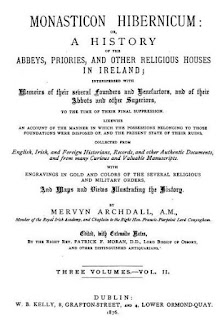
     Below is an account of Tuam from the Moran edition of Archdall’s Monasticon Hibernicum, which contains some interesting information on the rediscovery of the relics of Saint Iarlaithe in the seventeenth century:

    St. Jarlath is said to have made it a cathedral in the beginning of the sixth century; and it is also said that a city was built here in honour of this exemplary bishop. His remains were preserved at Tuam, in a chapel called Temple-na-scrin, i.e. the church of the shrine. After the death of this saint, we meet with three persons who are expressly said to have been abbots of Tuam, viz.: Cellach, son of Eochad, who died in the year 808; Nuadat Hua Bolchain, abbot and anchorite, who died 3rd October, 877; and Cornac, son of Kieran, abbot of Tuam and prior of Clonfert, who died in 879.

    The festival of St. Jarlathe, now kept on the 6th of June, is marked in our calendars on the 26th of December, on which day he is commemorated in the Martyrology of Donegal. He was born in the 5th century, and is said to have received in his childhood the blessing of St. Benignus, of Armagh. He established a religious house at Cluainfos. i.e., “the valley of retreat,” about a mile from the present town of Tuam, and subsequently erected the church and monastery of Tuam. St. Jarlathe was remarkable for his austerities, and in the poem of St. Cuimin of Connor, on the characteristic virtues of the Irish saints, he is styled “one who practised not penury,” and who made three hundred genuflections each day, and the same each night He died about the year 540. His relics were preserved in a rich shrine in a separate church, thence called Skreen, in the town of Tuam. Dr. John Lynch, writing in 1672, describes a portion of the old walls of this Skreen as still standing, though the place was then used as a barn. He adds that in the beginning of the century, while some men were engaged in threshing corn, they remarked something shining in the floor; removing the clay, they found a rich ornamental case enclosing the relics of St. Jarlathe — ” Cupream thecam quinquangularem S. Hierathii Reliquias includentem:” this was brought to Dr. Daniel, the Protestant Archbishop, who privately handed it over to the Roman Catholic Vicar-General, Francis Kerevan, by whom it was consigned to a good Catholic family for safe keeping. Colgan speaks of these relics as still preserved in his time. During the episcopate of Aed O’Hoisin, the cathedral was built through the munificence of Turlogh O’Connor, Monarch of Ireland.

    Rt. Rev. P.F. Moran, ed., M.Archdall, Monasticon Hibernicum, Volume II, (Dublin, 1876), 225-227.

    Content Copyright © Omnium Sanctorum Hiberniae 2012-2015. All rights reserved.