Tag: Irish Saints

  • The Night when the Book-Satchels Fell: Death of Saint Lon-garadh

    Book of Armagh Satchel. Source: TCD

    September 3 is the feast of Saint Lon-garadh, a saint with a reputation as one of the chief scholars of Ireland. I have previously posted a full account of this saint here, but below a reminder of the famous story about how the book satchels fell to the ground in all the monasteries of Ireland in sorrow at his death. Sadly, little historical information has survived about Saint Lon, but the legend associated with him was mentioned in the first lecture given by Professor Eugene O’Curry in March 1855 at the Catholic University of Ireland:

    There is a curious account of a private collection of books, “of all the sciences”, as it is expressed, given in a note to the Féliré, or metrical Festology of Aengus Celé Dé, or the “Culdee”; it is to this effect: Saint Colum Cille having paid a visit to Saint Longarad of Ossory, requested permission to examine his books, but Longarad having refused, Colum then prayed that his friend should not profit much by his refusal, whereupon the books became illegible immediately after his death; and these books were in existence in that state in the time of the original author, whoever he was, of the note in the Féliré.
    The passage is as follows: it is a note to the stanza of the great poem, for September 3; which is as follows:

    “COLMAN OF DROM-FERTA,
    LONGARAD, A SHINING SUN; 

    MAC NISSE WITH HIS THOUSANDS, 
FROM GREAT CONDERE”. 


    [NOTE.]—”Longarad the white-legged, of Magh Tuathat, in the north of Ossory (Osraighé); i.e., in Uibh Foirchellain; ie in Magh Garad, in Disert Garad particularly, and in Cill Gabhra in Sliabh Mairge, in Lis Longarad. The ‘white legged’, i.e., from great white hair which was on his legs; or his legs were transparently fair. He was a Suidh (Doctor or Professor) in classics, and in history, and in judgment (law), and in philosophy [filidecht]. It was to him Colum Cille went on a visit; and he concealed his books from him; and Colum Cille left a ‘word’ [of imprecation] on his books, i.e., ‘May it not be of avail after thee’, said he, that for which thou hast shown inhospitality’. And this is what has been fulfilled, for the books exist still, and no man can read them. Now, when Longarad was dead, what the learned tell us is, that all the book-satchels of Erinn dropped [from their racks] on that night. Or they were the satchels which contained the books of sciences [or, professions] which were in the chamber in which Colum Cille was, that fell. And Colum Cille and all that were in that house wondered, and they were all astounded at the convulsions of the books, upon which Colum Cille said: ‘Longarad’, said he, in Ossory, i.e., a Sai  (Doctor) in every science [it is he] that has died now’. ‘It will be long until that is verified’, said Baithin. May your successor [for ever] be suspected, on account of this’, said Colum Cille; et dixit Colum Cille:

    Lon is dead [Lon is dead];
    To Cill Garad it is a great misfortune;
    To Erinn with its countless tribes;
    It is a destruction of learning and of schools.
     
Lon has died, [Lon has died]; 
    
In Cill Garad great the misfortune;
    It is a destruction of learning and of schools,
    To the Island of Erinn beyond her boundaries”. 


    However fabulous this legend may appear, it will suffice, at all events, to show in what estimation books were held in the time of the scholiast of the works of Aengus, and also the prevalent belief in his time in the existence of an Irish literature at a period so long antecedent to his own. The probability is that the books were so old at the time of this writer as to be illegible, and hence the legend to account for their condition.

    Eugene O’Curry, Lectures on the Manuscript Materials of Ancient Irish History (Dublin, 1861),  17-18.

    Content Copyright © Omnium Sanctorum Hiberniae 2012-2023. All rights reserved.

  • Saint Cobrán of Cluain Cúallachta

    Completing a quartet of obscure Irish saints who share August 2 as a feast day with Cobrán of Cluain Cúallachta. In his entry for the saint in Volume VIII of his Lives of the Irish Saints,  Canon O’Hanlon has to admit defeat in identifying the place name associated with the saint. All he can record is the fact that the name of Cobrán of Cluain Cúallachta is found on the Irish calendars on August 2 and the speculations of the 17th c. hagiologist, Father John Colgan, who sought to link him to the bloodline of Saint Colum Cille:

    Article III. St. Cobhran or Cobran, of Cluana Cuanlach, or of Cluain-Cuallachta. 
     
    St. Cobran, of Cluana Cuanlach, is venerated on this day,  as stated in the Martyrology of Tallagh.  If we adopted the first reading so far as the name of his place is concerned, perhaps Cuanlach might be resolved into Loch Cuan, the ancient name for Strangford Lough; yet, it seems correctly to have been Cluain Cuallacta, and we know of no place in Ireland, with which it can be identified. A saint of this name is found, and whose pedigree is given by Colgan, who thinks he may be identical with the present holy man. He was known as Cobhran, the son of Enan,and the nephew of St. Columba, through Minchotha, who was sister to the latter, and the mother of Cobhran. A festival in honour of Cobhran, of Cluain Cuallachta, was celebrated at the 2nd of August, according to the Martyrology of the O’Clerys.


    Content Copyright © Omnium Sanctorum Hiberniae 2012-2023. All rights reserved.
  • Saint Fíonán Cam of Kinnity, April 7

    April 7 is the feast of an interesting saint, Fíonán (Finan) Cam, of Kinnity, County Offaly but also associated with various locations in County Kerry.  The Martyrology of Oengus records on this day:

    7. Finan the squinting,
    of Cenn Etig,
    around whom is
    much of clamour :

    There is a gloss on this entry, added by later anonymous commentators, which reads:

    Finán the Crooked of Cenn Etig. Of Húi Luchta was he, i.e. of Corcu Duibne, and of Ciarraige Luachra was his mother. That crookedness was in his eyes, i.e. he looked crookedly at his fosterfather when he was asking something for his guests. “Thou hast leave to be thus, semper,” says the foster father, even Brenainn son of Findlug.
    Fíonán Camm, i.e. crooked was his eye, of Cennetig in Sliab Bladma. Of the Corcu-duibne was he.
    A salmon of red gold came: it went in the west after sunset, against the womb of white Beccnat, (Finan’s mother) so that it became her husband, (i.e.) when she was bathing in Loch Lein: ut dicitur: Now thou hast no earthly father: the Holy Ghost has saved thee, has fostered thee.
    Inde alius dixit:
    Becnat, daughter of vast Idgna, the precious stone that was not scanty: like the Son of the Virgin, Finán Camm was born of her.
    In Becnat’s womb thou wast for a while, for thou wast conceived thro’ God’s word: an earthly father thou hast not, the Holy Ghost has saved thee, has fostered thee.
    Finan Camm brought wheat into Ireland, i.e. the full of his shoe he brought. Declan brought the rye, i.e. the full of his shoe. Modomnóc brought bees, i.e. the full of his bell and in one ship they were brought.
    Finan is entitled to true circuits, a measure of wheat for every household, the full of his brazen shoe: a tribute that no great saint had taken.
    Well, there is certainly much to unpack here! Let’s begin with his title of ‘The Crooked’. The Irish word cam means bent or crooked and when applied to an individual usually signifies some sort of curvature of the spine or limbs. In the case of Fíonán Cam, however, the bend is in his eyes, hence his title of ‘Fíonán the Squinting’. The commentator references Fíonán’s foster-father, Saint Brendan in relation to this and the Latin Life of Saint Fíonán confirms the relationship between the two. It tells us, in a trope typical of hagiography, that Saint Brendan predicted the future greatness of their son to Saint Fíonán’s parents, who as a child undertakes seven years of study of the monastic life with his saintly mentor. Brendan later directs Fíonán to the place of his resurrection at Kinnity, where he establishes his own monastery.
    Then we pass to the extraordinary conception of Saint Fíonán, which the commentator tells us involved a salmon. This too is upheld in the surviving written Lives of the saint, although in the opening to the Latin Life, translated by Pádraig Ó Riain in his 2018 collection Four Offaly Saints, the fish does not approach Fíonán’s mother while she is bathing in the lower lake at Killarney, but rather descends upon her during a vision:
    Holy Fíonán belonged to the family of Corca Dhuibhne; his father’s name was Mac Airdhe and his mother was called Beagnaid. This is how he was conceived; his mother saw a fish of reddish colour airborne from the direction of the rising sun, which entered her womb through her mouth, and she conceived from it. She told this to a wise and religious man who said to her: ‘The child in your womb will be a holy man, and he will have grace from God’.
    Wherever his mother went, for as long as he was in her womb, not a drop of rain, snow or hail touched her garment; her spittle cured every illness and feebleness, and whatever she served of food, however little or poor, it was enough for one and all.

    P. Ó Riain, Four Offaly Saints- The Lives of Ciarán of Clonmacnoise, Ciarán of Seir, Colmán of Lynally and Fíonán of Kinnitty (Four Courts Press, 2018), 81.

    It seems that the object of this episode is not to glorify Beagnaid, the expectant mother, but to show that the miracle-working power of her saintly son was present from the very beginning. The idea that his conception does not involve a human father, despite the fact that the name of Saint Fíonán’s sire is one of the first things the writer of the Life tells us, is perhaps designed to emphasize the purity of the saint as well as his likeness to Christ.
    The final section of the commentator’s annotations claims that Saint Fíonán is responsible for the introduction of wheat to Ireland. Daphne Pochin-Mould in the entry for Saint Fíonán on page 159 of her 1964 book The Irish Saints, makes this observation:
    The gloss on the entry for Finan Cam in the Martyrology of Oengus records the curious tradition that “Finan Camm brought wheat into Ireland, i.e. the full of his shoe he brought. Declan brought the rye, i.e. the full of his shoe. Modomnóc brought bees, i.e. the full of his bell and in one ship they were brought. Finan is entitled to true circuits, a measure of wheat for every household, the full of his brazen shoe: a tribute that no great saint had taken.” This recalls the shrine of Brigid’s shoe in the National Museum, and makes one wonder whether at one time a shoe of Finan Cam was similarly enshrined and venerated, and carried on the due collecting circuits.

    I haven’t encountered this tradition of shoes and dues collections before and would like to know more about it. The most recent thinking on the shoe shrine of Saint Brigid though is that it dates to the early eighteenth century.

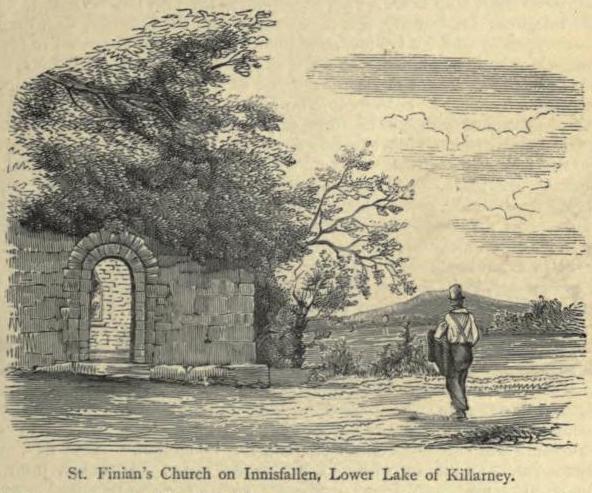
    As we have seen, the Martyrology of Oengus associates Saint Fíonán with Kinnitty alone but the Latin Life places him at various locations in County Kerry. The List of Homonymous Saints preserved in the twelfth-century Book of Leinster records eleven saints who share the name Fíonán, so perhaps it is not surprising to find that Saint Fíonán Cam has become entangled with Saint Fíonán Lobair ‘the leper’ of Swords, County Dublin. Fíonán Lobair is credited with the patronage of the church at Innisfallen, which may be because, according to Pádraig Ó Riain’s Dictionary of Irish Saints, in south Kerry Saint Fíonán’s feast was celebrated on 16 March, the feast day of the leprous one of Swords. Modern scholarship suggests that despite this confusion over the feast date it is the Kerry native, Saint Fíonán Cam, who is the true patron of Innisfallen.

    Content Copyright © Omnium Sanctorum Hiberniae 2012-2023. All rights reserved.