Tag: Irish Saints

  • Saint Foila of Killeely, March 3

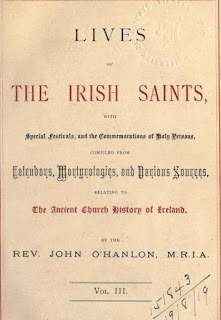
    A female saint of the west, Foila of Killeely, County Galway is commemorated on March 3. Canon O’Hanlon has this account of her:

    St. Foila or Foilenna, Virgin, and Patroness of Kill-faile now Killeely Parish, County of Galway.

    Colgan could not procure any special Acts of this saint, who was venerated in the southern parts of Connaught, in his own time. However, he and the Bollandists have short notices of her, at this day. St. Foilenna, Failenna, or Fallenda, or as more commonly called, St. Foila or Faila, also denominated Foilend, or Faoileann, is thought to have been daughter to Aidan, surnaraed Draignech, son to Lugadius, son to Dathy, King of Ireland; and, her mother, Cuillenn, or Cullenda, was likewise descended from a distinguished family. She had three brothers, Colgeus, or Colga, Aldus and Sorarius, who are numbered amongst the saints of our country. At what particular time St. Foila was born, we are not informed ; but, it was thought, probably, in an early part or towards the middle of the sixth century. It seems probable, she lived in Kill-faile. This place is identical with the present parish of Killeely, in the barony of Dunkellin, county of Galway. The old church there is yet in good preservation, being, in the opinion of Dr. O’Donovan, modernized during the 14th or 15th century. Measured on the inside, it is 63 feet long by 21 broad. The pointed or Gothic style there prevails. It is remarkable, that this parish joins Kilcolgan, where St. Faile’s brother, Colga or Colgan had been venerated. Both churches were near Ath cliath Medhruidhe, the ancient name for Clarinbridge. Both saints also belonged to the race of the Hy Fiachrach Aidhne. The church of Kill-faile derives its name from St. Foila, and it is situated within the diocese of Kilmacduagh. During her lifetime, St. Foila performed many miracles. The day and year of her death is not recorded ; but, the former probably fell on the 3rd of March, when her festival was kept, in the church of Kill-faile. It is commemorated on this day, according to the Martyrologies of Tamlacht, of Marianus O’Gorman, of Maguire and of Donegal. After her death, frequent pilgrimages were made to St. Foila’s tomb, from distant parts of the country, by persons afflicted with various maladies. For the cure of these, they reposed great confidence, in her merits and intercession.

    Content Copyright © Omnium Sanctorum Hiberniae 2012-2015. All rights reserved.

  • A Prayer to Saint Odhran

    February 19 is the commemoration of Saint Odhran, whom tradition remembers as Saint Patrick’s charioteer and as a martyr who sacrificed his life for his master. Below is a prayer to Saint Odhran, taken from the 1941 edition of the Catholic prayerbook, Saint Anthony’s Treasury. The prayer to Saint Odhran sounds like a product of the 19th-century nationalist revival, there is a strong emphasis on the land of Ireland but combined with an appreciation of the saint’s heroism and a desire that his ‘noble sacrifice’ should not be forgotten:

    Prayer to St. Odran

    (St. Patrick’s Charioteer)

    (Who gave his own life to save that of his master)

    Blessed Saint Odran, faithful and loyal to God and man! you whose name is almost forgotten by those who owe you an everlasting debt of gratitude, accept our poor thanksgiving, offered in the name of all Ireland, for your noble sacrifice of your life to save that of Ireland’s Apostle. You had toiled in his service long and devotedly; you had learned what priceless service he could render to God and the Irish land and, when the moment came when he or you should die, by pagan hands, quickly and resolutely you laid down your life, that your master might live and labour for the Divine Master of all.

    By your crown of martyrdom so gloriously won, by your centuries of endless peace and joy, we beseech you to look down on the toiling sons of Ireland and on those who try to guide them to their eternal rest. Look down on us all, O blessed Saint! for the love of him whose heart burned with love for Ireland, and pray that the blessing of the Triune God – Father, Son and Holy Ghost – may descend on us and remain with us for ever. Amen.

    St. Anthony’s Treasury – A Manual of Devotions (Anthonian Press, Dublin, 12th edition, 1941), 285-286.

    Content Copyright © Omnium Sanctorum Hiberniae 2012-2015. All rights reserved.

  • Saint Nuad of Armagh, 19 February


    A ninth-century Archbishop of Armagh, Saint Nuad (Nuada or Nodtat), is commemorated on February 19. Canon O’Hanlon records:

    St. Nuad, St. Nuada or Nodtat, Archbishop of Armagh

    [Eighth and Ninth Centuries.]

    At the 19th of February, Colgan and the Bollandists have entered some biographical notices of this holy archbishop, who enjoyed the supreme ecclesiastical dignity in Ireland for a brief period. Nodtat or Nuada, bishop, is mentioned in the Martyrologies of Tallagh, of Marianus O’Gorman, and of Donegal, on this day. He was at first a monk, and also an anchorite. From this state of life, and even against his own will, he had been promoted to the abbatial, and thence translated to the archiepiscopal dignity. His birth-place or residence is said to have been situated at Lough Uama. This signifies the “lake of the cave,” the water being said to rise out of a cavern, and the position is also assigned to Breiffny. Here, it is thought, he led the life of an anchoret. The lough, to which allusion has been made, was in the present county of Leitrim. It sometimes flowed back into that cave, whence it issued ; and, the people living on its borders especially believed, that this was an indication of the Dynast’s approaching death, or that of his children. Ancient Breffny comprehended the present counties of Cavan and of Leitrim. It was divided into Upper and Lower, or East and West Brefiny. In the latter division, called Brefiny Hy-Ruairc, our saint must have lived, until he was called to a higher dignity, on the death of St. Torbach Mac Gorman. This event took place, on the 16th of July, A.D. 812. Archbishop Nuad visited Connaught, A.D. 810 or 815; and, he is there reported, to have made a reformation of some abuses, which had crept into the churches. The Catalogue of the Armagh Primates allows three complete years, for the presidency of Nuad ; but, these must be understood, with the addition of some months, reckoning from the death of Torbach, on the 16th of July, A.D. 812, to the 19th of February, A.D. 816. Other authorities, however, place his demise before this date, viz., at the year 811 or 812. Under the year 811, this passage occurs in the Annals of Ulster, “Nuad of Loch-Huama, bishop, anchorite, and Abbot of Armagh, fell asleep.”

    Lanigan’s Ecclesiastical History of Ireland says that ‘in 811 Nuad made a visitation of some part of Connaught and on that occasion relieved some churches there from an annual offering, which used to be made to that of Armagh’ (Vol 3, p.252).

    The Ancient List of the Coarbs of Patrick lists Nuada as the 33rd holder of the episcopal see of Armagh.

    Content Copyright © Omnium Sanctorum Hiberniae 2012-2015. All rights reserved.