Tag: Female Saints

  • Saint Conchenna of Killevey, March 13

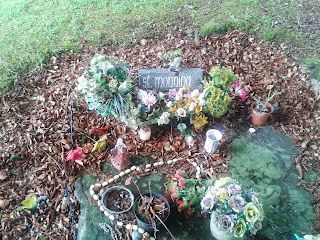
    Grave of St Moninne at Killevey (2013)

    On March 13 the Irish calendars commemorate the memory of Saint Conchenna, a holy woman of the monastery founded by Saint Moninne at Killevey, County Armagh. Her death is noted in The Annals of the Four Masters:

    The Age of Christ, 654, “Coincenn, of Cill-Sleibhe, died.”

    Not much more appears to be known of her life, but Canon O’Hanlon’s account notes that Conchenna was said to have been a sister to Saint Fintan Munna and the subject of one of his miracles. He also wonders if Saint Conchenna was abbess of the community or merely a member of it, but having raised this question he goes on to answer it by noting that the Annals usually only mark the passing of the superiors of religious houses:

    St. Conchenna, Conchend, or Coincheand, Virgin, of Kill-Slebhe, or Killevey, County of Armagh. [Seventh Century]

    Colgan endeavours to evolve some incidents regarding this holy virgin, at the 13th of March. The Bollandists have only a short notice of St. Conchenna. This saint was daughter to Tulchan, and her mother was Fethlemidia. She was a sister to St. Fintan Munnu, who is venerated at the 21st of October. Thus was she descended, from the noble Hy-Niall race of Ulster. This holy virgin embraced a religious life, in a nunnery, which had been founded by St. Monenna, at Kill-Slebhe, now Killevey, at the foot of Sliabh Cuilinn, or Slieve Gullion, in the southern part of the county of Armagh. Here she lived a very holy life, and illness which caused her death happened. But she was brought to life again, by her holy brother St Munnu, and at the request of their mother. There seems to be a doubt, as to whether she was abbess over the community, at Kill-Sleblie, or a simple member of it. She finally departed this life, A.D. 654; and, although the Four Masters give her no distinctive title, yet, Colgan remarks, they scarcely ever note the death of holy persons, not distinguished as presiding over religious houses. The Martyrologies of Tallagh and of Marianus O’Gorman register the name Conchend, at the 13th of March. Also, on this day, the festival of Coincheand was celebrated, as we read, in the Martyrology of Donegal.

    Note: This post first published in 2014 has been revised in 2022.

    Content Copyright © Omnium Sanctorum Hiberniae 2012-2015. All rights reserved.

  • The Holy Daughters of Leinin, March 6

    There are a number of interesting saints commemorated on March 6, but I have chosen to look at a group of holy women whose name lives on in the placename of Killiney, County Dublin. Canon O’Hanlon brings us the details, first of one group of five sisters and then of another sister called Brighit.

    THE HOLY DAUGHTERS OF LEININ, SAINTS DRUGENIA, LUIGENIA, LUICELLA, MACHA AND RIOMTHACH, AT THE CHURCH OF KlLL-NA-NINGEAN, NOW SUPPOSED TO BE KILLININY, COUNTY OF DUBLIN. [Sixth or Seventh Century.]

    In the last chapter of the “Sanctilogium Genealogicum,” these sisters are said to have been the daughters of Leninus, son to Garrchon, son to Donacius, the son of Conamalius, son to Colgan, son to Cronmael, son to Altius, son to Aengus, the son of Nuadatus, &c. In the Martyrology of Tallagh, these sisters are not named, at the 6th of March; but, there they are called, Ingena Lenini, or the “daughters of Leninus.” Marianus O’Gorman, Charles Maguire and the Martyrology of Donegal place the festival of these holy ladies, at the 6th of March. The site for their church is determined, by Dr. O’Donovan, to have been comprised, within the greater part of the barony of Rathdown, in the present county of Dublin, or in some northern part of Wicklow County. There the sept of Ui-Briuin-Cualann was located. According to William M. Hennessy, the place where these pious ladies lived was in the southern part of the county of Killiney Church, County of Dublin. It is now said to be known as Killininy, or Kilnanaughnin, near Fir House Convent, Bohernabreena. There is an old ruined church at Killiney, on the sea-shore of Dublin County, and near the beautiful bay, to which the church gives name…. Whether it was at Killininy, or at Killiney, the pious daughters of Lenin lived, seems an uncertain matter ; but, it is probable enough, that while their sister Brighit remained at the latter place, the following five occupied the former as a residence. Thus, the Martyrology of Donegal enters the daughters of Leinin, as Druigen, Luigen, Luicell, Macha and Riomhtach. These are said to be sisters of Brighit, daughter of Leinin. Their place is called Cill-inghen-Leinin, in Ui-Briuin Cualann, in Leinster. All of those pious ladies, here venerated, were sisters to St. Colman the Bishop and Patron of Cloyne Diocese and, accordingly, they seem to have lived, towards the close of the sixth or the beginning of the seventh century.

    Content Copyright © Omnium Sanctorum Hiberniae 2012-2015. All rights reserved.
  • Saint Oda of Rhoda, February 27

    Following on from yesterday’s saint, Beccan the Blind, today’s saint, Oda of Rhoda in Belgium, also has a connection with blindness. Canon O’Hanlon has included her in his work on the grounds of her alleged ‘Scots’ i.e. Irish background. The feast day of saint Oda is also open to question as her main feast appears to have been on 27 November rather than 27 February.

    St. Oda, or Odda, Virgin, at Rhoda, Belgium. [During or after the Eighth Century]

    Dempster, in his Scottish Menology, and Ferrarius, in his general Catalogue, insert a festival for St. Oda, Virgin, of Rhoda, in Taxandria, of Brabant, at the 27th of February. The Bollandists briefly allude to her, at the same date, although referring her festival to the 27th of November. Dempster states, that at Rhoda, St. Odda, a Virgin, was venerated, at the 27th of February. She was daughter to a king, and patroness of this place. Othbert, the Bishop, raised her precious remains, in 1103, to a place of honour. It is said, by Dempster, that she was daughter to Eugene V., King of the Scots, and a virgin, who led a most holy life. However, the authorities quoted by him, only make her daughter to a King of the Scots. It is thought, she flourished, about the year 500, although another more probable statement has 700, and 713. She was seized with blindness, but going to the tomb of St. Lambert, Bishop and Martyr, at Liege, she there prayed and recovered her sight. Through gratitude, she then vowed her virginity to God; nor, afterwards, could her father persuade her to marry. Following a Divine impulse, Odda went to Taxandria, and by her residence, she sanctified the whole Rhodan territory. It is related, that while she secretly prayed in a wood, a magpie betrayed this secret to men. Hence, in art, she is painted with a magpie. Renowned for her virtues and miracles, she was called, at last, to the nuptials of her Divine Spouse, and her body was deposited in a collegiate church at Rhoda, where she is commemorated as chief patroness. We are told, that her memory was greatly venerated, and that churches were erected to her honour, in various parts of the kingdom of Scotland. Her festival occurs, in the Kalendar of King Charles First’s Prayer-book, probably in virtue of her royal descent. Her Acts are said to be more fully written, in the Scotichronicon, by the Monk of Paisley, by John Molan, by Constantinus Ghinius, in the English Martyrology, and in other works. In the anonymous Catalogue of Irish Saints, published by O’Sullevan Beare, and in the “Historia Sanctorum Lovanii” as also in Father Henry Fitzsimon’s list of Irish Saints, at the 27th of February, we find entered, St. Oda, Virgo. However, the “English Martyrology” refers her feast, to the 27th of November. By Father Stephen White, she is said to have lived in the eighth century.

    Content Copyright © Omnium Sanctorum Hiberniae 2012-2015. All rights reserved.