Tag: Female Saints

  • The Teaching and Sanctity of Saint Ite

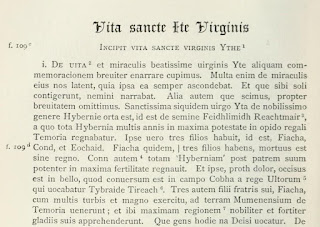
    Some fascinating glimpses of the teachings of Saint Ite and of the sanctity she manifested have been preserved in her Life. Here are a few examples taken from Dorothy Africa’s translation of Vita Sanctae Ite from Plummer’s Vitae Sanctorum Hiberniae. The Headings are mine.

    Saint Ite is transfigured

    2. One day the blessed girl Ita was asleep alone in her chamber (cubiculum); and that whole chamber appeared to people to be burning. But when the men approached it to help her, that room was not burned; and all marveled greatly at this, it was said to them from above, what grace of God burned around that comrade of Christ, who was asleep there. And when holy Ita had arisen from sleep, her entire form appeared as if it were angelic. For then she had beauty such as she had neither before or after. So also her aspect appeared then so that her friends could scarcely look at her. And then all recognized what grace of God burned around her. And after a short interval the virgin of God was restored to her own appearance, which was certainly pretty enough.

    An Angel appears to Saint Ite and Testifies to the Holy Trinity

    3. On another day when the blessed Ita slept, she saw an angel of the Lord coming toward her, and giving her three very precious stones. And when the handmaiden of Christ had arisen from sleep, she did not know what this vision signified. And the blessed (girl) had a question in her heart about this. Then an angel of the Lord came down to her, saying “What are you searching for concerning this vision? Those three very precious stones which you saw given to you, signify the holy trinity that came to you and visited you; that is a visitation of the Father, Christ his Son, and the Holy Spirit. And always in sleep and in vigils, the angels of God and holy visions will come to you. For you are the temple of the Deity, body and soul.” And speaking these things, he departed from her.

    Saint Ite Struggles against the evil one

    5. Not long afterward, the blessed virgin Ita fasted for three days and three nights. But in those days and nights through sleeping and vigils the devil openly (evidenter) fought against the virgin of God in many battles. And the most blessed virgin most wisely opposed him in all, as much sleeping as waking. On the second (posteriori) night, then, the devil appeared sad and wailing, and at day break, he departed from the familiar of God, saying in a grieving tone, “Alas, Ita, not only will you free yourself from me, but many others to boot.”

    7. And while the blessed Ita was on her way, behold, many demons came against her along the road, and began to contend (litigare) cruelly against her. Then angels of God from above arrived, and fought very hard with the demons for the bride of Christ. And when the demons had been conquered by the angels of God, they fled away through the byways, crying out and saying: “Alas for us, for from this day we will not be able to contend against this virgin. And we wished today to put our claim on her for our injuries; and the angels of God have freed her from us. For she will root up our habitation from many places and will snatch many from us in this world and from the nether regions.” But the virgin of the Lord, with the consolation of the angels of God, meanwhile advanced to the church; and in it was consecrated by the churchmen at angelic order on the spot, and took the veil of virginity.

    Saint Ite’s Asceticism

    10. The most blessed Ita made great efforts to keep two and three day fasts, and frequently four days. But the angel of the Lord, on a day when she was exhausted by fasting, came to her, and said to her “You afflict your body without measure by these fasts, and you ought not to do so.” But the bride of Christ (was) unwilling to ease her burden, (so) the angel said to her “God has given such grace to you, that from this day until your death you shall have the refreshment of celestial food. And you will not have the power not to eat at whatever hour the angel of the lord will come to you, bringing you food.” Then the blessed Ita prostrated herself and gave thanks to God, and from that bounty (prandium) the holy Ita gave to others to whom she knew it was worthy to be given. And without any doubt she lived thus until her death on the heavenly allotment administered by the angel.

    Saint Ite Demonstrates The Gift of Prophecy

    12. God even bestowed upon the holy Ita such great grace in prophecy that she knew whether the sick would survive their illness or die.

    Saint Ite Heals the Sick and Raises the Dead

    14. Then the most glorious virgin of God returned to her cell. And when the familiar of God was nearing her community, she heard from nearby a great and immense wailing. For three dead nobles were there, who had died on that day; and their friends were wailing and mourning for them. And they, knowing that holy Ita was passing by, came down,and asked the familiar of God in a doleful tone that she might come and pray for their souls at least. Holy Ita then said to them: “That thing more that you wish beyond prayer for their souls, in the name of Christ may it happen for you.” They did not know what to make of this speech at that point. The blessed Ita made the statement because she knew, being full of the spirit of prophecy, that it (or she?) in the name of God would revive them from death. Then the holy one went with them to where the dead were, and while praying she marked the prone bodies with the sign of the holy cross; and they arose living at her command. And the bride of Christ asserted (assignavit) that they lived before everyone.

    15. In that place there was then a certain paralyzed man in the clutches of a very great illness, and his friends, having beheld the revival of the dead, took him up and brought him to the holy Ita, that she might cure him. For they had no doubt that one who could revive dead men could cure a sick one. Then the familiar of God, observing the great misery of that man, looked to heaven, and said to him: “May God pity you”. And as she spoke, the made the sign of the holy cross on him. Most marvelous to say; when the familiar of God marked the hitherto paralyzed man, he stood up whole and unharmed on the spot before all, as if he had never been seized by paralysis. Then the shout of the whole people was lifted to heaven, praising God, and giving thanks tohim, and glorifying his familiar with deserved honor. Afterward, the familiar of God went on with her companions to her cell.

    The Teaching of Saint Ite on What is Pleasing to God

    22. At one time the holy Brendan (Clonfert) was asking the blessed Ita about the three works which are fully pleasing to God, and the three which are fully displeasing, the servant of God replied: “True belief in God in a pure heart, the simple life with religion, generosity with charity; these three please God fully. However, a mouth vilifying people (detestans homines), and a tenacious love of evil in the heart, confidence in wealth; these three fully displease God. Holy Brendan and all who were there, hearing such a statement, glorified God in his familiar.

    The Teaching of Saint Ite to her Nuns on the Holy Trinity

    11. One day a certain holy devout virgin came to the holy Ita, and spoke with her about divine precepts. And while they were conversing, that virgin said to the holy Ita: “Tell us in God’s name, why you are held in higher esteem by God than the other virgins whom we know to be in the world. For to you sustenance from heaven is given by God; you cure all the feeble with your prayer; you speak of past and future events; everywhere you drive out the demonic, daily God’s angels speak with you; you carry on in meditation on and prayer to the holy Trinity without hindrance.” Then the holy Ita said to her: “You answered your own question by saying ‘Without hindrance you carry on in prayer to and meditation on the holy Trinity.’ For who ever shall have done so, will always have God with him, and if I was such a one from infancy, all these things, as you have said, properly pertain to me.” That holy virgin, having heard this speech from the blessed Ita about prayer and meditation on God, departed rejoicing for her cell.

    23. A certain holy virgin, wishing to discover in what manner the most holy Ita was living in her most secret place, in which she was accustomed to be free for God alone, went out at a certain hour, in order to see her. She, then reaching there, saw three very bright suns, just as the natural (mundiali) sun lighting up the whole spot and surrounding area. And she was not able to enter out of terror, but at once turned back. The mystery of this portent would be hidden from us, but for the gifts of the holy Trinity, which made everything from nothing, which the most holy Ita assiduously served in body and soul.

    The Repose of Saint Ite

    36. Afterwards the most blessed patroness Ita was broken by illness; and she undertook to bless and advise her settlement (civitatem), and the clerics and people of Ua Conaill, who had taken her as their patroness. And having been visited by many holy persons of both sexes, amid the choirs of saints, with rejoicing angels in the path of her soul, after the greatest numbers of virtues, in the sight of the holy Trinity, the most glorious virgin Ita passed on most happily 18 days before the Kalends of February. The most blessed body of whom, with many persons having gathered from all around (per circuitum), with many miracles performed, which still have not ceased to be displayed there, most gloriously, after the solemnities of masses, in her monastery which she the very holy Ita, a second Brigit in her merits and morals, established, from the field, was taken (traditum est) to the tomb, reigning with our Lord Jesus Christ, who with God the Father and the Holy Spirit lives and reigns, God in the age of ages. Amen.

    http://monasticmatrix.osu.edu/cartularium/life-saint-ita

    Content Copyright © Omnium Sanctorum Hiberniae 2012-2015. All rights reserved.

  • Saint Ercnat, January 8

    On January 8 the Irish calendars record the name of a female saint, Ercnat ( Ercnat, Eargnat, Earcnad, Ergnata) known primarily from the hagiography of Saint Patrick. There she is depicted as one of the high-born female converts who receives
    the veil from the national apostle himself. Her father, Daire (Darius), is the local chieftain who grants the site of what later becomes the ecclesiastical capital of Armagh to Saint Patrick. Furthermore, Ercnat fulfills a
    designated role within the ‘household of Saint Patrick’, as one of his three embroideresses, according to the list found in the Tripartite Life.  The calendar entry in the Martyrology of Oengus records her as ‘Ercnat, chosen to the inheritance’ while the Martyrology of Donegal reads:

               8. A. SEXTO IDUS JANUARII. 8.
    EARGNAT, Virgin, of Dun-da-en in Dal-Araidhe.
    In the entry for Saint Ergnat in Volume I of his Lives of the Irish Saints Canon O’Hanlon depicts Ercnat as a pious nun whose admiration for the beautiful voice of another member of the
    Patrician household, Benen, the psalmist, leads to a case of unrequited love with potentially disastrous spiritual consequences. Fortunately, both the psalm-singer and his master are able to save Ercnat from herself:
    Article III. ST. ERGNAT, VIRGIN, OF TAMLACHT, COUNTY OF ARMAGH, AND OF DUNEANE, COUNTY OF ANTRIM [Fifth Century.]
     
    …This noble lady flourished in the very dawn of Christianity in our island, and about the year of Christ, 460. The places of her veneration are called Clauin-da-en or Dun-da-en, in the Feevah or wood of Dalaradia, and also in the Church of Tamlacht-bo. The parish of Duneane is situated in the diocese of Connor. Its church was an ancient one, standing within Lisnaclosky townland. We, find in the Martyrology of Donegal, as having a feast on this day, Eargnat, Virgin, of Dun-da-en, in Dal-Araidhe. This holy penitent’s acts have been written by Colgan. Her place is now called Duneane, in the county of Antrim. There is a St. Herenat, Virgin, of this same locality, entered at the 30th of October. It appears most probable, they are identical; in which case, this virgin had a double festival in the year. One of the Irish saints introduced to us this day, in the Felire of St. Aengus, is the present St. Ercnait. The etymology of Dun-da-en, contracted to Duneane, has been interpreted to signify “the fort of the two birds.” The four towns  of Duneane on one of which the Protestant church stands are surrounded by that part of Lord O’Neill’s property, known as ” the estate of Feevah.” From the Irish Apostle’s Lives, it would seem, that Ercnata was the daughter of Darius, and that she flourished as a contemporary of St. Patrick. Darius, surnamed Derga, was the son of Finchod, son to Eugene, son to Niell. This latter seems to have been the distinguished founder, from whom the family and territory of Hy-Niellain, near Armagh, derived origin. Colgan thinks the charming and celebrated locality, known as Drumsailech belonged to him, and that afterwards it was made over to the great Irish Apostle, St. Patrick, to found the noble city of Armagh, the Ecclesiastical Metropolis of Ireland. Among the noble ladies, who received the veil from St. Patrick, St. Ercnata or Ergnata is enumerated. Her love of God was earnest and sedulous. Her pure-mindedness and observance of charitable and pious works served to single her out from among other pious women, to make and keep in repair, as also to wash, the sacred vestments. These offices accorded with the tastes and zeal of St. Ergnat, while nothing on her part was left undone to promote that splendour and decency becoming the Divine Mysteries. At these she attended with rapt devotion. But her love for sacred music furnished an opportunity to the enemy of her soul to excite a momentary feeling, which soon developed into a strong temptation. Her admiration for the exquisite voice of St. Benignus, who sang sacred music with great pathos, presented a dangerous occasion of sin. Thus, even the holiest mortals may have reason to fear the unguardedness of a spiritual friendship, contracted through the purest motives. But, the Almighty saves from the blast of temptation those who fondly love Him, and so was the holy virgin Ergnat rescued from a temporal and spiritual death, through the instrumentality of St. Patrick  and St. Benignus. Rendered more cautious by her escape from a great danger,and increasing her labours with sole trust in the sustaining grace of God, she bewailed with abundance of tears in after-life the frailty of a short time. As a penitent, she afterwards obtained that Divine aid, which caused her perfectly to regard only the love of God and to despise that towards created beings. Her closing years were rendered illustrious by signs and miracles. About the middle of the fifth century she is thought to have flourished; but the exact year when or place where she died does not appear to have been discovered. She was buried at Tamlachta-Bo.  Probably her death took place about the close of the fifth century. Our hagiographers assign two different festivals to honour her. One of these occurred on the 8th of January, and the other on the 30th of October. The first denotes the day of her natalis; the other feast probably marks some particular event during her life, or a translation of her relics after death. In the Lives of the Saints, nothing engages more our human sympathies than a fall from grace and a subsequent return to its Divine Author; while our own trembling hopes of salvation are encouraged, when so many feeble mortals have bravely resisted the assaults of Satan and escaped from his wiles. The remote occasions of guilt are to be dreaded, since the fires of deceitful passion are seldom wholly extinguished. Sometimes transforming himself into an angel of light, the devil designs our destruction the more dangerously, because his approaches are insidious. He does not desire to sound the note of alarm, when his unseen snares are drawn closely around us.

    The Martyrology of Donegal gives some further detail on how Ercnat was saved from her inappropriate doomed love, in its entry for the feast of Saint Benen on November 9:

    The holy Benen was benign, was devout; he was a virgin without ever defiling his virginity; for when he was psalm-singer at Ard-Macha along with his master, St. Patrick, Earcnat, daughter of Daire, loved him, and she was seized with a disease, so that she died suddenly; and Benen brought consecrated water to her from Patrick, and he shook it upon her, and she arose alive and well, and she loved him spiritually afterwards, and she subsequently went to Patrick and confessed all her sins to him, and she offered her virginity afterwards to God, so that she went to heaven; and the name of God, of Patrick, and of Benen, was magnified through it.

    Archbishop John Healy, shares Canon O’Hanlon’s relief that Ercnat’s love for Benen was transformed from the earthly into the spiritual, commenting:

    It is a very touching and romantic story, which has caught the fancy of our poets and chroniclers, and, as the scribe in the Martyrology declares, gave glory to Patrick and to Benen after God: but none the less is the holy maiden’s name glorified also, whose young heart was touched by human love, which, in the spirit of God, was purified and elevated to the highest sphere of sinless spiritual love in Christ. It has often happened since.

    Most Rev. J. Healy, The Life and Writings of St. Patrick, (Dublin, 1905),  p. 578.
    Modern scholar, Pádraig Ó Riain in his 2011 Dictionary of Irish Saints notes ‘Earcnad (Latin Archanta/ Ergnata) of Dál nAraidhe, who was associated with the Antrim parishes of Doagh Grange  (29 October) and Duneane (8 January)’ but does so within the entry for yet another member of Saint Patrick’s household, ‘Bishop Earc, his judge’. Earc of Slane , feast day November 2 was an important early saint who may have been commemorated in the form of various namesakes, for example at 27 October as Earc of Donaghmore. Ó Riain therefore suggests that our saint Ercnat could be this same Saint Earc ‘in female guise’. 
    Note: This post on Saint Ercnat, first published on January 8 2105 has been revised and republished on January 8, 2022.
    Content Copyright © Omnium Sanctorum Hiberniae 2012-2022. All rights reserved.
  • The Life of the Holy Virgin Samthann

    December 19 is the feast of Saint Samthann of Clonbroney and last year’s post on her life can be found here. The Life of Samthann is known mainly from an early 14th-century manuscript, Rawlinson B.485. Richard Sharpe, who has studied the various collections of Irish saints’ Lives argues that the ‘Oxford group’ in which the Life of Samthann is included may have originated in the Longford/Westmeath region. Saint Samthann’s monastery of Clonbroney was in County Longford, so this may explain why her Life forms part of that collection. Unusually among the monastic saints, Samthann was not the founder of her community and I looked at the circumstances in which the leadership of Clonbroney was passed to her in last year’s post. Furthermore, the Life does not include an account of her birth and early years, as one usually finds in other saints’ Lives. Dorothy Africa, who has published a translation of the Life of Saint Samthann, comments on some of the text’s other unusual features, the first of which we will now turn to:

    Except for the omission of an account of her early life, the Life of St. Samthann follows the general pattern of Irish saint’s Lives. It has, however several distinctive features worthy of comment. Few saints Lives display such an opening sequence as this one, with the protagonist entering her own life sound asleep and hurtling within a few sentences into full dramatic action. It is common, however, in the Lives of women saints for the saint to struggle heroically to avoid a marriage forced upon her by parents and kin. Fosterage was a common practice in Ireland for children of both sexes. Usually a woman’s own family, not her foster father, would make arrangements for her marriage, but if they were distant, as appears to be the case here, responsibility might pass to a fosterer.

    Dorothy Africa, trans., Life of the Holy Virgin Samthann, in T. Head, ed., Medieval Hagiography – An Anthology (Routledge, 2001), 99.

    So, here is that dramatic beginning to the Life of Saint Samthann, taken from a translation made by two Irish priests, Fathers Diamuid O’Laoghaire and Peter O’Dwyer:

    Samthann’s father’s name was Diamramus, and her mother’s Columba. As she matured her foster-father, Cridan, king of the Ui Coirpri, gave her in marriage to a nobleman. Before the marriage solemnities were celebrated, the nobleman saw at midnight something like a ray of the sun extended through the roof of the house onto the bed in which Samthann was sleeping with the king’s two daughters. Amazed by the unusual vision of light at such an hour, he rose immediately and, advancing toward his spouse’s bed, found that her face was illumined by that ray. He was very happy that he was gifted with a spouse who was surrounded by heavenly light.

    The following night, when the solemnities had been celebrated, both were entering the marriage bed, as is customary, when her husband said to her, “Undress yourself so that we may become one”. But she replies, “I ask you to wait until all who are in this house are asleep.” Her husband agreed. After a short time tiredness overcame him. Then Samthann gave herself to prayer, knocking at the doors of divine mercy so that God might keep her virginity unblemished. And God heard her prayer, for about midnight that town in which they lived seemed to outsiders to be on fire. A flame of extraordinary magnitude was seen ascending from the mouth of the holy virgin to the roof of the house. A mighty cry was raised outside in the town and those who were asleep within were awakened. Together, they hastened to extinguish the fire.

    In the meantime the holy virgin Samthann hid herself in a cluster of ferns nearby. The fire vanished immediately without doing any damage to the town. When morning came, her foster-father, the king, set out to look for her. When he found her, she said to the king, “Was your town burned last night?” The king replied, “No.” She said, “I thank God that it was not burned.” Then she spoke to the king again, “Why did you wish to give this poor servant of the Almighty God to any spouse without her consent?” The king replied, “All right, I will not give you to a man, but let you be the judge.” Samthann said, “This is not my decision: as of now you give me as a spouse to God and not to man.” Then the king said, “We offer you to God, the spouse whom you choose.” Then she, with her husband’s permission, entered the monastery of the virgin Cognat where she remained for a time.

    ‘Samthann of Clonbroney” in E.C.Sellner, Wisdom of the Celtic Saints (Indiana, 1993), 194-5.

    Content Copyright © Omnium Sanctorum Hiberniae 2012-2015. All rights reserved.