Tag: Female Saints

  • Saint Gobnait of Ballyvourney, February 11

    February 11 is the feastday of Saint Gobnait (Gobnet, Gobnata) of Ballyvourney. A previous post on her life can be found here. Below is a charming account of the saint and her locality, taken from the pioneering work on Irish pilgrimage by Daphne Pochin-Mould:

    St. Gobnet is one of many early Irish saints about whom there is no written record, only a continuing and deep love and devotion amongst the people of the countryside that she had travelled, and a handful of traditional stories. Her connection with St. Abban puts her in the 6th century but there is no further definition to be had about her dates. She was on the Aran Islands and founded a church there and the islanders still honour her on her day, February 11th. The tradition is that she came seeking shelter on the islands from some enemy in Co. Clare. But she was not to remain there permanently, for an angel appeared and told her that that she must go and seek a place where nine white deer were grazing. There she would found a convent and settle permanently, there she would die and there would be, in the Irish phrase, the ‘place of her resurrection’.

    So Gobnet went back to the mainland and travelled over southern Ireland seeking the white deer. There are a number of old Celtic church sites and holy wells bearing her name, and most of these still seem to be venerated and visited. They include a site at Dungarvan, in Co. Waterford, and at Ballyagran near Charleville, the Kerry sites of Dunquin, looking out to the Blasket Islands, and of Cahirciveen. Not till she came to Clondrohid in Co. Cork did she meet any deer, but there she found three white ones grazing. Here is a special stone still venerated in her name, Cloch Ghobnatan, Gobnet’s stone, and it is traditional to carry a coffin deiseal once round this before the burial takes place. Next the saint met six white deer, at Ballymakeera, the next hamlet to Ballyvourney; finally at the latter place she found the full complement of deer.

    St. Gobnet’s little settlement is in a place where one might indeed expect to find nine white deer grazing. The River Sullane, a tributary of the Cork Lee, takes origin in the moorland and rock of the Derrynasaggart mountains, flowing from them into a deep but spacious valley, its flanks checkered with fields, broken with woodland and coppice. Even today one can realize the kind of place it was in the 6th century, little fields amongst trees and grassy stretches of sunlit turf amongst the woods of birch and hazel and oak, where one would come upon deer grazing peacefully. Gobnet’s convent was high up on the slope of the valley, set well above the river, amongst this bosky country where the rock begins to show through the grass, and the fields end against moor and wood; from it there is a great outlook down the river valley.

    There are some pleasant traditions about St. Gobnet and her nuns at Ballyvourney. How a robber tried to build a castle in the glen and how Gobnet resisted him, throwing a stone ball at his constructions as soon as he had begun them and knocking them down. The ball returned to Gobnet of itself; eventually the man tired of his fruitless labour and went away; but the miraculous stone ball is still venerated at Ballyvourney, preserved in a niche in the wall of the old church. Again, another robber came to drive off all the Ballyvourney people’s cattle. St. Gobnet was a great bee-keeper; she turned the bees onto him and he, not unnaturally, fled, leaving behind his prey of beasts. One account makes the rather unnecessary addition of each bee turning into an armed soldier for the attack. St. Gobnet is always represented in art with her bee skip, or beachaire.

    The saint also stopped the plague spreading into the district, by her prayers; when illness did come she was a good nurse. One of her nuns was sick and Gobnet took her to a sequestered glen to recover, praying God that no noise or disturbance would worry the nun. Ever since not even the loudest thunder has been heard in this place. The saint was also noted for her kindness and generosity to the poor; when she was very young she was taking meat to give to the poor. She met her father, who objected violently to these practices, and demanded to know what she was carrying. She was forced to produce her basket, but it was full of flowers into which the meat had been miraculously changed.

    Out of the traditions something emerges; the little community of women on the hillside, with their bees and their garden and a little farm; Gobnet helping the Ballyvourney people and curing their sicknesses. The convent is no longer there but the saint’s help remains, and to ask her assistance the crowds still come both on February 11th and on Whitsunday, when a second big pilgrimage takes place…..

    D.D.C. Pochin Mould, Irish Pilgrimage (Dublin, 1955), 93- 95.

    Content Copyright © Omnium Sanctorum Hiberniae 2012-2015. All rights reserved.
  • Saint Brigid, The Holy Patroness of Ireland, February 1

    As February 1 is the commemoration of Ireland’s national patroness, Saint Brigid of Kildare, below is  a nineteenth-century article on her life, taken from a volume published in the United States in 1880. As with the account by Father Albert Barry posted here, the author has drawn on the hagiographical tradition to bring us a stirring account of Saint Brigid’s virtues and miracles. If you would like to read an account of Saint Brigid from the 1930s, then please visit my other site dedicated to our three national patrons here. There I will be publishing new daily posts on Saint Brigid throughout the octave of her feast.

    ST. BRIDGET [1], the holy Patroness of Ireland, was born at Faughart, [2] a village in the present county of Louth, soon after the light of faith began to illumine her lovely native isle. Her parents were Catholics and persons of rank. [3] Bridget’s early life was surrounded by the supernatural. It is said that, when a child, angelswere her constant companions, and even aided her in erecting a little altar, at which she amused herself. On reaching girlhood, whatever she touched or had charge of in the way of food multiplied under her hand. Once when her old nurse was suffering from a burning fever the fair young Saint cured her by making the sign of the cross on some water, which was turned into mead — then the common drink of the country.

    She resolved to consecrate her virginity to heaven, but met with much trouble on account of her rare beauty and the opposition of her parents. Many sought her hand. But finding that the eagerness of a multitude of suitors might, perhaps, hinder her from devoting herself entirely to God, she prayed that her beauty might be changed to ugliness. Her prayer was heard. One of her eyes became greatly enlarged, and her angelic face so altered that both parents and suitors soon left her free to embrace the religious state. Taking with her seven young ladies, Bridget went to Bishop Maccelle, [4] a disciple of St. Patrick, and requested him to give them the veil.

    He hesitated for a time, but the lovely Saint re-doubled her prayers. At length, seeing a pillar of fire over her head, he clothed her in the mantle of religion, and received her profession and that of her fair companions.

    During the ceremony, as Bridget bent her head to receive the holy veil, she placed her hand on the wooden altar-step ; and in a moment the dry wood became green and fresh, her eye was cured, and all the radiance of her former beauty returned.

    On one occasion, as the Saint and her nuns were enjoying the hospitality of good Bishop Maccelle, she begged him to give them some spiritual instruction. He complied in a short discourse on the Eight Beatitudes. When he concluded she turned to her Sisters and said: ” We are eight virgins, and eight virtues are offered to us as a means of sanctification. It is true that whoever practises one virtue perfectly must possess every other; yet let each of us now choose a virtue for special devotion.”

    The Sisters, through courtesy and respect, requested St. Bridget, as superioress, to take the first choice. She at once took the beatitude of “Mercy ” as the beautiful virtue to which she especially wished to devote herself. It was, in truth, a happy choice — one in which she has had many followers in ” the Isle of Saints and Sages.”

    Of the many convents founded by this illustrious lady Kildare became the most renowned. ” As it was erected under the shelter of the oak,” writes the Nun of Kenmare, “it obtained the name of Cell of the Oak, or Kildare. The great plain of the Curragh was her pasture-ground, donated to her by some famous chief. Bishop Mel assisted her in her arrangements, and Ailill, the King of Leinster, gave her the wood for her building. This establishment was erected some time between the years 480 and 490.” [5]

    St. Bridget’s whole life was love in action. The wants of others touched her pure, noble, and affectionate heart. A good mother once brought her little daughter to see the Saint. The girl was about twelve years of age, and had been born dumb. Not knowing her infirmity, however, the Abbess caressed her, asking her if she intended to be a nun. There was no reply. The mother explained her child’s condition ; but St. Bridget remarked that she could not let the girl’s hand go until she received an answer. She repeated the question. “I will do whatever you desire,” said the child, who, thus wonderfully cured, remained with her dear benefactress ever after.

    The holy Abbess took the most tender care of her religious. One of the Sisters was very ill and asked for some milk. But there was none. The Saint, however, ordered some water to be given to the patient. It was suddenly changed into rich, warm milk, and the miraculous draught cured the sick Sister.

    During one of her journeys a man came to her and related his domestic troubles. His wife, he said, hated him for some unknown reason, and peace had fled from his home. The Saint gave the poor fellow some water, directing him to sprinkle it through the house in his wife’s absence. He did so, and his wife’s dislike was turned into the most tender affection — an affection that lasted for life.

    On one occasion a leper came to the convent and asked to have his clothes washed; but as he was only master of what was on his back, it became necessary to provide him with clothing while this act of charity was in the course of accomplishment. St. Bridget desired one of her nuns to give the afflicted son of Adam a second habit which she did not use. But the nun was unwilling to obey, and as a swift punishment she was then and there struck with leprosy. At the end of an hour, however, she repented of her disobedience, and was cured by the intercession of the tender- hearted Saint.

    Another nun, happy in possessing the true spirit of obedience, provided the leper with clothing; and when his tattered rags were washed and returned to him he was healed of his terrible disease. ” Thus,” exclaims the Nun of Kenmare, from whose excellent work [6] we have gathered these details — “thus was God glorified; for the miracles of the saints are not for their own glory.”

    “Her only thought was heaven and God,

    Her only joy was pure;
    She sought bright mansions in the skies,
    And life for e’er secure.”

    Our Saint enjoyed the most intimate friendship of St. Patrick. She foretold the date of his departure from this world, was present at his holy death, and supplied the winding-sheet — which she had long kept for the purpose — in which his blessed remains were wrapped.

    One of the most touching and beautiful incidents in the life of St. Bridget was her meeting with the young student, Nenedius. As she was leaving her convent on the plains of the Liffey, she met him running along with boyish impetuosity. The holy Abbess requested one of her religious to call him to her; but Nenedius was in such a hurry that he could scarcely be prevailed upon to stay a moment.

    The Saint enquired why he ran with such speed. ” I am running to heaven,” answered the boy.

    ” Would to God,” said Bridget, ” that I were worthy to run with you to that blessed place! Pray for me that I may one day enter there.”

    “O holy Virgin!” exclaimed Nenedius, “pray for me that I may persevere in the path that leads to heaven.”

    And the Saint prayed for the dear boy, telling him, in prophetic language, that on the day of her death she would receive the Holy Viaticum from his hands.

    St. Nenedius — for he became a saint — took the most special care of that hand which would one day be so honored ; and in the kindness and humility of his heart, which ardently hoped that the life of St. Bridget would be prolonged to extreme old age, he allowed many years to roll away before he was ordained priest. He left Ireland and wandered as a pilgrim in other countries. But at length he was raised to the sacred dignity of the priesthood, turned his steps homewards, and as he reached the shores of his native isle he was called to the bedside of Ireland’s holy Patroness. She was preparing for heaven. Nenedius administered the Holy Sacraments to the dying Saint, and on the 1st of February, in the year 523, St. Bridget, borne by angels, passed to the bosom of God. [7]

    Footnotes

    1  Bridget is from the Irish, and signifies strength. The name is sometimes written Brigit and Bride.

    2  Faughart is in no way remarkable except as the birthplace of the Saint. It is near the town of Dundalk. The ruins of St. Bridget’s old church are still here. The situation is very picturesque, looking out on the bay of Dundalk, the scene of many a notable event in Irish history. — Sister Cusack, Life of St. Bridget.

    3  Her mother, Broeseach, was an O’Connor, and was of noble birth; both her parents were Christians. — Sister Cusack.

    4  The celebrated Archbishop MacHale is directly descended from Bishop Maccelle, who received the profession of St. Bridget.
    — Sister M. F. Cusack, Life of Daniel O’Connell.

    5  The little conventual building in Kildare was soon surrounded by a great city. We have said little, for such it was in its first beginnings, but it soon became a vast building and contained many hundred inhabitants. — Nun of Kenmare.

    6  “Life of St. Bridget.”

    7 St. Columbkille wrote a poem in praise of St. Bridget. Its first stanza may be rendered :

    “Bridget, the good and the virgin,
    Bridget, dear lady without sin,
    Bridget, the bright and God-given,
    May she lead us to beautiful heaven.”

    There are churches dedicated to divine worship under the patronage of St. Bridget in Buffalo, Rochester, Pittsburgh, Cleveland, Philadelphia, San Francisco, St. Louis, New York, and countless other places in our country.

    John O’Kane Murray, Little Lives of The Great Saints (New York, 1880), 255-262.Content Copyright © Omnium Sanctorum Hiberniae 2012-2015. All rights reserved.

  • Saint Cróine, January 27

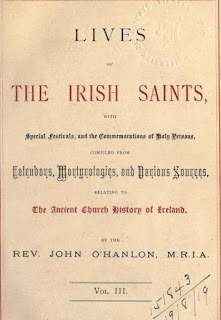
    January 27 is the feastday of an early female saint, Cróine, one of many Irish saints to have been recorded on the Irish calendars, but who has left no Vita to give further details of her life. As Canon O’Hanlon explains, there is even no certainty as to the locality in which she may have flourished, the Martyrology of Tallaght identifying her with Inuse Lochacrone which may suggest a County Sligo location, and the 19th-century scholar John O’Donovan placing her at Kilcroney, County Wicklow. The latest work on the Irish saints, Pádraig Ó Riain’s 2011 Dictionary of Irish Saints, places her instead at the County Carlow location of Ardnehue (Ceall Inghean nAodha) and sees her as one of three daughters of Aodh. Ó Riain acknowledges the confusion of this holy lady with others of the same name, including Cróine of Inis Cróine, who may be one of a number of possible doubles.

    St. Croine, Virgin, of Kill-Crony, in the County of Wicklow, or at Inishcrone, County of Sligo.

    A festival in honour of Croni of Inuse Lochacrone is entered in the Martyrology of Tallagh, at the 27th of January. The locality named is possibly identical with the present Inishcrone, near the River Moy, in Tireragh barony, county of Sligo. A strong castle of Eiscir-Abhann, stood here. Inishcrone town, with the ruined church and graveyard, is in the parish of Kilglass, and near the rocky shore, at Killala Bay. Again, there was a Cill-Cruain, now Kilcrone, an old church, giving name to a townland and parish in the barony of Ballymoe, in the county of Galway. We find that Croine, virgin, of Cill Croine, is recorded, likewise, in the Martyrology of Donegal, on this day. She is of the race of Máine, son of Niall. Her place has been identified with Kill-crony, in the county of Wicklow, and as giving no name to a modern parochial district, it may have been denominated from the establishment of a cell or nunnery here, by the present saint, while possibly clerical ministrations had been supplied by the religious community or pastor, living at Kilmacanoge, in remote times. More we cannot glean regarding this holy woman yet, we may conjecture, she must have flourished at a very early period.

    Content Copyright © Omnium Sanctorum Hiberniae 2012-2015. All rights reserved.