Tag: Female Saints

  • Saint Suibhsech of Tirhugh, January 9

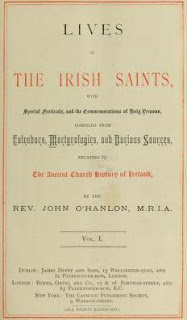
    The name of an otherwise obscure Irish holy woman, Suibsech of Tirhugh, is recorded in the Irish calendars at January 9. Canon O’Hanlon begins on a pious reflective note in his account below and places our saint in County Donegal:

    St. Suibhsech or Suabseg, Virgin, of Tirhugh Barony, County of Donegal.

    Virgins are purchased from among men, the first fruits to God and to the Lamb. Undefiled those virgins follow the Lamb whithersoever he goeth. Suabseg, a virgin, is mentioned simply in the Martyrology of Tallagh, as having been venerated on the 9th of January. Again, Suibhsech, in Tir-Aedha, occurs in the Martyrology of Donegal, on this day. The old name of the territory has been converted into the modern denomination of Tirhugh barony, in the county of Donegal. There probably we must look for the exact locality where this saint was venerated as patron.

    Content Copyright © Omnium Sanctorum Hiberniae 2012-2016. All rights reserved.
  • Saint Brigh of Coirpre, January 7

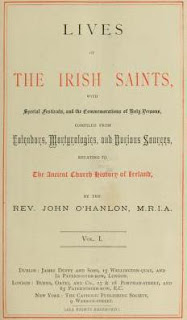
    January 7 is the feast of an obscure Irish holy woman, Brigh of Coirpre. She is one of the many who simply have their names recorded in the calendars at the date of their commemoration, but about whom nothing else is known. Canon O’Hanlon, in the absence of any further details, raises the possibility that she may be Brigh or Briga of Annadown, Co. Galway. The hagiographical tradition records that she was a sister to Saint Brendan the Navigator and indeed such was the relationship between the pair that they were even described by one writer as ‘The Benedict and Scholastica of Ireland’.  I can’t see that in his brief account below Canon O’Hanlon really offers any supporting evidence for his suggestion that Saint Brendan’s sister is the Brigh of Coirpre commemorated today. The name is one of the most commonly found in hagiographical sources and the majority of the saints who bear it are untraceable.

    St. Brigh, of Coirpre, or of Annaghdown, County Galway.

    About this saint’s identity, a considerable amount of doubt must yet be entertained.  We find simply entered, in the Martyrology of Donegal, on this day, Brigh, of Coirpre. The life of Brenann, son of Flinnlogh of Cluain-Ferta, proclaims that he had a sister named Brigh; but the same life states, that she was of Enach-Duin. The present saint is recorded, in the Martyrology of Tallagh, at the 7th of January, as being Brige, Corpre.  Annaghdown is in the county of Galway, and here there are yet extant several interesting vestiges of antiquity.
    Content Copyright © Omnium Sanctorum Hiberniae 2012-2016. All rights reserved.
  • Saint Muadhnat of Caille, January 6

    Among the saints commemorated on the Irish calendars on January 6 is a County Sligo holy woman, Muadhnat of Caille. As Canon O’Hanlon explains below, she is one of three saintly siblings, the Daughters of Nadfraich:

    St. Muadhnat, Virgin, of Caille, Drumcliffe, County Sligo.

    [Sixth Century.]

    In numerous instances, we find it was customary in the Irish Church to venerate, on the same day, saints of a particular family, community, or place. Nor is it probable, that all such persons could have died on that particular festival. It rather appears to have been a matter of convenience, thus to classify and unite them, for various good reasons. The present holy woman, and the other two virgins, who follow in order, are said to have been the daughters of Naidfraic, and sisters to St. Molaissius, Abbot of Devenish. The Martyrologies of Tallagh and of Marianus O’Gorman, as also a Commentator on St. Aengus, place the festivals of those pious sisters at the 6th of January. They were venerated at a place called Enac-ard. We find that Caille is said to have been the name of St. Muadhnat’s habitation. It seems to have been situated in Cairbre, and near Drum-cliabh. This was probably her natal place. It is now known as Drumcliffe, a parish in the barony of Lower Carbery, and county of Sligo.  It lies near the sea-shore, a little to the north of Sligo, and it is situated within the diocese of Elphin. A portion of its round tower here remains, as a proof of its ancient consequence. St. Columkille is said to have been the first founder of a religious establishment, at this place. From the sixth century, Drumcliffe had its abbatial succession, and the herenachy of the Church became limited in the eleventh century to the family of O’Beollain or O’Boland. To St. Columkille is attributed the poetic sentiment of attachment to this spot :—

    Beloved to my heart also in the West—
    Drumcliffe at Culcinne’s strand.

    Its situation is one of great attractiveness to the tourist, and yet in a district but little frequented.

    The present Protestant church stands on the site of an ancient religious establishment; while many relics of the past are observable throughout the parish. We are told that a religious house had been founded here by a St. Fintan, a disciple of St. Columba, at a place called Cailleavinde. This was probably the Caille, where St. Muadhnat’s Convent stood.

    St. Muadhnat is mentioned in the Martyrology of Donegal, as having had a festival on this day. She lived in the sixth century. In the table appended, she is also called Muaghneat, i.e., Mo-Aignes. In the published Martyrology of Tallagh, we find a notice at the 6th of January, Ingen Natfraich, in Enach-airdd. There is probably a mistake for Ingena, the plural form, and which relates to the festival of Natfraich’s daughters. Likewise, incorrectly joined, there is an entry together with St. Diarmaid, whose feast occurs this same day.