Tag: Feasts

  • The Feast of the Dispersion of the Apostles, July 15

    On July 15 Canon O’Hanlon notes the recording, in the Martyrology of Aengus, of The Feast of the Dispersion of the Apostles. This feast marks the dispersal of the Holy Apostles to their various missionary destinations, but in some of the copies of Saint Aengus’s calendar a list of not only the biblical Twelve Apostles is appended, but also a list of the ‘Twelve Apostles of Ireland‘. This was a name given to a group of early saints, presented as students of Saint Finnian of Clonard, who themselves dispersed to various parts of Ireland to evangelise this country. Some of them are also credited with founding missions outside of Ireland. In the account below I have transferred the actual quotations from the Martyrology out of the footnotes and into the main body of Canon O’Hanlon’s text. I have also added some notes on the identities of the Irish Twelve:

    Festival of the Twelve Apostles.

    In the ancient Irish Church, on the 15th day of July, was celebrated the Festival of the Twelve Apostles, as we read in the “Feilire” of St. Aengus. In the “Leabhar Breac” copy is the following Irish rann, translated into English, by Whitley Stokes, LL.D.

    “The twelve Apostles who excel every number,
    before a countless host
    Jesus distributed them among Adam’s seed.”—

    There is an Irish stanza annexed, in which those Twelve Apostles are severally named. Thus translated into English :—

    “Simon, Matthaeus and Matthew,
    Bartholomew, Thomas, Thaddaeus,
    Peter, Andrew, Philip, Paul,
    John and the two Jameses.

    and succeeding it, there is another, enumerating the Twelve Apostles of Ireland. This is headed “XII. Apostoli Hiberniae,” and then follow these lines, thus translated into English:

    “The Twelve Apostles of Ireland :—
    “Two Finnens, two chaste Colombs,
    Ciaran, Caindech, fair Comgall,
    Two Brenainns, Ruadan with splendour,
    Nindid, Mobii, son of Natfraech.”

    This ancient Festival, styled the Separation of the Apostles of Christ for their Missions in various parts of the old world, has been often alluded to by the early Greek and Latin Fathers. The Bollandists, who place it at the 15th of July, have a learned disquisition on its origin and history, to which the reader is referred.

    _______________________________________________________________________________

    Notes on the Twelve Apostles of Ireland:

    Two Finnens – the two great Saint Finnians – Finnian of Clonard, ‘tutor of the saints of Ireland’ and Finnian of Moville.

    Two Chaste Colombs – Saint Columba of Iona and Saint Columba of Terryglass.

    Ciaran – Some lists include two Ciarans, both Saint Ciaran the Elder (of Saighir) and Ciaran the Younger (of Clonmacnoise).

    Caindech – Saint Canice or Kenneth of Kilkenny.

    Fair Comgall – Saint Comgall of Bangor.

    Two Brenainns – Saints Brendan the Elder (of Birr) and Brendan the Younger (the Navigator) of Clonfert.

    Ruadan with splendour – Saint Ruadhan of Lorrha.

    Nindid – Saint Ninnidh of Inismacsaint.

    Mobii – Saint Mobhí of Glasnevin.

    Son of Natfraech – Molaise of Devenish.

    Finally, it may be noted that the list of the Twelve Apostles of Ireland is preserved in various manuscripts which do not always tally. Some of the saints, not present on this list, can include Saints Senan and Sinell.

  • Teach me, O Trinity

    E. Hull Poem, Book of the Gael (1913)

    To mark Trinity Sunday, below is a poem taken from a 1913 collection of texts and translations by the Anglican writer Eleanor Hull (1860-1935). She is perhaps best known for her English versification of the hymn ‘Be Thou My Vision’. Miss Hull contributed translations from Old Irish to many of the scholarly journals of her day and published various books on early Irish history and mythology. The poem below, by the 12th/13th-century writer Muireadhach Albanach Ó Dálaigh, is a beautiful plea to the Holy Trinity:

    TEACH ME, O TRINITY

    By Murdoch O’Daly, called Murdoch “the Scotchman” (Muredach Albanach), on account of his affection for that country; born in Connaught towards the close of the twelfth century.

    TEACH me, O Trinity,

    All men sing praise to Thee, 
    Let me not backward be, 
    Teach me, O Trinity. 
    Come Thou and dwell with me, 
    Lord of the holy race; 
    Make here thy resting-place, 
    Hear me, O Trinity. 
    That I Thy love may prove. 
    Teach Thou my heart and hand. 
    Ever at Thy command 
    Swiftly to move. 
    Like to a rotting tree 
    Is this vile heart of me; 
    Let me Thy healing see, 
    Help me, O Trinity. 
    Sinful, beholding Thee; 
    Yet clean from theft and blood My hands; 
    O Son of God, 
    For Mary’s love, answer me. 
    In my adversity 
    No great man stooped to me, 
    No good man pitied me, 
    God ope’d His heart to me. 
    Lied I, as others lie. 
    They deceived, so have I, 
    On others’ lie I built my lie — Will my God pass this by? 
    Truth art Thou, truth I crave, 
    If on a lie I rest, I’m lost ; 
    My vow demands my uttermost; 
    Save, Trinity, O save!
    Eleanor Hull, ed. Poem Book of the Gael,  Translations from Irish Gaelic Poetry into English Prose and Verse, (London 1912), 156-157.

    Content Copyright © Omnium Sanctorum Hiberniae 2012-2016. All rights reserved.

  • The Feast Which Surpasses All Others

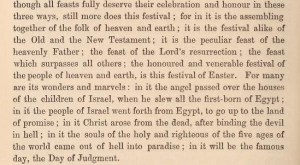
    And though all feasts fully deserve their celebration and honour in these three ways, still more does this festival; for in it is the assembling together of the folk of heaven and earth; it is the festival alike of the Old and the New Testament; it is the peculiar feast of the heavenly Father; the feast of the Lord’s resurrection; the feast which surpasses all others; the honoured and venerable festival of the people of heaven and earth, is this festival of Easter. For many are its wonders and marvels: in it the angel passed over the houses of the children of Israel, when he slew all the first-born of Egypt; in it the people of Israel went forth from Egypt, to go up to the land of promise; in it Christ arose from the dead, after binding the devil in hell; in it the souls of the holy and righteous of the five ages of the world came out of hell into paradise; in it will be the famous day, the Day of Judgment.

    Homily XIX, ‘On the Resurrection’ – The Passions and the Homilies from Leabhar Breac – Text, Translation and Glossary by Robert Atkinson (Dublin, 1887), 390.


    Beannachtaí na Cásca oraibh!

    Content Copyright © Omnium Sanctorum Hiberniae 2012-2016. All rights reserved.