ALL THE SAINTS OF IRELAND

  • Saint Ultán of Cúl Corra, January 17


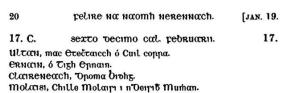
    January 17 is the feast of Saint Ultán of Cúl Corra, one of the many Irish saints about whom not much information has survived. There are at least half a dozen saints of this name found on the twelfth-century List of Homonymous Saints, seventeenth-century hagiologist, Father John Colgan, said he knew of twenty. We have both a place and a patronymic assoicated with this particular Saint
    Ultán. The Martyrology of Donegal records ‘ULTAN, son of Etechdach of Cuilcorra’ as its lead entry for the saints of the day. Canon O’Hanlon, as we shall see below, wondered if this saint may have been associated with the old church of Coolkerry in his native County Laois, but Father Colgan seems to have thought he belonged in Kera in County Mayo. In 2017 modern scholar Dr Elva Johnston posted on her social media account that ‘Lough Derravarragh is more often associated with the legend of the Children of Lir than with the local saint, Ultán of Cúl Corra’, which would place the saint in County Westmeath. Nothing more seems to have been recorded of Saint Ultán of Cúl Corra or of the period in which he flourished. Canon O’Hanlon in Volume I of his Lives of the Irish Saints mentions a reference to the Life of Saint Declan, but the Ultán who appears there as a close disciple of Declan of Ardmore is not identified as Saint Ultán of Cúl Corra:

    Article II. St. Ultan, Son of Etechdach of Cuilcorra. 
     
    Owing to her admirable constitution, all in the Church is strong, because in her everything is divine and everything is in unity. As each part is divine, the bond also is divine, and the connection of parts is such, that each part acts with the force of a whole. The very life of one among her saints reveals this happy unison and strength. We read in the Martyrology of Donegal on this day about Ultan, a son to Etechdach of Cuilcorra. For further particulars regarding this saint, we are referred to the life of St. Declan, by a commentator, in the table, which has been placed after the text of this Martyrology. In the published Martyrology of Tallagh this saint’s name is omitted, or wrongly inserted. Marianus O’Gorman informs us, likewise, that St. Ultan, the son of Etectac, was venerated in Cuilchorra, at this date. This church is placed in that part of Connaught, known as Kera, according to Colgan, and there too St. Patrick is said to have erected a church. However we cannot at all be certain that such was the exact place, with which St. Ultan’s religious ministrations had been connected. 
     
    There is an old church of Coolkerry, in a parish of that name, within the barony of Clarmallagh and in the Queen’s County. Measured from the interior, it is about 48 feet in length, by 20 in breadth, while the walls are nearly four feet in thickness. However, only an old gable, and quite a featureless one, stands in an imperfect shape, as several stones have been removed from its top and sides. Its limestone walls are covered with yellow lichens. Grass-covered side walls, with one end wall, or faint traces of it, over the foundations are visible. This church stands on a mound, near the road bridge, which crosses the River Erkina a considerable stream flowing beneath it. Several moss and lichen-covered rude head-stones are in the graveyard, which has long been used for purposes of burial. In an adjoining rich pasture field, and quite near the old church, there are very curious earth-mounds; and here the inhabitants say were and are the foundations of ancient religious erections. What is denominated a Monument Bush, and of large growth, may be seen at the entrance from the road to the graveyard, which is unenclosed. The bush was a fine flowering hawthorn, at a time when the writer visited this spot. Unbaptized infants were interred beneath the bush, and a pile of loose stones surrounded its gnarled trunk. It may be worthy of investigation, to find if this place could have been identical with the Cuilcorra and its St. Ultan here recorded.

    Content Copyright © Omnium Sanctorum Hiberniae 2012-2025. All rights reserved.

  • Pilgrimages in Donegal

    Pilgrimages to a variety of ancient ecclesiastical sites in Ireland are commonplace today, but below is an article from 1877 when things were rather different. It is a report in the Australian press of a lecture given by a priest who commended the importance of visiting traditional holy sites, in this case the Doon Well in County Donegal. I found this piece interesting not just for the choice of Donegal rather than some of the more famous places Father Barter listed towards the end of his talk, but also for the way in which he linked the Doon well to Lourdes, which had grown in fame and popularity throughout the Catholic world since the apparitions to Saint Bernadette there nearly twenty years earlier. I noticed a typically Victorian presentation of Irish holy places as wild and remote, an idea, then as now, central to ‘Celtic Christianity’ and a sense of a lost earlier and purer age. Here it’s perhaps best summed up by the author’s reference to ‘the remote glens of Donegal, where the relics of some of the greatest of our Irish saints are not enshrined in gold or silver, but in crumbling walls, swathed in green ivy’. The writer recalls memories of the Penal Era as well, here too Victorian writers often presented the liturgy offered at the Mass Rock in a lonely glen as surpassing in spiritual quality the glories of High Mass offered in a European cathedral. I was unable to find out any further information on Father James Barter but for further information on the Doon Well you can do no better than this post by Dr Louise Nugent on her Pilgrimage in Medieval Ireland site:

    IRELAND. 

    PILGRIMAGES IN DONEGAL.

    The Freeman reports the following lecture which was recently delivered by the Rev. James Barter, at the rooms of the St. Kevin’s branch of the Catholic Union:—

    The rev. lecturer said a thick rain was falling when he drove late one evening last summer over the long and steep hill of Meenaroy, near Letterkenny, in the county Donegal. Looking before him into the dim twilight he saw a figure moving forward with much difficulty. Soon he came up with a peasant carrying a parcel on his
    back, who told him he was returning from a pilgrimage to “Doon Well,” with a few bottles of its miraculous water, and that his home was still distant thirty miles off, near those mighty cliffs on the western coast of the county beneath which the waves of the wild Atlantic rave and roar for ever. The peasant went on to talk with enthusiasm of the supernatural powers of his precious burden, while he listened, and fancied he heard in the moaning of the wind the sneers of modern unbelievers, directed, however, with harmless effect, against the strong faith of the humble pilgrim. (Applause.) As he descended into the valley of Lough Finn he looked back upon the poor man whom he had just left, and he was swaying under his heavy burden and the pelting rain. He watched him until his bent form receded into the darkness, and that vision was stamped upon his memory. This incident suggested the idea of seizing the present occasion to awaken the memories of those places in his own native mountains consecrated by the piety of a thousand years. The present seemed to him a fitting time to tread again these holy scenes. (Applause.) The old devotion of France for her ancient shrines, which had been swept away by the shock of the Revolution, had been revived. Within the last few years the apparition of our blessed Lady to the poor girl, Bernadette Soubirons, in the grotto at Lourdes, has poured balm into the wounds inflicted on that great Catholic nation by blasphemers who set up the Goddess of Reason in Paris. Summer after summer a long stream of pilgrims, even from our own shores, poured out upon the scene of that apparition, and their gratitude for favours there received has crowned the rock of Massabielle with one of the finest temples of modern times. While wealth and fashion hurry through the gay cities of the Continent to swell the tide towards this favoured shrine and the celebrated sanctuary of Paray le Monial, it was, he thought, “a holy and wholesome thought” for such of his countrymen as declined to be dragged at the chariot wheels of fashion to gird their loins with the coarse cincture of the pilgrim of olden time and retire, into the remote glens of Donegal, where the relics of some of the greatest of our, Irish saints are not enshrined in gold or silver, but in crumbling walls, swathed in green ivy. (Hear, hear.) Here the vastness of the solitude would enable one to commune more fervently with God—the heart would be moved more deeply by the earnest piety of a fine people, and the will strengthened by the example of their pure and simple lives. (Applause.)

    After a brilliant description of the scenery surrounding the Rock of Doon, the lecturer related some of the historic memories connected with it. He said it was under the shadow of that rock the Catholics of the neighbourhood had to hear Mass in the dark days of persecution. It was upon that rock the O’Donnells were inaugurated chieftains of Tyrconnell, and it was here the ill-fated Sir Cahir O’Doherty fell, fighting for his rights against the English, in 1608, when he rose in rebellion to revenge the outrage offered him by Sir George Paulett, Governor of Derry. (Applause.) Close to this Rock of Doon, said the lecturer, is a well, blessed by a holy priest who lay concealed in these mountains. This was the sacred fountain from which the poor man whom he had met on the bleak Meenaroy fetched his burden, and it was the object of one of the most frequented pilgrimages in Donegal. On special or station days pilgrims might be seen in long procession winding over the mountain path leading to this privileged spot. They go round the well—some on their knees—reciting the rosary – and other prayers in tones so solemn and subdued that in the distance they came swelling on the ear like the tender wailing of the “Miserere.” (Applause.) The holy places of Palestine were then sketched, and the enthusiasm with which they were frequented by pilgrims from the west down to the tune the Crusaders were expelled from Jerusalem by the Moslem. What had occurred, said the lecturer, in the Holy Land in early Christian times, and at Lourdes in our own day, was repeated at the well of Doon and at many another holy well and shrine in Ireland, for the hand of God had not been shortened. In Donegal there was not the Holy Sepulchre, nor the Mount of Olives, nor Calvary, but we had the penitential retreat of St. Patrick in the Island of Lough Derg, and numerous spots sanctified by the presence of St. Columba, now marked by a rude cross, or a blessed well, or the grass-grown remains of a chapel.

    Over twelve centuries had passed away since Columba’s time, but his memory was still cherished by the people of his native mountains, and the faith of which he was the great apostle was still as green in their hearts as the wooded slope at Gartan on which he was born. These holy places were now sadly neglected. Sheep and cattle grazed within their hallowed precincts. He was sure they would join him that evening in the expression of a hope that a faithful people would help, before many years, to build upon these privileged spots, if not imposing structures, at least neat chapels, in which the local clergy could hear the confessions of the pilgrims on station days. It was not in Donegal alone these places of pilgrimage were to be found, for Glendalough, in Wicklow, Clonmacnoise, on the Shannon, and St. Brigid’s, in Clare, were celebrated among the shrines of Ireland. There was Gougan Barra also, the famous sanctuary of St. Finbarre, rising out of the smooth lake, with a crown of moss on its brow, in which the traveller could read another lesson on the neglect with which the shrines of our country were treated. But he story of Gougan Barra and the other celebrated pilgrimages of Ireland remained to be told as it deserved. He had begun at least to give the history and scene of the holy places at Tyrconnell.

    Often had he wandered from his home there among those peaceful shades, and filled his soul with their sacred associations, and in inviting his countrymen to follow his example he felt convinced they would be amply rewarded. (Applause.)

    The Advocate, Saturday February 24, 1877, p.5

    Content Copyright © Omnium Sanctorum Hiberniae 2012-2025. All rights reserved.

  • "Saint Patrick Arriving on Runway Five"

    The Catholic News Agency recently reported that the tradition of blessing the fleet of Irish national air carrier, Aer Lingus, is alive and well thanks to the appointment of a new airport chaplain. Their report can be found here. Below is an earlier report from 1953, published in  the Australian press, which lists the litany of Irish saints to whom the individual aircraft were dedicated. I was especially pleased to see two female saints among them. Sadly, the almost perfect safety record which existed at the time this article was published ended on March 24, 1968 when Aer Lingus Flight 712, “Saint Phelim”, crashed off the coast of County Wexford, close to the Tuskar Rock Lighthouse, killing all sixty-one souls on board. In such a changing world it is heartening to see the tradition of naming aircraft after Irish saints survive and long may it continue!

    LITANY OF IRISH SAINTS MAKES UP EIRE’S AIR FLEET

    “St. Patrick arriving on runway five from Dublin.”

    The announcement came in rich brogue but it was no blarney. Up the runway, as sleek as you please, taxied St. Patrick himself, the pride of the Aer Lingus fleet.

    There’s a whole litany of Irish saints in the Aer Lingus fleet. Besides St. Patrick, other planes are named for St. Brigid, St. Columcille, St. Malachy, St. Aiden, St. Albert, St. Finnan, St. Colman, St. Laurence O’Toole, St. Brendan, St. Enda, St. Finbar, St. Ita, St. Senan, and St. Flannan.

    Fittingly enough, many of these saints were intrepid travellers, carrying on apostolic labors in many parts of Europe.

    Founded in 1936, with every plane in its fleet named for a saint, is it any wonder that Aer Lingus holds the world safety record in the airway realm? The good patrons of this airway system must be cocking a watchful eye on their ships. As one of the Aer Lingus men remarked: “It’s only right to mark the planes which soar through the heavens after the good ones above.”

    The name of the patron saint stands out in foot-high lettering—in green paint, of course—on the nose of the plane. More comforting, perhaps, to the air traveller is the strategically located placard bearing the saint’s name over the more mundane signs warning, “Fasten safety belt” or “No smoking.” This patron saint, of course, is invoked hopefully and anxiously.

    Since the first airship, with dedication to an Irish saint, was both blessed and launched 17 years ago, Aer Lingus has won all kinds of air safety awards. Only one casualty has been recorded in the Irish airline history.

    Aer Lingus plans to purchase new planes to replace the Douglas C-47’s next year as business is on the increase. The planes will be of a different make, but not the guiding patrons.

    Southern Cross, Friday 7 August 1953, page 12.

    Content Copyright © Omnium Sanctorum Hiberniae 2012-2025. All rights reserved.