
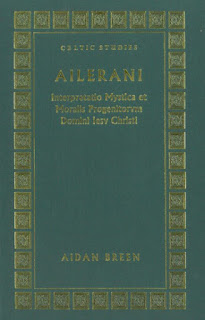
December 29 is the feast of Saint Ailerán, one of the foremost scholars associated with the monastery of Clonard, County Meath. Sadly, in the year 665 he was one of the victims of the Buidhe Chonaill plague which claimed the lives of many Irish saints. He was credited with the authorship of a variety of now mostly lost works ranging from a prayer in praise of the Trinity to hagiographical writings on Saint Féchín of Fore and the Irish patrons Saints Patrick and Brigid. I have already posted a translation of the prayer attributed to Saint Ailerán here. But it is as a biblical scholar that Saint Ailerán is more famous and the Interpretatio Mystica et Moralis Progenitorum Domini Iesu Christi is his best-known surviving work. It is an exposition of the genealogy of Christ as given in the opening verses of Saint Matthew’s Gospel which is divided into two sections. In the first, the mystical, he expounds the names of Christ’s ancestors as they prefigured and foretold His birth, mission, passion, death, resurrection and second coming. In the second, the moral, the names are related to some aspect of the Christian life. In 1995 Four Courts Press published a scholarly edition and translation of the Interpretatio by Dr Aidan Breen and to celebrate the feast of Saint Ailerán, below is a small selection taken from the conclusion to the work. This is his exposition on Saint Joseph, the final name in Saint Matthew’s genealogy of Christ:
Part One – Mystical Exposition
In Joseph, increased or adding to, as he says: I have come that you may have life and have it more abundantly’. And elsewhere: ‘And I have other sheep which are not of this fold, and these also I must bring, that there may be one fold and one shepherd.’
Part Two – Moral Exposition
In Joseph, that if the outer man of ours fall into decay, the inner man may be renewed day by day, and advance in steps of spiritual growth, until it may be said of each one of us, in a spiritual sense, that we are “a son growing”. Let us therefore grow in love, until we come to the perfect man and to the measure of the age of the fullness of Christ, that passing from virtue to virtue, and from the fear of God which is the beginning of wisdom, by steps of perfection rising to the love which is the end and purpose of the whole commandment, we may thereafter be able to behold the God of gods in Sion.
Aidan Breen, ed. and trans., Ailerani Interpretatio Mystica et Moralis Progenitorum Domini Iesu Christi (Dublin, 1995), 49, 57.
Content Copyright © Omnium Sanctorum Hiberniae 2012-2021. All rights reserved.


 OMNIUM SANCTORUM HIBERNIAE