ALL THE SAINTS OF IRELAND

  • Saint Fintan Corach, February 21

    The Irish calendars commemorate a Saint Fintan given the title ‘Corach’ at February 21. Canon O’Hanlon says that this word has a variety of meanings depending on context, it may mean the “volatile,” the “giver of a promise,” or the “melodious.” The entry in the Martyrology of Oengus reads:

    21. The calling of quireful
    Fintan, post contemptum mundi,
    on the fair feast with splendour
    (?) of Verulus (and) Jucundus.

    and the notes add:

    21. Finntan Corach i.e. on his pilgrimage he went into Connaught, and they took pledges from him to come again, alive or dead. And in Lemchoill in Tir lia nDuach and Laigis is Finntan Corach: or in Cluain Aitchen in Laigis, or in Brenainn’s Clonfert he is. i.e. Coir ‘choruses’ are sung at his grave, and not praise. Corach, i.e. a pledge whether alive or dead to come back again. Or the shrine wherein were his relics made turns of it (?). Or ’tis he that made adjustments (cora) in the order of the new rite, ut Sancti etc.
    Vel quod uerius, in Cluain eidnech are the four Finntans. Finntan Corach, Senach the rough, friendly Colman son of Comgall, a trio of them with valorous warfare, one after the other in the abbacy.

    The Leabhar Breac adds:

    “Fifteen years and six score (was) the age of Finntan, a-chanting lasting melodious psalms over the brink of a fountain.”
    The Martyrology of Tallaght, at this date, has the entry:

    “Finntani Coraighi Illeamchoill vel Cluaineidneach,” i.e., the Feast of Fintan Corach of Lowhill, or of Clonenagh.

    The Martyrology of Donegal records:

    21. C. NONO KAL. MARTII. 21.
    FIONTAIN CORACH, Bishop, of Cluain-ferta-Brenainn ; and he is at Cluain-eidhnech, also

    This dual location for Saint Fintan Corach, linking him to both Clonfert, the monastery of Saint Brendan, and Clonenagh, the monastery of Saint Fintan, whose feast we have just celebrated on the 17th of February, has led to some confusion. As O’Hanlon explains, the lack of an extant Life of the saint makes placing when and where he flourished difficult:

    Although ruling over many churches and monasteries, according to our native Martyrologists, this saint has not been distinguished, in any biographies or Acts, whereby some doubts regarding him could more easily be dissipated. Colgan has an unsatisfactory account, at the 21st of February [where] it is said, that he presided over Leamchuill church, within the boundaries of Kilkenny County. Fintan was either buried, or venerated, at this place, as some of our Martyrologists relate. We next find it mentioned, that he presided over Clonenagh Monastery; yet, it is difficult to reconcile this statement with subsequent accounts regarding him. It has been asserted, that our saint flourished, towards the close of the sixth century. However, as this holy man cannot be confounded with Fintan Maeldubh, who, being successor to the great St. Fintan, died in the year 625, nor with that other St. Fintan Munnu, who again succeeded, and who died in 634. Dr. Lanigan suggests, that a chronological difficulty might be avoided, by supposing our saint to have been a simple monk, living at Clonenagh.

    Some authorities state, that he either founded or governed a church at Cluain-aithchen, or Clonkeen, in Leix. A very probable conjecture has been hazarded, that this latter place may have been mistaken for Clonenagh ; and, if such be the case, a difficulty which arises by placing him at Clonenagh, might disappear. Colgan gives us to understand, that having abandoned Ciuain-aithchin, according to a promise made, he returned to Clonenagh Monastery, or, at least, that he was buried, at this latter place. It is said, that our saint discharged the double office of Abbot and Bishop, over the monastery and see of Clonfert. Our Fintan became bishop, it has been supposed, after the death of Moenninnius. Nevertheless, Dr. Lanigan does not assert, that our saint was his immediate successor. According to the same authority, he followed St. Brendan, as Abbot ; and, our saint was afterwards succeeded at Clonfert, by the Abbots, Colman, the son of Comgall, and by Senach Garbh.

    It is said, that St. Fintan acquired the surname, Corach, either on account of his continual charge of place and residence ; or, because of a promise, given to his brethren, that he should return to Clonenagh or, perhaps, because of his melodious voice, by which he was distinguished for exactitude and devotion, whereby he performed sacred chaunts in celebrating Divine praises. It is said, our saint also introduced, among his monks, a new style for singing psalms and sacred canticles…

    The exact date of his death is not known ; but, it is a conjecture of Colgan, that he flourished, about the end of the sixth century. Our Martyrologists place his festival, at the 21st of February; thus, St. Oengus the Culdee in his “Feilire,” the Martyrology of Tallagh, the Martyrology of Donegal, Duald Mac Firbis, enter Fintann Corach. In the ancient Martyrology of the Cathedral Church of the Holy Trinity, Dublin, the festival of St. Fintan, Confessor, occurs, at the ix. of the Kalends of March— 21st of February—although it is not in the prefixed Calendar. Even, in Scotland, he was reverenced. Thus, at the ix. of the March Kalends— which is the 21st of February—the Kalendar of Drummond relates, that the Natalis of St. Fintan was celebrated on this day, in Ireland. A considerable share of doubt appears to have existed among writers, respecting the place of his death and sepulture. Leamchuill, now Loughill, or Lowhill, Cluain-aithchin, Clonenagh and Clonfert or Clonfert Brendain are severally named by our Martyrologists, in connection with the anouncement of his festival, or of his departure, or of the place where his remains had been deposited. It may be supposed that our saint died towards the close of the sixth, or during some earlier part of the seventh, century: his immediate successor, in the Monastery of Clonfert, having departed this life in the year 620.

    Content Copyright © Omnium Sanctorum Hiberniae 2012-2015. All rights reserved.

  • Saint Olcan of Armoy, February 20

    We have another saint known to us from Patrician hagiography commemorated on February 20, Olcan, Bishop of Armoy in County Antrim. The Irish word olc means bad or evil, as in the concluding line of the Pater Noster ach saor sinn o olc, ‘but deliver us from evil’. The hagiographers thus made an attempt to explain our saint’s unusual name and the extraordinary story of his birth is only one of the strange stories associated with Saint Olcan. The account below has been taken from the writing of the Archbishop of Tuam, Dr John Healy:

    III.—Patrick in Dalriada,

    From Magh Elne Patrick crossed the river Bush, and came into the ancient and famous territory of Dalriada, afterwards known as the Route…

    The first incident recorded in connection with the Saint’s missionary journey into Dalriada is of a very striking character. The following is the narrative as given in the Rolls Tripartite :—

    Then Patrick went (from the Bann) into Dal-Araide, and him Doro, King of Carn Setnai, in the North. He heard the crying of the infant out of the earth. The carn is broken up, the grave is opened. A smell of wine comes round them out of the grave. They see the live son with the dead mother, a woman who had died of ague. She was taken by them oversea to Ireland, and after her death brought forth the infant, who lived, they say,- seven days in the carn. “Olc (bad) is that,” said the King (Doro). “Let Olcan be his name,” said the Druid. Patrick baptised him. He is Bishop Olcan, of Patrick’s household in Airthir Maige, a noble city of the Dal Riatai.

    Such is Dr. Stokes’ version of this important passage; and it appears to us to be an accurate rendering of his Irish text. Colgan’s Latin version of the Tripartite is substantially the same except in two points. He makes St. Patrick baptise the infant; and the odour exhaling from the open tomb he describes as a ‘sweet’ odour instead of an odour of wine. As he knew the Irish idiom perfectly from the days of his childhood in Inishowen, we may fairly assume that he has rendered the Irish expression accurately in his own figurative language….

    IV.—Patrick and Olcan of Armoy.

    …Another interesting question is— When did Olcan become Bishop of Armoy? Patrick baptised him—that we know for certain, and we may safely say he did so about the year 443, when he first came into Dalriada. We are also told that Olcan belonged to Patrick’s household; so we may fairly assume that he was educated by the Saint, and prepared for his episcopal duties under his guidance. Usher thinks he was not consecrated Bishop until some thirty years later, about 474, when Patrick himself had been long established in Armagh; and perhaps this is the safest opinion. But the Tripartite speaks of his baptism and episcopacy in the same context, as if he became bishop very shortly after his baptism. In certain cases, as, for instance, St. Fiacc’s, such was the fact; but we can hardly assume it as probable in the case of St. Olcan. Our opinion is he became Bishop before St. Patrick finally left Dalaradia.

    By anticipation, no doubt, another singular fact is related regarding Olcan. Saran was, as we have seen. Prince of Dalaradia when St. Patrick crossed the Bann. He was very justly excommunicated by Patrick, not only because he refused him the site of a church, but also because he drove him and his followers with contumely out of his territory. In that state of excommunication Saran must have lived for several years.

    But, ‘after a certain time,’ this very Saran made a raid into Dalriada, and carried off many captives from that territory. Bishop Olcan met him carrying off his prey. The wretched captives, bewailing their hard fate, besought the bishop to help them. He implored the fierce chief to liberate them; but Saran rudely refused, except on condition that Bishop Olcan would procure him ‘ admission to heaven, from which Patrick had excluded him.’ “Verily,” said Olcan, “I cannot do that since Patrick hath taken it from thee.” Then said Saran, ” I will slay not alone these captives but all your people, sparing only yourself. And wherever I find a shaveling —that is, a tonsured man— I will put him under the edge of the sword.”

    Saran was a decided anti-clerical of the worst type, so thereupon, the affrighted bishop ‘ promised heaven to Saran,’ or, in other words, released him from Patrick’s terrible excommunication, and, no doubt, got off his own followers, as well as the captives, scot free from the vengeance of the fierce warrior.

    Now, Patrick soon after heard all this, and when Olcan went from the North—doubtless to Armagh—to do his will, that is at Patrick’s command, Patrick happened to meet him on the road, at a place called Cluain Fiacnae. Olcan was sore afraid at this rencontre, for he had heard that Patrick was wrathful against him, ‘because he promised a blessing and baptism, and heaven to the man from whom Patrick had taken them away.’ It seems the road was narrow, and that Olcan threw himself on his knees to implore forgiveness. “Over him with the chariot,” said Patrick. “I dare not drive over a bishop,” said the charioteer. Then Patrick, still angry, foretold how Olcan’s cloister would not be high on earth, and he added that three great evils would overtake it—poverty (midgla), decay, and blood-defilement. ” Your land, too,” said Patrick, “shall belong to that little boy carrying your vestment-box, who is one of your own household ” — namely, Mac Nissi of Condere — ‘and to one not yet born’ —namely, Senan of Inis-altich…

    St. Olcan’s festival is celebrated on the 20th of February; and Colgan gives a sketch of his life at that date. He adds nothing, however, to what the Tripartite tells us, except the doubtful statement that St. Patrick sent him to study in Gaul, about the year 460; that he returned home after completing his studies, and opened a great school in his native territory, in which he trained up many disciples in sacred learning, the most celebrated of whom was St. Mac Nissi, the first Bishop of Connor. Usher thinks St. Olcan became Bishop of Armey in 474, which is not unlikely. A strange, but unsupported, statement is made in the Martyrology of Salisbury that Olcan’s mother was a sister of St. Patrick. We are told, it is true, that she was a woman ‘ who came over the sea,’ perhaps from Scotland, the nearest land to Dalriada; but no other ancient authority makes her a sister of our Apostle….

    Content Copyright © Omnium Sanctorum Hiberniae 2012-2015. All rights reserved.


  • Saint Odhran, February 19

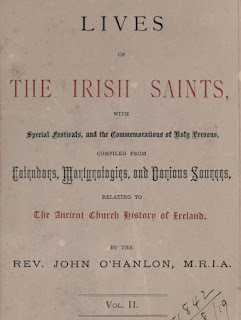
    The Irish calendars commemorate Saint Odhran, whom tradition associates with Saint Patrick’s household, on February 19. Indeed, Saint Odhran is credited with being Saint Patrick’s chariot driver who willingly accepted martyrdom to save the life of his master. His sacrifice took on a particular  importance since the introduction of Christianity to Ireland did not involve large-scale martyrdom. This home-grown martyr was thus seen as a very special saint. A prayer in honour of Saint Odhran can be found here. Canon O’Hanlon has a good description of the popular legends surrounding the brave charioteer in Volume II of his Lives of the Irish Saints:

    St. Odran or Odhran, of Disert-Odhrain, in Offaly, Martyr.

    [Fifth Century.]

    The Martyrologies of Tallagh, of Marianus O’Gorman, and of Donegal record on this day, Odran or Odhran, of Tir-aonaigh or of Tiri-oenaigh. From all we can learn, he became devotedly attached to the Irish Apostle, and he was a constant personal attendant on his missionary travels. Odran became a servant to St. Patrick, whom he served in the capacity of charioteer. We have no express mention of him, except incidentally, in different Lives of St. Patrick. From such sources, Colgan has compiled his eulogistic biography, adding notes to it. The Bollandist writers have inserted Acts of St. Odran, Martyr, in six paragraphs, at this day. This humble and devoted charioteer is classed among the disciples of the Irish Apostle.

    On St. Patrick’s return from Munster, about the year 451, in Colgan’s opinion, and after, or during the year 456, according to Ussher, the Irish Apostle entered Hy-Failge territory. Here were two powerful chieftains ruling at the time: one was a wicked Pagan, Failge Berraide, who entertained a implacable hatred against St. Patrick, because he had destroyed the idol, known as Crom Cruach, an object of adoration among the Gentile Irish, while the other chief was named Failge Ros, who had conceived a great love and reverence towards the holy man. As the former had frequently boasted, that he would take the Apostle’s life away, whenever the opportunity might be afforded; the present stage of his journeying, which brought him along the highway, not far from Failge Berraide’s Castle, seemed favourable for this son of Belial’s purpose. That district, since so well known as Offaly, at least in this part, was then ruled over by the merciless pagan, Failge Berraide. This wicked man’s design was basely to take away by assassination the life of our great Irish Apostle; and, in the accomplishment of such a purpose, he resolved on arresting the progress of the Christian Religion, by effecting the destruction of its greatest promoter. However, Providence frustrated his purpose, although it does not seem, that St. Patrick had any suspicion of the threatened danger. Yet, his charioteer, Odhran, had some prevision of the consequences likely to ensue. In most accounts, it is said, that having had previous intimation of this design, Odran concealed his knowledge concerning it from St. Patrick, whom he induced to occupy the driver’s seat in the chariot, whilst Odran himself should have some short time for rest. The holy Apostle most readily assented. He unsuspectingly relinquished his place, and assumed the reins, in order to gratify his servant’s wish. They had passed from Birr, and were travelling along an ancient road, which bore in an eastern direction, north of the Slieve Bloom mountains, where their enemy lay in wait. Failge met the travellers on their journey. Rushing against Odran, whom he mistook for St. Patrick, the furious chief transfixed him, with a stroke of his lance. Horrified at the sight thus presented, the Apostle was about to pronounce a malediction on the murderer, when the dying Odran prayed it should rather descend on a very high tree, that grew on an adjoining hill, called Brig-damh. Yet, for his Satanic perfidy, the murderer was struck dead immediately afterwards; and as a just punishment for his grievous crime, his soul was buried in hell, while angels were seen bearing that of Odhran to heaven, where he joined the array of purple-robed martyrs. St. Patrick furthermore announced, that the posterity of that wicked Foilge should wane, and lose power, in the principality; while, Foilge Ros and his posterity should rule therein, which prediction was fulfilled. In an old Biburgensian Manuscript Life of St. Patrick, we are told, that when the soul of Foilge, for his wickedness, had been carried away to hell, the devil took possession of his living body, and dwelt in it, until St.Patrick came to the house of that cruel chief. It is stated, the Irish Apostle asked one of the servants for his master, and that he was told Foilge was within. “Call him to me,” said Patrick. But, the servant returned, and told the Apostle in great sorrow, that he only found the dry bones of his master. Then said Patrick :”From the time, when Foilge butchered my charioteer before me, he was buried in hell, but the devil came to possess his body, so that while his soul was consigned to perdition, his body was also dishonoured by demoniac influences.”
    [O’Hanlon inserts an interesting footnote from author W.B. McCabe, who wrote a book of stories for younger readers which included the unhappy tale of Foilge:
    The second tale, Foilge; or the Possessed, is a veritable Irish tradition. It is the earliest account that the author has been able to trace, of that belief, which still prevails in many parts of the world, viz., of an evil spirit entering into the body of a dead man, and making that dead man appear as if he were still living—a belief, it may be remarked, very different from that which prevails as to the demoniacs described in Scripture—that is, living men, into whose bodies an evil spirit had entered. Foilge as portrayed in the Irish legend, (Act. Sanct.vol. iii., pp. 131, 132) was the same in most respects as the modern vampire; in some particulars like to the malignant dead described in the Sagas of the Scandinavians.]
    Attempts have been made to identify the place, where this martyrdom occurred. Afterwards, it received the name, Desart-Odran of Hy-Failge;… on the road, between Frankfort and Roscrea, is the little village of Killyon; and about two miles from the latter village, is yet shown the place, where Foilge attempted the life of St. Patrick.
    Odran’s name occurs, in some foreign Martyrologies; yet, his festival has been assigned to distinct days, from the present date. Thus, the 8th of May, the 27th of September, as also the 2nd and the 27th of October have been conjecturally mentioned, in connexion with it, by various Martyrologists. About, or soon after, the middle of the fifth century, this martyrdom of Odran is considered to have occurred. This saint is honoured as a martyr, chiefly on the 19th of February; but, in certain places, as we are informed, on the 27th of October. Some churches were formerly dedicated to him, in the country about Birr, and in the Ormonds…It is probable, that many of those circumstances related, as connected with St. Odran’s death, are unreliable; although, we take it for granted, that this saint must have lost his life, for his attachment to the Christian faith, and while faithfully serving his illustrious master.