ALL THE SAINTS OF IRELAND

  • Saint Davog of Lough Derg, July 24

    July 24 is one of the three feast days assigned to Saint Davog (Dabheoc) of Lough Derg, County Donegal, home to the medieval pilgrimage site of Saint Patrick’s Purgatory. As this day falls within the pilgrimage season it is the one on which the memory of this early saint is marked on the island itself. As you can see from the photograph above (taken on my last visit) Saint Davog gives his name to one of the boats which ferries pilgrims to the island. You can also see the beautiful marble statue of the saint in the basilica and hear the current Prior recite a prayer to Saint Davog by clicking on this link. I have already posted a full account of Saint Davog on his January 1 feast day here, but below we have a reminder of his career from Irish Anglican writer St. John Drelincourt Seymour (1880-1950), who penned a number of interesting historical studies including Saint Patrick’s Purgatory: a Medieval Pilgrimage in Ireland:

    At one time Station Island was known as St. Dabheoc’s Island, from which the cave and surrounding district took the name of Termon-Dabheoc. This saint, whose name sometimes appears under such forms as Beoc and Mobheoc, following a recognised method of treating Irish saints’ names, and is latinized Dabeocus, Abogus, Arvogus, and perhaps Beanus, is held to be the patron saint of Lough Derg. Three festivals were annually held in his honour viz., January 1st, July 24th, and December 16th. In the Martyrology of Tallaght occurs the following allusion to him:

    “Aedh, Lochagerg, alias Daibheog.”

    Lochagerg, or Loch Gerg, being other forms of Lough Derg. St. Cummian of Connor, in his poem on the characteristic virtues of Irish Saints, credits him with performing the following austerities, which were also practised by other persons eminent for sanctity in Ireland and the East:

    “Mobheoc the gifted, loved,
    According to the synod of the learned,
    That often in bowing his head
    He plunged it under water.”
    His memory is still perpetuated in the townland-denomination of Seeavoc on the southern extremity of the lake. This name means “St. Dabheoc’s Seat,” and this curious structure may still be seen in the vicinity, though it is not now reckoned as on the above townland.

    It is certain that at some remote date a saint named Dabheoc lived at Lough Derg, and was very probably the original founder of the monastery there. Beyond this all is mere conjecture. There exists some uncertainty as to whether there were not two saints of the same name connected with the spot, the one a Welshman, son of a king named Brecan, who ruled over a district now represented by Brecknock, the other an Irishman, descended from Dichu, St. Patrick’s convert. But that an important Celtic monastery flourished here at an early date is made certain by the irrefragable arguments of stone. On Saints’ Island are the remains of an ancient oratory and cemetery, while the large lis, or circular earthen enclosure there, probably marks the site of the original monastic establishment. On Station Island are the remains of the “penal beds,” which so great an authority as Wakeman, after a careful examination, considered to be the ruins of what were originally bee-hive oratories, probably of the ninth century, of which examples are to be found along the west coast of Ireland. It seems probable that the two islands were held as one by the Celtic monks, forming together the monastery of Lough Derg. Add to the above the remains of carved stones, inscribed monuments, and fragments of crosses, and some small conception may be formed of its erstwhile importance.

    But, as unfortunately happens so often in Ireland, the mists settle down very speedily, and the history of the site is blotted out. Under the year 721 the Four Masters record the death of Cillene of Lough Derg, who was probably an inmate, or perhaps abbot, of the establishment. It is quite probable that at some unrecorded date the monastery was wiped out by the Danish invaders in their terrible forays.
    Rev. St. John D. Seymour, Saint Patrick’s Purgatory: a Medieval Pilgrimage in Ireland (Dundalk, n.d. 1918?) 11-13.


    Content Copyright © Omnium Sanctorum Hiberniae 2012-2022. All rights reserved.

  • Beatha Mhairghréad- An Irish Life of Saint Margaret


    Although this site is dedicated to the saints of Ireland, I also enjoy seeing how devotion to saints of the universal Church manifests in an Irish context. July 20 is the feast of Saint Margaret of Antioch, one of the Great Martyrs of the east who, although she enjoyed a widespread cult in the west during the Middle Ages, is now largely forgotten. In the western setting she was one of the Fourteen Holy Helpers, a group of saints whose intercession was sought to aid in the difficult and dangerous realities of medieval life. The account of Margaret’s martyrdom included an episode where she was swallowed by a dragon but managed to irritate the creature’s insides by making the sign of the cross and was expelled from its body. Thus she came to be viewed as a saint to whom women in childbirth, an extremely hazardous time for the medieval female, could turn. Lives of Margaret survive not only in Latin but also in many medieval European languages, and in Irish alone there are reputed to be at least ninety manuscripts containing accounts of her [1].  These Irish accounts remain largely unpublished but one interesting later manuscript, taken to America by an emigrant family, has been described by the late Dr Kenneth Nilsen [2]. He was invited to view the Irish Collection of the Boston College Library and was intrigued to find a small book with a leather and cardboard cover with the title “Margaret O’Brien’s Book, Dated November 23rd 1822”. It comprised a manuscript of one hundred and four pages, eighty-seven of which had a Beaha Mairgréad and the rest a Himin Phadruig, a prayer to Saint Patrick. The name of the scribe, Soan Breanach, appears on page 88, along with the date 1819.  At the end of the Saint Patrick prayer he dedicated the work with a prayer for divine protection for Murcha Ó Briain, his wife, Margaret McCarthy and their children. 

    What is fascinating to me about this early nineteenth-century manuscript is how it carried on the traditions of medieval hagiography into the modern era. The book measures only 3 inches by 4 inches and Dr Nilsen concludes that it was probably designed as a portable type of talisman, carried or possibly even worn as protection. This is borne out by the last words of Saint Margaret, a petition to God which she was allowed to make immediately before her execution and which may account for the continuing popularity of The Life of Saint Margaret.  Here is a flavour of the protective powers the saint claims attend the hearing or reading of the account of her Passion:

    “…Any house in which my Passion or Life is read may no defective, deaf, blind, dumb, lame or maimed child be born there. And any house in which it is chanted, may it be free from all diseases and from the power of fire, water and enemies. If it is read to a man before he goes to battle, he will return safely and victoriously with pure faith.

    Then there is another petition which affirms Saint Margaret’s role as the protectress of women in labour:

    “If it is recited to a woman in the throes of childbirth, she will come through that difficulty unharmed and with faith and hope in the One True God and in the aid to the angelic court to pray to God to ask Him to show her a sign.

    There are also others for travellers, which presumably had a direct application to an Irish family crossing the Atlantic: 

    “Whoever listens to it as he travels overseas will return safely to the same country if his intention is pure.

    “If it is read to someone going on board ship, he will return safe from that journey with proper faith and hope in the one true God….”

    Having repeated her petitions in verse, Saint Margaret is beheaded and her persecutor himself falls down dead beside her. Hosts of angels then descend and lead Margaret’s soul into heaven.

    This manuscript Life of Saint Margaret, copied by a trained scribe in the second decade of the nineteenth century, is thus a fascinating survival of the medieval hagiographic tradition which along with the enduring power of talismanic prayer continued to find an outlet in Irish popular religious expression.

    Notes:

    [1] Salvador Ryan, ‘“I, too, am a Christian”: early martyrs and their
    lives in the late medieval and early modern Irish manuscript
    tradition’, in Peter Clarke and Tony Claydon (eds), Saints and Sanctity:
    Studies in Church History 47. Abingdon: Boydell Press,
    (2011), footnote 34, p. 204.

    [2]  Kenneth E. Nilsen,  An Irish Life of St. Margaret, Proceedings of the Harvard Celtic Colloquium, Vol. 4 (1984), pp. 82-104.

    Content Copyright © Omnium Sanctorum Hiberniae 2012-2022. All rights reserved.
  • Saint Killian of Würzburg, July 8

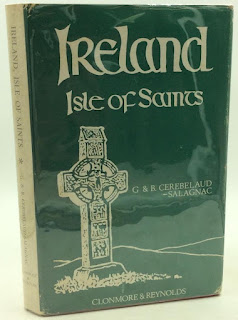
    8 July is the feastday of Killian of Würzburg, an Irish missionary saint and martyr, whose memory is still very much alive today. I have previously published an account from Abbé McGeoghegan here and now bring a reminder of the martyrdom of Saint Killian and his companions from the English translation of another French work, Irlande Ile des Saints, by G and B Cerebelaud-Salagnac:

    Let us now set out for Thuringia, in the footsteps of Killian (or Cilian). He would have been born about the year 640 in County Cavan. When he became a monk, and was first moved by the missionary grace, he went to the Continent with eleven companions (always the number twelve, clearly regarded as perfect). Passing through northern Gaul they reached the Rhine which they crossed and came to the castle of Würzburg, where lived Gozbert, Duke of Thuringia. Gozbert heard Killian readily, even when the monk pointed out to him that his union with Geilana, his brother’s widow, was incestuous (this was the commonly accepted view at that time). He renounced Geilana. This woman conceived a deep resentment against the monk and from then on she only lived to revenge herself. About the year 689 she brought about the murder of the Bishop, along with two of his companions, Colman and Totnan.

    “A custom, similar to that which was to be found among the Jews, had been in common practice among the people of Würzburg, and it had just been adopted by Prince Gozbert himself. He had taken as his wife his brother’s widow, whose name was Geilana (or Geila). The prince had feelings of love and affection for her. It soon became Saint Killian’s duty to explain to him the Church’s ruling on this matter…. He did this gently and in the most persuasive way … the first time he approached this subject, the king showed great aversion to this idea of separation, but when he became aware that this was necessary, if he wished to live according to his profession of faith, he consented, in a Christian spirit of
sacrifice. The king’s resolution came to the knowledge of Geilana. She was not prepared to bow to the royal decision. Her arguments and her cunning were, however, without effect, for the prince’s will was unshakeable. She then began to burn with unquenchable rage against the servants of Jesus Christ, and decided to seize the first opportunity for taking a terrible revenge; this was not long in appearing.

    “The prince was called to a long distance on a military expedition in the
year 689; his cruel wife was able to find some hardened criminals, whom she hired to carry out her plan of vengeance, Although miraculous warnings had been given, it is said, to Saint Killian and his companions about this plot, they did not wish to save their lives by flight, nor even by seeking the protection which they would have easily found among the people of Würzburg. Saint Killian exhorted his companions to be steadfast, assuring them that their souls could not be injured by the assaults of their enemies. The holy missionaries began to prepare themselves, by prayer and by fasting, to face the danger by which they were threatened. On July 8th, 689 (according to certain authors 688), while Saint Killian and his companions, among whom were Colman and Totnan, were meeting together, these murderers, armed with swords, entered the room where they were. St. Killian offered himself the first to the executioners, and was immediately struck down at their feet. His companions fell in the same fashion. In order to conceal the marks of this slaughter, the bodies of the martyrs were taken away by night and buried secretly. The cross, the book of the Gospels with their other books and belongings, were thrown into the same grave….

    G and B Cerebelaud-Salagnac, Ireland Isle of Saints (Dublin, 1966), 107-8.


    Content Copyright © Omnium Sanctorum Hiberniae 2012-2022. All rights reserved.