ALL THE SAINTS OF IRELAND

  • Saint Papán of Santry, July 31


    July 31 is the feast of a County Dublin saint, Papán of Santry. As Canon O’Hanlon’s entry for this saint in Volume VII of his Lives of the Irish Saints explains, a seventeenth-century hagiologist, Meredith Hanmer, whilst he  preserved the memory of the saint’s annual patron at Santry, confused  him with a Belgian  saint, Poppon of Stavelot. Actual details of our Irish saint’s life are hard to come by but his memory lives on in Saint Pappin’s holy well and also in the name of the townland of Poppintree or Pappan’s tree. His name also occurs in connection with the feast of the Sons of Nadfraech, although it is not certain that he is one of this group. Canon O’Hanlon contents himself by giving us an historical sketch of the later medieval foundation which stood at Santry and ends by citing the evidence for the saint’s feast day from the Irish calendars:

    Article IV. — St. Papan, of Santry, County of Dublin. 

    [Supposed to be of the Fifth and Sixth Centuries.] 

    The Martyrology of Tallagh  mentions, that veneration was given, at the 31st of July, to Papan, of Sentribh, now Santry, near the Irish metropolis. Here was one of the ancient sanctuaries of Ireland, with an old church or a monastery, long since gone, yet tradition preserves the memorial of this saint. Already, at the 25th of January, we have alluded to a St. Poppo, Pappan, or Poppon, supposed to have been Abbot of Stabuletum, who had a festival at that date; but, it is probable, the present St. Papan, of Santry, was a distinct person. Much obscurity, however, surrounds his history. According to what we find recorded, the father of this saint must have been Nathfriach— or more correctly Aengus. From this parentage, it must be inferred, that Papan was born in the fifth, and he probably lived on to the sixth, century. If we are to believe Dr. Meredith Hanmer, he was a native of Santry. In the townland of Poppintree, or Papan’s Tree, so late as the beginning of the present century, the Patron of St. Papan, used to be held annually, on the 31st day of July. It may be supposed, that the former parish church of this pretty village stands on the site of the present Protestant church, which is surrounded by an ancient burying-ground. Whether, at this spot, an older ecclesiastical structure, than that erected in the latter part of the twelfth century, existed, we have now no means left for ascertaining; but, it seems very probable, since in the year 827, we find recorded in our ancient annals the death of Cormac, son of Muirgheas, Abbot of Seantrabh, interpreted Santry. After the Anglo Norman Invasion, however, King Henry II. of England, in granting the kingdom of Meath to Hugh De Lacy, included this neighbourhood within that charter. The latter feudal lord regranted the manors of Skryne and Santry to Adam de Feipo or Phepoe. Afterwards, this proprietor erected a church, consisting of a chancel and nave, separated or connected by a choir-arch. This he conveyed by deed to the Cistercian Abbey of St. Mary, in Dublin. It seems to us, that the Anglo-Norman Baron intended to dedicate the church of his foundation to St. Poppo or Poppon, Abbot of Stavelot, in the Low Countries, rather than to the more ancient Irish Saint bearing a nearly similar name. Wherefore, it is very probable, that both have been confounded in local popular tradition. In the family of De Feipo or Phepoe the manor of Santry continued until about 1375, when Johanna, daughter and heiress to Francis de Feipo or Phepoe, married Thomas Mareward, who was afterwards created Baron of Skryne. The village here seems to have grown up about the church, and it is mentioned in a Chancery Roll, which is dated 1379. In the year 1435, it is recorded as belonging to the Phepoe family; the manor at that time extending over the lands of Ballymun, Shillok, Little Ballycurry, Ballystrawan, &c. In many documents of the period, it gives its own name to the surrounding barony. In 1539, on the 28th of October, William Landey, the last Abbot of St. Mary’s, Dublin, surrendered to King Henry VIII. all the estates of his Abbey, including those belonging to this parish, at that time when the dissolution of religious establishments took place. Then, the rectory, with a manse and a glebe, was of the annual value of £14 12s.; and in the sixteenth century, the manor of Santry passed from the Marewards, who had previously acquired the fee, to William Nugent, eighth Baron of Delvin, who had married Janet, the daughter and heiress of Walter Mareward, Baron of Serine. Afterwards, it was transmitted to the family of the Barrys, and later still to that of the Domviles. In 1609, the church of Santry was rebuilt, and it became the burial place for the latter  families; while, in 1615, we learn, that the church was in good repair, but that the chancel was ruined. The present edifice was erected in 1709, on the ruins of the former one. At this same date, July 31st, the Martyrology of Donegal, has the simple entry, Papan. Marianus O’Gorman and the Martyrology of Tamlacht appear to be cited for confirmation of this insertion.

     Content Copyright © Omnium Sanctorum Hiberniae 2012-2022. All rights reserved.
  • St.Cobthach of Iona, July 30


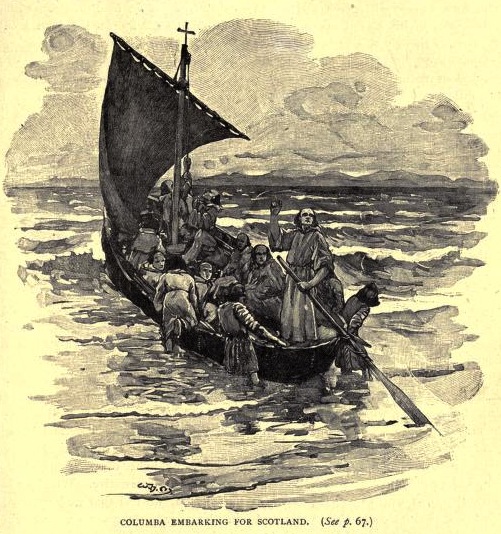
    On July 30 Canon O’Hanlon has a short account of Saint Cobthach, kinsman of Saint Colum Cille of Iona, whom he claims has a feast on this day, at least according to the two nineteenth-century scholars John O’Donovan and George Petrie. Unfortunately I have not been able to access the work referenced to see on what basis this claim was made. Bishop William Reeves, who published a scholarly edition of The Life of Saint Columba in 1857, noted that the seventeenth-century Scottish martyrologist, David Camerarius, had ascribed August 7 to the feast of Cobthach, but without any supporting authority. In the hagiography of Iona’s founder, Cobthach features as the son of Colum Cille’s father’s brother which would make them first cousins. Cobthach, along with his brother Baithene, were among the original twelve disciples of Saint Colum Cille who accompanied him on the voyage from Ireland to Iona, as Canon O’Hanlon explains:  

    Article IV.—St. Cobthach, Disciple of Columkille. 
     
    This devoted follower of the great Abbot of Iona, was the son of Brendan, and brother of St. Baithene, who immediately succeeded St. Columkille in the monastery at Iona. He was one of the twelve first disciples, who sailed from Ireland to that island with the founder. We find a commemoration for him at the 30th of July, on the authority of George Petrie, LL.D., and John O’Donovan, LL.D. The Rev. Dr. Reeves,when alluding to the early companions of St. Columkille, remarks, that Camerarius gives him a day, at the 7th of August, in the Calendar, but without any authority.

    Content Copyright © Omnium Sanctorum Hiberniae 2012-2022. All rights reserved.

  • Saint Bití of Inis Cumscraigh, July 29

    A County Down monastic saint, Bití (Bitus, Bite) of Inis Cumscraigh, is commemorated on the Irish calendars on July 29. Inis Cumscraigh is today known as Inch, which as the name suggests was once an island on the River Quoile but is now on land close to the town of Downpatrick.  It boasts some very impressive and extensive Cistercian monastic ruins. Inch Abbey was founded in the 1180s by the self-styled ‘Prince of Ulster’, John de Courcy, following his conquest of the area. It was a daughter-house of the Cistercian foundation at Furness in Lancashire, from whom de Courcy commissioned the hagiographer Jocelyn to write a Life of Saint Patrick. I have written about de Courcy, Jocelyn and Saint Patrick in a post at my blog dedicated to the Irish patrons here. But today’s native Irish saint pre-dates both the Normans and the Cistercians. In a 1977 paper archaeologist Dr Ann Hamlin, drawing on the evidence from the Irish calendars and Annals,  provided a useful sketch of the history of the pre-Norman monastery at Inch:

    An earlier name for the island was Inis Cumhscraigh, and it was the site of a pre-Norman monastery. ‘MoBíu of Inis Cúscraid’ is listed at 22 July in the main text of the Martyrology of Oengus, and the entry is glossed ‘i.e. beside Dún dá lethglas’, whilst in the Martyrology of Tallaght ‘Dobí of Inis Causcraid’ appears at 29 July. The Martyrology of Oengus was written between 797 and 805 and the Martyrology of Tallaght  a little earlier, so these references provide firm evidence for a pre-Viking church on the island. Several annal entries refer to the site in the eleventh and twelfth centuries. In 1001 ‘Sitric, son of Amhlaeibh, set out on a predatory excursion into Ulidia, in his ships, and he plundered Cill-Cleithe [Kilclief] and Inis-Cumhscraigh, and carried off many prisoners from both (Annals of the Four Masters, also Annals of Tigernach). The Annals of Ulster record the death of ‘Ocan Ua Cormacain, herenagh of Inis Cumscraigh’ in 1061, and in 1149 Inis-Cumscraidh was plundered together with other churches in the area (AFM). The erenagh of Insecumscray was among the witnesses to the foundation charter of Newry abbey in about 1153. These references collectively suggest that a church and perhaps some form of monastic life did continue on the island into the twelfth century.

    Ann Hamlin, A Recently Discovered Enclosure at Inch Abbey, County Down, Ulster Journal of Archaeology Third Series, Vol. 40 (1977), 85-86.

    Saint Bití is the second saint named in connection with this monastery with a feast falling just seven days (and thus within the octave) of that of Saint MoBíu commemorated on July 22. Canon O’Hanlon, in his entry for July 29 in Volume VII of his Lives of the Irish Saints feels that they are probably the same person:

    Festival of St. Bitus or Bite, of Inis Cumscraigh, now Inch, or Inniscumhscray, Strangford Lough, County of Down. 

    According to the Martyrology of Tallagh, veneration was given, at the 29th of July, to Bitus or Bite, of Innsi Caumscridh. This holy man is called Bute, or perhaps Byte, by Marianus O’Gorman. That island or rather peninsula is beautifully situated in Strangford Lough, and nearly opposite to Downpatrick, county of Down. Some interesting ruins are yet seen in this place. An abbey or a monastery stood here – as has been already observed – before the erection of one, which has been founded by the Anglo-Norman warrior, John de Courcey. When the present saint flourished has not been ascertained. In the Martyrology of Donegal, we find an entry of Bite of Inis Cumhscraigh, at the 29th of July. We are inclined to think, that the present holy man is not distinct from the Abbot so called, and who is celebrated on the 22nd day of this month, where an account of him has been already given.

    Canon O’Hanlon’s account of Saint MoBíu can be read at the blog here.

    Content Copyright © Omnium Sanctorum Hiberniae 2012-2022. All rights reserved.