ALL THE SAINTS OF IRELAND

  • Saint Lughaidh of Rattoo, October 6

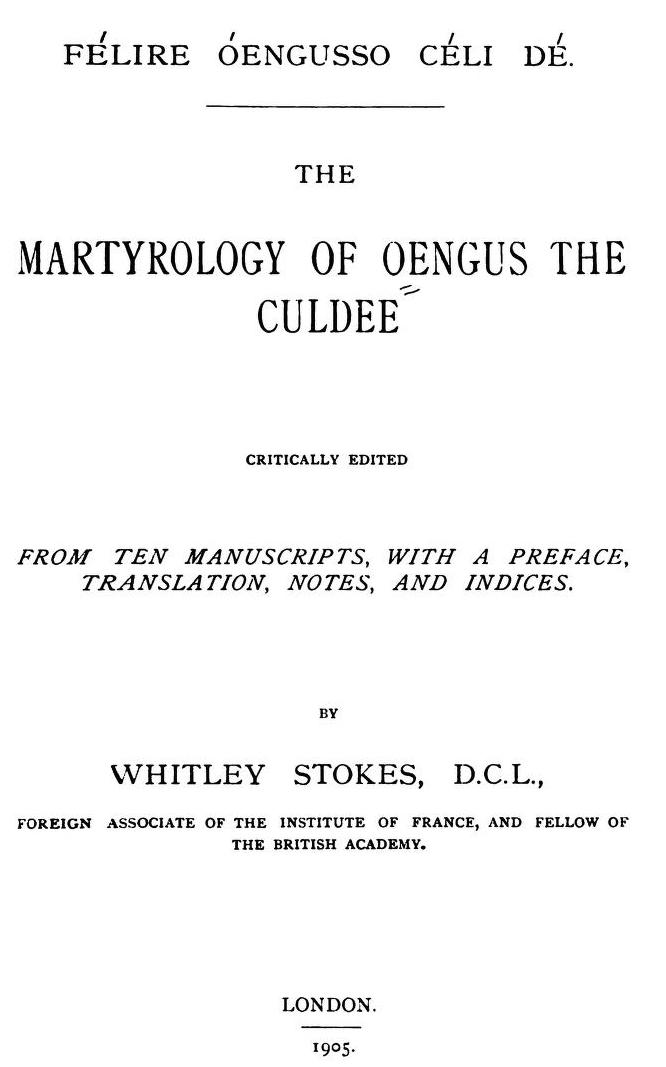
    Among the Irish saints commemorated in the Martyrology of Oengus on October 6, is epscop Lugdach ligach, the gentle bishop Lugdach. The scholiasts’ notes suggest a number of possible localities with which our gentle bishop may have been associated. They range from Counties Leix and Offally through to the northern shores of Lough Erne, County Fermanagh and all the way back to County Kerry:
    6. of Lugaid, i.e. from Cell Aitgin in Leix, or from Cell Chuair in Hui Failge. Lugach, i.e. bishop Lugaid in Cill Aithgen in Leix, or in Cill Bennchoir in Offaly. Or bishop Lugach in Cuil Bennchoir in Lurc on the shore of Lough Erne. Or in Daire Mochua in Ciarraige Luachra.
    The later Martyrology of Donegal supplies a genealogy for the Bishop:
    6. F. PRIDIE NONAS OCTOBRIS. 6.
    LUGHAIDH, son of Lucht, son of Anrodhan, son of Maeltuile, son of Aithcleach, son of Ferb ; and Medhbh, daughter of Garbhan, son of Brocan, son of Garbhan, son of Dubhchertan, of the Ui- Saithghil of Ciarraighe Luachra, was his mother. He was bishop of Cuil-Beannchair, on the brink of Loch Erne, and of Rath Muighe-tuaiscirt in Ciarraighe Luachra; or of Cuil-Beannchair in Ui-Failghe, and of Tuaim-fobhair in Luighne.
    He is also commemorated in the twelfth-century Martyrology of Marianus O’Gorman as ‘bishop Lugach (Lugaid ?) the bright-coloured.’
    In his annotated edition of the classic 18th-century work on Irish monasteries by Mervyn Archdall, P.F. Moran, Bishop of Ossory, was able to supply some further detail on the County Kerry locality of Rath Muighe-tuaiscirt, anglicized as Rattoo or Rathtoy:
    O’Donovan, in the Ordnance Survey Papers, informs us that the Rattoo was sometimes called by the Irish writers Rath-muighe-tuaiscirt, “the fort of the northern plain.” This enables us to identify St Lughaidh, as one of the early bishops of this see. His feast is on the 6th of October. The Martyrology of Donegal speaks in a somewhat doubtful manner, and calls him “Bishop of Cuil-Beannchair, on the brink of Loch Erne, and of Rath-muighe-tuaiscirt, in Ciarraighe Luachra; or of Cuil-Beaunchair, in Hy-Failghe, and of Tuaim-fobhair, in Luighne.” However, the Felire of St. Oengus removes all doubt on this head. In the text of the Felire the saint is commemorated as “the gentle Bishop Lughdhach;” and then the note is added, “This is Bishop Lughdhach from Daire-na-FIann, in the Eoghanact of Caisel, viz., Lughdhach, bishop in Cuil Bendchair, in Uibh-Failghe. The same Bishop Lughdhach is in Cuil-Bendchair in Lurg, on the brink of Loch Erne; and he is in Rath-muighe-tuaiscirt, in Ciarraighe Luachra, viz., at Daire Mochua on the banks of the Feile.”
    Rt. Rev. P.F. Moran, ed.,M.Archdall, Monasticon Hibernicum, Volume II, (Dublin, 1876), 245.

    Content Copyright © Omnium Sanctorum Hiberniae 2012-2015. All rights reserved.
  • Saint Sínech of Crohane, October 5

    The Martyrology of Oengus commemorates a holy woman of County Tipperary, Sínech daughter of Fergnae, on October 5:

    E. iii. nonas Octobris.
    Blog dond liic lógmair
    la slóg martir namrae,
    Sínech ingen Fergnae
    Crúachan Maige Abnae.
    5. A fragment of the precious stone,
    with a host of marvellous martyrs,
    Sínech Fergnae’s daughter,
    of Cruachu Maige Abnae.
    Scholiast Notes

    5. A fragment of the precious stone, i.e. Sínech daughter of Fergnae, or good (ergna) is she herself, in Cruachan Maige Abna in Eoganacht of Cashel. Sínech, i.e. Fergna is her father’s name. Or she is ergna, i.e. good, from Cruachan Maige Abna, etc.

    Saint Sínech is also remembered in the later Martyrology of Donegal:
    5. E. TERTIO NONAS OCTOBRIS. 5.
    SINEACH, daughter of Fergna, of Cruachan Magh-Abhna, in Caenraighe. She was of the race of Eoghan Mor, son of Oilioll Olum, according to the Naomh-Senchas.
    According to this website Saint Sinech is the patroness of Crohane, County Tipperary and the writer helpfully provides information from Canon O’Hanlon:
    St Sinech is given as the Patroness of Crohane. The Mart. of Donegal commemorates her on Oct. 5th. says she was the daughter of Fergna of Cruachan Magh Abhna and of the race of Eoghan More, son of O. Olum according to the genealogical history of the Irish saints. The book is wrong in placing Magh Abhna in Co. Limerick.
    O’Hanlon says “she is mentioned also on Oct 5th by the Feilire of St Aengus, and as the daughter of Fergna of Cruachan Muige Abnae in Onacht Cashel”. Maurice Lenihan says “the virgin is likely the sister of St Senachus, Bishop, who was with St Ruadhan and St Columba of Terryglass among the pupils and disciples of St Finian of Clonard”. Crohane must be identified with the Cruachan of St Sinech he says, and the denomination of Magh Abhna has been reformed into Mowney a neighbouring parish in the barony of Slieveardagh. Her acts are not known to exist. Up to 1810 says O’Hanlon, her festival was remembered in Ballingarry on Oct 5th.
    Crohane-Cruachan Muighe Abhnae. Church ruins are in Drangan parish. In the Feilire Aenguis, Crohane is given as the round hill of Moy-Owney. This parish is bounded on the west by the parish of Killenaule, on the east by the parish of Mowney, on the north and north east by the parishes of Lickfinn and Ballingarry. The parish is in Slieveardagh Barony, and an amount of its land would be at present in Ballingany parish, though the old church ruin is in Drangan. This is the place called Cruachan Muighe Abhnae i.e. Croghane Mowney in the Festiology of Aengus, at Oct 5th for the glossographer places it in the territory of Eoghanacth Chaisil. This is rendered absolutely certain by the existence of the well of the Patron Saint and of other names of places in its vicinity, which the ancient authorities place in Eoghanacth Chaisil as Doire na bFlann etc. The name signifies the round hill in the plain of Abhna, which may be interpreted the plain of the river. Magh Abhnai, the name of the plain is still retained in that of the parish of Moy-Owney which bounds Crohane on the east.

    Content Copyright © Omnium Sanctorum Hiberniae 2012-2015. All rights reserved.

  • Saint Baluíne, October 4

    On October 4 our early Irish calendars present us with something of a mystery surrounding a female saint with the name of Baluíne. The Martyrology of Oengus begins:

    D. iv. nonas Octobris.
    Áil Marcellum nepscop
    co nhaidbli a bríge,
    la céssad na hóige
    in ballgel Baluíne
    .
    4. Beseech Marcellus the bishop,
    with the vastness of his vigour,
    at the suffering of the virgin,
    the bright-limbed Balbina.
    The phrase ‘suffering of the virgin’ would imply a female martyr, yet as we know, the vast majority of the early Irish saints who suffered martyrdom did so contending for the faith in other countries. It is clear from the scholiast notes on this entry that later commentators were perplexed and sought to find a local identity for the ‘bright-limbed Balbina’:
    4. Baluina .i. tair ata, nó isi Bicsech ó Chill Bicsige i nHuaib macc Cuais Midhe. R1 . in marg. Baluina uirgo et martir. Nó commad hí Baluina .i. Bicsech o Chill Bicsechi i nHuib Maccuais Mide, sed non est uerum. R1
    4. Balbine .i. in the east she is. Or it is Bicsech of Cell Bicsige in Hui mace Uais in Meath. in marg. Baluina virgin and martyr. Or maybe Baluina is Bicsech of Cell Bicseche in Hui Macc-uais of Meath; sed non est uerum.
    Bigsech of Kilbixy is an Irish female saint whose feastday is commemorated on June 28. In Canon O’Hanlon’s account of her, which I posted here, he remarked that ‘this saint appears to have had another festival, at the 4th of October.’ But did she? For Balbina was not an Irish woman at all, despite the attempted Gaelicization of her name, but one of the early Roman martyrs. There seem to be two saints of this name, the first, commemorated on March 31, is said to have been the daughter of a Roman official called Quirinus and is linked to the discovery of Saint Peter’s chains. There is a second Balbina, however, whose name is attached to one of the Roman catacombs, and inevitably the identities of both have been the subject of some confusion over the centuries. In Volume 5 of his work The Sacramentary: Historical and Liturgical Notes on the Roman Missal, Ildefonso, Cardinal Schuster, records at October 4 ‘Saint Balbina, Martyr’ and it would seem that this is the second Balbina, who gave her name to the Roman cemetery and who was commemorated on this day, even in Ireland!

    Content Copyright © Omnium Sanctorum Hiberniae 2012-2015. All rights reserved.