ALL THE SAINTS OF IRELAND

  • The Daughters of Comgall, January 22


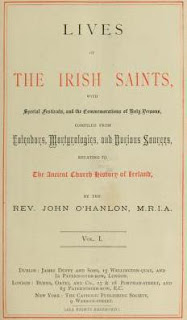
    The earliest Irish calendars – the Martyrology of Oengus and the Martyrology of Tallagh- both make reference to a feast on January 22 of the daughters of Comgall – Lassir, Columba and Bogha – and associate them with the church of Glenavy in County Antrim. The origin of this northern church is mentioned in the Tripartite Life of Saint Patrick, where it was first known as Lettir-phadraic but later as Lann Abhaigh. Canon O’Hanlon brings together the evidence from the sources for us before concluding with a triumphal flourish:

    The Daughters of Comgall, Colma, Bogha, and Lassara, of Glenavy, County of Antrim.

    The Martyrology of Tallagh mentions a festival on the 22nd of January in honour of Comghaill’s daughters, Lassir, Columba, and Bogha. Some confusion in rendering their names appears to have crept into our calendars. According to the Martyrology of Donegal, on this day was venerated Colma, also called Columba, Bogha, and Laisri, three sisters. These virgins belonged to the sept, and were daughters of Comhgall, son to Fianglach. They were buried and venerated at Leitir Dal-Araidhe; they were disciples—or, according to another version, foster-children—to Comhgall of Beannchair, or Bangor. According to the poem beginning “The Hagiology of the Saints of Inis-Fail,” they are of the Dal m Buain, the race of Eochaidh, son of Muireadh. The place called Lettir in Dalaradia was anciently known as Lettir-Phadruig, after the Irish Apostle St. Patrick, who there first built a church. From the disciple, called Abhac, placed over it, Lann-Abhaich, Lan-avy, and finally Glen-avy, were titles given to this spot. It is a parochial church in the diocese of Connor, and in the ancient territory of Delmunia. It is said, that the present church does not occupy the original site; but that old Glenavy churchyard lay at some distance, in an angle formed by the Glenavy and Pigeonstown roads. Yet this account seems inconsistent with an existing tradition. Glenavy parish is situated within the barony of Upper Massereene, and in the county of Antrim. At a place called Camus Comhgaill, those holy women are also said to have been venerated. This, by others, is also thought to be the spot where their bodies had been interred. The holy virgins’ names are included in the calendar compiled by the Rev. William Reeves. They are likewise entered in the Kalendar of Drummond; but, apparently in a most incorrect manner, at the xi. of the February kalends, which corresponds with this date. Thus in early ages, and in the same family, we find many saints, while from the fifth to the eighth century Ireland appeared to realize the glorious vision of a church which St. John had in Patmos.

    O’Hanlon also contacted the then parish priest of Glenavy who in a letter dated 2nd May, 1873, furninshed some further local detail which appears in a footnote:

    There is no vestige of the old church of Glenavy. A tradition exists, that the Protestant church is on the site of the old one. It is divided by a river from what is supposed to be the old cemetery, where, according to Reeves, were buried the three sisters. These are said to be the sisters of St. Comgall, abbot and founder of Bangor. He came from Maheramorne, near Lame. Perhaps there was a religious house in Glenavy, to which the three sisters retired. There is no ruin whatever on the spot.

    Reeves is Bishop William Reeves, an Anglican scholar who produced a most useful volume on the ecclesiastical history of the northern dioceses. He too quotes from the sources beginning with the Martyrology of Oengus on January 22:

    ” Exitus filiarum Comgalli”.
    “i.e. at Lettir in Dalaradia they are[buried], and from Dalaradia they are [sprung]”.

    Their names are given in the Calendar of the Clerys at the same day:

    “Colman, Bogha, et Lassera, three sisters, and three virgins, and they were foster children to Comghall of Bangor, and they are [interred] at Lettir in Dalaradia; or [according to others] it is at Camus Comghaill they are [resting]”.

    Their descent also is given by Colgan : 

    “SS. Boga, Colma sive Columba, et Lassara virgines, tres filiae Comgelli filii Fingalacii filii Demaui filii Nuathalii filii Mutalani filii Cantalani filii Fiengalacii filii Niedi filii Buani a quo Dal-Buain, Coluntur in Ecclesia Litterensi in Dalriedia [recte Dalaradia] 22 Januarii”.—(Act. SS., p. 471.)

    Rev. W. Reeves, Ecclesiastical Antiquities of Down, Connor and Dromore (Dublin, 1847), 237.

    Content Copyright © Omnium Sanctorum Hiberniae 2012-2015. All rights reserved.

  • Saint Maccallin of Therasche, January 21

    Saint Maccallin, commemorated on January 21, was a tenth-century monastic who laboured in northern France and Belgium. It is possible to see the abbey of Saint Michael where he served as abbot here. Canon O’Hanlon records what is known of him, including the usual difficulty of whether as a ‘Scot’ the medieval writers intended to convey the earlier usage of Scotia which applied to Ireland rather than to Scotland:

    SAINT MACCALLIN, OR MALCALLAN, ABBOT OF SAINT MICHAEL’S MONASTERY AT THERASCHE, AND ABBOT OF WASOR, IN BELGIUM.

    The acts of St. Maccallin—so far as they are known—have been compiled by the Bollandists, and by Colgan, while they are found in the Benedictine collection. From these sources, also, Bishop Challoner has published a brief account of this holy man. A goodly-sized volume, relating to his “gests,” had been once preserved, as the monks at Wasor had assured Colgan, but this unfortunately has been lost. The Bollandists read a life of St. Maccallin; this however was filled with wondrous and incredible prodigies, although nowhere in it was there any mention of his festival. The Bollandists consider, that the name of this saint, as differently rendered Makkallinus, or Maccallinus, Makalinus, Malcallinus, Malcalanus, Malacanus, seems from its Irish or Scottish compounds capable of being rendered,” Son of Chilian,” “of Kalan,” or ” of Kalin.” Colgan states, that he should be most correctly named Malcallan, a name found more than once in our Irish annals.

    This holy servant of God was an Irishman by birth. However, it has been stated, that Malcalin, said to have been Abbot of Verdun, and venerated on the 21st of January, was a native of Scotland. Dempster allows, notwithstanding, that he was educated in Ireland, where he lived under a regular discipline or rule. In the earlier half of the tenth century, St. Forannan, had already left our island, and directed his course to Flanders. Here he was called to assume the government of Wasor monastery, on the River Meuse. Going through Britain about the year 946, with St. Cathroe, St. Fingen, St. Lazarus, and with other pious companions, St. Maccallen sought the shrine of St. Fursey at Perrone. They were hospitably received and entertained by Herswindes, a noble matron. She was wife to Count Filbert, who dwelt not far from Perrone, in Picardy. Those holy pilgrims had signified their desire for leading a solitary life in some proper place, where they might freely serve our Lord, and live by the labour of their hands. Their benefactors recommended St. Malchallan to Agnoald, who was abbot over Gorze, in Lorraine. Under this holy superior, Malcallan became a professed monk. Cathroe sought another pious destination. Previous to this course, however, those thirteen Irish companions who had arrived in France, seemed by common consent to have resolved on selecting St. Cadroe as their superior. St. Malcallan’s powers of persuasion were chiefly used to secure his consent. This could not be obtained, however, owing to the holy man’s true humility. The fellow-voyagers appear for a considerable time to have been maintained through the bounty of their noble patrons, who pointed out to them a place in the wood of Therasche, which might be suitable for their retired manner of living. This spot was dedicated to the holy Archangel Michael, and there they built dwellings. The count and his wife contributed to their comforts and convenience in every possible way. Those religious finally chose Malcallan for their superior. Under his conduct, for some time, they were exercised in watching, fasting, and prayer. St. Cathroe, the chief of his companions, desiring greater perfection, chose to embrace for his manner of life the Benedictine institute. At that time St. Benedict’s rule was observed in its full vigour at the celebrated monasteries of Fleury in France, and of Gorze in Lorraine.

    After St. Cadroe and St. Malcallan had made their respective professions, the good lady, Herswindes, desired and obtained their return to Thierasche. There St. Malcallan was constituted abbot over St. Michael’s Monastery. This her husband, Count Eilbert, had founded in that forest. The Count established another great monastery, at Wazor, upon the River Meuse. It lay between Dinant-and Huy. This he gave to the same saint. Both of these abbeys Malcallan governed for some time, in such manner as to unite most perfectly the care of his own sanctification with the perfection of that religious community committed to his charge. At last, finding it too great a burthen to govern, at once, two distant monasteries, he resigned that of Wazor to St. Cathroe. Then Malcallan lived retiringly in St. Michael’s Monastery, at Therasche. Some have affirmed, that St. Malcallan was abbot over St. Michael’s Abbey at Verdun. But this is a mistake of many writers who followed the “Martyrologium Anglicanum.” There was no abbey of St. Michael at that place, as shown by Menard, who properly observes, that his veneration at the Church of St. Michael the Archangel was not in Verdun. Thus Ferrarius states, and he adds, moreover, that in Lotharingia, this Abbey of St. Michael, over which Makalin had been abbot, was placed. Saussay and Wion made a similar mistake. About the year 975, St. Cadroe is said to have died, when the government of his community devolved once more on St. Maccallin. It is generally believed, he was the third abbot over Wasor, in the order of succession.His elevation and enthronement were attained with the common assent of the Bishop of Metz, and of all his own subjects. He obtained the rule of souls and the care of those pertaining to him in the Basilica of St. Michael. At Therasche this holy abbot went to bliss in the year 978, as Flodouardus, a contemporaneous writer, records: “The man of God, Malcallan, an Irishman by nation, on the eve of St. Vincent, the deacon and martyr, left this transitory life, which he hated; and happily began to live with the Lord, whom in his lifetime he had continually served. As to his body, it lies buried in the Church of Blessed Michael the Archangel. This abbey, during the time of his corporal stay in the world, he had piously governed. His obsequies were honourably and religiously performed; while in aftertime, he was regarded as a saint, and his memory was held in great popular veneration.

    St. Malcallan’s Abbey of St Michael is well known to have been in Thierasche or Tierarche, a province of Belgic Gaul, on the confines of Haynault. It was situated within the diocese of Laon, on the River Aisia, over the village of Hiersson. There this holy abbot’s festival is duly celebrated on the 21st of January, which the Calendarists have allowed to be the date for his festival. Thus, Dorgain and Hugh Menard place it, in the Martyrology of their order. Truly might this venerable missionary exclaim with holy David, “Lord, Thou has proved me and known me; Thou hast known my sitting down and my rising up. Thou hast understood my thoughts afar off: my path and my line Thou hast searched out.” That the Almighty approved his course of life upon earth has been manifested, in the fruits his labours procured, and in that hallowed memory bequeathed to the inhabitants of those places he had adorned and blessed before he was called away to Heaven.

    Content Copyright © Omnium Sanctorum Hiberniae 2012-2015. All rights reserved.

  • Saint Molagga of Timoleague, January 20


    January 20 is the feast of Saint Molagga of Timoleague. This County Cork saint was extremely well-travelled; tradition credits him with having been a student of Saint David of Wales as well as having gone on to found churches in Scotland. He is also associated with a number of localities in Ireland, not to mention with a number of other Irish saints, and thus I would be interested to see how modern scholars assess the career of Saint Molagga. To introduce his life however, I am reproducing some extracts from an article on Timoleague in a nineteenth-century Catholic magazine which summarizes all of the traditional stories about this most interesting saint:

    TIMOLEAGUE

    …Timoleague is just an easy, half-Englished way of pronouncing the Irish words meaning the “House of Molaga”; and Molaga was one of the early Saints when Ireland was young in the Christian faith for which it has suffered so much. Like many another Saint of that time, he had much to do with his brother missionaries of the Celtic race in Scotland and Wales; and his own life was spent in much travelling to and fro, studying and founding monasteries and doing any good work that came to hand, even to spreading the culture of bees in his own Ireland.

    It is common enough among these early Irish Saints and yet it is strange, when one comes to think of it that they have left their names bound up with all the different periods of their country’s history. This is because of the work done so well by them during their busy lives, and of the work done after they were dead and gone by the devotion of the common people to them through the succeeding centuries. Thus, in the case of Molaga, we have a few antique bits of building in the rude, primitive style of the early Celtic Christians, dating from himself or his disciples and telling a story of zeal for the glory of God’s house and the salvation of souls. Then we have the fine “Abbey” built much later in his honor by friars who came over from Italy hundreds of years after his death. And, in their turn, these splendid arches now stand broken and open to the day with only the ivy to clothe them round about, and the birds and winds to make music where the priests once sang to the glory of God and the Saint God gave them Molaga….

    It was in the territory of Fermoy, on the bound of the present barony of Condons and Clangibbon, far toward the north- eastern corner of County Cork, that our Saint was born, in the old principality of the O’Keefes which was long known as the Roches’ country. He was of the family of the O’Dugans, possessors of this territory of the “woodland,” as it was called. His parents were humble tillers of the ground, as were many who were kin to the petty Kings then governing the land. They had long been childless, and had all their hopes in the heavenly kingdom. One day, as they were sowing a ridge of flax on the south side of the road that runs along the little river Funshion, a troop of priests passed by travelling somewhither with St. Cummin the Long at their head. The Saint foretold to them that they should bring forth a son to their old age, as did Abraham and Sara; “that he would be a friend of learning, and that he should sit in the smooth hill of the plain as Abbot of the school.”

    When the child of prophecy was born, his parents brought him to the Cross of the Dun or neighboring Fort; and, behold, St. Cummin was at the ford awaiting to baptize one with whom, indeed, he was to be connected all his life. Here, later on, arose the church of Aghacross. Its ruins remain by the bend in the river ; and beside it is still an ancient well, consecrated to the Saint and flowing with its clear waters by lone Molaga’s holy cells.

    The cells of the Saint, which he built for himself and his disciples in the rude fashion of the time, have still their ruins on his “smooth hill of the plain.” They are in the Saint’s own parish of Tempul Molaga ; for his name, as we have said, remains everywhere here, however far away and dim may be the memories of the period in which he lived. On the southern slope of the hill, with the mountain stream winding below, the cashel or termon wall encloses an open space in which are the early oratory, a church of later date, another square building, and two of those crosses which speak so pathetically of the faith of Erin. The oratory is some twenty feet from the church. A great ash tree overshadows its eastern window, inside which according to ancient custom stood the altar whereon Christ -the mystic Day spring and Orient from on high- was offered in the Holy Sacrifice, even as now in the nearest and scarcely less humble parish church. Forty years ago there were six of these trees, and the walls stood much higher; but everything is slowly disappearing before the hand of man. So much the more necessary is it that the holy associations of the place should be preserved while there is yet time. Eighty feet away and still along the southern side of the hill, are four pillar stones as if to mark a boundary. To the west stretch afar the Galty Mountains in swelling waves, blue in the distance and mingling nearer the deep shadows of retreating valleys with the great russet spots on greenclad slopes which form so characteristic a picture in the memory of the tourist through Southern Ireland.

    Molaga -a young Culdee or Irish monk- did not long remain in the monastery after the years of his studies were over. He had gathered together a few disciples in this spot. But there were still Druids and idolatrous practices in the country ; and he felt himself driven forth, sore at heart, from the midst of so many evils. So he set out for Connor in Ulster, where there had been a bishop since the time of the Apostle St. Patrick. It still forms a bishop’s see, though long since united under one head with Down. Like the other holy men of his day, he carried a bell with him to give sign of the exercises of devotion. It was lost by him on the way, and its recovery was the occasion of founding a church (now Kill-foda in O’Neil-land East), whose lands were afterward called the Termon of the bell, while the “priest’s mistake of his bell ” passed into a proverb. From this he wandered on into Scotland and down to Wales, to the disciples of the great St. David of Menevia, a title which in our own day after centuries of forced apostasy on the part of the Welsh people has again been given to a Catholic bishop’s see.

    After some time spent in Wales, the Saint returned to his own country. He had received during his stay in other lands, first, the name by which we know him for Mo-laga is the kind-hearted Irish way of saying ” My Lachen,” the name bestowed on him by the religious children of St. David ; and second, a bell presented to him in memory of the religious ties he had formed with them. This present was enough to leave his name to a place in Wales, long called Boban-Molaga.

    St. David had always been in communication with his Celtic brethren of Ireland, and another of his disciples – Modomhnog, or Dominic of Ossory- had brought home with him from the Welsh monastery a swarm of bees, the culture of which he introduced among the Irish monks. But by this time ” My Dominic’s” bees were in need of another trained hand for their due care; and the services of our own Saint were eagerly demanded by the chieftain of what is now Dublin, as soon as he arrived there on his way homeward. He took this as an indication of the will of Providence ; for he was ever distrustful of the voice of flesh and blood in seeking again his native region among the hills of Munster Liath-Muine. So a church and land were given him a little to the north of what is now Balbriggan town ; and the King of Dun Dubhline ordered that every person in his domains should pay the Saint a pighin or penny every three years for his support, while he was to take charge of the patriarchal swarm of the Irish bees. In the midst of the blessed ground where the dead of his race are still laid away in the hope of the same resurrection which he preached, are the ruins of his old chapel of Lambeecher in Bremore, which is nothing else than the good Welsh name Llan-beachaire or “Church of the Beeman.” …

    We next find St. Molaga amid St. Kieran’s Seven Churches of Clonmacnoise on the River Shannon, the greatest of the ancient Irish establishments of religion and learning. About this time his old neighbors of Fermoy came to beg him to return to his own monastery of Tulach-mhin the smooth hill on the plain. They promised him many things, even fifty white milch cows every successive year ; and when he sent them away, they simply came back to him accompanied by their beseeching wives and children. He could no longer withstand so earnest entreaties ; and henceforth, to his death, his name is associated with his native home. It afterward became known by his name as Labba or Leaba Malaga “the Bed of Molaga;” for there, as all tradition has it, his mortal remains still lie awaiting the resurrection. …

    One of the latest acts of the Saint had been to imperil his life for his brethren by ministering to them in the time of the terrible “yellow plague” the Buidhe Chonnuil

    It is not in connection with his last resting-place, but with the great Abbey called by way of excellence the “House of Molaga” Teach-Molaga that our Saint’s name is chiefly known. Colgan, the historian of the Irish Saints, gives on the 20th of January ” the feast of St. Molaga, Confessor, Patron of the Church of Timoleague.” This was probably the site of one of the Saint’s primitive monasteries; but its present memories date only from the coming of the Franciscans, in 1240.

    The Messenger, Vol. VI (xxvi). January, 1891, 3-18.

    Content Copyright © Omnium Sanctorum Hiberniae 2012-2015. All rights reserved.