ALL THE SAINTS OF IRELAND

  • Saint Baitan, Abbot of Clonmacnoise, March 1


    On March 1 the Irish calendars commemorate Saint Baitan, a seventh-century abbot of the monastery of Clonmacnoise. The entry in the Martyrology of Donegal reads

    1. D. KALENDIS MARTII. 1.

    BAOTAN, Mac Ua Corbmaic, abbot of Cluain-mic-Nois, A.D. 663.

    Saint Baitan (Boetan, Baotan, Buadan, Boedan, Baithan, Da-Buadoc) succeeded Aedlugh, whose death is recorded in the Annals at 26th of February, 651, as abbot of Clonmacnoise. Here is how one nineteenth-century writer described him:

    BAEDAN MAC UA CORMAIC,

    whose tribe was of the illustrious Conmaicne Mara family, succeeded in the Abbacy. Ware, Lanigan, and Lynch, in his MSS. history, style this holy man Baitan O’Cormac, ” first a Monk, then Abbot, and lastly Bishop of Clonmacnoise; a man of much piety and learning.” He is named in our Martyrologies, on the 1st of March; but there, as well as in our ancient Annals, receives only the title of Abbot. This is a strong confirmatory proof of the assertion with which we set out, namely, that Abbot and Bishop may here be taken as synonymous. This holy Bishop’s obit, is put down by some as having taken place in 663, and by others, in 660. About that year the plague, called Buidhe Connaill, began to rage in Ireland, and of it some of the most remarkable men of that time in Ireland died.

    Rev John Monahan, Records Relating to the Dioceses of Ardagh and Clonmacnoise (Dublin, 1886), 82.

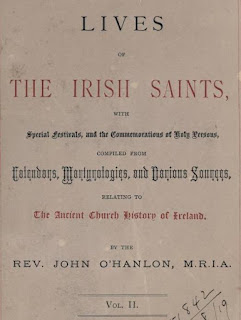
    Canon O’Hanlon summarizes the evidence for Saint Baitan’s feast on the calendars:

    Baitan, Bishop of Cluan, is mentioned in the Martyrology of Tallagh, as having a festival on the 1st of March, which it appears was the date for his death. Marianus O’Gorman, and his Scholiast, as also Maguire, concur in their statements. We read, in the Martyrology of Donegal, that Baotan, Mac Ua Corbmaic, Abbot of Cluain-mic-Nois, was venerated on this day. The year 660 is assigned for the death of this holy abbot, by the Chronicon Scotorum, and by the Annals of Clonmacnoise; but, A.D. 663, according to the Annals of Ulster, and of the Four Masters.

    Content Copyright © Omnium Sanctorum Hiberniae 2012-2015. All rights reserved.

  • Saint Dichuill of Airiudh-muilt, February 28

    To close the month of February, Canon O’Hanlon brings a notice of a saint linked to the locality of Lough Erne. Although he does not say so in his brief entry for Saint Dichuill of Airiudh-muilt, I am assuming that O’Hanlon is referring to Lough Erne in County Fermanagh:

    St. Dichuill, of Airiudh-muilt, Lough Erne.

    In the Martyrology of Tallagh, and at the 28th of February, we find recorded, “Dichuill Mac Maelduibh in Airudh Muilt oc Locuibh Eirne.” Marianus O’Gorman has an entry, which is somewhat similar. The Martyrology of Donegal registers on this day, Diochuill, son of Maoldubh, of Airiudh-muilt, on Loch Eirne. It seems impossible, at present, to identify this saint’s locality, or to determine whether it was on an island, or along the shores.

    Content Copyright © Omnium Sanctorum Hiberniae 2012-2015. All rights reserved.
  • Saint Oda of Rhoda, February 27

    Following on from yesterday’s saint, Beccan the Blind, today’s saint, Oda of Rhoda in Belgium, also has a connection with blindness. Canon O’Hanlon has included her in his work on the grounds of her alleged ‘Scots’ i.e. Irish background. The feast day of saint Oda is also open to question as her main feast appears to have been on 27 November rather than 27 February.

    St. Oda, or Odda, Virgin, at Rhoda, Belgium. [During or after the Eighth Century]

    Dempster, in his Scottish Menology, and Ferrarius, in his general Catalogue, insert a festival for St. Oda, Virgin, of Rhoda, in Taxandria, of Brabant, at the 27th of February. The Bollandists briefly allude to her, at the same date, although referring her festival to the 27th of November. Dempster states, that at Rhoda, St. Odda, a Virgin, was venerated, at the 27th of February. She was daughter to a king, and patroness of this place. Othbert, the Bishop, raised her precious remains, in 1103, to a place of honour. It is said, by Dempster, that she was daughter to Eugene V., King of the Scots, and a virgin, who led a most holy life. However, the authorities quoted by him, only make her daughter to a King of the Scots. It is thought, she flourished, about the year 500, although another more probable statement has 700, and 713. She was seized with blindness, but going to the tomb of St. Lambert, Bishop and Martyr, at Liege, she there prayed and recovered her sight. Through gratitude, she then vowed her virginity to God; nor, afterwards, could her father persuade her to marry. Following a Divine impulse, Odda went to Taxandria, and by her residence, she sanctified the whole Rhodan territory. It is related, that while she secretly prayed in a wood, a magpie betrayed this secret to men. Hence, in art, she is painted with a magpie. Renowned for her virtues and miracles, she was called, at last, to the nuptials of her Divine Spouse, and her body was deposited in a collegiate church at Rhoda, where she is commemorated as chief patroness. We are told, that her memory was greatly venerated, and that churches were erected to her honour, in various parts of the kingdom of Scotland. Her festival occurs, in the Kalendar of King Charles First’s Prayer-book, probably in virtue of her royal descent. Her Acts are said to be more fully written, in the Scotichronicon, by the Monk of Paisley, by John Molan, by Constantinus Ghinius, in the English Martyrology, and in other works. In the anonymous Catalogue of Irish Saints, published by O’Sullevan Beare, and in the “Historia Sanctorum Lovanii” as also in Father Henry Fitzsimon’s list of Irish Saints, at the 27th of February, we find entered, St. Oda, Virgo. However, the “English Martyrology” refers her feast, to the 27th of November. By Father Stephen White, she is said to have lived in the eighth century.

    Content Copyright © Omnium Sanctorum Hiberniae 2012-2015. All rights reserved.