Below is a paper on Irish devotion to Saint David of Wales in which the author has assembled all of the traditional lore about the saint, including Glastonbury’s claim that he was the uncle of King Arthur! The writer does not hesitate to claim the Welsh patron for Ireland and at the end of the piece gives some interesting illustrations of his cult within this country.
Note: This post was first published in 2015 and re-posted in 2026
ST. DAVID-PATRON OF WALES -VENERATED IN IRELAND.
JOHN B. CULLEN
IN many of the Calendars of the Irish Saints the name of St. David, patron of Wales, is inserted under the date of his Festival March 1st. It is unusual, in our national martyrologies, to find a saint commemorated who was not connected with our country by birth, or had not made Ireland the scene of his missionary labours. However, this great Apostle of the early Celtic Church, although he may not have spent any time in this country, was associated with it by lineage and family ties of a very remarkable kind. Moreover, the celebrated monastic School of Menevia, in Pembrockshire, of which St. David was founder and abbot, was largely frequented by scholars from Ireland, and most of the great Irish Saints in the sixth and seventh centuries spent some time in this monastery studying the sacred Scriptures and in pursuit of a more profound knowledge of the practices and discipline of the Religious life. In fact, relations of a most intimate kind seem to have existed between the Irish Monasteries and Menevia down to the Norman period. The birth of St. David is assigned by most authorities to the year 445. His father named Xanctus was a British prince who ruled over the territory of Cerectica, which is said to have corresponded with the present Cardiganshire.
The mother of the future Saint was of Irish descent and a member of an illustrious family whose name figures conspicuously in the military history of Wales in the fourth and fifth centuries. She was a most devout Christian, and such was her reputation for pre-eminent sanctity that soon after her death she was popularly acclaimed a Saint, and her name enrolled on the sacred calendars of the Church as St. Non. Her shrine one of the lateral chapels in the mediaeval cathedral of Menevia, may still be seen. As it was owing to his maternal ancestry that St. David is classed among the Saints of Ireland and venerated in several parts of the Province of Leinster, as a local patron, we shall touch briefly as we can on this phase of the Saint’s family history. Some incidents connected with it serve to establish, or at least to shed considerable light on, the question referring to the existence of Christianity in some parts of Ireland, for a century or more previous to the coming of St. Patrick.
Among the “Lives of the Cambro-British Saints,” to be found in the Cotton Manuscripts, preserved in the British Museum, is the life of St. Brenach, who, apparently, flourished in the early part of the fifth century and made Cambria, or Wales, the scene of his missionary labours. In the “Triads “(Welsh Chronicles) he is expressly styled “Brynach Gwyddel,” meaning Brenach the Irishman. He was a prince by birth, but when he was converted to the true Faith he laid aside all his claims to worldly honours, and became a hermit in one of the mountain solitudes of his native country. Later on he undertook a pilgrimage to Rome, and on his return, spent some years in Brittany, whence he crossed over to South Wales, where, not far from the confluence of the Rivers Cleddan, he erected a little hermitage and church close to the present Milford Haven. Here he was joined by some companions, probably countrymen of his own, who, desiring to follow his saintly example in forsaking all for Christ, became his first disciples. Finding after some time their life of solitude was disturbed by predatory bands of lawless men, the little community moved on to the banks of the River Gwain and settled for a time near the town, now called Abergwain. However, being admonished by a heavenly sign that this was not to be their final resting place, they eventually directed their steps towards Pembrockshire, where, in the valley of the Caman river, they chose a solitary spot, surrounded by mountains, and erected a monastery. Their missionary labours among the hillside tribes were crowned with success, and by their teachings and examples numerous souls were lead to abandon superstitions and idolatry of their Pagan forefathers and accept the truths of Christianity. The heaven-directed mission of St. Brenach was the means of establishing the Faith in Pembrockshire, and was also, we may assume, the origin of that long and remarkable connection which existed between the Celtic Churches of Wales and of Ireland.
Among the conversions wrought by the missionaries was that of an Irish (Pagan) Chieftain, named Brecan, from whom Brecknockshire derives its name. Aulach, the father of Brecan, was the son of an Irish King Cormac MacCarbery and became the leader of a band of colonists, who left their country shortly after the middle of the fourth century to seek their fortunes in Wales. Aulach, having established himself, by his valour and military prowess in that country, eventually won the hand of Marchella, the daughter of Tewdrig, who was then chief ruler of South Wales. Brecan, the child of this marriage, having reached man’s estate, succeeded, on the death of Tewdrig, to the chieftancy of his family.
On his conversion this great warrior became a most enthusiastic Christian. With such earnestness did he devote himself to the training of his numerous children that the family of Brecan is styled in the “Triads” as ”one of the three holy families of Wales.” The wife of this illustrious prince was the daughter of a Saxon King, named Theodric. She was also eminent for her sanctity and is described in the Irish martyrology of St. Aengus of Tallaght “the mother of ten holy sons”. Most of these, having entered religion, became identified with the infant Church of Leinster, in pre-Patrician times. Several of their little ruined churches’ crumbling remains may still be traced along the sea coast on the peninsular portion of South Wexford, from the mouth of the River Slaney to the estuary of Waterford Harbour. St. Non, the mother of St. David, to whom we have previously referred, was one of the seven daughters of St. Brecan. She and all her sisters became saints. Their names are commemorated in the calendars of Ireland, Wales and Brittany.
Here we may remark that the inhabitants of these three countries were, for the most part, of kindred origin, a fact that is still strongly attested by the affinity of language which exists in the Celtic dialects the Breton-Ahmerican, the Irish, and the Gaelic of Wales. These peoples were united in a kind of racial fellowship, strengthened by intermittent intercourse. From these circumstances naturally arise the singular uniformity of proper names, the similarity of traditions and social customs, as well as the folklore which characterises the history and legends of these countries.
This rather lengthened digression – “a story within a story” – so to speak, is made in order to explain the claims of St. David to Irish nationality, since, we see, he was the descendant of an Irish King, the grandson of an Irish Chieftain, and the nephew of a household of saints of the native race.
To return to the main trend of our narrative.
The birth of St. David is said to have been predicted by St. Patrick many years previously when he visited Wales.
For some years during the early life of the future Saint his mother, apparently, resided in Vetus Menevia, a small town that lay at some little distance from the present episcopal city. Through the anxious care of his saintly parent the child was trained in the paths of holiness and virtue. When he came to the years of understanding, David was confided to the care of the Abbot Iltud, whose monastery was situated at the City of Caerworgan, which was then the capital and chief seat of the Kings of Glanmorgan. St. Iltud’s monastic school was one of the most celebrated in Wales and was a fruitful nursery of saints and scholars, many of whom, like Gildas the Wise, were of the Irish race. Manifesting a desire to enter the religious state, David commenced his preliminary studies for the priesthood at the age of fourteen years. The example and instructions of his pious preceptors made a deep impression on his tender soul while his fervent piety and excellent abilities foreshadowed the career he was destined to fill in the Church of God, and in securing the salvation of souls. Being desirous of perfecting himself in the knowledge of Philosophy and the sacred Sciences, “with the approval of his superiors, David after a term of probation proceeded to the College of Whitland in Carmarthenshire, then presided over by its founder, St. Paulinus a disciple of St. Germanus of Auxerre. Here he spent ten years, during which period he was raised to the dignity of the priesthood. After his ordination he continued his sacred studies, devoting himself particularly to the perusal of the writings of the Fathers of the early Church and of the lives of illustrious apostolic saints, whose zeal and fervour he longed to imitate. To his fellow-students he was a model of humility, obedience and meekness, practising at the same time austerities that seem almost incredible, which he continued during the rest of his life. Nor were miracles wanting to shew the favour his profound faith had secured for him in the sight of God. It was at this period the following legend of the Saint’s life is narrated. His master, St. Paulinus, had now grown old and, as we are told, from his constant prayer and weeping for his faults his sight began to fail, till he became totally blind. One day whilst wrapt in sad contemplation, he was inspired to ask the blessing of some of his young disciples on his sightless eyes. One by one they came, obedient to his wish. At length, as if by a divine intuition, the holy man exclaimed: “But where is David? He has not yet come.” The young priest was at once summoned, and when with great humility he acceded to the request of his master, making the sign of the Cross on his tear-dimmed eyes, the old man’s vision was restored! Other miraculous privileges were vouchsafed the predestined Saint these, however, the space at our disposal in these pages precludes our touching on.
The vast scope of David’s literary attainments and his profound knowledge of the principles of monastic life led to his being appointed to the position of lecturer in Whitland. The remarkable lucidity he displayed in explaining the divine truths and the wonders of the works of God, made a lasting impression on his pupils. Whenever he preached to the faithful in the abbey church or in the open air multitudes assembled to hear him. His biographers tell us that such was his power of oratory that his words often incited his hearers to tears and touched the hearts of the most hardened sinners with sentiments of compunction and contrition for their sins. Moreover, he was gifted with a clear and melodious voice, a natural endowment, which more than once in the Saint’s after life was so far-reaching in its power as to be deemed miraculous. After the ten years of his sojourn in Whitland, it was revealed to Saint Paulinus by an angel that David was destined by Almighty God to go forth like the Apostles of old and preach the Gospel of Christ. Though sad at heart when parting from his revered preceptor, and leaving the peaceful retreat, endeared to him by the associations of so many happy years, he submitted to the decree of Divine Providence. Zeal for the conversion of his native land, which was still, for the most part, enveloped in the darkness of Paganism, sustained him in his hour of trial and sacrifice. Journeying towards the West, David is said to have restored twelve churches or monasteries, partially destroyed in the incursions of the Saxons. Apparently, he did not confine his missionary travels to the limits of Wales, since we find he crossed the Severn and visited Glastonbury, Bath, and other centres of religion in Somerset, and other places in the southern parts of England. Glastonbury is especially named in connection with his apostolic memories.
After some years of religious missionary activity, David resolved to found the monastery and school which immortalised his name in the pages of ecclesiastical history. The spot chosen at first for his monastic civitas was the brow of an iron-bound promontory on the south-eastern coast of Pembrockshire (now known as St. David’s Head). The place was sacred to Irish memories, since it is related, when St. Patrick visited Wales in the year 428, he founded a church there. It is further told that on this occasion the future Apostle of Ireland had a vision in which the hills and plains of Hibernia were set out before him, as in a panorama, when he heard the voice of an angel of God saying : “This is the land marked out as your inheritance for evermore”. During his stay in Wales he visited the Irish colonists who had settled along the coast and, being familiar with their language, applied himself to instructing them in the truths of Christianity, for many were still pagans. Though the visit of St. Patrick was of brief duration, so great was the success that attended his efforts that he would have desired to make Wales the scene of his future apostolate, had not God ordained otherwise. It is interesting here to remark that during his cursory mission he made the acquaintance of the Chieftain of Brecknockshire, Brecan, and the members of his worthy family. Later on, when the Saint was organising the staff of the assistant missionaries for Ireland, Cynog, the eldest son of the saintly household, was one of the first who volunteered to accompany him. St. Cynoc was then a priest and a missionary in his native country. He is venerated at Gallen in King’s County. During his stay in Ireland he visited the southern district of the present Co. Wexford. The place-name “Ballyhack,”(recte Bally-Canock) is derived from him. His two brothers, SS. Allog and Dubhain, are the patron saints of the adjoining parish Templetown. They evangelicised this part at a much earlier date. After his return to Wales he was murdered by the Saxons and is only martyr in the early Irish Church.
Although David was attracted to the site of his projected monastery–owing to its earlier associations, while marking out the boundaries of its enclosure, he was divinely assured by a messenger of God that there few of his disciples would merit heavenly rewards : ” Further on,” the angel said, “is the spot chosen by Heaven, where few shall be lost if they persevere in the faith.” He and his companions then removed to a little town about three miles distant, called by the Romans Menapia now known as Menevia (or St. Davids) . For centuries after the time of which we write it gave its name to the metropolitan See of Wales and was also spoken of as a city. It is at present only a quiet, unassuming village of a couple of thousand inhabitants.
When St. David took possession of the site of his future settlement as was customary with the early monks, he erected a rude Cross and kindled a fire, the smoke of which seemed to envelope a great part of the surrounding country. The ruler of the district was named Baya a pagan and a druid. Furthermore, we are told, he was an Irishman, one of those successful colonists who had established for themselves territories on the Welsh coast and continued to hold them by the sword. Baya, when he saw from afar the clouds of smoke that arose from the mysterious fire being filled with terror cried out to those who were with him : “The enemy that has lit that fire shall possess the land as far as the fumes have spread.” Immediately the chieftain and his followers resolved to slay the intruders, but their attempt was frustrated by a miracle of God, whereupon Baya hastened to meet the Saint and, falling at the feet of the holy man, expressed his desire to become a Christian. He, moreover, made a grant of Menevia, with the surrounding lands, to St. David, whose monastery quickly arose its after fame spreading far and wide through Britain, Ireland and Gaul.
St. Aidan, patron of the Diocese of Ferns, was one of the first who entered the School of St. David. He spent many years there as a student and, according to the records of his life, was ordained a priest in Menevia. Many times after Aidan had returned to Ireland, and founded the See of Ferns, he visited his former master, as the shores of Hy-Kinsellagh were distant only a day’s sail from the Welsh coast. On a clear summer’s day the hills of Pembrockshire are distinctly visible from the opposite sea-coast of the County Wexford.
Among the great Irish saints, associated as students with St. David’s School, we may name Finian of Clonard, Scothin and Senanus, patrons of Ossory ; Gildas the Wise and a host of others, but Aidan of Ferns was the dearest of St. David’s disciples, in whose arms the holy Abbot breathed his last sigh. Brendan, the Navigator, too, as recorded in his life, came to Menevia, for a while, after his seven years’ voyage over the trackless ocean in search of the “Island of the blest “the earthly paradise of his dreams.
At this period the Welsh were still an independent and unconquered people, but even then the aggressive Saxon looked wistfully on the little principality, and longed to subdue it. Hence it was that incursions over the borders and mountainous denies of Wales were frequent and sanguinary. Once, it is related, on the eve of battle St. David told his countrymen to wear “leeks” in their helmets so that they might easily be distinguished, in the fray, from the ranks of the enemy. At the time St. Aidan was at Menevia. Knowing the miraculous power of the latter, the Cambrians besought the Abbot to ask the Irish Saint to bless their standards and pray with uplifted hands like Joshua of old for their success in the conflict. Rudely prepared as they were and rather unequal in numbers as compared with their foes, victory fell to them ! From that day to this Welshmen wear the “leek” as a national emblem on St. David’s Day. And, moreover, it is said that as long as Aidan remained in Wales the Saxons abstained from aggression, so much did they dread the efficacy of his prayers with the God of the Christians.
When Dubritius, who was styled “Father of the Church of Wales,” resigned his See, he named the Abbot of Menevia, who was his near kinsman, to be his successor. From this we infer that the clan system, which prevailed so remarkably in the appointment of abbots and bishops in the Celtic Church of Ireland, must have existed, to some extent in Wales, at the same period. The seat of the Primatial See was at Caerleon, which was then the capital and chief residence of the kings of Monmouth.
St. David, who entertained a life-long wish to visit the Holy Land, resolved to carry out his desire before assuming the responsibility imposed on him by his ecclesiastical superior, whose command he looked upon as the voice of God. Taking with him, as companions, St. Teilo and St. Padarn (patron of Llanbadarn) he set out on his journey. A visit to Palestine in those early times involved a long space of time and was attended with difficulties and much fatigue, since most of the journey had to be made on foot. Passing through the various countries of the Continent the pilgrims preached as they went along and it is recorded that they were miraculously given the gift of tongues (like the Apostles after the first Pentecost) and spoke fluently the languages of the different nations through which they travelled. It was when in Jerusalem that St. David was consecrated a Bishop, at the hands of John III., Patriarch of the Holy City. This will have been about the year 516 when our Saint must have been well over sixty years of age.
As a parting gift, when setting out on his return to Europe, the Patriarch of Jerusalem presented St. David with a precious altar stone of sapphire adorned with gold and costly gems, which the Bishop afterwards deposited in a church which he erected at Glastonbury Abbey and dedicated to the Mother of God. In his history of Glastonbury the learned Cardinal Gasquet says “this precious gift survived in the possession of the Abbey to the end. During the contests between Saxon and Dane, which caused such havoc and destruction throughout the length and breadth of the land, this ‘Sapphire Altar ‘ was concealed, and for a time its hiding place appears to have been forgotten. Subsequently, however, the stone was discovered in a recess of the old church, and it appears as one of the Abbey’s most treasured possessions in the inventory drawn up by the Commissioners appointed by Henry VIII to seize the property of the monastery in 1539. Item ‘ The inventory recorded delivered unto his Majestic … a superatare garnished with silver and gilt, called the great saphire of Glasgonburge. . .’
After his return to his native country, one of St. David’s first acts was to convene a Synod at Brefi (Cardiganshire) to revise certain matters of discipline and custom hitherto prevailing in the Welsh Church. Later on he summoned another Council at a place, whose Welsh name is translated as “Lucus Victoriae” (519) in order to take measures to stem the tide of the Pelagian Heresy, whose blighting influences were, for a second time, permeating the British Church. Many Bishops and learned ecclesiastics attended, and amongst others St. Aidan, accompanied by several Irish students of Menevia, took part in the deliberations. So vast was the assembly of the clergy and the faithful that the voices of the speakers failed to reach the ears of numbers of those present. This immense convocation was the occasion of one of the most familiar miracles recorded in the acts of the Saint’s life. When St. David was called upon to address the vast concourse, it is related, the ground on which he stood swelled up till it took the form of a gentle mound which overlooked the whole surrounding plain, while a snowwhite dove descended from the sky and alighted on his shoulder. The clear tones of his voice reached the uttermost fringe of the encircling throng of eager listeners ! So powerful was the unction and eloquence of his inspired words it is recognised in the Christian Annals of Wales (Annales Cambrics) that the Heresy of Pelagius was never more heard of in this part of Western Christendom.
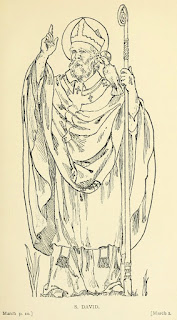
The miracle we have described has been perpetuated by artists since the Middle Ages to the present day in painting, statuary and stained glass St. David being always represented in a preaching attitude, standing on a little hillock, with the symbolic dove resting on his shoulder.
The acts of those two Synods were confirmed by the Holy See, and became, so to speak, the rule and standard of the British Churches.
Very soon after the introduction of Christianity into Wales, Caerleon, an important station of the Romans (called in the period’ of their occupation “Isca Silurum”) became the seat of a bishopric, and was, as we have already noted, the capital city of Monmouth. At the close of the Council of Brefi referred to, St. Dubritius, who had resigned his See to St. David, suggested that the Primatial Chair would be changed to Menevia. His proposal was unanimously approved of by the suffragan bishops present; hence, St. David had not to sever his connection with his beloved monastery, and there filled the dual position of Abbot and Bishop for many years. Of this apostolic Saint, Giraldus Cambrenses tells us: ” he spoke with marvellous force and energy,” and adds that “his example was more powerful than his eloquence.” Such was his fame among the ecclesiastics of his time that he was styled ”The head of the whole British Nation and the honour of his fatherland.”
St. David appears not to have limited the circuit of his episcopal activities to Wales, since we find his name associated with the restoration and spiritual revival of monasteries in the South of England such as Repton, Crawland, Bath, Wells, Raglan and Glastonbury. The last named was for centuries one of the most famous monasteries in the Western Church. It is said by many authorities that the Abbey was the site of the first Christian church built in Britain and tradition assigns its founding to St. Joseph of Arimathea, who came thither with twelve companions by the direction of St. Philip, the Apostle, when the latter preached the Gospel in Gaul shortly after the Ascension of Our Blessed Lord. This holy tradition of Joseph of Arimathea’s connection with Glastonbury seems never to have been doubted, and historians in different chronicles refer to the place as ”the first ground of God “, ”the first ground of the Saints of England ” and ”the rise and foundation of all religion in England”. About the year 530 St. David, accompanied by seven of his suffragan Bishops, visited Glastonbury, and expended large sums of money in adding- to the church. On this occasion the Archbishop of Menevia founded a votive chapel, beside the Abbey, in honour of the Mother of God. Previously he had intended to restore the Lady Chapel, which tradition asserted was raised in the days of St. Joseph of Arimathea, but was admonished in a dream that the whole church of the Abbey had been originally consecrated under the invocation of the Queen of Heaven and to erect his special chapel separate and apart. Therefore it was that St. David’s little shrine was built, in the precincts of the monastery. This, it is recorded, was of wood, sheeted inside and outside with lead, the interior being adorned with costly decorations and ornaments. It was on the altar of this chapel that the altar-stone of sapphire, brought from Jerusalem, was deposited as an offering to Our Blessed Lady, to whom St. David was especially devoted through his whole life.
Here it may be remarked that St. David was uncle of the renowned King Arthur, who in his time (A.D. 543) having been mortally wounded at the Battle of Camlan, was carried to this Abbey, that he might receive the last consolation of religion at the hands of the good monks, and be interred amongst such a number of saints as had reposed there from the beginning of Christianity. Accordingly on his death King Arthur, after “life’s fitful fever,” was laid to rest in Glastonbury Abbey.
Although St. David’s increasing years now weighed heavily upon him, he still continued almost to the end ever watchful of his flock and made frequent visitations over the vast districts entrusted to his pastoral care. As chief Bishop of Wales (Primate, as we would say now) his episcopal jurisdiction extended over the whole Principality. Nevertheless, he followed the same humble and penitential way of life which he had observed within the walls of his monastery. Perfectly detached from earthly things, he devoted the whole of his revenues to works of charity and the service of the Church. At the same time he gave himself up with unremitting assiduity to the instruction of his people, whom he earnestly strove to preserve from the inroads of schism and heresy. Almighty God blessed his efforts with great success, and his teachings and miracles were the means of gathering innumerable souls to the fold of Christ. Having founded many monasteries and been the spiritual father of many saints – both British and Irish – he finally withdrew to Menevia in order to prepare for his approaching end – revealed to him by a Messenger of God.
During the last days of his life St. David sent messengers across Ireland to summon his beloved friend, St. Aidan of Ferns, to come and visit him ere he died. It was in the arms of the latter that he breathed his last sigh. Previous to their parting on earth St. David gave to St. Aidan the staff of his monastery, his sacred bell and Book of Gospels – the most valued of his personal belongings. The bequeathing of those symbols of the abbatial office was tantamount to appointing St. Aidan his successor – according to the custom of the time. Hence, we learn that for some years after St. David’s death the saintly bishop of Ferns ruled the monastery and See of Menevia conjointly with his Irish diocese. The death of the Patron Saint of Wales, according to the “Annales Cambriae”, is said to have taken place on March 1st, A.D. 601. Other authorities state that it occurred at a much earlier date (544). Although the former date implied an almost incredible length of days – it is now more generally accepted by historians.
St. David was interred in the Church of St. Andrew, Menevia. After the Saint’s death this monastic church came to be called St. David’s – as was also the whole town and district around – which designation is continued to the present day. In fact the whole Wrlsh nation is frequently styled “Dewiland”. During the reign of the Anglo-Saxon King, Edgar, in the year 962, the relics of St. David were translated with great solemnity to Glastonbury Abbey. He was canonised during the Pontificate of Pope Celestine II (1120), being the only servant of God, belonging to Wales, raised to the Altars of the Church.
As we stated in the earlier part of this biographical essay, St. David is commemorated in many of our national martyrologies and venerated in Ireland, chiefly, as we have noted, in the south-eastern part of the Province of Leinster. In the present County of Kildare he is honoured as the patron of the county town – Naas – where a Welsh colony settled in the twelfth century and introduced the cult of their national Apostle. Again, in Southern Ossory, St. David is venerated. Here, likewise, a colony of Welsh immigrants settled and gave their name to a range of hills in the barony of Iverk – known as the “Welsh Mountains”. From this locality down to the more southward barony of Ida, bounded by the River Barrow, the Christian name “David” was very common some years ago, among the families living in the district.
However, in the County Wexford, more than elsewhere, we find memories of St. David preserved in the traditions of the people, while the Saint is local Patron of many parishes. The reason of this more special veneration is not far to seek. The sea-board portion of the southern Kingdom of Hy-Kinsellagh (now County Wexford) had been evangelised by a company of Welsh missionaries (all brothers) previous to the coming of St. Patrick to Ireland. These pioneers of the Gospel, in this remote par of our country, belonged to an earlier generation of St. David’s maternal kindred. One of them founded a little monastery close to the Tower of Hook. Hither, it is related, Prince Brecon, the grandfather of our Saint, came at the close of his days to prepare for Heaven and died at an advanced age in the abode of his saintly son – A.D. 450.
Some years ago, at Bally-na-Slaney, in the parish of Oylegate, St. David’s Holy Well was reopened, and since has become a famous pilgrimage place. Several cures are said to have been wrought there – through the efficacy of the Saint. A generous benefactor presented a statue of the saint and had it erected in the vicinity of the sacred spring.
This sketch of the remarkable incidents in the Life of St. David, Patron of Wales, may perhaps serve to revive a deeper interest in the career of one of the most illustrious of the sages and saints of Erin’s Golden Age – who in his day was styled: “The Head of the whole British Nation – and the honour of his fatherland” – Ireland.

 OMNIUM SANCTORUM HIBERNIAE