Category: Uncategorized

  • Saint Iotharnaisc of Clane, December 22

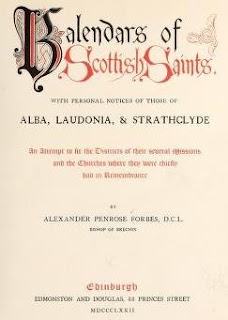
    December 22 is the feast of Saint Iotharnaisc of Clane, County Kildare, whom we met last year in a post on Saint Ultan Tua. It seems that Saint Iotharnaisc also had a Scottish link, where he appears under the Latinization of his name, Saint Ethernascus or as Saint Athernaise the Hermit or the Mute of Fife. It is interesting that he retains his reputation for maintaining the discipline of silence in both countries. Dom Michael Barrett has an entry for Saint Ethernascus in his calendar of the Scottish saints:

    22 St. Ethernascus, Confessor.

    FROM his retired life and spirit of recollection this Irish saint was known as “Ethernascus, who spoke not,” or “The Silent.” He was one of the chief patrons of Clane, in the county of Kildare. It is difficult to determine what was his precise connection with Scotland, but his office occurs with a proper prayer in the Breviary of Aberdeen. The church of Lathrisk, in Fifeshire, was dedicated to St. Ethernascus conjointly with St. John the Evangelist.

    Dom Michael Barrett, O.S.B., A Calendar of Scottish Saints (Fort Augustus, 1919), 180.

    Bishop Forbes supplies the collect for the day from the Breviary of Aberdeen:

    ETHERNASCUS, C. December 22.—

    The Breviary gives only a collect. “O God, who didst will that the soul of blessed Ethernascus, thy confessor, should penetrate to the stars of heaven, vouchsafe that, as we celebrate his venerable birthday, we may, by his intercessions, be deemed of thy mercy, in respect of his merits, meet to ascend to the joys of his blessed life, through our Lord.” There is an antiphon to the Magnificat, but no lections to the feast.

    In the Irish Kalendars, under this day, we find, in the Felire of Aengus

    Itharnaisc nad labrae.
    [Itharnaisc who spoke not.]

    In the Martyrology of Donegal, “Ultan Tua and Iotharnaisc, two saints who are (buried or principally venerated) at Claonadh, i.e. a church which is in Ui Faelain in Leinster.” This is Clane, in the county of Kildare.

    He is of Lathrisk in Fife, where we find a church dedicated to St. John the Evangelist and S. Ethernasc by David de Burnham on the v. of the Kalends of August 1243.—(Regist. Priorat. S. And. 348; 0. S. A vi p. 15.) The name Lanthrisk, or Lathrisk, contains evidently the Welsh Llan, which we find in Scotland elsewhere, as at Lumphanan, and Panmure and Panbride— the p and l being interchangeable, as we find in the Spanish where plenus becomes lleno. It is quite in accordance with probability that a Kildare saint should be found in the Church of Kenneth Macalpin. Thus we have a Cellach, at once abbot of Iona and Kildare, who died in 865.—(Grub, Eccl. Hist. i. 168.

    Alexander Penrose Forbes, D.C.L. Bishop of Brechin, Kalendars of Scottish Saints, (1872), 334.

  • The Monastic School of Clonard

    I now post part two of Archbishop Healy’s account of Saint Finnian and his monastery of Clonard. The writer is in fine form as he introduces us to the ‘Twelve Apostles of Erin‘ including the beautiful story of how Saint Finnian came to select Columba of Terryglass to be the man to minister to him at his life’s end. December 13 is the feastday of Saint Columba and last year’s post on his life can be found here. There is also an account of a later scholar of Clonard, Saint Aileran the Wise and his writings. The Archbishop finishes with a marvellous flourish against the Norman despoilers of Clonard and their Irish allies and strikes a wistful note in conclusion.

    The School of Clonard.

    St. Finnian seems to have founded his school at Clonard about the year A.D. 520, when he himself was in all probability not less than forty-five years of age. The place was previously a wilderness inhabited by wild beasts, which seem to have made their lairs in the dense shrubberies that covered the marshy banks of the Boyne and Kinnegad rivers. We are told expressly in Finnian’s Life, that a huge wild boar, which had frequented the spot where the saint resolved to remain, abandoned the place for ever. The saint threw himself on his knees in prayer, crying out in the words of the Psalmist—” This shall be my resting-place for ever; here will I dwell for I have chosen it.” So he built his hut in Erard’s Meadow, where the wild boar had previously kept his lair.

    An Irish school and monastery of the sixth century was, as we have seen, very different from the monastic establishments of modern times. Finnian began alone without, it seems, a single disciple. He built his little cell of wattles and clay, for stones are scarce at Clonard, and with such help as he could procure he also built his church quite near his cell, and in all probability of similar materials. We know, indeed, that afterwards there was a daimhlaig or large stone church at Clonard—for we are told that it was burnt down in A.D. 1045 no less than three times in one week, which is to be understood, however, of the furniture and the perishable materials of the roof. This stone church, however, was not built until the place had become famous by the life and labours of the saint. When the little church was built, he fenced around both the cell and the church with a deep trench or fosse which formed the monastic enclosure, and, heedless of the world, began to live for God alone in labour and watching, fasting and perpetual prayer. We are told that he slept on the bare ground, that he had a chain around his naked body which sank into his flesh, and that he wore the same old clothes until they fell to pieces from his back.

    His ordinary food was a little bread with herbs and salt and water. On festival days he allowed himself some fish, or whey and porridge; but flesh meat he never tasted. It was not difficult to procure these luxuries; and what time he could spare from labour he devoted to prayer and sacred study, especially to the study of the Sacred Scriptures, for deep knowledge of which he became pre-eminently remarkable.

    The fame of a life so austere and self-denying very soon spread abroad, and great numbers came to visit him. He performed many wondrous miracles; and, moreover, gave his visitors such heavenly instruction as showed that he was a man not only of great holiness but of great learning. He bad all the science of the saints, for he had been in the great monastic schools of Britain; some said he had been to Tours, others added that he had gone all the way to Rome— and these statements have come down even to our time, but unsupported by any satisfactory evidence. Then a great crowd of scholars began to gather round him; they were of all ages and came from all parts. Abbots left their own monasteries; even great bishops, some of them older than Finnian himself, left their cathedrals to profit by his bright example, and learn the lessons of divine wisdom that fell from his lips. To Clonard came all the men who were afterwards famous as “The Twelve Apostles of Erin.”

    Thither came the venerable Ciaran of Saigher, a companion of St. Patrick, to bow his hoary head in reverence to the wisdom of the younger sage; and that other Ciaran, the Son of the Carpenter, who in after years founded the famous monastic school of Clonmacnoise in the fair meadows by the Shannon’s shore. Thither, too, came Brendan of Birr, “the prophet,” as he was called, and his still more famous namesake, Brendan of Clonfert, St. Ita’s foster son, the daring navigator, who first tried to cross the Atlantic to preach the Gospel, and revealed to Europe the mysteries of the far off Western Isles. There, too, was young Columba, who learned at the feet of Finnian those lessons of wisdom and discipline that he carried with him to Iona, which in its turn became for many centuries a torch to irradiate the spiritual gloom of Picts, and Scots, and Saxons. And there was that other Columba of Tir-da- glass, and Mobhi-Clairenach of Glasnevin, and Rodan, the founder of Lorrha near Lough Derg, and Lasserian, the son of Nadfraech, and Canice of Aghaboe, and Senanus from Inniscathy, and Ninnidh the Pious from the far off shores of Lough Erne. It is said, too, that St. Enda of the Aran Islands and Sinellus of Cleenish, and many other distinguished saints spent some time at Clonard, but they are not, like those mentioned above, reckoned amongst “the Twelve Apostles of Erin.”

    We are told in the office of St. Finnian that he had no less than 3,000 scholars under his instruction, and that, too, not meaning those merely who were there at different times, but that there were so many as 3,000 together in his school. It might seem at first sight that this was a rather extravagant number, and that it would be impossible to find suitable accommodation for so many persons in this wild spot. We must remember, however, not to judge things according to modern notions. There were no school buildings necessary in our sense,—no libraries, lecture halls, or museums.

    The instruction was altogether oral. There were no books except a few manuscripts, and they were very highly prized. The instruction was generally given in the open air, and no more suitable place could be selected for the purpose than the green fields around the moat of Clonard. If the preceptor took his stand on its summit, or seated his pupils around its slopes, he could be conveniently heard, not only by hundreds, but even by thousands. They were easily accommodated, too, with food and lodging. They built their own little huts through the meadows, where several of them sometimes lived together like soldiers in a tent. They sowed their own grain; they ground their own corn with the quern, or hand-mill; they fished in the neighbouring rivers, and had room within the termon lands to graze cattle to give them milk in abundance. When supplies ran short they put wallets on their backs and went out on their turn to seek for the necessaries of life, and were never refused abundant supplies by the people. They wore little clothing, had no books to buy, and generally, but not always, received their education gratuitously.

    The routine of daily life in St. Finnian’s monastic school we can easily gather from his own Life, and from what we know of the monasteries in which he was trained. We are told in the Life that on a certain occasion he said to his beloved disciple Senachus, who succeeded him in the abbacy of Clonard: “Go and see what each of my disciples is doing at this moment.” Senachus bowed his head and went; and lo! he found them all intently engaged at their various occupations.” Some were engaged in manual labour, some were studying the sacred Scripture, and others, especially Columba of Tir-da-Glas, the son of Crimthann, he found engaged in prayer with his hands stretched out to heaven, and the birds came and alighted on his head and shoulders.” “He it is,” said Finnian,” who will offer the Holy Sacrifice for me at the hour of my death,” for his, it seems, was preeminently the spirit of holy prayer and meekness.

    The study of sacred Scripture, as this reference shows, was especially cultivated at Clonard. It is the most sublime, and in one sense the most difficult of all branches of sacred knowledge. Moreover it is a study in which prayer and meditation can do more for the student than mere human wisdom. It can be best acquired at the foot of the crucifix, and its best teacher is the Holy Spirit of God. But human wisdom, too, is necessary, and all the aids which it supplies; and Finnian made use of that, also, for his own advancement and for the instruction of his pupils. From his youth, under the guidance of St. Fortchern, he had been a diligent student of the sacred Volume; he pursued the same studies in foreign schools under many teachers; God’s Holy Word was food for his mind and a lamp to his feet through all his days, and in all his wanderings…

    It seems to have been this power of expounding the sacred Scriptures to his scholars that secured for Finnian such prominence in sacred learning beyond all his contemporaries, and filled the school of Clonard not only with scholars but with masters in Israel, who came with the rest to acquire divine wisdom at his feet. Hence he enjoys in history the glorious title of “Tutor of the Saints of Ireland.” Of the Second Order of Saints, the men who shone like the moon in the firmament of our early Irish Church, Finnian has been always recognized as the teacher and the chief. He has been compared to the rose tree to which the bees from every quarter gather in order to extract the honey. His seminary at Clonard has been described by others as a wonderful treasure-house, where illustrious men from all parts of Ireland assembled together in order to enrich themselves with the wealth of ecclesiastical discipline and Scriptural knowledge. The hymn for the Lauds of his office has a stanza:

    Trium virorum millium
    Sorte fit doctor humilis;
    Verbi his fudit fluvium
    Ut fons emanans rivulis.

    which may be imperfectly rendered in English:

    “Before three thousand scholars he,
    Their humble master, meekly stood;
    His mind a mighty stream that poured
    For all its fertilizing flood.”

    The Four Masters record his death under date of A.D. 548, but it may with more probability be fixed about A.D. 552; Colgan, however, thinks he lived until A.D. 563. The Four Masters frequently antedate by four or five years, so that the date of his death as fixed by them is really equivalent to A.D. 552 of the common era, which date is, we think, nearest the truth. In O’Clery’s calendar he is described as “St. Finnian, abbot of Clonard, son of Finlogh, son of Fintan, of the Clanna Rudhraighe (Clan Rory)”. Sir James Ware calls him Finnian, or Finan, son of Fintan -placing the grandfather in place of the father:

    “He was a philosopher and an eminent divine, who first founded the College of Clonard in Meath, near the Boyne, where there were one hundred bishops, and where with great care and labour he instructed many celebrated saints, among whom were the two Brendans, the two Columbs, viz., Columkille and Columb mac Crimthainn, Lasserian, son of Nadfraech, Canice, Mobheus, Rodanus, and many others not here enumerated. His school was in quality a holy city, full of wisdom and virtue, according to the writer of his life, and he himself obtained the name of Finnian the Wise. He died on the 12th of December, A.D. 552; or according to others A.D. 563, and was buried in his own church at Clonard.”

    We could find no trace of his tomb, because in truth there is now no trace of his church. The hand of the spoiler has devastated Clonard perhaps more completely than any other of our ancient shrines. There was, we know, a round tower there, which is said to have partially fallen in A.D. 1039. “The Cloichtheach of Clonard fell,” according to the Four Masters, in that year…

    … From the time of St. Finnian to Stephen Rochfort, the Norman Bishop of Meath, who transferred his episcopal residence from Clonard to Newtown, near Trim, we have a chronicle of the bishops and abbots who sat in the chair of St. Finnian. It is not certain that he was himself a bishop, although he is spoken of in his office as Praesul and Pontifex.

    It is much more probable, however, that he was a bishop, and his successors, though frequently styled abbots, seem to have been in episcopal orders; and all of them certainly exercised episcopal jurisdiction. The school of Clonard, too, for many centuries retained its ancient fame, and from time to time produced distinguished saints and scholars. St. Aileran the Wise, who, like many other Irish saints, died of the fatal yellow plague that devastated the country in A.D. 664, is described as chief professor of the schools of Clonard. He was also, in Colgan’s opinion, the author of what is known as the Fourth Life of St. Patrick, as well as of Lives of St. Brigid, and St. Fechin of Fore, in Westmeath. Moreover, he composed a Litany partly in Latin and partly in Irish, which O’Curry discovered in the Yellow Book of Lecain in Trinity College. Fleming, too, has published a fragment of a Latin treatise by St. Aileran on the “Mystical Interpretation of the Ancestry of our Lord Jesus Christ” This fragment was found in the Irish monastery of St. Gall in Switzerland. It was first published by Fleming in A.D. 1667, and reprinted in the famous Benedictine edition of the Fathers in A.D. 1677. It may, perhaps, with greater readiness be referred to in Migne’s Patrology (vol. 80, page 328). We make special reference to this fragment because we have no other writings of the Clonard school remaining, either of St. Finnian himself or of his immediate successors; and secondly because of itself it furnishes ample proof of the high culture attained at that early age in this great Irish seminary. The Benedictine editors say that although the writer did not belong to their order, they publish it because Aileran “unfolded the meaning of Sacred Scripture with so much learning and ingenuity that every student of the sacred volume, and especially preachers of the Divine Word, will regard the publication as most acceptable (acceptissima).”

    This is high praise from perfectly impartial and competent judges, and in that opinion we cordially agree. We read over both fragments carefully, that mentioned above, and also a “Short Moral Explanation of the Sacred Names,” by the same author, and we have no hesitation in saying that whether we consider the style of the latinity, the learning, or the ingenuity of the writer, it is equally marvellous and equally honourable to the School of Clonard. The writer cites not only St. Jerome, St. Augustine, and the author of the “Imperfect Work,” but what is more wonderful still, he quotes Origen repeatedly, as well as Philo, the Alexandrine Jew. We cannot undertake to say that he was familiar with these two authors in the original Greek, but even a knowledge of the Latin versions in that rude age is highly honourable to our Irish schools. This fragment shows, too, that a century alter the death of the holy founder scriptural studies of the most profound character were still cultivated with eagerness and success in the great school of Clonard. But evil days came upon this sanctuary of the holy and the learned, especially after the advent of the Danes.

    It was plundered and partially destroyed some twelve times in all. But the Danes had half that work of sacrilege to their own exclusive credit—they plundered it on five or six recorded occasions. It was burned no less than fourteen times, sometimes partially, but on other occasions almost wholly, as for instance in A.D. 1045, “when the town of Clonard, together with its churches, was wholly consumed, being thrice set on fire within one week.” On another occasion, in A.D. 1136, the men of Breifney, led even then by O’Rorke of the One-Eye, the husband of the faithless Dervorgilla, “plundered and sacked Clonard, and behaved in so shameless a manner as to strip O’Daly, then chief poet of Ireland. Amongst other outrages they sacrilegiously took from the vestry of this abbey a sword which had belonged to St. Finnian the Founder.”(Four Masters.)

    … His rival, Dermod McMurrough, who was not outdone in villainy by any other Irishman of the time, plundered and burned Clonard in A.D. 1170, and was aided in his foul work by Earl Strongbow and his friends from England; but next year he paid the penalty of his crimes, dying of a loathsome disease, without the sacraments, accursed of God and man, for the Four Masters tell us that “he became putrid whilst living, by the miracle of God, and Columkille, and Finnian, and the other saints of Ireland, whose churches he had profaned and burned” – truly a fitting end for such a life as his. In A.D. 1175 Walter de Lacy founded the monastery of Clonard for the Canons Regular of St. Augustine, but in A.D. 1206, as we observed above, Simon de Rochford transferred the See of Meath from Clonard to Trim and so the ancient glory of the place faded away until now it is merely a name known only to scholars, without even a broken arch or ruined wall to speak with saddening eloquence of its glorious past.

    Insula Sanctorum et Doctorum or Ireland’s Ancient Schools and Scholars by the Most Rev. John Healy (6th edition, Dublin, 1912), 199-208.

    Content Copyright © Omnium Sanctorum Hiberniae 2012-2015. All rights reserved.
  • Saint Finnian of Clonard, December 12

    December 12 is the feast day of Saint Finnian of Clonard. Last year I posted a paper on his life from the Irish Ecclesiastical Record which can be read here. Below is another and very different account of Saint Finnian, taken from Archbishop John Healy’s work on the monastic schools of Ireland. The writer divides his narrative into two parts, the first dealing with the early life of the saint and his monastic training in Wales. It ends at the point where he is led to Clonard, the second then deals with the school and its subsequent history. For writers of Archbishop Healy’s generation Saint Finnian of Clonard was viewed as an Irish-born saint with a distinct identity. Modern scholars, however, wonder if he is actually a Briton whose cult was established in various places and that Finnian of Clonard, Finnian of Moville and Finbarr of Cork may all be the same person. Archbishop Healy provides a traditional account of our saint’s life and will introduce us to many other saints along the way. Below is part one, I will post part two tomorrow to complete the story.

    St. Finnian of Clonard.

    St. Finnian of Clonard is set down first in the Catalogue of the Saints of the Second Order; and his School of Clonard was certainly the most celebrated, if not the earliest, of the great schools of the sixth century. It was the nursery of so many learned and holy men that its founder came to be known as the “Tutor of the Saints of Erin.” Twelve of his most distinguished disciples were called the “Twelve Apostles of Erin,” because, after St. Patrick, they were recognised as the Fathers and Founders of the Irish Church; and the monasteries and schools which they established became, in their turn, the greatest centres of piety and learning throughout the entire island.

    Clonard—in Irish Cluain Eraird, and sometimes Cluain Iraird, that is, Erard’s meadow— was very favourably situated for a great national college. Although within the territory of Meath, it was situated on the Boyne close to the Esker Riada, which formed the ancient and famous boundary between the northern and southern half of Ireland. It was thus a kind of neutral territory, open to the North and South alike; and both North and South availed themselves of its advantages.

    Its founder, St. Finnian, was by birth a Leinster man. His father, Finloch, was descended from Ailill Telduib, of the Clanna Rory, hence his own patronymic, Ui Telduib. His mother’s name, according to all the authorities, was Talech, and she belonged to the family of a Leinster chieftain. He was born at Myshall, in the Barony of Forth, county Carlow. The date of his birth cannot be ascertained; but if we are to accept the statements in his life, it cannot have been later than A.D. 470. When the child was born, his parents sent him to be baptized by the holy Bishop Fortchern, in the church of Roscur—Roscurensem ecclesiam. This Bishop Fortchern was son of Fedlimidh, and grandson of King Laeghaire. He was converted by Loman of Trim, shortly after the year A.D. 432, the date of St. Patrick’s arrival, and being a skilful artisan in metal work, he made chalices and patens for the use of the new churches founded by St. Patrick. At the earnest entreaty of St. Loman, he consented to become Bishop of Trim after that saint’s death, but he retained, it is said, that onerous office only for three days. After his resignation, he retired into Leinster, where many churches are said to have been founded by him in a district up to that time only partially evangelized. The Church of Killoughternan, parish of Slyguff, in the ancient Ui Drona, still bears his name; it is a corruption of Cill Fortchern. The town of Tullow, in the county Carlow, was anciently called Tullach Fortchern, and it is said that the saint had a school there, in which young Finnian studied tor many years.

    When the women were carrying the child to be baptized by Fortchern at Roscur, it chanced that the holy priest Abban met them, and inquired whither they were going. They replied that they were carrying the child to be baptized by Fortchern. Thereupon Abban, moved by a divine inspiration, took the child and baptized him, giving him the name of Finluch, or Finloch, because he was baptized at the place where two streams meeting formed a pool of clean water. But the name Finnian was afterwards given to him as a more appropriate one—retaining the first, but omitting the second part of the compound. A cross afterwards marked the spot where the saint was baptized, and it was called the Cross of Finnian.

    When the child grew up he was placed under the care of St. Fortchern, most probably at Tullow, and remained, it is said, under his care until he reached the age of thirty years. We thus see that St. Finnian was brought under British influence from his boyhood, for the mother of Fortchern was of British birth, and it was probably at the suggestion of his holy teacher that Finnian resolved to visit the saints of Wales, and perfect his education in the schools of that country. On his way, however, he stopped to visit a holy elder named Coemhan, who dwelt in the Island of Dairinis, in Wexford Harbour, and there he remained some time in the further pursuit of knowledge. Then taking voyage with some merchants, who were going to Britain, he set sail from Wexford, and arrived at Kilmuine, since called St. David’s, in South Wales.

    Here he had the good fortune to meet three celebrated saints, who seem to have exercised great influence over the mind of Finnian, and through him over the destinies of the Irish Church—St. David, St. Gildas, and St. Cathmael, or Cadoc, or Docus. As Finnian was trained, at least to some extent, by these holy men, and as they are all more or less intimately connected in many other respects also with the early monastic Church of Ireland, it is well to know something about their history.

    Dubricius (a.d. 421-522), Bishop of Landaff, who was a contemporary of St. Patrick, and was consecrated by St. Germanus of Auxerre, perhaps at the time of his second visit to Wales, a.d. 449, or some years later, is exhibited in the doubtful chronicles of this early period as the first Archbishop of South Wales, and the great father of monasticism in Wales. His monastery at Llancarvan was the nursery of those great saints, whose names are still familiar both in Ireland and in Wales. Dubricius himself was, it is said, a grandson of that Brychan, who has given his name to Brecknockshire, and who was by birth an Irish chieftain, though settled in Wales. It is certain that the Irish monks, like Finnian, found a warm welcome in Llancarvan, both during the life of Dubricius, as well as after his death; and in that celebrated college were trained many Irish saints, who afterwards carried its learning and its discipline to their native land.

    St. David, Archbishop of Menevia, is the most striking figure amongst the Cambro-British saints, and his memory is still venerated by all true Welshmen of every religious sect. Ricemarch, his successor in the See of St. David’s towards the close of the tenth century, has written his life, which was afterwards dressed up in more elegant language by the celebrated Gerald Barry. St. David was born about the middle of the fifth century, and lived, it seems, till the middle of the sixth. His father was Sanctus or Xantus, Prince of Ceretica, and his mother was Nonna, a religious, forcibly carried off by this rude prince, who was captivated by her beauty. The child was born at Old Menevia, near the place where he afterwards founded his cathedral city at the extremity of that bare and bold promontory which overlooks St. George’s Channel. St. Ailbe of Emly just then happened to arrive by divine guidance at Menevia, and he baptized the child. The young David was at first a pupil of St. Iltutus, and afterwards of Paulinus, who were both, it seems, disciples of St. Germanus of Auxerre.

    In course of time David founded a great college of his own at a place called by Gerald Barry, ‘Vallis Rosina,’ which may mean either the ‘Marshy Valley,’ or the ‘Valley of Roses,’ for rhos is a swamp, and rhosyn means a rose. It was, we are told, to this seminary that Finnian came on his first arrival in Wales. St. David afterwards became so celebrated that he succeeded Dubricius as Archbishop of Caerleon-upon-Usk; but with the permission of King Arthur, who was his near relative, he changed the seat of his Episcopal Chair from the City of the Legions to Menevia, which was at once his birthplace and monastic home, during what he doubtless regarded as the happiest and holiest years of his life.

    It is said that Finnian also met Cathmael, as well as David and Gildas, at the city of Killmuine in Britain. Killmuine of the Irish Lives is the exact equivalent of the Latin Ecclesia Menevensis, called in Welsh Mynyw or Miniu. The old monastic buildings still surround the cathedral, but are now much dilapidated. Gerald Barry, himself a Welshman, describes in his odd incisive way, ” this remote angle overlooking the Irish Sea, as a stony, barren, and unfruitful soil, neither clothed with woods, nor diversified by streams, nor adorned with meadows, but exposed to perpetual storms and whirlwinds—the storms of nature and the storms of war.”

    Cathmael is commonly identified with Cadoc or Docus, one of the most celebrated fathers of the Welsh Church. It is said there were two saints who bore that name; if so, Finnian’s tutor must have been Cadoc the Elder. His mother was Gladys, the daughter or grand-daughter of the Irish chieftain, Brychan, who gave his name to Brecknock—so Cadoc “who has made a deep impression on the Celtic race,” was not only of Irish blood, but was baptized, and trained up from his youth for many years, by an Irish anchorite named Meuthi, whose cell was in the neighbourhood of his father’s castle. Afterwards he went to Givent in Monmouthshire, where he studied under another Irish master, St. Tathai. There he made great progress in learning and holiness—especially in the knowledge of the Sacred Scriptures, so that he was called Cadoc or Cattwy, the Wise. He was under Dubricius the founder and chief professor of the celebrated College of Llancarvan, near Cowbridge in Glamorgan. This became the most famous centre both of secular and sacred learning in Wales. A great number of young Irishmen crowded its lecture rooms, who afterwards became very famous in their own country, so that if Cadoc received much from Irishmen himself, he gave them even more in return. There can be no doubt that, as we shall see further on, be visited Ireland afterwards, and spent some time with those who were once his own pupils in Wales.

    The influence exercised over the Celtic Church in Ireland by David, Gildas, and Cadoc may be estimated from the fact already referred to, that they are said to have given a Mass to the Second Order of the Irish Saints. This would seem to imply that these saints, most of whom spent some time in Wales, adopted the liturgy of the Welsh Church, which may have in some respects differed from the older liturgy established by St. Patrick. Finnian was the great means of diffusing the learning and practices of Llancarvan in Ireland. He taught at Clonard, what he had himself learned or seen at St. David’s and at Llancarvan ; and thus became the means of diffusing the monasticism of the Welsh Church through most of Erin, especially in its southern parts.

    The Life of Finnian given in the Salamanca MS. Records many miracles which he performed in Wales. By his prayers and his great faith in God he dried a lake to get a site for a monastery; he caused mountains to overwhelm the invading Saxons; he drove away the serpents, wasps, and birds that afflicted the religious men in the island called Echin, whom he visited in order to derive consolation from their life and doctrine. It is evident, however, from the narrative that he spent most of the thirty years of his sojourn in Britain under the spiritual guidance of Cathmael, and most probably in his great school at Llancarvan. The years being expressed in the manuscript Lives of the Saints by Roman numerals, are always liable to error—the addition of an X will make thirty out of twenty, and a double XX added by the fault of the copyist would make thirty out of ten. It is, however, stated expressly that Finnian having completed the XXXth year of his pilgrimage returned to his native country with Biteus and Genocus and some other religious men of the Britains, who followed the saint on account of the great holiness of his life and conservation. By God’s help they landed at Magh Itha in the south of Wexford, at a port called Dubglais, whence they proceeded to visit his ancient preceptor, the holy Coemhan, who still dwelt in Dairinis. There was a Dairinis or Oak island in the Blackwater, which was known as Dairinis Molana; but the island here referred to is “Dairinis of Coemhan,” as it is called in the Four Masters, A.D. 820. It was in Wexford Harbour; and, as we have already seen, Finnian when going to Wales spent some time with Coemhan in that island, so it is only natural that he should return to the scenes of his early years. From Dairinis Finnian went to visit Muiredach Melbrugh, King of Hy Kinselagh at that time, and sought permission to build a church in his territory. The king received Finnian with all honour and reverence, and sent him effective aid in building a church at a place called Achadh Abhail, now Aghold, a parish church in the barony of Shillelagh, county of Wicklow.

    Leaving some of his monks to continue his work at Aghold, he went himself into the neighbouring district of Hy Bairrche, and spent seven years teaching and preaching at a place called Maonaigh in the saint’s life. It takes its name from the Hy Maonaigh, an influential tribe who possessed that territory, some of whom having migrated to the North settled near the river Erne and gave their name to the Co. Monaghan. They are now known as Mooneys.

    As we are told that Finnian, during his residence in this neighbourhood, sometimes preached before St. Brigid and her nuns, his sojourn there must be fixed before the death of that saint, A.D. 523 or 525. In his great love for holy poverty the saint refused to accept even from St. Brigid a gold ring, which she presented to him as a token of her esteem. Going still further north he founded another church at a place called Esker Brenain, which in the Irish fashion he fenced in with a circular mound and trench, dug with his own hands. One day he found beside his church a poor boy who had been carried off as a captive by some robbers, and was abandoned by them near the church. Finnian took charge of the poor child, and finding him a youth of good parts, diligently instructed him both in virtue and learning, gave him the tonsure, and made him it seems, his assistant, either there or at Clonard. After the departure of Finnian he became his master’s successor in Esker Brenain.

    Then an angel appeared to Finnian and told him that he was to seek elsewhere the place of his resurrection. Finnian promptly obeyed, and rising up, under the guidance of the angel, he came to the place called Cluain Eraird.

    Insula Sanctorum et Doctorum or Ireland’s Ancient Schools and Scholars by the Most Rev. John Healy (6th edition, Dublin, 1912), 193-199.

    Content Copyright © Omnium Sanctorum Hiberniae 2012-2015. All rights reserved.