Category: Uncategorized

  • Saint Dymphna: 'Lode-star of the Lost Ones'

    Saint Dympna – or Davnet of Ireland may belong to legend or
    mythology; Saint Dympna of Gheel to a holy tradition: Saint-Dympna-of-Today belongs to us all. She is part, as it were, of
    our national innocence…

    …While the secret of
    Creation remains hidden from the wise and the prudent, it does seem to
    be revealed from time to time through this little saint whose century
    and nationality is quite obscure.

    Rejected from the
    acta of saints, she is paradoxically become the lode-star of the lost
    ones and has quietly but firmly established herself as their advocate.

    “Saint Dympna!” They cried long ago – AND THEY STILL DO – 

    “Saint Dympna – pray for us”. 

    Angela Verne, Fugitive Saint (Farnworth, 1961), 201-202.

    Content Copyright © Omnium Sanctorum Hiberniae 2012-2022. All rights reserved.

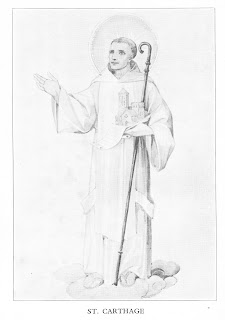
  • The Miracles and Monastic Life of Saint Carthage

    The Story of St Carthage (1937)

    May 14 is the feast of Saint Carthage (Mochuda) of Lismore, subject of a previous post here. Canon O’Hanlon’s account of this saint includes many of the miracles attributed to Saint Carthage by his hagiographers, which also give a glimpse into the saint’s life as a monastic. In the selection below the text is O’Hanlon’s, the headings are mine. We begin with a prophecy of the saint’s future greatness delivered by other important Irish holy men, a common trope in Lives of the saints:

    Saints Comgall and Brendan Prophesy the Future Greatness of Saint Carthage and of Lismore:

    The approaching birth of our saint was announced to St. Comgall, by an Angel, in the following words : “O holy old man, a child shall be born in the western part of Ireland. He must receive the name of Carthage, at the baptismal font, because he shall be loved by God and man, both in Heaven and upon earth. After a while, he shall come to you, on his way to Rome, and it is the Lord’s mandate, that you forsake him not, but that he remain with you an entire year.” St. Brendan of Clonfert had an angelic warning, also, regarding the birth of our saint. Brendan heard these words: “A wonder-working brother must shortly come to thee, who shall aid thy people here and hereafter. Men shall thus divide the region of Kiarraigh. His name shall be Carthage amongst you, and many shall rejoice in his commemoration; for, he will collect a great congregation of many people to the Lord, on the day of judgment. His first city shall be called Rathen, situated in Meath territory, in the midst of Ireland, among the people called Feara-Keel and this city shall be renowned. But, the second city shall be greater and more illustrious; for, Carthage shall possess a great principality called Lismore.”

    The Prophecy of Saint Comgall Fulfilled:

    He then undertook a pilgrimage alone, towards the northern part of Ireland. In the meantime, an Angel had appeared to his cotemporary, St. Comgall of Bangor, and told him, that a young and holy Priest should come to him, wishing to cross the sea, for Christ’s sake; that this was the person, regarding whom Comgall had formerly prophesied, before his birth; and that, according to God’s mandate, he should detain the pilgrim with him, for the remainder of the year. St. Comgall wished to know, how Carthage might be identified. Then the Angel said: “He shall be that person, who retires to the hospice, from the church, and with his face towards it.” Now, it was a custom of Moccuda, as it appears, never to turn his back towards any church, if he could possibly avoid it. That vision, and the token whereby our saint might be recognised, were communicated by the Abbot Comgall to his disciples. Afterwards, St. Carthage came to Bangor, and the Abbot discovered him, by practising the usual habit, while honouring the church as the house of God. Comgall was greatly rejoiced at our saint’s arrival, and communicated to him the Angel’s words, as also the Lord’s mandate. In obedience thereto, Carthage remained in Bangor, to the end of that year. On its expiration, by advice of St. Comgall, Carthage returned to his native province. There, he erected many buildings, to the honour of God. There, likewise, he wrought many miracles, and many disciples flocked to him, from all parts. A large extent of country was subject to his spiritual jurisdiction.

    Saint Hyaran Prophecies the Future Path of Saint Carthage

    Leaving his religious establishments, in Kerry, to the care of faithful guardians and religious men, St. Carthage afterwards went with a few companions, to the southern part of Munster. He visited the son of Fintan, St. Hyaran, a Bishop, who had founded a monastery at Roffigillain. From this saint, the pilgrim enquired, where his largest church should be built, in these parts; as the Angel of the Lord had declared to St. Comgall, that it must be founded in the southern part of Ireland. Accordingly, St. Hyaran, who was gifted with the spirit of prophecy, answered: “My dear fellow-servant in Christ, you shall first go to Niall’s posterity, and there shall you build a renowned house to our Lord. There shalt thou remain for forty years, and afterwards thou shalt be expelled therefrom, and return to Munster. Then only shalt thou build thy larger church.” St. Carthage said to him: “Holy father, I shall always regard thee as my patron.” But Hyaran said: ” My brother, it must not be so, but I offer myself and my monks to you for ever.” He declared, likewise, that Furudran, his disciple, should succeed him in his episcopal seat. Accordingly, such was the case, Furudran occupying the See for twenty years.

    Saint Columba Leaves the Building of Raithin to Saint Carthage

    While Carthage was on his journey, two monks met him on the way, and asked him whither he was going. He replied, to St. Colman-Elo. These brethren besought him to receive them as disciples, for they declared, that God’s grace appeared to shine in his countenance. He complied with their request, and, on coming to St.Colman, then declared his desire of remaining with him. However, Colman said: “It must not be so; but, you shall go to a certain place, near to me, and called Rathen, which has been promised you by the Lord. There shalt thou remain, and many monks shall serve the Lord under thee; while the place itself, from thee, shall assume for its name, Carthach Raithin. It is said, St. Columkille had formerly proposed the building of a cell, in this place. But, finding that the Almighty had destined such work for our saint, he left three bundles of twigs for Carthage, who constructed his home with these materials.

    Saint Carthage has to temper the strictness of his Rule:

    For a long time, St. Mochuda would not receive cows, oxen, or horses, to cultivate his land. This work was performed, by his monks with hoes, and they carried all burdens on their shoulders. But, St. Fintan, a relative of St. Carthage, on his return from Rome, visited him, and that guest said: “Why, O Carthage, dost thou impose upon rational beings the work of irrational animals? Your men are made like to beasts of burden, and I shall not eat in this place, unless you liberate your monks, who are the servants of Christ, from such degrading occupation.” Afterwards, through regard to St. Fintan, Carthage allowed oxen and horses to his monks, engaged in prosecuting their labours. St. Lanchean, or Lachean, Abbot, taking compassion on St. Carthage and his monks, set out towards Rathin, bringing thirty cows and a bull, with two herdsmen, and some vessels. When near the place, Lanchean concealed what he had brought; and, going into the monastery, he asked for milk, pretending to be sick. This request the servant conveyed to Mochuda. The saint ordered a vessel to be filled with water. Then, bestowing a blessing, it appeared to be changed into new milk. In this state, it was brought to St. Lanchean. Knowing what had occurred, he changed the contents of the vessel into water once more, saying: “I asked for milk, and not for water.” St. Lanchean then said before all: “Our father Carthage is a good monk, but, his successors shall not create milk out of water.” He then addressed the guest-master, “Tell St. Mochuda, that I shall not eat in this place, unless he receive gifts I have brought, to his brethren.” Carthage promised to accept them, and he said: “I was unwilling to receive herds from any person, in this place, but, through respect and reverence for thee, I have accepted them.” Lanchean then said: “Henceforth, abundance of temporal things shall be with you, and a multitude of religious men must inhabit thy city, in which thou shalt depart to Christ; since from this place, shalt thou be driven.” A mutual friendship, between these saints, was thenceforward established.

    The Obedient Colmans

    Another day, while our saint’s monks were abroad and near a river, one of them who was in authority told a monk, named Colman, to enter the water, on some emergency. At once, twelve monks bearing a similar name rushed clothed into the water, not stopping to enquire about the particular one, who had been designated. This gave much edification to the other brethren, because at the sound of a superior’s voice, they showed perfect examples of obedience.

    Saint Carthage Reconciles The Monk with The Miller

    Another day, about the ninth hour, Carthage said to his brethren: “We shall not eat today, until each one of you makes his confession to me; for one among you bears hatred towards another.” Having confessed Colman, son of Iona, one of these monks said : “Father, I love not our miller, nay, I have hated him. For, when I go to the mill, he will not remove loads with me, from the horses, nor fill measures of meal. Yea, even, he will not load the horses; he does injury to me, in every way, and he is always disagreeable and insulting. The Lord knoweth, but I do not, why he acts in this way; and even now have I thought, when I came to him again, and that he should do in like manner, I would strike him to the earth.” St. Mochuda answered: “Brother, hear what the prophet saith, ‘Turn away from evil and do good;’ therefore, according to my advice, be kind towards him; and he shall be moved by thy goodness. Then, youshall be friends, as long as you desire it.” The monk followed his superior’s advice, and for three days, he endeavoured to please the miller. But, the latter remained, in his former surly mood, and the brother’s hatred still continued. On the third day, St. Mochuda heard the confession of the monk, who said: “This is my confession, I do not love the miller.” Our saint then said, that on the same night, his heart should be changed, and that he should not take refreshment, until he would go to his adversary and eat with him. Our saint also declared, that during the refection, a friendship should arise between them, and this too must prove perpetual. That monk was filled with the spirit of God; and, as all things had happened, according to the prediction of Carthage, his brethren admired a Divine inspiration, which influenced their holy senior.

    The Heavenly Harvesters

    During the time of harvest, his steward said to Carthage: “Father, we cannot procure reapers enough, although the corn is over ripe.” Mochuda replied: “Go, my dear, in peace, the Lord will give you good reapers.” Accordingly, the Angels of God appeared, and reaped the greater part of the corn, collecting it into one heap. The monks, on seeing the progress of this work, gave thanks to God, and admired the sanctity of their venerable superior.


    Content Copyright © Omnium Sanctorum Hiberniae 2012-2022. All rights reserved.
  • The Saints and Animals

    The theme of ‘saints and beasts’ is a common one in hagiography where the interaction between holy men and women and the animal creation form some of the best-known and well-loved episodes in the Lives of the saints. Although stories of Irish saints and animals form a staple of anthologies of ‘Celtic Christianity’, this tradition is not exclusive to Ireland. Its origins are found in eastern Christianity among the Desert Fathers where a raven brings food to Saint Anthony and Saint Paul of Thebes and where the Great Martyrs such as Saint George and Saint Margaret of Antioch battle dragons and other fierce beasts. The tradition translated very readily to western Europe and below is an extract from a paper on ‘The Saints and Animals’ published in 1909 in the Paulist periodical The Catholic World by Irish writer Katharine Tynan (1859-1931). In her essay she combines some of the most famous Irish stories, such as that of Saint Kevin and the blackbird, with lesser-known stories of Saint Adamnan and Saint Beanus:

    A very distinguished Irishwoman, now dead, said to me many years ago that the old Irish saints were always preaching by their example the love of animals, and that fact proved to her mind that the preaching was no less needed in their day than in ours. But I am inclined to believe that the Irish saints, like the saints of other countries, loved animals just because they were the elect souls of the world. In those days gentleness betook itself to hermitages and cloisters, leaving the rough and the violent to carry on the world. In their hermitages these simple and saintly souls made companions of the animals, and came to love them, simplicity leaning to simplicity. Indeed one imagines that in our own days there may be many such instances in monastic life of friendship between men and animals as are recorded in the Acta Sanctorum. One who knows anything of monasteries will know how the cloistered monk keeps a heart like a child…
     
    …The lives of the saints contain the most delicious innocencies of the friendship and affection between them and the animals. Every one knows St. Francis of Assisi and his little brothers and sisters. Not so many know St. Jerome and his lion, St. Anthony the hermit and his hog, St. Benedict and his raven, St. Macarius and his hyena, St. Kieran and his badger, St. Rose of Lima and her gnats. Indeed the Acta Sanctorum contain records of friendship between the saints and the most unlikely creatures, even to snakes and vipers.
    In the Irish hagiology we find our father, St. Patrick, carrying a fawn in his breast after he had saved the little creature and its mother from death.


    While St. Kevin prayed in his cell that looks upon the dark waters of Glendalough, he stretched his hand through the window-space, and a blackbird immediately laid an egg in his hand and sat upon it. The saint forbore to disturb the sitting mother till the little bird was hatched, keeping his hand so stretched forth till that was accomplished.

    Another Irish saint, St. Kieran of Upper Ossory, worked his first miracle as a child when he saw a hawk swoop on and carry off a little bird. St. Kieran at this time did not know the true God, being the child of pagans, but he was moved to cry out to Him, and the hawk came back and laid the dead bird at his feet. Then Kieran said: “Arise and be made whole;” and so it was done, and the bird lived and gave praise to God.

     
    The life of St. Kieran, in the Gaelic, says with delicious naivete :
     
    “When first Ciaran came to that place (i.e. the wood where he built his monastery) he sat down in the shade of a tree. A fierce wild hog sprang up at the other side of the tree and as it eyed Ciaran it fled, but returned again as a gentle servant to Ciaran. That hog was the first disciple and first monk Ciaran had in that place. It used to go to the wood to cut rods for thatch, and bring them between its teeth to assist (the building of) the cell. At the time, then, there was no one at all along with Ciaran, for he came alone from his disciples to that hermitage. There came after that to Ciaran irrational brutes from every part of the wilds in which they were located, such as the fox, the badger, the wolf, and the doe, and they were submissive to Ciaran; and they humbled themselves to his teaching as monks, and used do all he bade them.


    “On a day that the fox came, which was very ravenous, crafty, and malicious, to Ciaran’s brogues, he stole them, and, shunning the community, went direct to his own den, and therein coveted to eat the brogues. When this was manifested to Ciaran he despatched another monk of his family, to wit, the badger, to head the fox and bring him to the same spot. The badger came to the fox’s den and found him eating the shoes (or brogues), for he had eaten the ears and thongs off; and the badger coerced him to come with him to the monastery. They came about eventide to Ciaran, and the brogues with them. Ciaran said to the fox ‘ O brother, why hast thou done that thievery which was not becoming a monk to do? And you had no occasion to do that; for we have water that is non-noxious in common, and food in like manner, and if thy nature constrained that thou shouldst prefer to use flesh, God would make it of the bark of the trees round thee.’ Then the fox asked Ciaran for remission of his sins, and to lay upon him the obligations of the Penance Sentence; and it was so done, and the fox did not eat food without leave from Ciaran, and thenceforward he was righteous like the others.”

    Here is a story of a less well-known Irish saint, St. Gobnet the little patroness of Ballyvourney, after whom so many County Cork girls are called, and which is Englished “Abby.” She was the daughter of a sea-king, who was a shrine robber. She had no sisters, and used to keep to the ship with her father and his men. Once she was ashore in a wood and God sent his angel to her to tell her to fly from her father and give her life to Him. She was willing to do that, but she knew no place of security. The angel came again, and told her to go on and give no rest to her soles until she would find nine white deer asleep. She went on and she came to a place and found three. She fondled them a while and went on to Kilgobnet, where she found six. Here she stayed a long time until they were all good friends. Then she left her heart with them and went on to Ballyvourney. There, as God willed it, she found the nine, and she made her dwelling with them, and they became her sisters, and she died in their midst and is there buried.

    We read of St. Bridget that the ducks from the lake came at her voice and flew into her arms, and that the saint gently caressed them against her breast. And again when she was a child, and in much terror of a very fierce stepmother, she was left to tend a dish of meat that was cooking for her father and his friends. But a dog which had just become the mother of puppies came and begged to be fed; and Bridget’s heart was so compassionate that she could not refrain from feeding the dog with the meat her stepmother had given her in charge, although she anticipated nothing but a savage punishment. But when the time came to set the dish on the table, lo! and behold, the meat had increased instead of diminishing, and was of a most excellent flavor. So did God reward her charity to the hungry dog.

    Here is a delightful story of St. Adamnan, Bishop of Iona: 
     

    “A Brother, by name Molua, grandson of Brennus, came to the Saint while he was writing, and said to him: ‘Please bless this weapon in my hand.’ So he raised his holy hand a little and blessed it, making the sign of the cross with his pen, his face meanwhile being turned towards the book upon which he was writing. As the aforesaid Brother was on the point of departing with the weapon which had been blessed, the Saint inquired: What kind of a weapon have I blessed for the Brother? Diarmid, his faithful servant, replied: ”A dagger for cutting the throats of oxen and bulls.’ But the Saint said in response: ‘I trust in my God that the weapon which I blessed will injure neither man nor beast.’ And the Saint’s words proved true that very hour. For after the same Brother had left the monastery enclosure and wanted to kill an ox, he made the attempt with three strong blows and a vigorous thrust, but could not pierce its skin. And when the monks became acquainted with it, they melted the metal of the same dagger by the heat of the fire and anointed with it all the iron weapons of the monastery ; and they were thereafter unable to inflict a wound on any flesh, in consequence of the abiding power of the Saint’s blessing.”

     
    I need not refer here to the better known stories, such as the story of St. Columba and the gull and the same saint and the horse. But an extract from Giraldus Cambrensis shows how a nineteenth century thought for animals in England was anticipated by the Ulstermen of his day. 

    “In a remote district of Ulster are certain hills, on which cranes and other birds build their nests freely during the proper season. The inhabitants of that place allow not only men but even cattle and birds to be quiet and undisturbed, out of reverence for the holy Beanus, whose Church makes the spot famous. That renowned Saint, in a wonderful and strange manner, used to take care not only of birds but of their eggs.

    “In the south of Momonia, between the hill of Brendan and the open sea which washes the coast of Spain and Ireland, is a large district which is shut in on one side by a river full of fish, and on the other by a small stream. And, out of reverence for the holy Brendan and other Saints of that locality, this affords a wonderful place of refuge, not only for men and cattle, but also for wild beasts, whether these are strangers or those which inhabit the district. Consequently stags, wild boars, hares, and other wild beasts, when they perceive that they can by no means escape from the dogs pursuing them, make their way as quickly as they can from remote parts to that spot. And when they have crossed the stream, they are at once safe from all danger; for the dogs in hunting are there brought to a standstill and unable to follow any further.”

    So much for the Irish saints. But their brethren of other lands were not behind them; and it may be said that there was no creature exempt from their pity and protection….

    Katharine Tynan, The Saints and Animals, The Catholic World, Vol. LXXXVII (September, 1908), 803-816.

    Content Copyright © Omnium Sanctorum Hiberniae 2012-2020. All rights reserved.