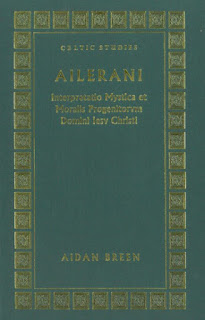
November 13 is the feast of Saint Caillín of Fenagh whom I have introduced in a previous post here. In the article below we are given a fascinating glimpse into the celebration of his feast or ‘pattern’ day at Ballyconneely in Connemara in the last decades of the nineteenth century. Pattern or ‘patron’ days, (Irish patrún) were popular expressions of devotion to a locally important holy man or woman. They usually took place at a site associated with the saint, most often a holy well, around which a set ritual or ‘station’ would be performed. Although in this case Saint Caillín was firmly linked to Fenagh, County Leitrim, the good people of Ballyconneely, County Galway clung to a tradition that he was the son of the King of Leinster and claimed him for their own. Writer Father William Ganly paints a vivid picture of the transformation of their quiet village on the pattern day as ‘tents, booths, and gaily covered marquees’ are set up and the crowds flock in, dressed in their finery for the occasion. He describes the local lore about the saint, his healing miracles and the sites traditionally associated with him in the vicinity. Although based around the feast day of a saint, pattern days had a distinctly less spiritual aspect to them too. They were occasions when rural people let their hair down and frequently involved an overindulgence in alcohol. Whilst outside the tents and booths some people were praying and performing rituals, inside others were more interested in getting drunk and dancing or fighting. This mixture of the sacred and the profane was extremely shocking to many who witnessed pattern days from outside the communities who cherished them. For the Protestant gentleman or clergyman they confirmed the worst stereotype of the Irish Catholic peasant, and for Victorian priests these occasions were something of an embarrassment which illustrated the dangers of allowing folk religion its head. Father Ganly does not spend much time here on describing the actual events of the day, but instead merely notes ‘the long rows of bottles, and casks piled one over another’, before swiftly moving on to the more congenial task of siting Saint Caillín within the ‘golden era of the history of our country’. Along the way he brings in a huge cast of characters which includes everyone from mythical races, kings and prophesying druids to Saint Colum Cille, not forgetting Queen Maedh ‘the Cleopatra of Ireland!’ :
THE HOLY PLACES OF CONNEMARA.— I
LIKE a fringe of fantastic embroidery set along the coast of Connaught, washed by the Atlantic waves which have hollowed its shores into countless creeks, bays and inlets, traversed by huge ranges of mountain, dotted with sparkling lakes and watered by almost innumerable rivers, is the district, famed in song and story as Connemara. To most people this territory bears the same relation to Ireland as Boeotia did to ancient Greece— a land of barrenness, barbarism and desolation. And yet Connemara is a much maligned country. If here nature has been, in some respects, less prodigal of her gifts than to other parts of Ireland, she has in other ways, more than compensated for her parsimony.
In the boldness and beauty of its natural scenery, in the richness of its botanical and geological treasures, Connemara stands unrivalled. But more than this, it is the very paradise of the archaeologist. Within a radius of twenty miles of the town of Clifden, the picturesque and interesting capital of Connemara, is to be met with the largest number of Pagan, early Christian, and mediaeval monuments, to be found in an equal area in the world.
About five Irish miles from Clifden, on the way to Slyne Head, is the village of Ballyconneely. Not many years ago, this place was one of the great strongholds of proselytism in the west, but the only relics of the vile system which now remain are a few white-washed rookeries occupied by degraded looking creatures, whose scared faces remind one of the inmates of pauper houses.
Beyond a fine view of the Twelve Pins which present the appearance of a huge wall raised by giant hands, here and there gapped by the artillery of invading armies, the hamlet itself is remarkable for nothing except dreariness. Solitude and desolation reign supreme. The querulous shriek of some startled snipe roused from his perch in a swamp, the whistling of the ubiquitous curlew, and the solemn roar of the ocean, never ceasing its plaintive moan, are the only sounds which break the monotony of the scene.
On one day of the year, however — the 13th of November — the place becomes a veritable bee-hive of activity. Crowds of peasantry clad in white flannels, Scotch caps and fantastic shawls, are met trudging along cheerfully in the direction of Slyne Head. They are on their way to a holy well. The morning of the 13th, finds Ballyconneely completely transformed. The streets are covered with tents, booths, and gaily covered marquees, well stored with tempting cakes and sweets in abundance for the children; nor are the grown people forgotten; for the long rows of bottles, and casks, piled one over another show that the thoughtful caterer has not forgotten to make provision for their tastes. Men and boys are shouting; half a dozen pipers are filling the air with asthmatic groans, while in the meantime a living tide of human beings is flowing from all directions.
The stranger asks in astonishment what is the cause of all this commotion, and he is told in reply that it is St Caillin’s day. On making further enquiries he finds that this saint is the patron of the district, that his holy well, much frequented, is a few miles off, and that the church in which he fasted, prayed, and worked miracles, may be seen on a little island, inside the light-house, known in modern times as “Duck Island.” You are, moreover, told in confidence, that the “pathern ” was originally held near St. Caillin’s well, on a sandy beach which looks like a veritable Sahara. When it was resolved to change the place of meeting, as if in disapprobation of such a profanation, a bell on the church of St Caillin kept ringing the whole night. Finally, you are apprised of a miracle which recently took place at the well of Caillin. A cripple had come there to perform a station. Unable to cross over a wall which obstructed his progress he cried out: — “Súd cugat mé, a Caillin, aird-mic righ Laigin; tá mé mo clairineac agus ni saruigim an cloide:” — which, translated into English, means “behold me, O Caillin, great son of the King of Leinster. I am a cripple, and cannot climb over the wall.” The result of this implicit petition was, we are told, the complete restoration of the cripple, who walked home joyfully without the aid of his crutches.
The tradition prevalent in this district, expressed in the cripple’s prayer, viz.: that Caillin was son of the King of Leinster, seems without foundation. He belonged to a Connaught family, in which province he was born probably towards the end of the fifth century. Colgan tells us that he and St. Jarlath of Tuam were disciples of St. Benignus, and under the year 464, the Annals of the Four Masters chronicle the burial of Conal Gulban by St. Caillin, in his church of Fenagh.
Like many of the Irish saints of the early ages, Caillin was a scion of one of these great Milesian families which, trace their origin back to the very cradle of history. His father, Niata, was descended in a direct line from Rudraige Mor, a great warrior who ruled as Ard Righ of Erin about thirty years before the Christian era. This monarch was grandson of the famous Fergus Mac Roy, who through feelings of hostility to Conor Mac Nessa, King of Ulster, came to Connaught as a voluntary exile, and having become the husband or paramour of Queen Maedh, the Cleopatra of Ireland, was the progenitor of the great Conmaicne family, from whom St. Caillin was descended.
The ancient authors or compilers of the lives of the Irish saints, in endeavouring to exalt the virtues and merits of their heroes have so mixed facts with fables, that an effort to arrive at the truth is sometimes very difficult if not altogether impossible. This is particularly true of St. Caillin. In the Book of Fenagh, said to have been originally compiled by the saint himself, but which bears manifest traces of a more recent origin, he is represented as having arrived at the patriachal age of five-hundred years. The place of his birth is not mentioned, but the annalist takes care to tell us that when the saint had reached the modest age of one-hundred, he was commanded by a certain Fintain to proceed to Rome in order to learn wisdom and knowledge, that he might afterwards be a precious gem, and a key for unlocking ignorance. This Fintain, if we believe the ancient records, must have been a very wonderful personage indeed. Mathusalem falls into the shade in comparison with him. Having originally come to Ireland in the train of the renowned Cesair, said to have been the grand-daughter of Noah, he out-slept the flood, and having witnessed the arrival of Partholan the Greek, of the Nemedians, Fomorians, Firbolgs, Tuatha de Dananns, and Milesians, he turns up hale and hearty to volunteer his valuable services and rich experience as guardian and tutor of St Caillin.
The latter, we are told, remained two hundred years in Rome, where he was promoted to the various degrees of Holy Orders and was consecrated bishop. Twelve years after the advent of St. Patrick, St Caillin returned from Rome. On his arrival, St. Patrick appointed him arch-legate of Ireland, which office he continued to discharge for a period of one hundred years. The occasion of St Caillin’s return to his native land was an invitation sent him by his kinsmen the Conmaicne, who occupied the western portion of the province of Connaught. Their lands becoming too thickly populated, one section of the tribe plotted the destruction of the other, and were about carrying their evil designs into execution until warned by an angel, who advised them to send to Rome for their father Caillin, who would settle the difficulty.
Having arrived in his native land, Caillin went straight to the Conmaicne and said to them:
“That which you purposed is not right. Do what I tell you.” “We shall do truly, O arch-legate!” they replied, “whatever in the world thou commandest us.”
“My advice to you then, sons of Conmac,” said he, “is to remain on the lands on which you at present are. I will go to seek possessions for you.”
With this object in view he made a tour of Connaught, visiting among other places Ard-Carva, now Ardcarn, and Cruachanai, now Croghan, both in the county Roscommon, and Dunmore, county Galway. The Cinel-Faghertaigh, a fierce tribe from whom the modern name Faherty is derived, had possession of the latter district. St. Caillin, however, seems to have learned the secret of the Blarney stone, for he not alone prevailed on this clan to comply with his demands, but was also successful in all the places he had visited.
Having succeeded in his purpose, and cursed a few lakes and rivers on the way for not producing fish, he directed his steps towards Magh Rein, now Fenagh, in the county Leitrim. A famous druid named Cathbad, who had lived in the time of Conor MacNessa, had foretold that Caillin would found a church there. When he had arrived at the place he was encountered by Fergna the King, who endeavoured to resist him by violent means. He sent his son Aedh Dubh, at the head of a great host to expel Caillin and his followers from the district But when the army and its leader saw the heavenly appearance of the monks, and heard their prayers and psalmody, their hearts were touched, they believed in the God of St. Caillin, and received baptism. Fenagh was presented to the saint by the son of Fergna. When the latter heard of the unexpected conversion of his son and whole army, he raged like a wild beast. He sent for his druids and commanded them forthwith to summon all their supernatural powers for the expulsion of the invaders. The latter commenced to fulminate against the holy men a series of incantations so foul, coarse and indecent, that the indignation of Aedh Dubh was aroused, and he commanded his army to destroy the pagan priests “No,” said Caillin, “we will not employ human power against them, but it is my will, if it be the Will of God, that the druids may be changed into stones.”
The words were no sooner spoken than the howling priests were changed into huge boulders, which remain to this day as a testimony of the truth of this narrative.
Fergna instead of being converted by this miracle only grew more obstinate in his infidelity. But his punishment was near at hand. Filled with fury he turned away from the scene of his discomfiture swearing vengeance against Caillin, when lo! a vast chasm opened under his feet and he was swallowed up alive into the earth.
These miracles were followed by another, performed in favour of Aedh Dubh, the friend of our saint. That prince was so-called because his personal appearance was dark and unprepossessing. He besought the saint to transform his visage, and give him the form and appearance of Rioce of Innisbofinde, son of Darerca, sister of St. Patrick, and the handsomest man in Ireland. Caillin and his monks fasted and prayed for the desired change in the appearance of the king. On the following day the transformation had been so complete that there was no distinction between the two, except the tonsure on the head of Rioce who was a monk. From thenceforth Aedh Dubh was known as Aedh Find or the Fair.
In gratitude for this favour the king loaded St Caillin with gifts, and placed himself, his territory and descendants under perpetual tribute to the church and monastery of Fenagh.
Another wonderful miracle recorded of St Caillin was the raising of the famous Conal Gulban to life. This prince was killed by a flying spear flung from the hand of one of the Tuatha-Slecht, a tribe inhabiting the district adjoining Fenagh. Conal was five years and a-half dead when St Caillin came to his grave. He was sorely grieved when the manner of his death was related to him, and more so when he learned from supernatural sources that the king was suffering torments in the other world. The saints of Ireland were assembled, and they prayed and fasted for the resuscitation of Conal. God heard their petitions, and the king was restored to life, and baptised in the famous bell of Clog-na Righ, which still exists in the church of Foxfield, near Fenagh, county Leitrim.
St. Columcille now appears on the scene. In the life of this saint, written by O’Donnell, we are informed that it was to St. Molaise of Devenish that Columba came for absolution after the Battle of Cul-Dremne. The Book of Fenagh, however, states categorically that St. Caillin was the person to whom the Dove of the Cells had recourse in his troubles, and that on this occasion the great penitent made his confessor a present of the Cether-lebor, or “Book of the Four Gospels,” and the Cathac, or “Book of the Psalms,” transcribed by St. Columba, and which is said to have been the cause of all his misfortunes.
As the departure of St. Columba for Iona took place about the year 563, St. Caillin, according to this account, lived to a much later date than is generally believed. Adamnan, the biographer of the great Abbot of Iona, is also introduced into this narrative as a contemporary of St. Caillin. The latter had a vision in which he saw Fenagh swarmed with monsters; the wolves of the forest roving through it; the sea inundating it; a bright torch flaming round it; furious lions contending against himself and Fenagh. He fancied himself extinguishing the torch with his breath, fighting the lions, and exhausting the sea.
The interpretation of this dream was given by St. Adamnan, who is represented as having been then at Fenagh. The portion of the manuscript containing it has, however, been lost.
The so-called prophecies of St. Caillin are also found recorded in the Book of Fenagh. An angel appears to the saint, and dramatically describes the various colonisations of Erin from the landing of the great Lady Cesair to the arrival of Heremon and Heber. The line of the Milesian monarchs is given in detail down to the reign of Diarmiad Mac Fergus Cerrbheoil, during whose time Caillin lived. Then follows a catalogue of the kings who were to rule over Erin until the year 1172; Ruaidhri O’Conchobhair occupying the last place. The most remarkable portion of this prophecy is, however, the enumeration of the monarchs — eleven in number — who, from the death of Roderic O’Conor, would rule over Ireland until doom’s-day. The names are given, but are merely fanciful descriptions of the supposed qualities of the personages indicated. They are: Derg-donn (brown-red); Aedh of the long hair; Lam-fada (long-hand); Cliab-glas (grey-chest); Crissalach (dirty-girdle); Sraptive; Brown-faced Osgamuin; Osnadach (the sigher); Jartru of Ailech; Foltgarb and Flann Cittiach (the slender), the last Arch-king of Ireland. Next follow the O’Ruaircs, Lords of Breifni, down to the year 1430. The other prophecies contained in this book relate to the family of Conal Gulban, the abbots of Fidnachta, and other matters of minor importance.
Among the disciples of St. Caillin is said to have been St. Manchan of Maethail, or Mohill, Co. Leitrim. To him were confided the custody of the relics which St. Caillin had brought from Rome; and to him also fell the duty of fulfilling his sainted master’s last wishes, and of administering to him the last Sacraments of the Church. St. Caillin had directed that his remains should be interred in Relig-Mochoemhog, or the “Cemetery of St Mochoemhog,” now Lemokevoge, Co. Tipperary.
When the time of the holy man’s death approached, he came, in company with St. Manchan, to the Church of St. Mochoemhog. Here he made many revelations to his companion, who afterwards anointed him.
“I grieve, O Caillin,” said Manchan, “that it is not in thine own Cahir and fair church thy relics and thy resurrection should be — i.e ., in Fidnacha of Magh Rein.”
“When my bones and relics shall be bare,” said Caillin, “do thou thyself come, O Manchan, and my congregation from Fidnacha, and bear my relics to my own church,”
“We will come truly,” said Manchan, “and the Twelve Apostles of Ireland will come with us, and we will convey thy relics to thy church.”
“My blessing on thee, O Manchan,” said Caillin, “ and whosoever destroys both our churches shall not obtain territory or tribe.”
After this St. Caillin went to receive the reward of his labours. His body, as he desired, was laid to rest with great veneration in Relig-Mochoemhog. His relics were afterwards brought to Fenagh, where they were interred with great pomp.
In an eloquent panegyric his biographer speaks of him as a man of truth, with purity of nature, like the patriarchs; a pilgrim, like Abraham; gentle and forgiving, like Moses; a psalmist, like David; a treasury of wisdom, like Solomon; and a vessel of election, like Paul.
Nor should we doubt the truth of this eulogium. Legendary and fanciful as many of the acts recorded of St. Caillin undoubtedly are, it is beyond question that he was one of the galaxy of saints who have made the golden era of the history of our country; that he was endowed with true wisdom, the wisdom of the saints; that he was a vessel of election to our pagan forefathers, who have handed down from son to son the fame of his sanctity. Nearly fifteen centuries of change have taken place since he lived; kings and conquerors are forgotten, or only mentioned with execration, but a memorial of gratitude to St. Caillin still remains — a monument, not, indeed, raised in stone or brass, but inscribed on more enduring tablets — the hearts and minds of a loving posterity.
William Ganly, C.C.
The Irish Ecclesiastical Record, 3rd ser, Vol X (1889), 432-440.
Content Copyright © Omnium Sanctorum Hiberniae 2012-2021. All rights reserved.