Category: Uncategorized

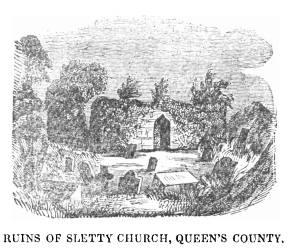
  • The Old Age of Saint Fiacc of Sletty

    October 12 is the feastday of Saint Fiacc of Sletty, a bard converted by Saint
    Patrick and later made a Bishop. A paper detailing his life can be read at the blog here. Below is a beautiful tribute to the saint in his old age when, despite
    his advancing years, there was no lessening of his ascetic discipline:

    …Fiacc in his old age lived a life of extraordinary austerity. At the
    beginning of Lent he usually left his monastery unattended, taking with
    him only five barley loaves, and these strewn with ashes. He forbade any
    of his monks to follow him, but he was seen to go to the hills to the
    north-west of Sletty, a wild and solitary district. In one of these,
    called Drum Coblai, he had a cave which sheltered him. The hill itself
    has been identified with the Doon of Clophook, which is just seven
    miles to the north-west of Sletty. Its eastern slope ‘which is steep and
    beetling’ rises abruptly to the height of 150 feet; at its base is the
    cave thirty-six feet deep by twelve in width. Close at hand there was an
    ancient church and cemetery, doubtless founded there in honour of the
    saint. Local tradition still remembers him; but as he was not seen
    coming or going to his church at Sletty, the wise people came to the
    conclusion that he had an underground passage through the mountains all
    the way to his own church. The fame of his sanctity and austerities
    still clings like the mists of morning to the mountain sides of Slieve
    Margy, where he spent his last and holiest days.

    The poet-saint
    sleeps amid many miracles with kindred dust in his own church of Sletty,
    within view of the spires of Carlow. An ancient stone cross still
    standing is said to mark the spot on the right bank of the river where
    his holy relics rest. He was one of the earliest of our native prelates,
    he led an austere and humble life, he was deeply attached to the person
    and to the memory of his beloved master St. Patrick, and his influence
    has been felt for many ages in all the churches of Leinster. His poetic
    Life of St. Patrick, to which we have already referred, is beyond doubt
    an authentic poem; and if so it is the earliest and most authentic of
    all the Lives of the Saint. In any case it is an invaluable monument of
    the history, the language, and the learning of the ancient Church of
    Ireland….

    Most Rev. Dr. J. Healy, The Life and Writings of Saint Patrick (Dublin, 1905), 399-400.


    Content Copyright © Omnium Sanctorum Hiberniae 2012-2020. All rights reserved.

  • Translation of the Relics of Saint Virgilius, September 26

    As there are not many commemorations of Irish saints found on the calendars at September 26, Canon O’Hanlon is forced to look further afield to fill up the September volume of his Lives of the Irish Saints. He notes that various continental sources record the Translation of the Relics of Saint Virgilius of Saltzburg at this date. Beneath this Latin name is Fearghal, an eighth-century Irishman, who embodies the missionary and scholarly ideals of Ireland in the Golden Age of the Saints. A contemporary of the English Saint Boniface, with whom he clashed, Saint Virgil established a reputation as a leading European scholar before his death in 784. His feast day, as Canon O’Hanlon notes below, is on November 27 and a paper on the life and work of this great Irish saint in Europe can be read at the blog here. Below is the account of today’s feast from Canon O’Hanlon’s Lives of the Irish Saints, I regret that he does not bring more actual detail of the circumstances of the translation of the saint’s relics:

    Article IX. Translation of the Relics of St.Virgilius, Bishop of Saltzburg. 

    By Canisius and Ferrarius, the commemoration of a Translation of the Relics of St. Virgilius, Bishop of Saltzburg, in Bavaria, takes place on this day. His Acts are more properly deferred to the 27th of November, the date for his principal festival. The Bollandists notice the Translation of his Relics, at the 26th of September.

    Content Copyright © Omnium Sanctorum Hiberniae 2012-2022. All rights reserved.

  • 'A Lion of Strength': Saint Finbarr of Cork

    The following abstract of the character of this holy man [Saint Finbarr] is from the Irish and Latin lives:

    “His humility, his piety, his charity, his abstinence, his prayers by day and by night, won him great privileges: for he was godlike and pure of heart and mind like Abraham; mild and well-doing like Moses; a Psalmist like David; wise like Solomon; devoted to the truth like Paul the Apostle; and full of the Holy Spirit like John the Baptist. He was a lion of strength, and an orchard full of apples of pleasure. When the time of his death arrived, after erecting churches and monasteries to God, and appointing over them Bishops; Priests, and other degrees, and baptising and blessing districts and people, Barre went to Cill-na-cluana (Cloyne) and with him went Fiana, at the desire of Cormac and Baoithin, where they consecrated two churches. Then he said, it is time for me to quit this corporeal prison and to go to the heavenly King, who is now calling me to himself; and then Barra was confessed, and received the sacrament from the hand of Fiana, and his soul went to heaven, at the cross which is in the middle of the church of Cloyne. And there came Bishops, Priests, Monks, and Disciples, on his death being reported, and to honour him; and they took him to Cork the place of his resurrection, honouring him with psalms and hymns and spiritual songs, and the angels bore his soul with joy unspeakable to heaven, to the company of the Patriarchs, Prophets, Apostles, and Disciples of Jesus Christ, and of the Holy Trinity, The Father, the Son, and Holy Ghost.” Amen.

     R. Caulfield, ed., The Life of Saint Fin Barre, First Bishop and Founder of the See of Cork (London, 1864),  


    Content Copyright © Omnium Sanctorum Hiberniae 2012-2022. All rights reserved.