This saint is both a poet and a scholar, who died in 1086. I knew the name of Máel Ísu Ua Brolcháin in connection with a hymn in Latin and Irish Deus meus, adiuva me which I am pleased to say still features in Irish hymnals today. I have posted a translation of it here. I did not know, however, that its author also featured on the Irish calendars of the saints, so I am delighted to bring a short essay on Saint Máel Ísu’s life and works from a latter-day daughter of the Ua Brolcháin clan, Muireann Ní Bhrolcháin:
Máel Ísu Ua Brolcháin (d.1086)
Máel Ísu Ua Brolcháin was a religious poet from Donegal who was a member of the Armagh community. His death in Lismore is mentioned in the Annals of Innisfallen in 1086. He is recognized as one of the primary poets of his age, and there is a full-page account of his life and family in the 16th-century Acta Sanctorum by Colgan. He was educated in the monastery of Both Chonais, Gleenely, beside the present-day Culdaff, Co. Donegal. His death is mentioned in all major annals, but the Annals of the Four Masters give a longer notice than others:
The senior scholar of Ireland, learned in wisdom, in piety and in poetry of both languages. So great was his erudition and scholarship that he himself wrote books and compositions of wisdom and intellect. His spirit ascended into heaven on the 16th of January, as is said: On the sixteenth of January/on the night of fair Fursa’s feast,/Máel Ísu Ua Brolcháin perished/Oh! Who lives to whom this was not a great distress.
His Work
The manuscript sources attribute eight poems to Máel Ísu. Scholars mention him as the possible author of four further compositions. Fr. F. Mac Donncha suggested that he may also be the author of the Passions and Homilies because he was well educated with a deep knowledge of the scriptures and of Latin and had access to an extensive library. The content of his poems reflect the concerns of his age, the secularization of the church and the budding reform. He composed devotional, personal prayers as well as didactic poems that reflect the beliefs and teaching of the Céilí Dé (Culdees) in preaching restraint, fasting, continence and study as a way of life. He prays directly to the Trinity, to St Michael, and to God himself, using his poetry as a vehicle for religious teaching and for personal prayer. Some of the poetry may be directed at his students. Dia hAine ní longu says: ‘You eat/as for me, I shall fast,/on account of fire which water does not extinguish/and cold which heat does not quench.’ He may have moved to Lismore in search of the reforming spirit that was absent in the secular world of Armagh.
The lorica, A choim diu, nom chomet, seeks protection from the eight deadly sins for eight parts of the body: eyes, ears, tongue, heart, stomach, male organ, hands and feet. The sins associated with each are outlined, for example: ‘Protect my ears so that I do not listen to scandal, so that I do not listen to the foolishness of the evil world’ and he continues: ‘Do not allow me to fall into the principal sins of the eminent, reputed eight, Christ come to me, to hunt them, to defeat them.’ In this he follows the teachings of the Penitentials as he does in his longest poem Ocht n-eric na nDualach that treats the eight vices. Some five or six stanzas are given over to each vice and to its cure, for example: ‘Greed- what it does is/to force miserliness upon you:/ a craving for all things,/pillage, plunder and robbery,/The sole cure is contempt for the dark world,/being in continual poverty/without acquiring wealth.
Muireann Ní Brolcháin, Máel Ísu Ua Brolcháin (d.1086), in S.Duffy, ed., Medieval Ireland: An Encyclopedia (CRC Press, 2005), 307-308.
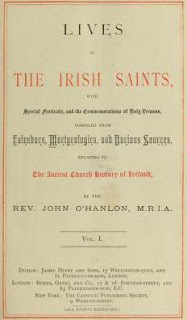
Canon O’Hanlon also has an entry for this great poet-saint. He tells us of a County Donegal parish which claimed Ua Brolcháin as its patron:
‘The patron saint of the parish of Cloncha, in Inishowen, was always regarded as being the present Maelisa Ua Brolchain. In this parish, there stood an ancient monastery, known as Temple Moyle, or Tapal Moule. An old graveyard, surrounded by a stone wall, with an iron gate entrance, is found at this place. We find recorded in the Martyrologies of Marianus O’Gorman and of Donegal, at the 16th day of January, Maelisa Ua Brolchain. On the seventeenth of the calends of February, he resigned his spirit to heaven, as stated in this quatrain:
” On the Seventeenth of the calends of February,
The night of fair Fursa’s festival,
Died Maelisa Ua Brolchain,
But, however, not of a heavy severe fit.”
This account seems to convey, that he ended life by a process of natural decline, and that he expired without much suffering. It is likely he attained an advanced age. The Annals of Clonmacnoise, at A.D. 1084, have recorded his death. The year 1086 was that of his decease, according to the Annals of Ulster and of the Four Masters. ‘
I am left with a picture of a saint who was very much a representative of the old penitential traditions of the Irish church and of its love of learning and scholarship. Yet he lived at a time of change, the Great Schism between east and west occurred in his lifetime and the church reforms he sought would come a century after his death. But Saint Máel Ísu Ua Brolcháin has not been forgotten. Apart from the survival of his hymn
Deus Meus, adiuva me, now sung in modern Irish and Latin, a number of his poems have been translated by twentieth-century scholars and I will post a selection of these in the future.
Content Copyright © Omnium Sanctorum Hiberniae 2012-2015. All rights reserved.