Category: Saints of Fermanagh

  • Saint Ferghas of Inis-Caoin, March 29

    A saint from the beautiful lakeland county of Fermanagh is commemorated on March 29 – Ferghas, son of Enda, of Inis-Caoin on Lough Erne. Finding himself with little information about the saint, Canon O’Hanlon instead writes an enthusiastic account of the beauties of his locality:

    St. Ferghas, son of Enda, of Inis-Caoin, Lough Erne.

    Ferghas, son of Enda, of Inis-Caoin — now Iniskeen — in Loch Eirne, is set down, in the Martyrology of Donegal, as having a festival, at this date. The place, with which he was formerly connected, was on an island of moderate dimensions, and this was situated a few miles from the town of Enniskillen, on the beautiful Lough Erne. That glorious sheet of water, including the River Erne, of rare beauty and magnificence, has a wide and winding extent of sliore, in the counties of Cavan, Fermanagh and Donegal. From various surrounding hills and mountains, its panoramic splendours are exhibited to the gaze, and in every possible novelty of colour and grouping. Over two hundred islands break the water surfaces. The Erne flows in a north-west course, almost centrally through the county of Fermanagh. It is supplied with many tributary streams, along the forty miles of its tortuous channel; being divided into the upper and lower lake.
    About midway on an island in the Erne, the elegantly-built and thriving town of Enniskillen stands, two handsome bridges, having five arches each, connecting this borough with the mainland. The romantic scenery both above and below this town is unrivalled. The upper lake has numerous indentations along its margin, on either side, and so thickly are its islands grouped, that at first sight it would seem a matter of extreme difficulty for a pilot, to find the proper channel. Its course gives the tourist a general idea of an inundated country. The islands are usually very fertile and verdant, while many are richly wooded. Projecting headlands on the river banks are often covered with fine timber, rising with stately trunks and branching tops, from the low and often marshy grounds. Herons and aquatic fowl breed along the rush-lined shores. Nothing can exceed the variety of landscape features here introduced. Swelling hills and more distant mountains frequently give a grand, and, an undulating, outline, to the prospect. The lower lake has a greater expansion of water, unimpeded by islands; although the latter are found to be not less numerous, while descending its stream.


    When St. Ferghas lived in Iniscaoin cannot be discovered; but, in the table, which is added to the Martyrology of Donegal, its compiler remarks, there is a parish church of St. Fergus of Iniscaoin, without cure of souls, because its rectory was secular or impropriate. The Bollandists barely allude to this holy man, as Fergussius, son of Ennius, of Inis-Caoin, in Lough Erne, and quote the Martyrology of Tallagh, as their authority yet, neither in the published work, nor in the Franciscan copy of that record, do I find any corresponding entry.

    Content Copyright © Omnium Sanctorum Hiberniae 2012-2015. All rights reserved.

  • Saint Molaisse of Devenish, September 12


    12 September is the feastday of one of my favourite saints, Molaisse of Devenish. I have been interested in him ever since visiting his island monastery in the beautiful lake country of County Fermanagh. He is less well-known than his namesake Molaisse of Leighlin, who was also associated with an island retreat, but this time off the Scottish coast. Molaisse of Devenish is one of the ’12 Apostles of Ireland’ and the following account of his life has been condensed from the entry in Canon O’Hanlon’s Lives of the Irish Saints:

    ST. MOLAISSI, OR LAISREN, OF DEVENISH ISLAND, COUNTY OF FERMANAGH.
    [Sixth Century]

    Like many of the pioneers of Christianity in Ireland, the very distinguished Cenobiarch, whose festival occurs at this date, descends through a very exalted lineage. Belonging to the race of Irial, son to Connal Cearnaigh, he was seventh in descent from Crum Badhraighe, son to Eochaidh Cobha, son of Fiacha Araidhe. St. Molaise or Molaisi, called also Laisren or Laisrean, was the son of Natfraich, and born in Carberry, near Sligo, according to the most probable accounts ; while Dr. Lanigan, with some others, states it as not improbable, that he was a native of Breffney. Monua was the name of his mother, as the account is found in his own Life.

    His education and religious instruction were received at the celebrated school of Clonard, and under St. Finian, as we find these circumstances related, in the Acts of this latter holy Abbot. He was one of the twelve chief disciples of that saint, and these were commonly called the Twelve Apostles of Ireland. Having planted the seeds of piety and ecclesiastical learning deeply in his mind, a fixed object appears to have been the desire of embracing a religious life, and the training up under his own direction a community of men, who might be induced to follow his example and emulate his virtues. In the Life of St. Maidoc of Ferns, we find the following legend, that he and St. Laisrean were bosom friends and one day, while both saints sat under the shade of two trees, they asked from God a manifestation of His holy will, as to whether they should live together or separate. Then, by a Divine decree, the two trees under which they were seated fell. That tree, under which Lasserian sat, inclined towards the North, and that under which Maidoc had been seated fell towards the South. Then, being filled with the spirit of God, they concluded those signs to have been an admonition from Heaven, indicating the course each was destined to take. Tenderly embracing each other, and in tears, Maidoc set out for the Southern part of Ireland, where he afterwards founded the monastery of Ferns; while Laiserian directed his course towards the Northern parts, where he could prosecute his intention of promoting God’s greater glory, and of attending to the interests of his own immortal soul.

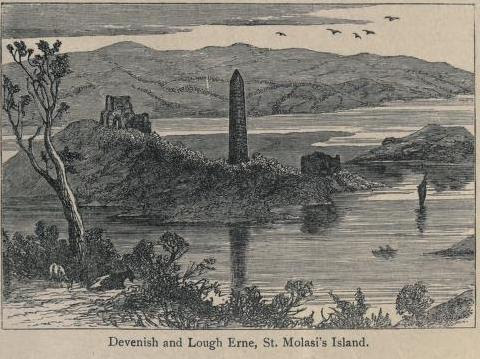
    With a view to attain his cherished purpose, St. Molaise selected a charming site for the foundation of a religious establishment. At an early age, our saint fixed his habitation on the lone Island of Devenish, at the entrance to Lower Lough Erne, and about two miles distant, from the present town of Enniskillen. At what precise period St. Molaise established himself on this island cannot be accurately ascertained.

    The story of St. Columba’s having been ordered by Molaisse to leave Ireland, however fabulous, yet pre-supposes that the latter was a renowned Abbot about 561, the year assigned for the battle of Cul-dremni, or Cul-drebhni. The account of its origin is of ancient date, however, and the tradition has long survived in the compositions of our bards and chroniclers. In conjunction with Saints Finian and Brendan, St. Molaisse is said to have advised his school-fellow, St. Columkille, to pass over into Britain. St. Molaisi is known to have lived at Damh-inis, before the departure of St. Columkille from Ireland, in the year 563, the second year after the battle of Culdrebhne, and in the forty-second year of his age. By some writers, the foundation of St. Molaisi’s monastery has been referred to the latter date.

    Many holy men, and among others St. Aidus of Killare, visited him in his retirement. We are told in the legendary Life of St. Aidus, that when this Saint came to Devenish, he found St. Laisrean at work with his monks. The visitor then asked what he could do to assist them. St. Laisrean told him to move a tree of great size and age from its position in the earth, when he ordered the tree in the name of Christ to be uprooted. On the instant, it was miraculously raised from the earth into air, and carried off into the sea. All who witnessed this miracle gave thanks to God. We have already seen, that St. Daigh or Dagcus said to have been a nephew of our Saint was also a pupil of St. Laisrian and of his brother, a Deacon, who taught in the school at Damh-inis. With that Deacon and uncle, the boy paid a visit to St. Mochta, of Louth, and afterwards, having had his future sanctity and eminence predicted by that patriarch, both returned to the lesser monastery, which was the school at Damhinis. There he learned fully the arts of writing, and he acquired a knowledge of polite learning, while he became celebrated for his skill as an artist in metal work, before he became bishop over Iniskeen, in the County of Louth. So that we may conclude, a school of repute had been established on the island, so early as the sixth century. There the very crypt or cell inhabited by St. Molaise is said to be still standing, but unroofed. Its walls are of massive solidity, and traces of the covering-roof remain.

    It has been stated, that St. Molaisse or Laiserian made a pilgrimage to the Eternal City, after he became Abbot over Devenish. However, the learned Dr. Lanigan thinks, that the journey Laiserian is said to have made to Rome rests on no sure foundation, and that he was probably confounded with his namesake of Leighlin. We have already seen, that St. Moedoc, Bishop of Ferns and St. Molaise of Devenish were intimates and friends. After their first separation in Ulster, it is said, St. Molaise, before he undertook that journey to Rome, resolved on visiting his beloved acquaintance at Ferns. Then a pact of amity was again confirmed, not only between the principals, but also between the members, of their respective communities, and this bond of union, it was agreed, should be perpetual. From Rome, our saint had resolved to bring back some clay and relics to hallow his cemetery at Devenish.

    An ancient hymn states, that St. Molaisse shone forth as a bright lamp, illustrating all Ireland by his sanctity and learning. He drew up a Rule for the instruction and guidance of his religious, over whom he presided as Abbot. Under his training, the monks aspired to the most sublime practices of devotion. The Life of Ciaran of Cluain states that the Order of Molaissi was one of the eight Orders that were in Erin but perhaps, adds the calendarist, it speaks of some other saint bearing the same name.

    Cuimin of Coindeire, in the poem which begins, ” Patrick of the Fort of Macha loves,” relates that Molaissi desired to be in a stone prison, and also to keep a house of hospitality for every one in Erin. These abodes of hospitality were usually known as the guest-houses, attached to nearly all the celebrated monasteries in Ireland. Generally speaking, a more generous refreshment was served up in them for the pilgrims and travellers, who were accustomed to visit those places held in such popular veneration, than was allowed for refection of the monks. On a certain occasion, as Molaisse and his monks were taking their scanty meal, the refectory in which they were caught fire. The monks rose suddenly to fly from the house, on seeing it lighted with red glowing flames. Their Superior requested them to remain, to go on their knees, and to pray, while he did the same, while reaching forth his hand towards the fire. Then the ridge-pole of the house fell in, and the fire did them no further injury. Afterwards, he permitted the monks to rise from their posture of prayer. St. Laisrean, it is stated, converted to the faith a certain Conall or Colman Derig, a King of Ulster, who had been struck with blindness. Of him we find no further historic account,

    So highly esteemed was Saint Molaise or Laisren both for his piety and learning, that he is said to have been created Bishop of Clogher, coming next in succession to Crimir-Rodan. It has been stated, moreover, that he administered the ecclesiastical affairs of that diocese, with prudence and edification. With other holy men, our saint is represented as one of the Twelve Apostles of Erin, and he is named, as having assisted at Congal’s feast. He is said to have been present at the Banquet of Dun-na n-Gedh. However, either the narrator was a very inaccurate historian, or the transcribers have corrupted his text. The present holy Abbot is numbered among the Irish Saints of the second class, as noted in the ancient Irish Catalogue. Among the Irish saints, no fewer than eleven bear the name of Laisrian or Molaisse. St. Laserian, the patron of Leighlin, and the present holy man, were the most eminent among these. An Alphabetical Latin Hymn, addressed to Laserian or Molaisse, of Daimh-innis or Devenish, is to be found in the ” Liber Hymnorum,” a Manuscript preserved in Trinity College, Dublin. This was first published in the “Irish Ecclesiastical Record” of 1869, and it has been again printed with some inaccuracies. The latest issue of it is that by the Henry Bradshaw Society, under the editorship of J. H. Bernard, D.D, and R. Atkinson, LL.D. This Hymn is probably derived from an Office for the Feast of St. Molaise, of which a fragment is extant as a marginal note in the Martyrology of Donegal, at the 12th of September.

    After a life usefully and religiously spent, St. Molaisse was called away to receive the crown of his labours and virtues, on the 12th day of September. He was buried, in the cemetery, on the Island of Devenish. His stone coffin is said to have been found, embedded in the earth, near one of the ruins. The lid, which had been long taken for the shaft of an antique cross, lay at the eastern side of what is called the Lower Church. To the north of the oratory, within a small quadrangular enclosure, which appears to have been the aherla, or Saint’s burial-place, was to be seen that very rude stone coffin, now broken into pieces. The material is sandstone, and the bottom seems to have been composed of three separate stones. The lid has been carried away, a fact greatly to be regretted as by an examination of its style, a very correct idea might be formed regarding the date of the sarcophagus.

    The festival of St. Molaisse is kept on the day of his death. For a long time, it had been religiously observed by those, who dwelt in the vicinity of Lough Erne. During the last century, and in the beginning of the present, countless numbers repaired to the Island to practise various devotions on St. Molaise’s festival day. The local guide pointed out another object of interest, viz. the exact spot on the North side facing down towards the Lough, where St. Molaise’s well flowed, although it was then covered up with stones. Stations were formerly carried on near it. There is a tradition, that in the olden time Devenish was connected with the mainland by a causeway. A portion of this work appears to remain, and upon it there is a very well defined crannogue, or artificial Island. Except in very dry summers, this islet is covered with water. The exact year of St. Molaisse’s death has not been determined. However, the Annals of Boyle place it so early as A.D. 544. By some authors, it is referred to 563. After completing thirty years, we are told, that he went to Heaven, A.D. 563, according to the Annals of Ulster, and again this record assigns it to 570, which other writers adopt. Again, the year 571 is thought to be the latest date that can be noted for his departure. In the “Feilire” of Oengus, at the 12th of September, there is an encomiastic notice of Laisren, called the beautiful, of multitudinous Damh-inis. There is a comment, having an Irish verse attributed to him. The published Martyrology of Tallagh records a festival, at the 12th of September, in honour of Molaissi Daimhinsi, i.e. MacNatifraich. It is also entered in the Book of Leinster copy. In the Irish poetical Martyrology of Marianus O’Gorman, which has been edited by Whitley Stokes, D.C.L., and which contains several Biblical, Continental, Anglo-Saxon, British and Aremorican Saints, besides the Irish Saints, Lasrian is commemorated with a eulogy for his meekness, in that Irish metre, called the Rindard mor, or Great Rindard. The Martyrology of Marianus O’Gorman professes to enlarge the number of Irish Saints in the Calendars of Tallaght and of Oengus, and to arrange the festivals of a great number of them in those days on which the Church celebrates their festivals. The only copy of this composition known to exist was that transcribed by Brother Michael O’Clery, about the year 1630, in the Franciscan Convent of Donegal. We find him mentioned, at still greater length, in the Martyrology of Donegal, at the same date, as Molaissi, son of Nadfraech, Abbot of Daimhinis. On the 15th day of this same month is celebrated the festival and holiday of Molaissi, in his own parish, and termon, at Bealach Ui Michein. This exact locality is not easily ascertainable at the present time, among the modern townland denominations in Ireland. St. Molaise was Patron Saint to the O’Flannagan family of Tuath-Ratha, or Toora. There is a curious account of the tribes of Dartry in the time of Molaisse. In an Irish Poem introduced into the Life of St. Molaise, the tributes and contributions from the Chiefs and people of Toora are set forth and in full, as also the spiritual and temporal benefits which they in turn were to receive from him. They are told that if they undertake a just battle, and carry the Gospel of Molaise before them as their standard, they shall be victorious. At the time of the suppression of religious houses, the possessions of Devenish are specified in a particular manner. The veneration of this holy Abbot reached the South of Ireland. The old church in the Parish of Kilmolash, county of Waterford, means ” the church of St. Molash,” the celebrated Saint of Devenish in Lough Erne.

    Content Copyright © Omnium Sanctorum Hiberniae 2012-2015. All rights reserved.
  • Saint Mochaemhog of Inis Caoin, April 13


    A saint from the lakeland county of Fermanagh, Mochaemhog, is commemorated on April 13. He was an abbot of the island monastery of Inis Caoin, anglicized as Iniskeen, but we do not have many other details of his life, as Canon O’Hanlon explains:

    ST. MOCHAEMHOG, ABBOT OF INIS CAOIN, NOW INISHKEEN, COUNTY OF FERMANAGH.
    [SEVENTH CENTURY]
    THIS holy man is recorded in the Martyrology of Tallagh, at the Ides or 13th of April, as Mocammoc Innsi Cain. There is an allusion to him, by Colgan, under the Acts of St. Mochoemog or Pulcharius [feastday March 13]. We are told there, that this holy man was the son of Endeus, son of Cormac, and belonging to the Colla Dachrich race. He flourished on Iniscaoin Island, about the middle of the seventh century. He was Abbot over Inishkeen, on Lough Erne, in the county of Fermanagh…A commemoration has been made of St. Mochaemog, by Marianus O’Gorman, at the present day. Likewise, at the same date, as we read in the Martyrology of Donegal Mochaemhog, of Inis Caoin, had veneration paid him. A similar notice is to be found, at the 13th of April, or at the Ides of this month, in that Irish Calendar, preserved in the Library of the Royal Irish Academy. However, these brief notices give us no particulars, that could afford us any light, regarding his personal history.
    Content Copyright © Omnium Sanctorum Hiberniae 2012-2015. All rights reserved.