Category: Saints of Clare

  • Saint Cronan of Tomgraney, October 19

    October 19 is the commemoration of a County Clare saint, Cronan of Tomgraney. The Martyrology of Donegal records:

    19. E. QUARTO DECIMO KAL. OCTOBRIS. 19. 

    CRONAN, of Tuaim Greine.

    The website of the Clare County Library has a page which explains the origins of the place name associated with our saint and which mentions him as the founder of its monastery. Sadly by the nineteenth century, the Ordnance Survey scholar, John O’Donovan, was dismayed to find that little local knowledge of the saint had survived, not even the memory of when his feast day was commemorated. Another nineteenth-century source, the Cyclopedia of Biblical, Theological, and Ecclesiastical Literaturealluded to some of the difficulties in disentangling the founder of Tomgraney from others of the same name:

    Cronan (Croman, or Chronan) is a very frequent name in Irish hagiologies, and has several synonyms, as Cuaran, Mochuaroc, and frequently Mochua, Cron and Cua having in Irish the same meaning.

    13. Of Tuaim-greine (now Tomgraney, in the barony of Upper Tulla, County Clare), commemorated October 19. This saint appears twice in the Mart. Doneg., first in the original hand at October 19; and next in the second hand, on the authority of Mar. O’Gorman, at November 1. Among the saints of the family of St. Colman of Kilmacduach (Feb. 3), or house of the Hy-Fiachrach, Colgan gives “St. Cronan, son of Aengus, son of Corbmac, etc., February 20 or October 19;” and Mart. Doneg. at February 20 also mentions that there is a Cronan with this pedigree (Todd and Reeves, Mart. Doneg. pages 55, 279,293; Colgan, Acta Sanctorum, page 248, c. 2).

    James Strong and John McClintock, eds., The Cyclopedia of Biblical, Theological, and Ecclesiastical Literature (Haper and Brothers; NY; 1880). [extract from online edition here.]

    Modern scholar, Pádraig Ó Riain in his dictionary entry for the saint explores the evidence from literary sources and place names and confirms the difficulties of the earlier hagiologists in establishing a single identity and feast day for this saint.


    Content Copyright © Omnium Sanctorum Hiberniae 2012-2015. All rights reserved.
  • Saint Cocca of Ros-Bennchuir, June 29

    June 29 is the commemoration of Saint Cocca, who appears in the hagiography of Saint Ciarán of Saighir first as his nurse and later as the abbess of Ros-Bennchuir. She is the second saint of this name to be commemorated in the month of June as the feast day of Saint Cocca of Kilcock falls on June 6. The account below comes from Volume 6 of Canon O’Hanlon’s Lives of the Irish Saints:

    ST. COCHA OR COCCA, ABBESS OF ROS-BENNCHUIR.
    [FIFTH CENTURY.]

    WE have to regret, that indications are not more clear, in reference to the pious female saint, whose celebration in our Calendars has been assigned to this day. However, we can only present, as we find them, the few particulars, that seem to be on record. This holy virgin has her name usually written Coca or Cocca; but, incorrectly, it has been converted into Concha and Cota. In an English Life of St. Kieran of Saighir we find this saint called “Coinche.” In the Martyrology of Tallagh, at the iii. of the Kalends of July —June 29th— and included with that of other saints, there is a festival for Cocca, of Ruis Beandchoir. The greater portion of the Life of St. Cocchea is to be found interspersed and interwoven, so to speak, with the Life of the great St. Kieran, whose nurse and guardian it was her privilege to be. Owing to these circumstances, it appears to be altogether probable, that she was born, or at least, that she lived for some time, in the Island of Cape Clear, in the present county of Cork. She is stated to have been the nurse of St. Kieran of Saigir; and if so, her period should date to the beginning of the fifth century. She may have been converted from the errors of paganism, by receiving baptism at the hands of her Apostolic foster-son. St. Cocca is related, to have embraced a religious life, and to have presided over the monastery of Ros-bennchuir. That it was situated on the sea-coast appears from the Life of St. Kieran of Saigir, who was one of the principal coadjutors of St. Patrick, in the southern parts of Ireland. The principal work of St. Cocchea consisted in presiding over the education of noble virgins, who were entrusted to her care, some for a time, and others for life. St. Cocchea rendered the greatest assistance to St. Kieran, in propagating the Christian faith. The religious establishment of Ross-bennchuir was possibly situated on the western coast of Clare County, as has been stated, but on what ancient authority is not cited. Perhaps this place was identical with the townland of Ross, on the sea-shore, in the parish of Kilballyowen, in the barony of Moyarta, in the south-western part of the county of Clare. There St. Cocha’s nunnery— according to one writer —was situated, about twelve miles W.S.W. from Kilkee, in that county, and within a few hundred yards of the Natural Bridges of Ross. The ruins, we are told, present no interesting architectural features. In the Life of St. Kieran, we are told, that he sent oxen each year from Saigir to this place; and, although the distance was considerable, it is said, they always went in a direct course to Ros-benchuir, without being even conducted by a driver. These oxen were sent to plough the lands of St. Cocca, and after the ploughing season was over each year, they returned again to Saigir.

    There is a small ruined church in the townland of Ross, and which is called Teampull-an-naonmhar-naomh, i.e., the church of the nine saints. Of this edifice, the west gable and side walls remain to the full height, with 4 feet of the under part of the east gable. It measures 34 feet 4 inches in length, by 15 and a half in breadth. At the distance of 24 feet, south from the ruin, is what the peasantry call the grave of the nine saints. This grave measured 33 feet in length, from north to south, 7 feet 9 inches in breadth, and it was 2 feet in height. The sides were built up of loose stones, after the ordinary manner of graves.

    We are also told, that on each festival of our Lord’s Nativity, after the people had received Holy Communion from St. Kieran’s own hands, in the monastery of Saigir, he was accustomed to proceed to the monastery of St. Cocca, at Ros-bennchuir, that he might again offer up the Holy Sacrifice there, and on the same morning. After St. Cocca and others had received communion from him, he returned again to Saigir, before the dawn of daylight. Relating these circumstances, the ancient writer of St. Kieran’s Life remarks, that he and others knew not by what means this saint went and returned, as he concealed such matters from them —meaning his monks. We are informed, that there was a large stone on the sea-shore, which had been surrounded with water, near the monastery of Ros-bennchuir. To this the Abbess often retired, and it was called, “the stone of St. Cocca, because on it she frequently prayed. According to the English Manuscript Life of St. Ciaran of Saighir, this place was called “Carrig Conchy.” As an old legend has it, St. Ciaran went one day on that Rock, and it floated over the waters with him, and returned to its own place again, it being Ciaran’s wish it should so happen. The Martyrologies of Marianus O’Gorman and of Cathal Maguire state, that the Natalis of this saint had been celebrated, on the 29th of June, in the church of Ros-bennchuir. We do not find her name occurring on this day, in the copy of the Irish Calendar, belonging to the Ordnance Survey Office, Phoenix Park. She is entered, however, in the Martyrology of Donegal, as Cocha, of Ros-Bennchair.

    Content Copyright © Omnium Sanctorum Hiberniae 2012-2015. All rights reserved.
  • Saint Criotan of Macreddin, May 11

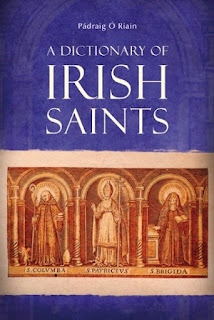
    May 11 sees the commemoration of another of the British saints who came to Ireland as a student, Criotan of Macreddin. Canon O’Hanlon tells us that he eventually opted to remain in Ireland and was remembered as one of the saints of Leinster. In his 2011 Dictionary of Irish Saints, Pádraig Ó Riain says that there are two mentions of this saint on the calendars, first associating him with Achad Finnigh and apparently with a priest called Cormac but then the pair are relocated to Aran, where no further trace of their cultus survives.

    ST. CRIOTAN, OR CRIDANUS, CREDAN OR CREDANUS, OF AGHAVANNAGH, OR MACREDDIN, COUNTY OF WICKLOW.

    [SIXTH OR SEVENTH CENTURY.]

    The Feilire of St. Aengus enters My-Critoc, designated “a fair servant,” at the 11th of May. The name of Critan Mic Iladon is mentioned, in the Martyrology of Tallagh, at the 11th of May. The Bollandists, quoting this notice, call him Critanus, the son of Illudion and they state, that he bore also the name Mochritocus, which may be Anglicized “My Chritoc.” Thus, from the early calendars, we learn, that his father was called Iladon or lolladon; and, he was born—as appears most probable—some time in the sixth century. This we can discover, by reference to the period, when some of his contemporaries flourished. He is variedly called Criotan, Credan, Credanus, or Cridanus. He seems to have been the disciple of that holy Briton, St. Petrock, or St. Petrocus, who fled into Ireland, after having embraced the monastic state, in his own country. He passed over to this Island, and afterwards he applied to learning, and to the study of the Sacred Scriptures. For twenty years, he read assiduously in our Island; but, we know not in what school or monastery he lived. It seems probable, however, that it was somewhere in the eastern part of Leinster. He afterwards returned to Britain, while Credan, Medan, and Dagan left, perhaps, the Leinster province, where they had been his pupils, to receive further instruction from him. In Cornwall, St. Credan, with those other Irish youths, attended the lectures of Petrocus. We can scarcely doubt, that they became novices, in the religious state, under him. How long our saint remained, with so distinguished a master, does not appear; but, he returned to Ireland, and he probably selected a place for his religious retirement, not far from the district, where he was born. St. Credanus was venerated in Leinster, at a place called Acadh Einnech, on the 11th of May, according to Colgan, who, however, does not particularly identify it. We think, there is a mistake, in the correct spelling of that local denomination. The proper name of this place appears to have been Aghamanagh, “the field of the monks.” It is now known as Aghavannagh, in the parishes of Moyne and Ballinacor, and barony of Ballinacor South, in the county of Wicklow. It lies circled round with sheltering hills, in a highly romantic part of that mountainous region. There is a cemetery, at the spot, and still greatly resorted to for interments. No trace of a church now remains; but, the burial-ground is covered with large trees, beneath which, the graves and tombs are sheltered. Yet, tradition has it, that a church was formerly there, and the people have a great veneration for that place of interment. Not far removed from Aughavannagh, are the townlands of Macreddin East and West, in the parish of Ballykine, barony of Ballinacor South, and county of Wicklow. Not many centuries ago, this was written Moykredine —evidently in English—”the plain of Credin.” At the present time, there is a Catholic church there, which was authorized to be placed under the patronage of St. Laurence O’Toole. It would seem, however, that Credin was formerly the local saint, and that he gave denomination to those townlands.

    The Martyrology of Donegal, on this day, records the name of Criotan, son of Iolladon; but, the date for his death cannot be met with, in our annals. In the Irish Calendar—now kept in the Royal Irish Academy—at the 11th of May, we find mention of Criotan Mac Iolladon. A patriotic and distinguished prelate of our country has remarked, that if there be beatified remains in foreign lands, we may find, too, the bones of martyred and sainted forefathers, whitening the soil around us. In many of our almost forgotten and neglected cemeteries—as in the present case—it seems more than likely, the relics of holy founders repose, with those of the faithful, for long past generations, while awaiting the final resurrection and sentence of the just.

    Content Copyright © Omnium Sanctorum Hiberniae 2012-2015. All rights reserved.