Category: Saints of Armagh

  • Saint Nuad of Armagh, 19 February


    A ninth-century Archbishop of Armagh, Saint Nuad (Nuada or Nodtat), is commemorated on February 19. Canon O’Hanlon records:

    St. Nuad, St. Nuada or Nodtat, Archbishop of Armagh

    [Eighth and Ninth Centuries.]

    At the 19th of February, Colgan and the Bollandists have entered some biographical notices of this holy archbishop, who enjoyed the supreme ecclesiastical dignity in Ireland for a brief period. Nodtat or Nuada, bishop, is mentioned in the Martyrologies of Tallagh, of Marianus O’Gorman, and of Donegal, on this day. He was at first a monk, and also an anchorite. From this state of life, and even against his own will, he had been promoted to the abbatial, and thence translated to the archiepiscopal dignity. His birth-place or residence is said to have been situated at Lough Uama. This signifies the “lake of the cave,” the water being said to rise out of a cavern, and the position is also assigned to Breiffny. Here, it is thought, he led the life of an anchoret. The lough, to which allusion has been made, was in the present county of Leitrim. It sometimes flowed back into that cave, whence it issued ; and, the people living on its borders especially believed, that this was an indication of the Dynast’s approaching death, or that of his children. Ancient Breffny comprehended the present counties of Cavan and of Leitrim. It was divided into Upper and Lower, or East and West Brefiny. In the latter division, called Brefiny Hy-Ruairc, our saint must have lived, until he was called to a higher dignity, on the death of St. Torbach Mac Gorman. This event took place, on the 16th of July, A.D. 812. Archbishop Nuad visited Connaught, A.D. 810 or 815; and, he is there reported, to have made a reformation of some abuses, which had crept into the churches. The Catalogue of the Armagh Primates allows three complete years, for the presidency of Nuad ; but, these must be understood, with the addition of some months, reckoning from the death of Torbach, on the 16th of July, A.D. 812, to the 19th of February, A.D. 816. Other authorities, however, place his demise before this date, viz., at the year 811 or 812. Under the year 811, this passage occurs in the Annals of Ulster, “Nuad of Loch-Huama, bishop, anchorite, and Abbot of Armagh, fell asleep.”

    Lanigan’s Ecclesiastical History of Ireland says that ‘in 811 Nuad made a visitation of some part of Connaught and on that occasion relieved some churches there from an annual offering, which used to be made to that of Armagh’ (Vol 3, p.252).

    The Ancient List of the Coarbs of Patrick lists Nuada as the 33rd holder of the episcopal see of Armagh.
    Content Copyright © Omnium Sanctorum Hiberniae 2012-2015. All rights reserved.
  • Saint Torbach Mac Gorman of Armagh, July 16


    Canon O’Hanlon brings us details of an eighth/ninth-century Archbishop of Armagh, Torbach Mac Gorman, at July 16:

    St. Torptha, or Torbach Mac Gorman, Archbishop of Armagh.

    [Eighth and Ninth Centuries.]

    At the 16th of July, the Martyrologies of Tallagh, and of Donegal, register simply the name, Torptha. He was identical with a celebrated Archbishop of Armagh, whose father’s name was Gorman. He descended from the Kinel-Torbaich, i.e., the Hy Kellaich of the Bregian district, in the east of Meath. He was an admirable lector and abbot of Ard-Macha. He only sat for one year, after having been elevated to the primatial dignity. He is known as Torbach Mac Gorman. He departed this life, on the 16th of July, A.D. 807, or recte 812.


    Content Copyright © Omnium Sanctorum Hiberniae 2012-2015. All rights reserved.

  • Saint Conchenna of Killevey, March 13

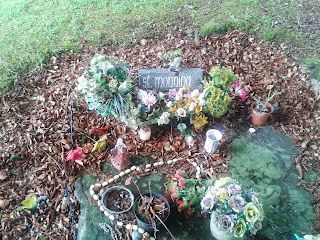
    Grave of St Moninne at Killevey (2013)

    On March 13 the Irish calendars commemorate the memory of Saint Conchenna, a holy woman of the monastery founded by Saint Moninne at Killevey, County Armagh. Her death is noted in The Annals of the Four Masters:

    The Age of Christ, 654, “Coincenn, of Cill-Sleibhe, died.”

    Not much more appears to be known of her life, but Canon O’Hanlon’s account notes that Conchenna was said to have been a sister to Saint Fintan Munna and the subject of one of his miracles. He also wonders if Saint Conchenna was abbess of the community or merely a member of it, but having raised this question he goes on to answer it by noting that the Annals usually only mark the passing of the superiors of religious houses:

    St. Conchenna, Conchend, or Coincheand, Virgin, of Kill-Slebhe, or Killevey, County of Armagh. [Seventh Century]

    Colgan endeavours to evolve some incidents regarding this holy virgin, at the 13th of March. The Bollandists have only a short notice of St. Conchenna. This saint was daughter to Tulchan, and her mother was Fethlemidia. She was a sister to St. Fintan Munnu, who is venerated at the 21st of October. Thus was she descended, from the noble Hy-Niall race of Ulster. This holy virgin embraced a religious life, in a nunnery, which had been founded by St. Monenna, at Kill-Slebhe, now Killevey, at the foot of Sliabh Cuilinn, or Slieve Gullion, in the southern part of the county of Armagh. Here she lived a very holy life, and illness which caused her death happened. But she was brought to life again, by her holy brother St Munnu, and at the request of their mother. There seems to be a doubt, as to whether she was abbess over the community, at Kill-Sleblie, or a simple member of it. She finally departed this life, A.D. 654; and, although the Four Masters give her no distinctive title, yet, Colgan remarks, they scarcely ever note the death of holy persons, not distinguished as presiding over religious houses. The Martyrologies of Tallagh and of Marianus O’Gorman register the name Conchend, at the 13th of March. Also, on this day, the festival of Coincheand was celebrated, as we read, in the Martyrology of Donegal.

    Note: This post first published in 2014 has been revised in 2022.

    Content Copyright © Omnium Sanctorum Hiberniae 2012-2015. All rights reserved.