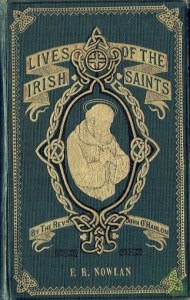
July 6 is the feast day of an early female monastic, Monnine of Killeavy, in County Armagh. Whilst there are at least a couple of Lives of Saint Monnine extant, one in the Codex Salamanticensis and another by a writer called Conchubranus, she shares with Saint Palladius, who is also commemorated today, the experience of having her identity subsumed into that of another saint. For the Irish Monnine later surfaces as the English Modwenna in a Life written by a 12th-century hagiographer, Geoffrey of Burton. This deserves a separate post though, as it is a most interesting topic in its own right. As ever, we can turn to Canon O’Hanlon’s Lives of the Irish Saints for an account of what has traditionally been known about Monnine the Irish Abbess, drawn from her Lives:
‘The pedigree of St. Darerca or Moninne is drawn by twelve generations from Fiache Araidhe, King of Ulster, who flourished, in the year 236, and who reigned ten years in Emania. The name of her father is generally written Mocteus or Mochta. Her mother is called Coman, the noble daughter of a king named Dalbranaith, who ruled over all the territory from Duvelin to Regunleth. This pious couple lived at the time, when St. Patrick had been sent by Pope St. Celestine I to preach in the northern parts of Ireland. Hence, we may infer, that their daughter Monynna had been born in the earlier part of the filth century. For when the Irish Apostle visited their part of the country, where he was hospitably received, several of the inhabitants flocked to hear his preaching, and these became converts. Among others, who desired baptism at his hands, was the present saint, then only a child. It seems likely, that her parents became Christians, also, for we are informed, that they bestowed a religious care on their daughter. She is said to have been born in the plain of Coba—also known as Magh Cobha — and in the reign of Conaille. That district surrounding the Hill of Forhart, in the county of Louth, is alluded to, as having been the place in which she was born. The present holy woman is said to have been first known by the name of Darerca, if we are to credit the accounts of some old Irish rhymers. Some of their stanzas are to be found as scholia to the Leabhar Breac copy of the “Feilire” of St. Oengus, and they are thus translated into English, by Dr. Whitley Stokes, LL.D. :—
” Nine score years together
According to rule without warmth,
Without folly, without crime, without fault
Was the age of Moninde,
(The name) ‘Mo-ninde’ was given to her
To the holy virgin, pious, with splendour
‘Mo-nanna’
(was) her gracious name
Which the maidens used to say.
Or from this the name was said
Of the nun for her appellation
From Nine the poet (the better thereof)
Who besought her for her prayer
I will tell it out to you
Her own name usually,
‘Darerca ‘
for a time adhered to her
Till she got the agnomen,
Nine score.”
According to an Irish comment on the Leabhar Breac copy of the Feilire of Oengus, Sarbile was a name this holy virgin bore, and a legendary story is told to account for the change of her name to Moninne. This Irish comment is thus translated into English by Dr. Whitley Stokes :—”Moninne, etc., i.e., Moninne of Slieve Gullion, and Sarbile was her name previously. Or Darerca was her name at first. But a certain dumb poet fasted with her, and the first thing he said [after being miraculously cured of his dumbness] was minnin. Hence the nun was called Mo-ninde, and the poet himself Nine Ecis.”
It is stated, in one of her Lives, that by the imposition of hands, the Irish Apostle administered confirmation on her. He had an interior admonition, likewise, that his new convert was destined to lead a holy life, and he bestowed a special benediction. St. Monnina having thus been converted through the preaching of St. Patrick, also received the veil at his hands. She is thus classed among his disciples. Early in life, she took the vow of chastity. She was veiled near the pool of Briugis, which is said to mean abundance. This appears to have become a place of pilgrimage, in after time. The Irish Apostle admonished his convert, to persevere in her angelic state of life, and to associate with herself other pious women, who were to learn the fear and worship of God under her direction, and thus learn to accomplish his work in the religious state. Then, to the charge of a holy priest, residing near her parents’ residence, was she committed, in order that she might learn the Psalms. Under his teaching, she remained for some time. Being a person of sound understanding and of retentive memory, she readily imbibed the precepts of religion and practised its injunctions. She associated with herself eight virgins and one widow. The widow had a baby son, named Luger, who was adopted by Darerca. Afterwards, he became a bishop, and he was otherwise distinguished. It is said, as in her nation, no house had yet been founded for religious women, that the saint lived for some time with her parents. However, finding social intercourse with them and her relatives to be a cause for distraction and a weakening of the religious spirit, she resolved on leaving them, and on seeking a home, whence the ways and conversation of worldlings should be rigorously excluded.
About this time, St. Ibar is stated to have lived in the Western Isles of Ireland, and thither she repaired with her nuns. They remained for a long time under his discipline. At length, the holy Bishop went to the southern part of Ireland, where he took up a permanent residence. His religious daughters again followed him. At the Island of Beg Ere or Little Ireland, in Wexford Harbour, St. Darerca and her nuns were under the guidance of St. Ibar. Hearing of her extraordinary virtues, they visited St. Brigid, in Leinster.
Under her rule, and partaking of her hospitality, they remained for some time. St. Darerca was appointed portress to the hospital, and while in this situation, her humility and charity were approved by all. The Almighty even bestowed on her the gift of healing infirm and possessed persons. She was regarded as such a benefactress to the poor, that numbers sought relief from her, and they returned loaded with her bounties. When some of the sisters complained, that she gave too lavishly, reserving little for their conventual wants, she returned for answer, that if they had firm faith in Christ, and obtained food and clothing, it should be sufficient for them, and that if yielding to the temptations of the devil they desired riches, they should not fail to be devoured by avaricious cares. Besides, she urged, that as the poor were suffering members of Christ’s mystical body, He would be sure to compensate the nuns for any temporal loss, and to reward their labours in the blessed cause of charity. Having spoken thus, when St. Darerca went to seek rest, on her bed were found twelve beautiful dresses ; so that believing they were a gift from Heaven, she went to St. Brigid, and then told her, that the Almighty had bestowed them to supply her necessities. The latter holy Abbess replied :” Those garments sent by the Lord to your sisters divide among them as you will, because they are more in need of such articles than are our sisters.” A certain pauper, having denied that those garments were a gift from Heaven, fell dead very suddenly, but he was soon restored to life again, through the prayers of St. Darerca.
Afterwards, it is said, this holy woman and her company of virgins sought St. Ibar, and placed themselves under his protection. They now settled in Ard-Conais, where their congregation greatly increased. Several pious virgins and widows resorted thither, while some of these belonged to regal and noble families. Both by word and example, Darerca trained them in a good rule of living. At one time, the wells and cisterns there were dried up, during an unusually warm summer, and her religious complained about their wanting water. Moved by their entreaties, the servant of Christ offered her prayers, when a fountain was miraculously produced. This spring thenceforward afforded an inexhaustible supply, not only to her nuns, but to all the people living in their neighbourhood. So great had become the reputation of St. Moninna, that numbers of both sexes came to receive her blessing, and to ask spiritual favours through her intercession. She was even gifted with the spirit of prophecy. When, on a certain occasion, St. Ibar recommended a girl living in her neighbourhood to be consigned to her care, and to be trained according to her rule ; the holy virgin, having an intuition of what should happen, said : “This pupil child shall prove to be the cause, why we must desert our cell, on a future occasion.” The event corresponded with this prediction ; for, when that girl became an adult, she was filled with an invidious feeling towards Darerca, and this spirit she communicated to her relations. The meek superioress then called her sisters together and said : ” Lo ! what the Almighty revealed to us regarding this girl is now clearly manifested. If while I live, you have to endure such opposition, when I am dead, how shall you be able to live here ? Let us then yield to the envious, and let us leave to them all we possess, except our habits, and the Lord shall provide another place for us, and where we can dwell. “A legend is related, about St. Darerca’s leaving that place with fifty of her nuns. On coming to a river which was usually fordable, a great flood suddenly took place, so that they were unable to pass. This was owing to the fault of one among the sisters, who had taken a certain article from Ard Conis, contrary to the order given by her superioress. This she was ordered to restore, and afterwards the company of religious were enabled to ford that river.
Again, they visited St. Brigid and remained with her for some days, which were spent in pious colloquies. They asked her blessing on taking leave, and Brigid said : “May the Almighty God preserve you along the way on which you travel, and grant that you reach the desired habitation”. At their departure, St. Brigid presented St. Darerca with a silver vessel, called Escra, in the Irish language, and one which the chiefs of Ireland were accustomed to use when drinking. However, Darerca did not wish to receive anything but a blessing from the venerable Abbess, and on leaving with her sisters, she deposited the measure in a secret place, where it was afterwards found by the nuns of St. Brigid. Presenting it to their superioress, she said : “What we have given for God’s sake, we ought not again receive.” Then, St. Brigid ordered that it should be cast into the adjoining River Lyfi, now known as the Liffey. In a miraculous manner, as the legend relates, it was restored to St. Darerca.
Afterwards, the virgin of Christ went to the northern parts of Ireland, and there she found her relations, in the plain of Murthenne. The people of that district—said to have been greatly addicted to magian practices—had been brought to a knowledge of the true religion, through the ministry of St. Patrick. Here, she is related to have lived a very retired life. She especially avoided the society of men, and in order that she might not be seen by them, often under the shade of night, she set forth to visit infirm persons and to exercise other works of charity. Always she wore a veil when abroad. Several extraordinary miracles are attributed to her, but they are mostly of a legendary character. According to the writers of her Lives, St. Darerca and her companions lived at Fochard, near Dundalk, and in the present county of Louth. It is intimated, furthermore, that she was the first to establish there a religious house. One hundred and fifty sisters are said to have lived with her. Nor does she seem to have continued long in that place; for, finding some of the neighbouring people to be of dissolute morals, and addicted to the singing of improper songs, she told her sisters, that they should seek out a less frequented locality. She then asked her brother Roman to search for a more suitable spot, and it is said to have been revealed by the Almighty Himself. However, before St. Darerca left the mountain of Facartha, now the Hill of Faughart, she selected one of her nuns, named Orbile, to dwell there, and to guard her establishment.
For the sake of greater quiet, Darerca sought a desert place, near the Mountain of Culinn, to which she removed. Here, the nuns found a swineherd belonging to the King of Orior, and whose name was Macloithe. Nor would he suffer such a numerous company to settle in that place, without first learning the pleasure of the king. For seven whole days were they obliged to wait in great privation for that rustic’s return. He obtained permission from his master, however, that they might remain there, and so fix their abode. Meantime, the swine had strayed in different directions during his absence. The holy virgin Monnina told him to be of good cheer, and that his charge should be safely restored to him. Her promise was redeemed that very same hour. When the swineherd found all the animals together, he selected one of them to present as an offering to St. Moninna and her sisters. They told him, however, that they were accustomed to live on roots and herbs, tasting no flesh meat. In this remote situation, where a range of desolate mountains is to be seen at the present day, St. Darerca resolved on founding her church and monastery. It was situated at the foot of Sliabh Cuillinns or Slieve Gullion. Her church of Cill-tsleibhe is now known as Killevy or Killeavy, a very old building, in a parish bearing the same name. It lies near the present town of Newry.
In her Acts, it is stated, that St. Darerca exacted from her sisters such a rigorous course of fasting, that on a certain occasion they were brought almost to a condition of starvation, when a holy and compassionate man entreated her to relieve their necessities. This she effected, and in a miraculous manner. She raised also a dead novice to life through her prayers. Various other miracles are recounted in her Lives, but it is unnecessary to specify them, as many may be relegated to the class of fables. In the Life of this holy woman and which is quoted by Colgan, three pious virgins, who seem to have had a special relation with her, are named. These were Brignata or Brecnata, Damnoda, and Derlasre. The first of these is said to have been sent from her monastery to that of Rosnat, in the Island of Britain, where she was commissioned to learn the rules there practised. Like a true daughter of obedience, she hastened thither, and remained for some time in the hospice, reading the Psalms and other pious books. Having accomplished the object of her mission, Brignat returned to Slieve Cullin, after a prosperous journey. It is stated, in St. Darerca’s Acts, that the Angels of God were accustomed to visit her and to hold frequent conferences with her. However, on a certain night, when the sisters were going forth to recite Matins, Darerca missed the accustomed angelic visitation, and she had a revelation, that some one among her companions must have committed a grievous sin. She invited all the sisters to examine their consciences. One of the widows acknowledged, that contrary to her rule, she had not asked permission from the Abbess to retain a pair of shoes, which she wore to protect her from the cold, and which she had received from a man of bad morals. Darerca suggested, that these should be thrown into a neighbouring lake, where they might not more be found, and she charged Brignat with this commission. The angelic messengers afterwards appeared, and the saint gave thanks to God, that the community devotions were not further interrupted through any similar cause. The foregoing narrative is followed by another, that when the sisters returned to their dormitory to have a little rest before daylight, the virgin Brigid went alone to the chamber, where the Abbess prayed, and where she held colloquy with the Angels. When she approached that place, two swans of a snow-white colour seemed to fly away from it. This vision terrified the sister, and she fell on the ground. She soon arose, however, and tremblingly knocking at her superior’s door, she revealed what had occurred. Darerca told her, to sign her eyes with a sign of the cross, lest she might have had a demoniac vision, as sometimes happened to saints in the desert. However, on being told the particulars, Darerca said : ” Now do I truly know, that the Almighty, who reveals many things in favour of the human race, hath enriched thee with his grace, and it is time thou shouldst profit by it, in seeking thy birth-place. Soon shalt thou want those eyes, which have seen the Angels, yet better ones shall be given thee, and which may enable thee mentally to see God. But, until I depart this life, reveal thy vision to no person.” The servant of Christ observed the instructions of her holy superioress, and obeying her command, she went to her natal place, which was one day’s journey removed from Darerca’s monastery. There she found a place, suitable for the erection of a nunnery, and so long as she lived, Brigid was deprived of corporal vision.
An old tradition has it, that Darerca through her custom of mortification never ate a sufficiency, and that she never took a dinner; while this habit of living is dated from the time, she wore a girdle about her body—a phrase equivalent to the modern one of taking the veil. It is certain, however, that St. Moninna practised great austerities, and that she was most abstemious as regarded food. This is expressed in an old Irish rann, thus translated into English by Dr. Whitley Stokes :
She took a girdle on her body,
It is according to knowledge of her
that I hear
She ate not her fill of food.
Moninne of Slieve Gullion.”
We are told, that in the coarseness of her garments, she might be regarded as a true daughter of Elias and of St. John the Baptist, while her sisters nobly emulated her example in this species of heavenly warfare. As a light placed on its candlestick, so did she dissipate the darkness of those northern parts. Her vigils and prayers were incessant. She was never a moment idle, and she laboured with her own hands. She wrought many miracles, and she was always victorious over the assaults of Satan. Her chastity was so admirable, that she had applied to her the term “a sister of Mary,” as the highest eulogy; for, that she was a virgin even as Mary is remarked by a scholiast on the ” Feilire” of St. Oengus. Her humility was very great, while she endeavoured to conceal her good actions and virtues from the knowledge of men. The fame of her great merits spread notwithstanding over all parts of Ireland. Noble matrons were especially anxious to visit her, to prostrate themselves at her feet, to seek her counsel, and to gain the favour of her prayers. Besides, the number of virgins in her community increased day by day, and they came not only from her neighbourhood, but even from distant places…
… we have every reason to suppose, that St. Monninna departed this life, in her establishment, at Slieve Cuillinn. This is very distinctly laid down, in the most authentic of her biographies, where it is stated, that when her death approached, King Eugene, with his chiefs and a great multitude, moved through sorrow for her anticipated departure, came to her place, and he besought a bishop named Herbeus to entreat her for their consolation to remain one year more among them. However, she refused that request, preferring rather with Saints Peter and Paul—who had favoured her with a vision—to go at once into Heaven.
The day for St. Darerca’s or Moninne’s death is usually set down as the 6th of July. The Martyrology of Tallagh registers at this day, Moninni Sleibhi Culennquae et Darerca prius dicta est. She is also mentioned in the Calendar of Cashel, in the Martyrology of Marianus O’Gorman, and in that of Muguire. The Carthusian Martyrology, as also Greven’s additions to it, and Father Henry Fitzsimon, record Nonninia, virgin, at the 6th of July. In the anonymous Calendar published by O’Sullevan Beare, at the same date, we find Noninna. In the posthumous Manuscript of Father O’Sheerin, she is set down,however, as ‘Moninna de Sliabh-Cuillium, quae et Darerca prius dicta’. At the same date, in the Martyrology of Donegal, her name appears as Moninne, virgin, of Sliabh Cuillinn. In his Universal Martyrology, Castellan enters the name of St. Darerca in Ireland. Among the Scottish Calendars, we find the name of St. Moninne set down at the 6th of July, as in the Kalendar of Drummond.