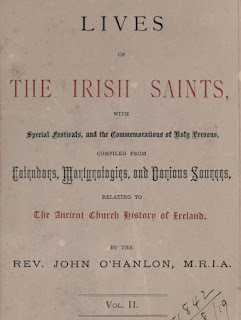
Category: Irish Saints

  • Saint Onchu of Clonmore, February 8

    February 8 sees the commemoration of a saint who was himself interested in collecting and preserving the relics of saints. However, when Saint Onchu visited the monastery of Clonmore-Maedoc, County Carlow and demanded a finger from its still very much alive founder, he got more than he bargained for. The Martyrology of Oengus reads:

    D vi. idus Febr.

    8. (Onchu), the splendid descendant of the sage, his speech was concerning Christ.

    and the notes to the entry say:

    descendant of the sage etc., i.e. Onchu his name : in the oratory of Relic na n-aingel (the Angels Graveyard) in Cluain mor Maedoc he is.

    A good poet was he, and to this he gave heed, to collect the relics of Ireland’s saints. He used not to stay in any church without some of (the saint’s) relics being given to him. So that he had a great shrine of the saints’ relics which he had collected. Now he went to Cluain mo Maedoc i.e. Maedoc hua Dunlaing of Leinster, and not Maedoc of Ferns. Maedoc happened to be alive before him.
    “Somewhat of thy relics (cut) off thee for me, O cleric, that they may be along with these relics.” 
    “That is hard,” says the cleric. “It is to be done, however,” says the poet. So the cleric cuts off his little-finger and gives it to the poet. Then the cleric is pained thereby, and he declared: “What thou hast collected,” says he, “will be here, and thine own relics also.” And this has been fulfilled.

    Splendid descendant of the sage, i.e. in Cluain mor Maedoic he is, i.e. of Connaught is he. ‘Tis he that collected the saints’ relics in the oratory of the grave-yard of Cluain mor Maedoic.

    The later Martyrology of Donegal confirms Saint Onchu as a collector of relics and the connection to Clonmore but also adds that he was likened to Saint Ambrose:

    8. D. SEXTO IDUS FEBRUARII. 8.

    ONCHU, Mac in Eccis, of the Connacians. It was he that collected a great deal of the relics of the saints of Erinn to Cluainmor-Maedhog.

    A very ancient vellum old book, which we have mentioned under Brighit, at 1st February, states, that Mac-in-Eccis was, in his manners and life, like unto Ambrose.

    Canon O’Hanlon’s account of Saint Onchu summarizes the entries from other calendars:

    The ancient calendars of Ireland contain allusions to this holy pilgrim, at the present date. Thus, on the 8th of February, the Martyrology of Tallagh registers Hua ind Egais, who collected the relics of the saints. We are further informed, that his discourses were always regarding Christ. The Calendars of Cashel and of Marianus O’Gorman celebrate, likewise, the characteristics and pursuits of this most religious poet. In the Kalendars of Scotland, our saint was likewise celebrated. The Kalendar of Drummond enters the natalis of the confessor Oncu, at the vi.Ides —corresponding with the 8th—of February, in the island of Hibernia.

    He adds:

    The Irish name for this saint was Onchu; and Colgan says, that word means ” a water-dog” or “leopard.”… Having visited St. Finian the Leper, this latter holy person was urged to undertake a pilgrimage, in company with our saint. Onchu wished to journey through all parts of Ireland, visiting various hermitages, cells and monasteries, where saintly men dwelt, at that time, or during any previous period, so that he might collect together relics, at the different localities, hallowed by connexion with those servants of God. Impeded by his infirmity, St. Finian declined, however, assenting to this proposal. He even sought to dissuade Onchu from such a purpose, saying it was decreed, both of them should die in that place, where they then were. From this account, and sequel of the narrative, it would appear, that the place, at which St. Finian and St. Onchu held this interview, must have been at Clonmore, in the county of Carlow. Nevertheless, our saint, full of his pious intention, resolved on prosecuting his journey alone, and immediately he set out on his travels. The holy man formed his resolution of visiting each place, throughout our whole island, in which he thought there might be the most remote chance for discovering or procuring relics, of any Irish saints. He had hoped, that such a collection might afterwards serve to increase devotion, and preserve the memory of those pious servants of God, among the people. Such purposes he accomplished; for, whatever monastery or cell, he visited, furnished some contribution to the store, he had previously acquired. Not only did he obtain memorials of the dead ; but, he received even certain gifts or articles, from pious men, whose reputation for sanctity had been already established, in the Irish Church. All of these precious treasures, Onchu deposited, in the same reliquary.

    …having nearly accomplished his original purpose, he came to the flourishing monastery of Clonmore, in Leinster, over which the illustrious Maidoc or Aidus, son to Eugenius of the Leinster family, then presided as abbot. St. Onchu received kind hospitality, and he demanded some memorial from this holy superior. Through humility, however, Maidoc refused such a request ; when, it is said, his finger fell to the ground in a miraculous manner. Our saint immediately took it up, and placed it among his other relics. Having felt pain, caused by the loss of his finger, St. Maidoc was moved by Divine inspiration, to cry out: ” All the relics thou hast collected must remain in this place, and thy remains shall be with them.” The event justified this prediction ; for, the precious reliquary, with its contents, was preserved long afterwards, in Clonmore monastery. The prophecy of St. Finian, the Leper, was also fulfilled, for his bones reposed, together with those of our saint near the cross, to the south of it, in the adjoining cemetery. There, St. Onchu found his last resting place on earth. When he died, too, at Clonmore, all his relics were there religiously preserved.

    St. Onchu lived, probably, during the time when Aid, the son of Ainmireach, King of Ireland, reigned, from about the year 568 to 594, since our saint was contemporaneous with St. Maidoc of Clonmore, said to have been an elder, and a uterine brother of that monarch Aid.

    Content Copyright © Omnium Sanctorum Hiberniae 2012-2015. All rights reserved.
  • Saint Tressan of Mareuil, February 7

    February 7 is the commemoration of an early Irish missionary saint who laboured in France in the sixth century. Canon O’Hanlon bases his entry in the Lives of the Irish Saints on the Acts of the Saint used by the 17th-century hagiologist Father John  Colgan, which testify to Saint Tressan’s humility, sanctity and miracles. They include some motifs which occur in the lives of other saints, for example, water is made to flow from a dry place through the staff of the saint and his ultimate resting place has to be decided by heavenly intervention. Canon O’Hanlon takes up the story:

    ARTICLE I.— ST. TRESSAN, OR TRESAN, CONFESSOR, AT AVENAY, FRANCE.

    [FIFTH AND SIXTH CENTURIES.]

    The Acts of Tressan are compiled from a MS., which belonged to the monastery of St. Remigius, at Rheims. Colgan thinks it was at least a document old as the tenth century. Flodoard, a writer, who lived in that century, treats of this holy man and of his brothers, in the history of Rheims. He seems also, to have read these Acts. St. Tressan’s old Life is included in Colgan’s work, and this is followed by an appendix, comprising three chapters.

    St. Tressan had six holy brothers, viz. : Saints Gibrian, Helan, German, Veran, Aleran, Petran, and three sisters, Fracla, Promptia, and Posemna. All of these were very devout persons, who despised the things of earth, that they might aspire only to those of Heaven. Elsewhere, the names of those brothers and sisters are spelled in a different manner. They are mentioned, also, by Flodoard. They were natives of Hibernia, where Tressan heard the voice of God proclaiming to him these words, formerly addressed to Abraham “Go forth out of thy country, and from thy kindred, and out of thy father’s house, and come into the land, which I shall show thee.” Afterwards, Tressan sought a secret place for his dwelling, where he might more freely serve God in solitude; but, whether this was in Ireland, or in France, his Acts do not render sufficiently plain.

    Suspicions are entertained by Colgan, that the present saint, his brothers and sisters were the children of a certain Goill or Gallus. It is mentioned, in the Life of St. Ailbhe, that when returning from Rome to Hibernia, he left some of his disciples, the sons of Guill, in a monastery he had erected in Gaul. Now, the time is thought well to accord; for, St. Ailbhe was a contemporary with St. Patrick, and he is calculated to have lived, from A.D. 450 to 520. He was also contemporaneous with St. Tressan, his brothers and sisters. These holy persons, too, settled in Gaul. Another circumstance is somewhat remarkable; for, one of these brothers was named German, and we actually have a German, son of Gaill or Goill, noticed in our Calendars. Yet, although those brothers and sisters were distinguished for their sanctity, all are not noticed separately, in our Irish Martyrologies.

    Wishing to lead the life of a pilgim, Tressan went to France, taking along with him six brothers and three sisters, whose names have been already given. But, being simple-minded and ignorant to a degree, this pious man was regarded as an idiot; and, when resolved to earn his livelihood, by some kind of menial service, he retired to a village, supposed to be Murigny, in the Duchy of Rheims, on the banks of the River Marne.

    Here, a native of the place, finding him to be an Irishman born, and quite ignorant of the Frankish language, set him to the humble occupation of tending swine. According to Sigebert’s chronicle, Tressan was in France A.D. 509. Faithful to his charge, and mindful of the Apostolic mandate, “Servants, be subject to your masters with all fear,” the lowly swineherd carefully governed all the movements of his soul. This happened, it is stated, while St. Remigius lived in that part of the country.

    According to his Acts, Tressan was an illiterate man; yet, he was a very religious and a very good Christian. A church, dedicated to St. Martin, happened to be in the village of Murigny; and here, a priest had been engaged reciting matins, and in celebrating the solemnities of Mass. Not loosing sight of his herd, Tressan would steal towards the doors of the church, while he endeavoured to learn all he could regarding the sacred rites. And the Lord was pleased miraculously to reward this holy thirst for science, by filling his mind with a knowledge of letters. It would appear, Tressan had unwittingly excited the prejudice of certain rustics, in that place, known as Ay; for, when St. Remigius visited a village near it, and which was called Villare in Silva, or Villiers en Selue, these peasants accused the poor Scottish swineherd, for having caused their vineyards to be injured, their fields and meadows to be grazed and trodden down, through his neglect. But, St. Remigius was not the bishop, to hear a one-sided accusation, without sifting its truth : he sent a messenger for Tressan to appear, and when he did so, the holy prelate, fully convinced of his innocence, consoled him with gentle words, while he drove the malignant accusers away from his presence. The old author of our saint’s Acts relates, that unjustly accused man afterwards stood on an elevated spot, known thenceforward as St. Tressan’s Mount, where he had collected the herd of swine together, with a view of bringing them to the homes of their owners. Looking towards Ay, in the spirit of prophecy, he exclaimed: “You, who have falsely accused me to the high priest of our Lord, shall pass out of this life, when you have lived to the age of thirty years, nor will your worldly substance increase; thus, it shall be better, that you receive punishment here, rather than suffering without end, in the other world.” The Almighty was pleased to make good these words of his faithful servant; and, to the time when his ancient Acts were written, the people remarked, how the descendants of St. Tressan’s accusers never lived beyond the thirtieth year, that they were obliged to subsist by manual labour, to be in want, and even to beg for the necessaries of life. Returning the swine to their rightful master, Tressan, thenceforth, devoted himself entirely to God’s service.

    After some years, having acquired sufficient learning, he went to the town of Laon, in the province of Picardy. Genebald or Genebaud had been ordained its first bishop by St. Remigius. On the recommendation of St. Genebaldus, Bishop of Laon, who admired the humility, good dispositions, and progress he had made in learning, Tressan was ordained priest by St. Remigius, when the requirements of the canons had been fulfilled. Thus was he chosen, by one of God’s elect, and blest, by a saint. St. Remigius, before taking leave of Tressan, exhorted him regarding the manner in which he should serve at the altar; he also comforted and encouraged this disciple. In our saint, he found a truly good subject; for, Tressan fasted and prayed almost continuously, while he crucified the flesh, with its vices and concupiscences. He avoided all snares of the enemy; he despised the things of this world; he gave alms to the poor, and spent much time in vigil. So closely did Tressan adhere to God’s law and to the works ordered by Christ, that he might be regarded as being with him, both in soul and body.

    After his ordination, Tressan chose for a place of residence Marogillus, or Marville, where a church had been dedicated to St. Hilary, Bishop of Poictiers. Tressan stopped in the territory of Rheims, near the Marne, during the time of Bishop Retnigius. He preached with great zeal, while in France. Serving the Lord most faithfully, at the church of St. Hilary; he had a church near it, which had been consecrated in honour of St. Martin, the holy Bishop of Tours. He was wholly intent on the worship of God, and his manner of life was extremely simple. While there, an inhabitant of the place came to make a confession to him, and then devoutly asked the saint to offer prayers for his salvation. Knowing, likewise, that the Lord would return, hereafter, and in a hundred-fold measure, whatsoever should be given to his holy minister, the devout penitent besought his confessor to receive a small gift. Knowing his earnestness and sincerity, Tressan assented to a request he made, for bestowing a meadow that was near, to serve as pasture for an ass. This meadow lay within the bounds of Ay village, and afterwards it went by the name of our saint.

    One day, having celebrated the Matins, Office and Mass, in the church of St. Martin at Murigny, and while returning to Mareville, he felt wearied, and he sat down on the side of a dry hill, from which water had never flowed. Fixing his staff in the ground, the wearied saint fell asleep; but, on awaking, he found the staff had grown into a tree, which was covered with a bark and green leaves. At the same time, a fountain of most delicious water ran from the root of this tree, to the very foot of the mount. When the holy priest, Tressan, witnessed this, he drank from the well, and he asked of the Almighty, that no injustice or turpitude should there occur. It was regarded as a “holy well,” while several persons, troubled with tertian and quartan agues, came thither, drank of its waters, and were cured. After the Lord had manifested these and other wonders of His glory, through this humble servant, Tressan was seized with a fever. He then called various priests and clerics around him, confessing that he was a sinner and an unworthy priest, having offended God, and having injured his fellow-men. Lying on the bed, in his last agony, he was consoled by his visitors, while with great humility and contrition, he received the sacraments of reconciliation. Then he cried out : “Dearly beloved brethren, be ye comforted in the Lord, and. in the power of his virtue, according to that word of our Redeemer, “Walk whilst you have the light,” and according to that saying of the Prophet David, “the fear of the Lord is the beginning of wisdom.” Then he added : “Meditation on death is the beginning of wisdom.” He afterwards asked for Holy Viaticum. Rising from the bed, and lying prostrate on the ground, he exclaimed with heartfelt devotion :

    “Hail, our most happy Hope! hail, our holy Redemption! Hail, most holy Body of Christ, more precious and dear to me than gold or topaz, and sweeter than the honey or the honeycomb. Hail! most adorable Blood of Christ, mercifully shed for our sins, and given as the price of our redemption. Hail! Jesus Christ, son of God, may thy power defend me from the snares of my old enemy, and may the prince of darkness meet me not. As thy servant, I pray you make me appear the last in order among your saints.”

    Saying these words, he received the Body and Blood of Christ. Then, when lifted into bed, with eyes and heart directed towards Heaven, where all his hopes were centred, his happy soul flew to bliss. There for ever his spirit shall enjoy the beatific vision of God.

    Tressan seems to have spent a great part of his life, in the diocese of Rheims, near the River Marne. And, at the very moment, when his spirit was exhaled to Heaven, a most fragrant odour spread around, so that those who were present declared, nothing they had a sense of before could be compared to it.

    Having thus distinguished himself by his great piety and various miracles, on the Ides or 7th day of February, the priest of Christ, Tressan, finished his temporal agony, to receive a good and an eternal reward, from the Supreme Remunerator. The priests and others, who were present at his death, began to arrange for his interment. It was proposed to deposit his remains in the Church of St.Hilary, at Mareville, as he had so long served the Lord in that place. Yet, when the attempt was made to lift his corpse, all efforts proved vain. Again, it was thought well to have the coffin brought to the monastery of Altovillarense or Haultvilliers -yet, the trial proved unavailing. Then, it was resolved, to yoke a pair of bullocks to a waggon, and to leave the disposal of Tressan’s holy remains to the direction of Providence.

    We read in the Old Testament, that the satraps of the Philistines placed the Ark of the Lord on a new waggon, and then yoked kine to it that had sucking calves. The Ark was brought thus in a direct line to Bethsames. Now, as the Ark represents the Church of Christ, and the kine its doctors, so was a holy son, and servant of the Church, brought with tears and requiem psalms, by doctors of the Church, to the very spot the Lord Himself had designated. When the yoked oxen brought that waggon to a certain spot, they were not able to proceed further, and there it was determined to inter the remains of St. Tressan. He died curate of Mareuil, and he was buried at Avenay, in Champagne. This the attendants regarded as decreed by supernatural agency. The Bollandists justly observe, certain writers are wrong in saying, that the bodies of St. Tressan and of his holy brothers and sisters rest in Rheims. The Acts of our saint place his relics at Avenay; and, there is no authentic account of their having been removed. The relics of this holy man are said to be in Pont-aux-Dames, in Brie. In art, he is represented with a budding staff, to indicate the miracle contained in his Acts.

    Content Copyright © Omnium Sanctorum Hiberniae 2012-2015. All rights reserved.
  • Saint Mel of Ardagh, February 6

    On February 6 the Irish calendars commemorate a saint with close links to Saint Brigid, Bishop Mel of Ardagh. He is also linked to Saint Patrick, with a number of sources claiming that he is the nephew of the apostle to the Irish, being the son of his sister Dareca. This woman was reputedly a mother to no less than seventeen early Irish bishops and saints, which has led some scholars to speculate that she may have been a mother in the spiritual, rather than the biological, sense. Saint Mel figures most prominently in the Life of Saint Brigid by being the bishop who conferred the veil of the religious life upon her.  We can turn now to Volume 2 of Canon O’Hanlon’s Lives of the Irish Saints for an account of Saint Mel’s life:

    THE festival, commemorated by the Irish Church, on this day, recalls to our minds, that gratitude we owe to our early Christian missionaries, who helped to gather and labour, in the same field of noble enterprise with St. Patrick… This renowned saint is classed among the primitive fathers of our Irish Church. He was a contemporary, and, it has been asserted, a near relative to the great Apostle, St. Patrick. At the very dawn of Christianity in our island, an illustrious champion and preacher of the Gospel had been already prepared, for a strenuous encounter, with the spirit of darkness. He is named Mel or Melus, in old Latin acts; and, this title was typical of those honied stores of Divine wisdom and of saintly qualities, which had been hived within his breast. A special Life of this holy man is not known to exist. From various ancient Acts of St. Patrick, and of St. Brigid, as also from other sources, Colgan has compiled a Life of St. Mel, and he has admirably annotated it. In like manner, the Bollandists have inserted Acts of Saints Mel, Melchuo, Mune, and Rioc, Bishops, at the 6th day of February. From these authorities shall we chiefly draw succeeding materials, to render intelligible the recorded actions of the holy Bishop Mel, the special patron of Ardagh diocese.

    He seems to have been born, in the earlier part of the fifth century. It is said, Saint Mel or Melus was a nephew to the great Irish Apostle Patrick, and whose sister Darerca is named as Mel’s mother.

    St. Mel built a famous monastery at Ardagh. At this place, also, it is recorded, he exercised the jurisdiction both of abbot and of bishop. Among other celestial endowments, our saint received the gift of prophecy, whereby he was enabled to predict future events. This was exemplified in St. Brigid’s case, and soon after he had arrived in Ireland from Britain. He foretold the greatness and sanctity of that holy virgin, while yet carried in her mother’s womb. Some time subsequent to St. Brigid’s birth, St. Mel administered to her the Sacrament of Confirmation. In conjunction, probably, with his disciple St. Machaille, Mel likewise bestowed the religious veil on that youthful spouse of Christ. Afterwards, the greatest friendship existed between our saint and the future abbess, as recorded in St. Brigid’s Life.

    St. Brigid seems often to have visited St. Mel, when she resided not far from Ardagh. At one time, the king of that district entertained both these holy personages ; and,- a remarkable miracle was wrought by the illustrious abbess, at a banquet, given in their honour. The kindness of St. Mel, interceding with the king for a supposed transgressor, on this occasion, pleasingly illustrates the holy bishop’s character. St. Mel and St. Moelchu—both being regarded as distinct—are stated to have accompanied the abbess, to a synod, which was held at Tailten, in Meath.

    It is said, that St. Mel wrote the Acts, virtues and miracles of his uncle, St. Patrick, while this latter holy man had been living for, the great Apostle of Ireland is supposed to have survived our saint five years. For his death, a.d. 466 has been assigned. Mel departed this life, at Ardagh, however, about the year 487 or 488. St. Oengus the Culdee, the Martyrology of Tallagh, Marianus O’Gorman, Cathal Maguire, and the Martyrology of Salisbury, record this holy bishop’s festival, at the present date. It was probably that of his death, which is usually assigned to the 6th of February, and according to accounts left by our Irish hagiographers. This corresponds with the 8th of the February Ides.

    Notwithstanding the celebrity of this saint, Mel, Epis.—meaning bishop— is the only entry, in the Martyrology of Tallagh, concerning him. Besides this, we read, in the Martyrology of Donegal, as having a festival on this day, Mel, Bishop of Ard-achadh, in Tethbha. He was a disciple of Patrick, according to the same authority ; but, nothing has been noted, about his relationship. Mel is regarded, as the first bishop over the see of Ardagh, and, he has been constantly venerated as the special patron saint of that diocese.

    The Martyrology of Donegal entry reads:

    6. B. OCTAVO IDUS FEBRUARII. 6.

    MEL, Bishop, of Ard-achadh in Tethbha, disciple of Patrick, A.D. 487. Darerca, sister of Patrick, was his mother.

    and the Annals of the Four Masters records his death thus:

    The Age of Christ 487. The ninth year of Lugaidh. Mel, Bishop of Bishop of Ard-achadh, in Teathbha, disciple of Patrick died.

    Note: The picture below shows a painted scene of Saint Mel and Saint Brigid preaching to the people of Ardagh. It is from Saint Brigid’s church in Ardagh, County Longford.

    Content Copyright © Omnium Sanctorum Hiberniae 2012-2015. All rights reserved.