Category: Irish Saints

  • Saint Cele Christ, March 3

    On March 3 the Irish calendars commemorate a saintly bishop who rejoices in the name of Cele Christ. Although a descendant of the northern line of Niall of the Nine Hostages, he flourished in Leinster in the eighth century. The Martyrology of Donegal entry reads:

    3. F. QUINTO NONAS MARTII. 3.

    CELE-CHRIST, Bishop, of Cill-Cele-Christ in Ui-Dunchadha in Fotharta in Leinster. He was of the race of Eoghan, son of Niall.

    Canon O’Hanlon summarizes what is known of him:

    This devoted servant of Christ, in after time, deserved well the name he seems to have obtained in baptism, of Cele-Chriost, Latinized, Christicola, i.e.”worshipper of Christ.” He descended from an illustrious family… Judging by the date assigned for his death, this holy man must have been born about, or after, the middle of the seventh century. His birth probably took place, in the northern part of Ireland, inferring from his family pedigree. But, he resolved on leaving Ulster, and betook himself to a place called Hi-Donchadha, in the western part of Leinster. It is also said to have been in Fotharta. Here he erected a cell, which is called Cella-oc. It may be asked—and the situation warrants such suspicion—could this have been the place, which subsequently had been converted into the denomination of Templeoge, where [the] present form of the name would lead one to believe, that it means ” little temple” or ” church.” Probably at some former period, it obtained the appellation Kill-Cele-Chriost, or “the cell of the worshipper of Christ,” in honour of the founder’s name.

    Besides this church, as noted, the district of Ui-Dunchadha contained the church denominations of Cill-mochritoc, on the banks of the Dodder, i.e. Achadh-Finnigh—already identified with Finnmagh—and Cill-na-managh, in the parish of Tallagh. Here Cele-Chriost desired to spend his days in retirement, and solely engaged, in Divine contemplation. Yet, although declining ecclesiastical rank, it was urged on him as a duty, when he accepted the office of bishop. It is stated, that he felt a great desire to make a pilgrimage to Rome, and that taking a band of companions with him, Cele-Chriost set out for this purpose. On the way, however, they were proffered hospitality, by an evil-minded man, who really intended their murder, to obtain money he supposed them to possess. The pretended host fastened his door, on the outside, when the strangers entered his house. These, suspecting an evil design, took counsel among themselves, as to what should be done, when Cele-Chriost addressed them as follows :”This seems to me the best course for you to adopt ; allow me to take charge of your effects, and to collect them into one wallet, so that when he comes to take your lives, and when he opens the door of your enclosure, let each one of you rush out who can escape with life.” His companions cried out: “Caoin-erain.” This is rendered, in Latin:”Bonum concilium invenisti.” It is more than probable, the Irish designation, in the text, should read, cain airle which means “good counsel.” This was agreed upon, and the consequence was, all safely obtained their freedom. Afterwards, we are told, our saint bore the name Cele-Christus, Coin-erael. Little more is known regarding him, save that he returned to Ireland, and died A.D. 731 or 732, having been buried, in his church, at Cill-oc. The Annals of Ulster defer his demise to the year 726. Colgan and the Bollandists have some notices regarding him, at this day. His church was situated, in the district of Ui Dunchadha, that, through which the River Dodder, near Dublin, flowed. The Mac Gillamocholmogs ruled over it, and their lands extended southwards to Glen Umerim or Glanunder, now Ballyman, on the confines of Dublin and Wicklow counties. There seems to be great difficulty in identifying the exact site of this ancient church.

    Duald Mac Firbis records under the heads of Both Ghonais and Gill Cele Christ, the Bishop Cele-Christ, of Cill-Cele-Christ, at the 3rd March. In Hy Dunchada, in the Fotharts of Leinster, he adds, is the church of Cele-Christ, of Both Chonais.

    The Feilire of St, Oengus, in the “Leabhar Breac,” has his commemoration, at the 3rd of March; while, the Martyrology of Tallagh, likewise, enters the name of Celicriist. Marianus O’Gorman has even a more detailed statement. The Martyrology of Donegal, at the same date, has Cele Christ, Bishop of Cill-Cele-Christ in Ui Dunchadha, in Fotharta, in Leinster, with the statement, that he sprung from the race of Eoghan, son to Niall. In the Kalendar of Drummond his feast is this day noted. It is supposed possible, that the name of Christ Church, Dublin, may have been derived from this Cele Chriost, a saint of high reputation.

    Content Copyright © Omnium Sanctorum Hiberniae 2012-2015. All rights reserved.

  • Saint Fergna Britt, Abbot of Iona, March 2

    On March 2 the Irish calendars commemorate no less than three saintly abbots of Iona (Ia, Hy), successors to the great Saint Colum Cille. We will begin with Saint Fergna Britt, the fourth successor to the founder, and the account given of him by Canon O’Hanlon’s Lives of the Irish Saints:
    The Acts of St. Fergna, or Fergnaus, drawn from various writers, have been published by Colgan, at the 2nd of March. The surname Britt, which signifies a “Briton,” was derived, in Colgan’s opinion, from his having lived in Britain; but, the Rev. Dr. Reeves thinks, that probably more is implied in such an epithet, than is found recorded. He belonged to the race of Conall Gulban, son to Niall, and he was son to Failbe, belonging to the family of Enna Boghaine. Fergna was born, probably after or about the middle of the sixth century, having been a member of the community in St. Columba’s time. He is called Virgnous, by Adamnan, who describes him as being a youth of ardent piety. St. Oengus the Culdee and the Calendar of Cashel designate him, by an epithet meaning “white” or “fair.” He appears to have presided over the religious community, at Iona, from A.D. 605, to 623, having immediately succeeded St. Laisren, or Laisrien, who died on the 16th of September, in the former year.

    It is said, that St. Fergna had lived for some time with St. Lugudius, Abbot of Cluain-Finchuil, or Cluain-Fiacul, “in Ireland;” but, this Fergnous or Vergnous is clearly a different person. Both are confounded, however, by Colgan, who represents St. Fergna, as the disciple of St. Columkille. He was the fourth abbot, in succession; but, not so nearly related, to St. Columba, as his predecessors. Fergna’s death is noted, at A.D. 616, in the Annals of Inisfallen; at A.D. 622, by the Annals of the Four Masters; and, at A.D. 623, by the Annals of Tighernach, and by the Rev. William Reeves. The 2nd of March is supposed to have been the day of his death. Simply the name Fergna, Abbot of Ia, is found in the Martyrology of Tallagh, at the same date. St. Oengus the Culdee notices him, at the 2nd of March, as likewise Marianus O’Gorman; but, in the gloss to his Calendar, Fergna is styled bishop. Yet, this is thought to have been an incorrect designation; in so much as the precedent, so recently established, in Iona, by the founder, could hardly have been departed from, in the case of its fourth abbot.

    Besides, a century afterwards Venerable Bede asserts, that in Iona they were always accustomed to have its ruler, a priest abbot. The Martyrology of Donegal mentions, as having a festival on this day, Fergna Britt, son of Failbhe, Bishop. In the entry of his name, by the compiler of a table added to this Martyrology, it is Latinized, Virgnous. In addition, Duald Mac Firbis enters Fergna Britt, Bishop and Abbot of Ia-Coluim-Cille, at March 2nd. At this date, likewise, the Carthusian Martyrology records his feast. At the 2nd of March, the Drummond Kalendar observes, that the Abbot Fergna, of the Hy monastery, went to Christ. In Ireland, this holy man seems to have had his office recited in nine lessons, as we learn from an old Antiphonarium, belonging to the Library of Trinity College, Dublin.


    Content Copyright © Omnium Sanctorum Hiberniae 2012-2015. All rights reserved.
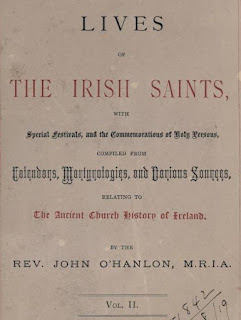
  • Saint Comgan of Gleann Ussen, February 27

    On February 27 we commemorate an Abbot of Gleann Ussen, modern Killeshin, County Laois. There is some confusion around the identity and period in which Saint Comhghán (Comgan, Comhdan) flourished. Some of this has arisen due to conflicting accounts about his pedigree in the Irish genealogies, but also because of the attachment of the suffix ‘cend-inis’ to his name in some of the calendars. This is found in the entry in the Martyrology of Oengus for 27 February:

    With the suffering of Abundus,
    Great his gifts of poems ;
    The feast of Comgan, Cend Inis,
    The finding of the head of
    John [the Baptist].

    In the nineteenth century Margaret Stokes translated this epithet as meaning ‘without reproach’, but some of the earlier hagiographers appear to have believed that Cend Inis (Ceann Innis or Kean-Indse) was a place in Munster associated with the saint and assigned him to the period of the seventh century. Canon O’Hanlon, however, believes that he actually belongs to the ninth century and is more firmly associated with Gleann Ussen. As he explains:

    That St. Comgan was connected with Gleann-Ussen appears, from the authority of the Menelogium Genealogicum, the Martyrologies of Tallagh, of Cashel and of Marianus O’Gorman. This was the name of a remarkable glen, situated in the territory of Hi-Bairche, about two Irish miles to the west of Carlow. There exists a considerable portion of the ruins of an ancient church, called Cill Ussin, anglice Killeshin.

    At Killeshin, St. Diarmaid or Diermit is said to have built or presided over a church or monastery; and, this must have been as late as the ninth century, if we are to identify him with that Diarmaid, Abbot of Gleann-Uissean, whose death is recorded at A.D. 874. Now, Comgan is generally allowed to have succeeded him ; but, at what particular date is not clearly ascertainable, for we cannot find any well-known allusion to him in our Annals.

    We find him placed after St. Diarmaid, in the government of Killeshin Monastery, and he cannot have enjoyed this position, before the close of the ninth century. Probably this was about the time, when our St. Comgan was abbot over that establishment.

    At this day, he is commemorated in our Irish Calendars. We find the simple entry, Comgan, of Gliuni Usin, inserted in the Martyrology of Tallagh, at the 27th of February. St. Oengus the Culdee, likewise, has placed his festival in the Feilire. The Martyrology of Donegal reads:

    27. B. TERTIO KAL. MARTII. 27.
    COMMAN, Mac Ua Theimhne.

    COMDHAN, [i.e., Diarmaid,] of Glenn-Uissen, son of Diarmaid, son of Deghadh, of the race of Cormac Cas, son of Oilill Oluim ; and Ethne, daughter of Feidhlimidh, son of Tighernach, was his mother.

    The Kalendar of Cashel, the Martyrology of Marianus O’Gorman, and the Martyrology of Cathal Maguire, have entered his festival, at the 27th of February. This holy man appears to have been greatly venerated, in Ireland, where his Office, containing nine Lessons, was formerly recited.

    At the iii. of the March Kalends, or at the 27th of February, we learn from the Kalendar of Drummond, that in the Island of Hibernia, the Natalis of the holy Confessor Comgan, who went to Christ, was celebrated. No further biographical statements, in reference to him, have been preserved.

    In his authoritative 2011 Dictionary of Irish Saints, Pádraig Ó Riain upholds Saint Comhghán’s identification with Killeshin and that cen dinnis means without  reproach. He has been confused with another saint Diarmuid of Gleann Uisean, but they are two distinct individuals. Ó Riain suggests that the importance of Gleann Uisean is reflected in its early twelfth-century ‘chief teacher’ Duibhlitir Ua hUathghaile who wrote a version in Irish of the Sex Aetates Mundi, the Six Ages of the World. Saint Comhghán himself appears in a list of saints whose aid is sought for the men of Leinster in a poem attributed to Saint Moling. Saint Comhghán thus seems to be a good example of a saint who was once  ranked as an important saint of Leinster with a notable monastic foundation, but who is now shrouded in obscurity.

    Note: This post was first published in 2012 and revised in 2024.

    Content Copyright © Omnium Sanctorum Hiberniae 2012-2015. All rights reserved.