February 1 is the feast day of Saint Brigid of Kildare, secondary patron of Ireland and the most well-known and well-loved of all our female saints. She shares her day, however, with a number of other lesser-known holy ladies, one of whom is Saint Cinnia (Cinne, Cionna), a 1928 account of whom I came across whilst browsing the Australian newspaper archives. Newspapers there syndicated articles likely to be of interest to the Irish expatriate community and I have been struck by how many relatively obscure saints they included. Cinnia was part of a feature on ‘Irish Saints in Miniature’ along with the sisters Eithne and Fidelma and like them is claimed to be one of Saint Patrick’s early converts. It is clear that the writer of this account has drawn on the hagiography of Saint Patrick and in his 2011 Dictionary of Irish Saints Pádraig Ó Riain acknowledges the Tripartite Life as the source of the stories about Saint Cinnia, her father and her monastic teacher, Cathuberis (Ceachtamair) . He confirms too her association with Druim Dubháin, County Monaghan. The saint is also documented on the Irish calendars of the saints. At February 1 the name of Saint Cinnia is found on the Martyrology of Tallaght, and on the Martyrology of Gorman where she is described as Cinne chaemhfind,’ dear-white Cinne’, as well as on the Martyrology of Donegal. The newspaper account reads:
ST. CINNIA, VIRGIN. — February 1. St. Cinnia was the daughter of Eochod, chieftain of Oirgliialla (in Ulster). “Whilst still in the darkness of paganism, her father wished her to espouse Cormac, a descendant of the great Neill, King of Ireland; but some holy instinct urged her to refuse her consent. She was destined for a nobler spouse. When St. Patrick first arrived in her father’s territory (near Clogher), he came upon Cinnia in the forest. He spoke to her, instructed her in the faith and exhorted her to deserve the reward of virginity. Like SS. Eithne and Fidelma, she is. said to have’ been baptised by St. Patrick and to have received at his. hands the veil of virginity.
The Apostle then commended Cinnia. to the care of the holy virgin Cathuberis, who first of all women had received the veil from his hands. She was then ruling over a large community of nuns in the convent at Druimdubh (near Clogher). Here Cinnia prayed unceasingly for the conversion of her father; but he died without receiving the light of Faith. St. Patrick raised him to life, instructed him and gave him holy Baptism. Then to Eochod ha gave a choice:
. . .Yet awful more than beauteous. “Rule o’er earth, Rule without end, were naught to that great hymn Heard hut a single moment. I would die,” Then Patrick, on him gazing, answered : “Die!” And died the king once more.
— Aubrey de Vere.
In 482, St. Cinnia died. With St. Brigid of Fiesole and St. Darlua of Kildare, the favourite disciple of St. Brigid, St. Cinnia’s Feast day falls on that of the greatest of the Virgin Saints of Ireland— St. Brigid of Kildare.— “The Golden Hour.”
IRISH SAINTS IN MINIATURE. The Age (Brisbane, (1928, February 18). p. 20.
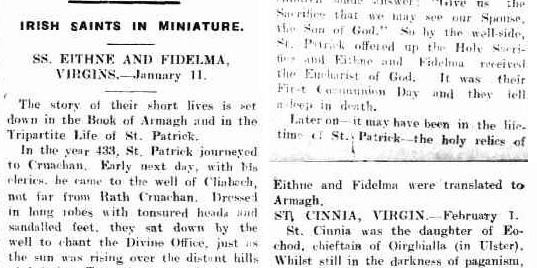
January 11 is the traditional date when we commemorate two female saints known from Patrician hagiography: Saints Eithne and Fidelma. As I explained in a previous post here, the origins of this feast day can be traced to the seventeenth-century hagiologist, Father John Colgan, who speculated that the otherwise unidentified Saint Fidelma (Feidhealm) whose name is found in the Martyrology of Tallaght on January 11, was Feidhealm Ruadh, sister of Eithne and daughter of King Laoghaire. Father Colgan further assigned February 26, when an otherwise obscure Eithne’s name occurs on the Martyrology of Tallaght as the feast day of Fidelma’s sister. Both sisters share their names with a number of other Irish women saints. But despite the uncertainties surrounding their feast days, there is no denying the beauty of their story as recorded by Saint Patrick’s biographer Tírechan and summarized below in a 1928 newspaper article. I was hoping that ‘Irish Saints in Miniature’ might have been a regular series but this was the only article I could trace. It did however, include another female saint, Cinnia, who shares her feast day with Saint Brigid of Kildare and so I will hold over that account until February 1:
IRISH SAINTS IN MINIATURE.
SS. EITHNE AND FIDELMA, VlRGlNS. — .January 11.
The story of their short lives is set down in the Book of Armagh and in the Tripartite Life of St. Patrick.
In the year 433, St.. Patrick journeyed to Cruachan. Early next day, with his clerics, he came to the well of Clebach, not far from Rath Cruachan. Dressed in long robes with tonsured heads and sandalled feet, they sat down by the well to chant the Divine Office, just as the sun was rising over the distant hills of Leitiim. Through the meadows came two young maidens remarkable for their extraordinary beauty. The elder of the two was of fair complexion and had golden hair: the other was of ruddier features crowned with auburn hair. They were Eithne “the Fair’ and Fidelma “the Red Rose” — the daughters of Laoghaire, High King of Erin. They came attended by their maids and by the Druids, Caplait and Mael. the fosterers of the Princesses. Seeing the clerics, dressed in strange garments and speaking strange words, they were lost in wonder. They knew not who these might be — fairy men or gods, of the earth, perhaps? Eithne the Fair spoke to St. Patrick: “Who is your God? Where is He? Is He beautiful? Is He ever-loving? Is He to be found? How is He to he loved? Shall we find Him in youth or in old age? Tell us this knowledge of God.”
Whereupon Patrick instructed them and they believed and he baptised them. He blessed a white veil — not the veil of the rite of baptism but the white veil of their virginity which they had consecrated to God — and placed it upon their heads. Then they asked to see the face of Christ. But the Saint said: “You cannot see the face of Christ except you taste of death and receive the Sacrifice before death. You must first with the mouth of your heart and of your body devoutly receive the Flesh and Blood of your Spouse. Thus being quickened with the Living Food and having tasted of death, you may pass into the starry bride-chamber.” The children made answer: “Give us the Sacrifice that we. may see our Spouse, the Son of God.” .So by the well-side St. Patrick offered up the Holy Sacrifice and Eithne and Fidelma received the Eucharist of God. It was their First Communion Day and they fell asleep in death.
Later on— it may have been in the lifetime of St. Patrick — the holy relics of Eithne and Fidelma were translated to Armagh.
November 6 is the Feast of All the Saints of Ireland, a feast established by Pope Benedict XV, who also granted an official Litany of the Irish Saints to the Irish Church in 1921. Below is an Australian view of the Feast, published a decade after its establishment. The Diocese of Maitland was one of the Australian dioceses which observed the feast and its official journal printed a stirring speech given by one of its former bishops who had ‘imbibed his Irish Catholic Faith from his good parents.’ Interestingly, in his address Bishop Dwyer does not allude at all to Ireland’s primary patron Saint Patrick, but instead gives pride of place to our tertiary patron, Saint Colum Cille. Although he pays tribute to the wider educational and cultural legacies of the Irish saints, for Bishop Dwyer the true message of their lives is the message of self-sacrifice.
The Feast of All the Saints of Ireland also marks the thirteenth year of this blog and so I thank everyone for their support of my work. Beannachtaí na Féile oraibh go Léir! Orate pro nobis omnes Sancti Hiberniae!
THE HOLY SEE HAS SANCTIONED A FESTIVAL IN HONOUR OF “ALL THE SAINTS OF IRELAND.”
The Feast is celebrated each year on the 6th of November.
Maitland is one of the Dioceses of Australia in which the Festival is to be observed. The late Bishop, Dr. Dwyer, had decreed so. Dr. Dwyer had imbibed his Irish Catholic Faith from his good parents. And his strong Irish Faith he held to the last. It is appropriate to record here that the last sermon preached by our late Bishop was a beautiful discourse on the Saints of Ireland, delivered by him in the Dominican Convent, West Maitland, on the Feast of St. Lawrence O’Tool, 14th November, 1930.
The Saints of Ireland! How numerous! How self-sacrificing they were! By their spirit of self-sacrifice and their zeal they accomplished great things. By their mortified lives they sanctified themselves. And they strove, and not without success, to impart the spirit of self-sacrifice to their fellow-countrymen.
Through their zeal they gave the light of the Gospel to many of the nations of Europe. Referring to the early ages of Christianity in Ireland, Seamus McManus writes (Story of the Irish Race, p. 196):
“A consuming thirst for knowledge and a burning desire for the spread of the Gospel, swept the eager land as a Lammas fire would sweep the powder-dry mountain side.”
True to the Celtic tradition the Irish Saint was always a scholar. Christianity and learning went hand in hand in Ireland from the beginning. Almost every one of her multitude of holy men became a scholar, and every holy scholar became a teacher. Thus we find that St. Carthage established his school at Lismore, St. Ciaran at Clonmacnoise, St. Finian at Clonard, and St, Comgall at Bangor. In fact these holy men covered the land with schools.
And in our day the Celtic tradition still lives. A recent writer has remarked that, in modern colonisation the Englishman’s presence is known by the existence of a Church, a cricket ground and a School of Arts. The presence of the Irishman is marked by the establishment of a Church, a Convent and a Catholic School. Thus to the present day the Christian School is the special concern of the Catholic Irishman.
During a recent debate in the Dail Eireann a member referred to St. Columba (Columcille) as “The greatest Irishman of all time.” And this greatest Irishman of all time was also a great Saint.
And Saint Columba was one of the kindest and one of the most gentle of men. Ex uno disce omnes. Here are a few gems concerning the renowned Saint from the pen of that graceful Irish writer, Mrs. Concannon, M.A. In “The Real Columcille,” quoting Adamnan who knew our Saint so well, she writes:
“For he was of Angelic aspect, polished in speech, holy in deed, of excellent disposition, great in council, for thirty years “on active service” as an Island Soldier …. and in all his occupations he was dear to all.”
“Dear to all!” “Your Saints are Cruel” wrote the poet in a fit of petulance, at the same time making full use of the “poetic license.” The real Saint is the gentlest of men. Such was Columcille.
Again hear Mrs. Concannon:
“How soft and tender that big heart of his was, innumerable instances show. When Brito, the first monk of his Community to answer the Summons, was dying in lona, the Abbot had to leave the death chamber. ‘And when the venerable man,’ says Adamnan, ‘visited Brito in the hour of his departure he stood a little while at his bedside, and blessing him, he quickly goes out of the house, not wishing to see him die.’’
“Most of his miracles were wrought,” the authoress continues, “to save from suffering the friends he loved. He sends his favourite messenger, Lugaid Laidir, on a long journey from Iona to Clogher with a little pinewood box he had blessed, to heal the broken limb of the Nun, Maugina. Later on when a plague fatal to both men and cattle was raging in Ireland, he sent Silnan with blessed bread that was to be dipped in water, then sprinkled over the humans and animals to their speedy cure. The greatest miracle of his saintly career, the raising to life of a dead boy, was wrought at the spectacle of the grief of a heart-broken father.” How like to the miracle wrought by our Lord in raising to life the young man of Naim who was “the only son of his mother, and she was a widow.”
And does not the instruction to one of his monks show us that St. Columba resembled the gentle St. Francis in his love of the birds.
“For from the Northern region of Ireland, a certain guest, a crane, driven by the wind, will arrive, very weary and its strength almost exhausted. It will fall and lie before thee on the shore, and thou wilt take care to lift it up kindly and carry it to a neighbouring hut; and there wilt hospitably harbour it and attend to it for three days and carefully feed it; at the end of three days refreshed and unwilling to sojourn longer with us, it will return with fully returned strength to the Sweet Region of Ireland, whence it originally came. And I thus earnestly recommend it to thee for that it came from the place of our own fatherland.”
In the early Christian ages the Saints and Missionaries of Ireland performed a wonderful work. They evangelised England and Scotland, France, Belgium, Germany, Switzerland and Italy.
Says Kuno Meyer (Introduction to Irish Poetry):
“Her (Ireland’s) sons carrying Christianity and a new humanism over Great Britain and the Continent became the teachers of whole nations, the counsellors of Kings and Emperors.”
Montalambert, in his “Monks of the West,” referring to England, says:
“The Italians, Augustine and his monks, had made the first step, and the Irish now appeared to resume the uncompleted work. But what the Sons of St. Benedict could only begin, was completed by the Sons of Saint Columcille.”
And Doctor Reeves writes: “St. Augustine arrived in England in 597, …. but Christianity made little headway in the provinces until Aidan began his labours in Lindisfarne in 634.”
The following words are from a tribute paid to Ireland, her Saints and Missionaries in an address which the Heads of German Colleges presented to Daniel O’Connell in 1844:
“We can never forget to look upon your beloved country as our Mother in religion, that already, at the remotest periods of the Christian Era, commiserated our people, and readily sent forth her spiritual sons to rescue our pagan ancestors from idolatry, and to bestow upon them the blessings of the Christian Faith.”
The Saints of Ireland had to suffer and endure in order that they might accomplish the work which Divine Providence had assigned them. The world may ignore, or even deride them, but God never forgets, and His reward is sure. Says the Book of Wisdom (Cn. v. 4 and 5):
“We fools esteemed their life madness, and their end without honour. Behold how they are numbered among the Children of God, and their lot is among the Saints.”
Devotion to the Saints of Ireland will teach us the Spirit of Self-sacrifice. It will also inspire us with zeal for the glory of God, and will help to endow us with true charity towards our neighbour.
The Newcastle and Maitland Catholic Sentinel. Vol. I. No. 2, NOVEMBER 2, 1931.

 OMNIUM SANCTORUM HIBERNIAE