Category: Irish Saints

  • Saint Finlugh of Tamlachtfinlagan, January 3

    January 3 is the feast of two saintly brothers, Fintan and Finlugh. Last year I looked at the life of Saint Fintan of Doone in a post which can be found here, now we can turn to the life of his brother Finlugh as recorded by Canon O’Hanlon in Volume 1 of his Lives of the Irish Saints:


    ST. FINLUGH, LUGAD OR FINN-LUGAIN, PATRON OF TAMLACHTFINLAGAN, COUNTY OF LONDONDERRY. [Sixth Century.]

    This holy man was brother to the preceding saint [i.e. Fintan of Doone], but whether senior or junior to him does not appear. He is variously named. Sometimes he is called Finlog or Finlugh, Lugad, Lagan, or Logha. The latter forms appear to represent his original name, to which the prefix Finn or Fionn, which signifies ” white” or “fair,” was afterwards added. This appellation was probably bestowed on account of some quality of complexion, or from the colour of his hair. He had the same father and mother as Fintan; and to the former biography the reader is referred for notices regarding them. At the 3rd day of January, St. Finlog, as well as his brother Fintan, was venerated at Dunbleisque, or Doone; and again do we learn from St. Aengus and his commentator, from the “Martyrology of Tallagh,” from the ” Calendar of Cashel,” and from Marianus O’Gorman, as also from the “Martyrology of Donegal” that St.Finlog had been venerated at Tamlacht Finnlogha, or Finlagan, in the territory of Cianachta Glinne Geimhin, on this same day. Finlog seems to have been originally the disciple of his brother, at Dunbleisque, where, as has been- already related, it was predicted that he should pass over the sea, and die an exile from the country of his birth. In the former life we have already related the manner of his departure. It is thought probable, that he went to Iona, and that he was the identical Findluganus, who interposed to save the life of his great master, St. Columkille, in the island of Hinba. We are informed, that while living here St. Columkille had resolved on excommunicating certain oppressors of religious houses. Among these, Joan, the son of Conall, was especially conspicuous. One of his wicked associates was called Lamh Dess. Instigated by the devil, he rushed on the saint with a spear intending to kill Columba. To prevent this dreaded result, one of the brethren, named Findlugan, put on the saint’s garment and interposed his person, being ready to die for sake of the holy man. But St. Columba’s garment served as a kind of strong and impenetrable shield, which could not be pierced by the thrust of a very sharp spear, although made by a powerful man. The brother who wore it remained safe and uninjured under divine protection. The ruffian who attempted this outrage, and whose name is found Latinized Manus Dextra, retired, thinking he had transfixed the saint with his spear. Exactly one year afterwards, when the saint was in the island of Hy, he said: ” A year has just now elapsed since that day when Lamh-dess did his best to put Findlugan to death in my place, but that man is now slain, as I believe, and on this very hour.” So it happened; for at that moment, according to the saint’s revelation, in an island which is Latinized “Longa,” in English, “Long Island,” a battle was fought between a number of opposing warriors. Lamh-dess alone was slain by Conan, son of Baithen, and transfixed with a dart. It is said, this stroke was given in the name of St. Columba.

    After the fall of Lamh-dess the battle ceased. Whether these events occurred before or after what remains to be noted regarding St. Finlog cannot very clearly be ascertained. Again, St. Columkille is said to have founded a religious establishment at a place near Lough Foyle, in the barony of Kenaught, county of Londonderry. The townland is called Tamlacht. Over the house thus established the great father of Irish monasticism placed his disciple, Finlog, as first abbot. Hence the place seems to have derived its appellation of Tamlachtfinlaghan. It is now a parish in the diocese of Derry. The place of the old monastic site is marked by a much frequented cemetery, within the enclosure of which are the ruins of an old church. Whether any portion of this building dates back to the time of St. Finlog may very fairly be questioned…

    Besides his cultus at Tamlacht Finnlaghan, and Dunbleisque, St. Finlog appears to have been venerated, likewise, on the island of St. Finlagan, where are the ruins of a small chapel dedicated to him. That island lies within Loch Finlagan, in the parish of Killarrow, at Islay, or Ila. From this fresh water lake flows the Killarrow river, and between the chapel of St. Finlagan and the east coast at Kilcholmkill stood a chapel dedicated to St. Columba. Before the year 1380, John, lord of the Isles, is said to have roofed the chapel of Finlagan and other churches. He gave them, moreover, proper furniture for the service of God, and for the maintenance of officiating clergy. The lords of the Isles exercised the right of patronage in connexion with the chapels of St. Finlagan and of St. Columba. On the island cemetery of Finlagan the wives and children of the island lords were buried, while these latter were buried at Iona—regarded as still more sacred ground. It may have been the case that a part of St. Columba’s missionary enterprise embraced Islay, and that St. Finlog either founded a church at Loch Finlagan, or lived and, perhaps, died there ; but great uncertainty prevails in reference to these matters.

    The Christian courage and charity of this saint deserve well the encomium of Prince O’Donnell, for he desired to sacrifice his own life in preserving that of his great spiritual father, whose loss to the Church Findlugan deemed irreparable on earth. Greater charity than this no man possesses, when he is ready to give up his own life for the safety of his friends. Utterly unselfish and nobly generous was his spirit of self-devotedness. His humility and obedience were equally conspicuous, for he felt ready to accept any injunction which might best promote God’s honour. In either Scotia his religious acts were conspicuous; and the people both of Ireland and of Scotland have just reasons for celebrating his virtues.

    Content Copyright © Omnium Sanctorum Hiberniae 2012-2015. All rights reserved.
  • Saint Connla of Rúsgach, December 30


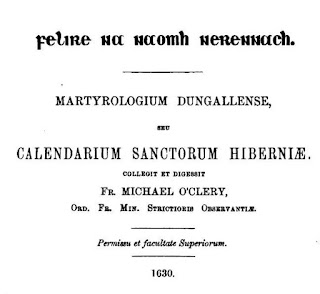
    December 30 is the feast of Saint Connla, described in the Martyrologies as a Bishop of Rúsgach. Unfortunately, apart from discovering that this locality was identified by 19th-century scholar John O’Donovan as Rooskagh, a townland in the barony of Moycashel, County Westmeath, I have been unable to find out any further details. The Martyrology of Donegal  records:

    30. G. TERTIO KAL. JANUARII. 30.
    CONNLA, Bishop of Rúsgach.
    Our saint is not the only one associated with this locality to be recorded in the Martyrology of Donegal, for on August 20 one of the saints commemorated is:

    MOTRENÓG, son of Aenghus, Abbot, of Rúsgach.

    These commemorations indicate that there must have been a religious foundation at this locality, about which I hope I may be able to find out some further details.Content Copyright © Omnium Sanctorum Hiberniae 2012-2015. All rights reserved.

  • Saint Samthann of Clonbroney, December 19


    December 19 is the feastday of one of my favourite Irish saints – Samthann of Clonbroney, County Longford. The Martyrology of Oengus  devotes its entire entry for this day to her:

    C. xiv. cal. Ianuarii.

    19. Blithe unto my soul,
    with the vastness of her host,
    be the fair pure manna of elemental God,
    Samthann of Clúain Brónaig !

    The later Martyrology of Donegal  reads:

    19. C. QUARTO DECIMO KAL. JANUARII. 19.

    SAMHTHANN, Virgin, of Cluain-Bronaigh, in Cairbre in Tethbha, near Granard. She was of the race of Fiatach Finn, monarch of Erin. The age of Christ when she went to heaven was 734.

    We are blessed in having a surviving Life of Saint Samthann which records how, having forsaken her aristocratic husband on their wedding night to follow the religious life, she came to the monastery of Clonbroney and was put in charge by its founder, Saint Fuinech. The following excerpts from the Vita Sanctae Samthannae Virginis have been taken from Dorothy Africa’s translation:

    5. At that time the foundress of Clonbroney, the blessed virgin Fuinech, dreamt that sparks of fire in the likeness of Saint Samthann came and consumed the whole monastery, and then rose up in a great flame. She told her dream to the sisters and gave this interpretation: “Burning with the fire of the Holy Spirit, Samthann will make this place shimmer by virtue of her merits and in the splendour of miracles”. For that reason, Fuinech sent for Samthann and gave her the community.

    Like Saint Brigid of Kildare, with whom she has much in common, many of Saint Samthann’s miracles concern food and in the one recorded below, she also emerges as a saint with a sense of humour:

    6. After she had taken charge, first she wanted to construct an oratory of trimmed timber, and so she sent for carpenters and other workmen to bring in timber from forests nearby. One of the carpenters, observing the paucity of the provisions and the number of workers, thought to himself “Oh, if only we could have forty wheaten loaves with butter and cheese and milk, for such a quantity of bread suffice us.” Man is not frustrated in his desire for something his soul has desired. For through the merits of holy Samthann, all he had thought he saw placed before him. The intimate of Christ, giggling, said “The thought of your heart is fulfilled is it not?” And he said to her “Indeed so Mistress, there is neither something in addition, or anything missing.” Then all gave thanks to God and ate their fill.

    But, as an Irish saint, it doesn’t do to cross her, even at a distance:

    16. Once the holy servant of Christ desired to build a large hall for the work of the sisters, and sent Nathea the prioress with the craftsmen into the forest of Connacht for pine timber. When they had searched for three whole days without finding the wood, the weary group decided on the fourth day to return home. While they slept that night, the blessed Samthann suddenly appeared in a dream to her disciple Nathea, saying “Tomorrow morning cut down bog willows at the root, and you will find enough pine lying there.” At daybreak, they did just so as she instructed, and found the pine they desired. But the owner of the woods, seeing such a heap of pine, said, “unless you buy them, you will not get these trees.” Nathea said to him “we will buy them willingly”. The following night Samthann appeared in a vision to that man. She spoke in a threatening voice, saying “What tempts you fellow, to withold these things offered to God?” Then she struck his side with a staff, saying “wretch, unless you do penance, know that you will die very soon.” Next morning, that man, stung by penance, gave them the lumber outright. When word got out, the inhabitants of the region praised God as manifest in the holy Samthann. They provided sixty yokes of oxen and conveyed all that wood back to the monastery.

    But, of course, the  Life  balances such accounts of the saint’s displeasure with accounts of her mercy. Below is my very favourite instance of her clemency, where Saint Samthann deals leniently with a young whippersnapper who fails to show her the proper respect:

    23. Once the community of brothers on the isle of Iona sent some of their members to the holy Samthann with a boatload of wool. While they were clearing the level surface (of the sea), the calm of the air changed suddenly. The waves, raised by the heightening of the winds, menaced them angrily with death. A lad among them spoke up foolishly, saying, “Let’s throw the granny’s wool overboard lest we sink”. The navigator of the ship refused to allow this, and said, “Certainly not, with the old lady’s wool we shall either live or die”. With this remark, such serenity of the sea ensued that the wind disappeared altogether and they resorted to rowing. Then the same boy piped up again, “Why can’t the granny provide us any wind now?” The navigator responded, “we believe that God will assist us for the sake of her merits”. At once the wind filled their sails and they capitalized on this gift for three whole days and nights until they reached the harbour at Colptha. When they had arrived at the monastery of the blessed virgin, they saluted her as they entered and kissed her hand. When the aforesaid lad approached her, the virgin said “Now what was that you were saying about me at sea when the storm threatened you with death?” The boy was confounded into silence with shame. She said to him “Never doubt this, if ever dangers corner you, call upon me boldly”.

    The  Life  ends with a beautiful image of Saint Samthann’s journey to heaven at the end of her earthly life:

    26. On the very night in which her spirit returned to heaven, the holy abbot Lasran, of whom we spoke earlier, awoke and saw two moons, one of which dipped towards him. He was mindful of his own request, for he had asked her that when she passed to the celestial realm she would bend toward him. Recognizing her in the guise of a star, he said, “Well done, Samthann, faithful servant of God, for now you are ushered into the rejoicing of the Lord, your spouse.” In this fashion she faded away, climbing into the sky, where eternal life is enjoyed for ever and ever, Amen.

    Dorothy Africa, trans., ‘Life of the Holy Virgin Samthann’, in T. Head, ed., Medieval Hagiography – An Anthology  (Routledge, 2001), 97-110.

    Amen indeed! A further selection from the Life of Saint Samthann can be read here.


    Content Copyright © Omnium Sanctorum Hiberniae 2012-2015. All rights reserved.