Category: Irish Saints

  • St.Cobthach of Iona, July 30


    On July 30 Canon O’Hanlon has a short account of Saint Cobthach, kinsman of Saint Colum Cille of Iona, whom he claims has a feast on this day, at least according to the two nineteenth-century scholars John O’Donovan and George Petrie. Unfortunately I have not been able to access the work referenced to see on what basis this claim was made. Bishop William Reeves, who published a scholarly edition of The Life of Saint Columba in 1857, noted that the seventeenth-century Scottish martyrologist, David Camerarius, had ascribed August 7 to the feast of Cobthach, but without any supporting authority. In the hagiography of Iona’s founder, Cobthach features as the son of Colum Cille’s father’s brother which would make them first cousins. Cobthach, along with his brother Baithene, were among the original twelve disciples of Saint Colum Cille who accompanied him on the voyage from Ireland to Iona, as Canon O’Hanlon explains:  

    Article IV.—St. Cobthach, Disciple of Columkille. 
     
    This devoted follower of the great Abbot of Iona, was the son of Brendan, and brother of St. Baithene, who immediately succeeded St. Columkille in the monastery at Iona. He was one of the twelve first disciples, who sailed from Ireland to that island with the founder. We find a commemoration for him at the 30th of July, on the authority of George Petrie, LL.D., and John O’Donovan, LL.D. The Rev. Dr. Reeves,when alluding to the early companions of St. Columkille, remarks, that Camerarius gives him a day, at the 7th of August, in the Calendar, but without any authority.

    Content Copyright © Omnium Sanctorum Hiberniae 2012-2022. All rights reserved.

  • Saint Bití of Inis Cumscraigh, July 29

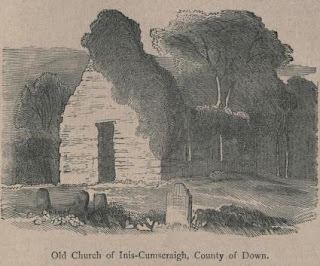
    A County Down monastic saint, Bití (Bitus, Bite) of Inis Cumscraigh, is commemorated on the Irish calendars on July 29. Inis Cumscraigh is today known as Inch, which as the name suggests was once an island on the River Quoile but is now on land close to the town of Downpatrick.  It boasts some very impressive and extensive Cistercian monastic ruins. Inch Abbey was founded in the 1180s by the self-styled ‘Prince of Ulster’, John de Courcy, following his conquest of the area. It was a daughter-house of the Cistercian foundation at Furness in Lancashire, from whom de Courcy commissioned the hagiographer Jocelyn to write a Life of Saint Patrick. I have written about de Courcy, Jocelyn and Saint Patrick in a post at my blog dedicated to the Irish patrons here. But today’s native Irish saint pre-dates both the Normans and the Cistercians. In a 1977 paper archaeologist Dr Ann Hamlin, drawing on the evidence from the Irish calendars and Annals,  provided a useful sketch of the history of the pre-Norman monastery at Inch:

    An earlier name for the island was Inis Cumhscraigh, and it was the site of a pre-Norman monastery. ‘MoBíu of Inis Cúscraid’ is listed at 22 July in the main text of the Martyrology of Oengus, and the entry is glossed ‘i.e. beside Dún dá lethglas’, whilst in the Martyrology of Tallaght ‘Dobí of Inis Causcraid’ appears at 29 July. The Martyrology of Oengus was written between 797 and 805 and the Martyrology of Tallaght  a little earlier, so these references provide firm evidence for a pre-Viking church on the island. Several annal entries refer to the site in the eleventh and twelfth centuries. In 1001 ‘Sitric, son of Amhlaeibh, set out on a predatory excursion into Ulidia, in his ships, and he plundered Cill-Cleithe [Kilclief] and Inis-Cumhscraigh, and carried off many prisoners from both (Annals of the Four Masters, also Annals of Tigernach). The Annals of Ulster record the death of ‘Ocan Ua Cormacain, herenagh of Inis Cumscraigh’ in 1061, and in 1149 Inis-Cumscraidh was plundered together with other churches in the area (AFM). The erenagh of Insecumscray was among the witnesses to the foundation charter of Newry abbey in about 1153. These references collectively suggest that a church and perhaps some form of monastic life did continue on the island into the twelfth century.

    Ann Hamlin, A Recently Discovered Enclosure at Inch Abbey, County Down, Ulster Journal of Archaeology Third Series, Vol. 40 (1977), 85-86.

    Saint Bití is the second saint named in connection with this monastery with a feast falling just seven days (and thus within the octave) of that of Saint MoBíu commemorated on July 22. Canon O’Hanlon, in his entry for July 29 in Volume VII of his Lives of the Irish Saints feels that they are probably the same person:

    Festival of St. Bitus or Bite, of Inis Cumscraigh, now Inch, or Inniscumhscray, Strangford Lough, County of Down. 

    According to the Martyrology of Tallagh, veneration was given, at the 29th of July, to Bitus or Bite, of Innsi Caumscridh. This holy man is called Bute, or perhaps Byte, by Marianus O’Gorman. That island or rather peninsula is beautifully situated in Strangford Lough, and nearly opposite to Downpatrick, county of Down. Some interesting ruins are yet seen in this place. An abbey or a monastery stood here – as has been already observed – before the erection of one, which has been founded by the Anglo-Norman warrior, John de Courcey. When the present saint flourished has not been ascertained. In the Martyrology of Donegal, we find an entry of Bite of Inis Cumhscraigh, at the 29th of July. We are inclined to think, that the present holy man is not distinct from the Abbot so called, and who is celebrated on the 22nd day of this month, where an account of him has been already given.

    Canon O’Hanlon’s account of Saint MoBíu can be read at the blog here.

    Content Copyright © Omnium Sanctorum Hiberniae 2012-2022. All rights reserved.
  • Saint Killian of Würzburg, July 8

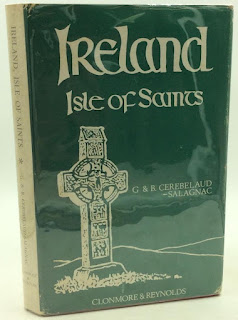
    8 July is the feastday of Killian of Würzburg, an Irish missionary saint and martyr, whose memory is still very much alive today. I have previously published an account from Abbé McGeoghegan here and now bring a reminder of the martyrdom of Saint Killian and his companions from the English translation of another French work, Irlande Ile des Saints, by G and B Cerebelaud-Salagnac:

    Let us now set out for Thuringia, in the footsteps of Killian (or Cilian). He would have been born about the year 640 in County Cavan. When he became a monk, and was first moved by the missionary grace, he went to the Continent with eleven companions (always the number twelve, clearly regarded as perfect). Passing through northern Gaul they reached the Rhine which they crossed and came to the castle of Würzburg, where lived Gozbert, Duke of Thuringia. Gozbert heard Killian readily, even when the monk pointed out to him that his union with Geilana, his brother’s widow, was incestuous (this was the commonly accepted view at that time). He renounced Geilana. This woman conceived a deep resentment against the monk and from then on she only lived to revenge herself. About the year 689 she brought about the murder of the Bishop, along with two of his companions, Colman and Totnan.

    “A custom, similar to that which was to be found among the Jews, had been in common practice among the people of Würzburg, and it had just been adopted by Prince Gozbert himself. He had taken as his wife his brother’s widow, whose name was Geilana (or Geila). The prince had feelings of love and affection for her. It soon became Saint Killian’s duty to explain to him the Church’s ruling on this matter…. He did this gently and in the most persuasive way … the first time he approached this subject, the king showed great aversion to this idea of separation, but when he became aware that this was necessary, if he wished to live according to his profession of faith, he consented, in a Christian spirit of
sacrifice. The king’s resolution came to the knowledge of Geilana. She was not prepared to bow to the royal decision. Her arguments and her cunning were, however, without effect, for the prince’s will was unshakeable. She then began to burn with unquenchable rage against the servants of Jesus Christ, and decided to seize the first opportunity for taking a terrible revenge; this was not long in appearing.

    “The prince was called to a long distance on a military expedition in the
year 689; his cruel wife was able to find some hardened criminals, whom she hired to carry out her plan of vengeance, Although miraculous warnings had been given, it is said, to Saint Killian and his companions about this plot, they did not wish to save their lives by flight, nor even by seeking the protection which they would have easily found among the people of Würzburg. Saint Killian exhorted his companions to be steadfast, assuring them that their souls could not be injured by the assaults of their enemies. The holy missionaries began to prepare themselves, by prayer and by fasting, to face the danger by which they were threatened. On July 8th, 689 (according to certain authors 688), while Saint Killian and his companions, among whom were Colman and Totnan, were meeting together, these murderers, armed with swords, entered the room where they were. St. Killian offered himself the first to the executioners, and was immediately struck down at their feet. His companions fell in the same fashion. In order to conceal the marks of this slaughter, the bodies of the martyrs were taken away by night and buried secretly. The cross, the book of the Gospels with their other books and belongings, were thrown into the same grave….

    G and B Cerebelaud-Salagnac, Ireland Isle of Saints (Dublin, 1966), 107-8.


    Content Copyright © Omnium Sanctorum Hiberniae 2012-2022. All rights reserved.