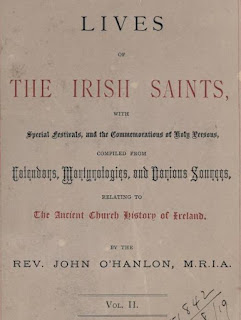
We find Cronan Cille Bicci, in the Martyrology of Tallagh, at the 21st of February. Where “the little church,” to which he had been attached, was situated, can hardly be determined with accuracy… [The author proceeds to give dozens of examples of the placename Kilbeg from every corner of Ireland]… The foregoing denominations must probably include the changed form of the present saint’s former place; but, without some local tradition of a pattern or saint’s day corresponding, it would not be possible to decide on any one spot. In conclusion, we find Cronan, of Cill Beg, is set down in the Martyrology of Donegal, as being venerated on this day.
Category: Irish Saints
-
Saint Cronan of Cill Beg, February 21
Among the Irish saints commemorated on 21 February is one simply recorded on the calendars as Cronan of Cill Beg or Kilbeg, a place name which translates to ‘small church’. Canon O’Hanlon’s account demonstrates how important local traditions of popular devotion can be in helping to identify the location where a saint flourished:St. Cronan, of Cill Beg, or Kilbeg.Content Copyright © Omnium Sanctorum Hiberniae 2012-2015. All rights reserved. -
Saint Colga the Wise, February 20
The Irish calendars commemorate an eighth-century scholar saint, Colga the Wise, (Colgu, Coelchu) lector of Clonmacnoise, on February 20. The Martyrology of Tallagh has the simple entry ‘Colgu Mac h. Dunechda’ at February 20th, as does the Martyrology of Gorman. The Martyrology of Donegal, however, has a fuller entry, which tells of one of the stories associated with Saint Colga – his miraculous meeting with Saint Paul the Apostle:20. B. DECIMO KAL. MARTII. 20.COLGA, Mac Ua Duinechda, i.e. Lector of Cluan-mac-nois. It was he that composed the kind of prayer, called the Scuab Chrabhaidh (Broom of Devotion). It was to him Paul the Apostle came to converse with him, and to help him on his road, and he took his satchel of books at Moin-tire-an-air, and it was he that pleaded for him to the school of Cluain-mac-Nois, and the prologue or preface which is before that prayer states that this Colga was a saint, was a priest, and was a scribe of the saints of Erin, etc. And there is a Saint Colga, with his pedigree, among the race of Dathi, son of Fiachra, son of Eochaidh. Muidhmhedhoin, and he may perhaps be this Colga.In his book on the monastic schools, Archbishop John Healy expands on the story of Saint Paul, which was recorded by the 17th-century hagiologist Father John Colgan. It seems that the great apostle intervened in a theological dispute between the scholars of Clonmacnoise, represented by our saint, and some other monastic school:One day returning from his class hall with his leathern book-satchel on his shoulder, he sat down to rest at the place called Mointireanir. As he sat a stranger came up and began to converse in the kindest and most affable way with the professor, and even ventured to give him counsel and instruction. Nay, more, he took up the book-satchel, and carried it on his own shoulders, letting the tired master walk on by his side. The kind stranger turned out to be the Apostle Paul himself. On another occasion when public disputation was being held at the college, it seems certain scholars were objecting vigorously to Colgu’s views, when St. Paul once more appeared as a learned stranger, and was invited to take part in the discussion.The unknown scholar accepted the invitation, and reasoned so convincingly that in a very short time he clearly showed to the satisfaction of all present that Colgu’s view of the question at issue was the correct one.There are a couple of writings which still survive which are linked to Saint Colga. The first is the prayer, mentioned in the Martyrology of Donegal entry above, called the Scuab Chrabhaidh (Broom or Besom of Devotion). The second is a letter written by Saint Alcuin of York from the court of Charlemagne to ‘Colcus, a lector in Scotia’. The seventeenth century hagiologist, Father John Colgan believed that Saint Colga of Clonamacnoise was Alcuin’s correspondent.The 20th of February is established on the calendars as the feast of Saint Colga and the annals variously give his death as occuring in the year AD 789, 791, or 794.Content Copyright © Omnium Sanctorum Hiberniae 2012-2015. All rights reserved. -
Saint Maeldobharchon of Kildare, February 19
February 19 sees the commemoration in the Irish calendars of Saint Maeldobharchon, a bishop of Kildare. Canon O’Hanlon summarizes what is known of him:
St. Maeldobharchon, or Maeldobhorchon, Bishop of Kildare, County of Kildare. [Seventh and Eighth Centuries]
The Bollandists have a brief entry of this holy bishop, at the 19th of February. The Martyrologies of Tallagh and of Marianus O’Gorman, and of Donegal, on this day, record Maeldobharchon or Maoldobhorchon, Bishop of Cilldara, now Kildare, in the county of the same denomination. It seems likely enough, the Abbot of Kildare, Lochen, surnamed Meann, or the Silent, also called Lochen, “the Wise,” who died on the 12th of January, or 12th of June, A.D. 694, as also St. Farannan, Abbot of Kildare, who died on the 15th of January, A.D. 691, may have exercised episcopal functions over this see. If so, it is probable, the present holy man succeeded this latter. According to Colgan, he died A.D. 704 but, the Annals of the Four Masters state, that this prelate died, A.D. 707. According to the Annals of Ulster, he departed this life in the year 708.
The entries from the Annals are also quoted in the essay on the Bishops of Kildare by the Rev. Michael Comerford:
“A.D. 707. MAELDOBORCON, Bishop of Kildare, died on the 19th of February.”(Four Masters.) “A.D. 708. Maeldoborcon, Episcopus Cille-daro, pausavit.” (Annal Ult.) The death of this Prelate is stated by some to have taken place in the year 704 (Ware). Keating (Book, 2, p. 46,) relates that King Congall Kennmagar persecuted the Church at this time, and burned the secular and regular clergy of Kildare; but Lanigan discredits this statement, judging to the contrary from the peaceable and prosperous reign ascribed to this monarch by old writers. A great conflagration, it is true, laid Kildare waste in 709. (Four Masters), during this King’s reign ; and, as we may suppose that some clerics lost their lives in this fire, this circumstance may have given occasion to the story.
Rev. M. Comerford ‘Collections Relating to the Dioceses of Kildare and Leighlin’ (Dublin, 1883), 5.
Content Copyright © Omnium Sanctorum Hiberniae 2012-2015. All rights reserved.

