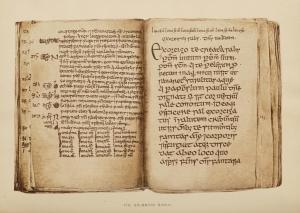
On March 10, we commemorate a Scottish saint, Kessog (Kessoc) of Lennox, also known as Kessog of Luss . It is claimed that this saint was a native of Cashel and related to the ruling family of Munster. One of the sources, the lessons from the Aberdeen Breviary, begins: ‘Kessog, the noble confessor of Christ, drew his origin and name from the state of Munster and the stock of illustrious Irish kings…’ However, the saint appears to be unattested in Irish sources, his name is not found on the Irish calendars of the saints, nor in the Irish genealogies or Annals. It was suggested by W.J.Watson in his 1926 study of Scottish place names that our saint may be the same as a Saint Cessán who acted as a chaplain to Saint Patrick:
Cessóc, Ceaság, March 10, is stated by the Aberdeen Breviary to have been born in Cashel in Munster, of royal family, a statement which would be of much interest if it were confirmed. He is perhaps the same as Cessán, who is styled ‘son of the king of Alba, and a chaplain of Patrick.’ His name is a reduced form of some compound beginning with cess, a spear. He is specially connected with Luss on Loch Lomond. In 1566 (RMS) mention is made of ‘the lands of Buchquhannan, with the bell and alms of St. Cassog’ (cum campana et elimosina S. Cassogi). On the east he is the patron of Auchterarder, ‘ecclesia Sancti Mechesseoc de Kohterardeuar,’ 1200 (Chart. Inch.), ‘ Sancti Mahessoc de huctherardouer,’ 1211, 2b. Tom mo Cheasaig, ‘my-Kessock’s knoll,’ and Féill mo Cheasaig, ‘St. Kessock’s fair,’ are at Comrie and Callander in Perthshire. Cladh nan Ceasanach in Glenfinglas, near Glen Main Burn, seems to mean ‘graveyard of St. Kessock’s people.’ In Strathearn there is ‘ Barrnakillis (Church-hill) with the chapel and holy bell of St. Kessog,’ 1538, 1542 (RMS). Port Cheiseig, Kessock Ferry on the Beauly Firth, is probably named after the saint. In 1270 (Reg. Pasl.) ‘Mauricius filius Gilmekesseoch ’ was witness at Paisley.
W.J. Watson, The History of the Celtic place-names of Scotland (Edinburgh, 1926), 277-78.
Watson also records the traditions preserved in the twelfth-century Book of Leinster that the Eoganacht dynasty of Munster were the forbears of the mormaer (mormáir) or Earl of Lennox. Doctor Alan Macquarrie, editor of the 2012 edition of the Aberdeen Breviary, suggests that this may provide a context for the claims that Cashel was the birthplace of Saint Kessog:
Perhaps an exotic Munster origin has been constructed for a local saint of Lennox to parallel the Munster origin claimed for the mormáir of Lennox. This may have lifted material from the vita of a Munster saint, but the source has not been traced.
A. Macquarrie, ed., Legends of Scottish Saints – Readings, Hymns and Prayers for the Commemorations of Scottish Saints in the Aberdeen Breviary (Dublin, 2012), 376.
So it seems that, as Watson remarked, the statement in the Aberdeen Breviary that Saint Kessog was born in Cashel in Munster, of royal family ‘would be of much interest if it were confirmed’, such confirmation still eludes us. Canon O’Hanlon, brings in all of the traditional sources in his account of the saint found in Volume III of his Lives of the Irish Saints:
St. Kessog, Mackessog, or Makkessagus, Bishop, and Confessor, Patron of Lennox, Scotland.
[Sixth Century]
This holy bishop is venerated, and not unmeritedly, in the church of Scud, on his natal day, as elsewhere in Scotland. There, while living on earth, he sought out the true way of living for ever in heaven. The Bollandists have the Acts of St. Kessog, at the 10th of March. These consist of two preliminary sections, with the lection of his Life, as found in the Breviary of Aberdeen. From this we learn, that it had been compiled, from a special Life of St. Kessog. Bishop Forbes gives an interesting account of this Scottish bishop. The Rev. S. Baring-Gould has some notices about St. Kessog. He was born,as we are told, in Cashel, the capital city of Munster, while his name and family were derived from the royal race of Irish Kings. From early youth, his virtues were remarkable, and he was distinguished for his miracles. His father was King of Cashel; and, in that station, he not only desired to cultivate the friendship of other Irish kings, but he hospitably invited them to banquets, and he even desired, that his noble guests should be accompanied by their sons. We learn, from the Aberdeen Breviary, that the King of Cashel was accustomed to receive his visitors, in great state, when trumpets and musical instruments welcomed them to his royal city. On one of those occasions, while Kessog, still a child, played with two other handsome young princes, who were sons of a visitor, near a lake, or pond, all fell into it, and Kessog alone escaped with life. He told the tale in secret to his father. A certain Elinthus, a citizen of Cashel, feared that such intelligence should cause a great commotion among the kings; and, he endeavoured, as best he could, to relate all the circumstances of the sad accident, so as to excuse Kessog, who, in some manner, seems to have been blamed, in connexion with its occurrence. Filled with grief and indignation, the strange kings vowed they would burn the city of the King of Cashel, and that they should devastate all his province. But, after a night spent in prayer by Kessog, at the request of his aftrighted father, the boy heard an angel of the Lord say to him, towards morning, “Kessog, rise at once from prayer, for the Lord hath heard you, since the kings’ sons, for whom you prayed, have come to life and are restored.” Soon were their parents satisfied on the matter, and their rejoicing was very great. Many other miracles were wrought by him, as related in his special Life. According to their National Breviary, St. Makkessagus ruled over the Scots, as a bishop. His feast occurs, on the 10th of March, and he flourished, it is said, A.D. 520. According to Dempster’s conjecture, he was elected from the Culdee order. His church was in Levinia, near the county of Menteth, and, it was called, “Templum Portus.” Celebrated for its fair, the place was much resorted to by crowds. He is stated to have written “Manipulum Precum,” lib. i., and ” Catechesin ad Neophytos,” lib. i. He is thought to have lived, in the Island of Inchta-vanach, where he devoted himself to prayer and to evangelizing the neighbourhood.
According to tradition, St. Kessog suffered martyrdom for the truth, at Bandry. There a cairn, and a large stone, on which an ecclesiastic’s effigy is carved, were erected to his memory. Another account has it, that he was martyred in a foreign land, and that, embalmed in sweet herbs, his body was brought to the church of Luss, his native place. There he was buried, according to the Breviary of Aberdeen. These herbs, called Luss, in Gaelic, germinated, and gave name to the parish. At the place of his burial is Carn-ma-cheasaig. Malcolm, Earl of Lennox, granted a charter to John of Luss, “for the reverence and honour of our patron the most holy man, the blessed Kessog.” In 1313, Robert Bruce granted a sanctuary-girth of three miles, to the church of Luss, in a charter, which is preserved at Buchanan. In the Lennox, a bell of St. Kessog was held in reverence, during the seventeenth century. The church of Auchterarder is dedicated to him, and he was honoured at Callander. In this latter place was a curious conical hill, or mound, which seems to be artificial. It is called Tom-ma-chessaig, and there an old church stood. In like manner, the fair of Fel-ma-chessaig is held, on the 21st of March, the 10th, old style. There is a Kessog’s fair, in Cumbrae, on the 3rd Wednesday in March, and there is a Kessog Ferry, at Inverness.
The Rev. Dr. Todd identifies this saint with Moshenoc, of Beitheach, at the 11th of March. According to the Kalendar of Arbuthnott, we find, at the 10th of March, or vi. Ides, St. Kessog, Bishop, and Confessor; while, the same notice occurs, in the Kalendar of the Breviary of Aberdeen, having the addition, that his Office was celebrated with Nine Lessons. Adam King’s Kalendar, at the 10th of this month, enters S. Makkessage bisch. and cof. in Scotl. Dempster, in his “Menologium Scoticum,” at this same date, has in Levinia, Makkessag, bishop, who is depicted in a military habit, and whose intercession is earnestly implored by soldiers. Also, in the Scottish entries, as found in the Kalendar of David Camerarius, we have, at the 10th of March, St. Makkessog, who is also called Kessog, Confessor and Bishop “in Boina Scotie provincia,” celebrated for the lustre of his miracles. The “Circle of the Seasons” has its note of St. Kessog, at this date. In art, it is said, he was represented as a soldier, with a stretched bow and arrows in his hand, and a quiver at his back.
Note: This post, first published in 2014 has been revised in 2025.
Content Copyright © Omnium Sanctorum Hiberniae 2012-2015. All rights reserved.

 OMNIUM SANCTORUM HIBERNIAE