Author: Michele Ainley

  • Saint Odhran, February 19

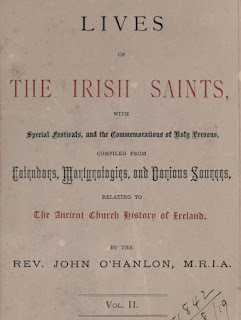
    The Irish calendars commemorate Saint Odhran, whom tradition associates with Saint Patrick’s household, on February 19. Indeed, Saint Odhran is credited with being Saint Patrick’s chariot driver who willingly accepted martyrdom to save the life of his master. His sacrifice took on a particular  importance since the introduction of Christianity to Ireland did not involve large-scale martyrdom. This home-grown martyr was thus seen as a very special saint. A prayer in honour of Saint Odhran can be found here. Canon O’Hanlon has a good description of the popular legends surrounding the brave charioteer in Volume II of his Lives of the Irish Saints:

    St. Odran or Odhran, of Disert-Odhrain, in Offaly, Martyr.

    [Fifth Century.]

    The Martyrologies of Tallagh, of Marianus O’Gorman, and of Donegal record on this day, Odran or Odhran, of Tir-aonaigh or of Tiri-oenaigh. From all we can learn, he became devotedly attached to the Irish Apostle, and he was a constant personal attendant on his missionary travels. Odran became a servant to St. Patrick, whom he served in the capacity of charioteer. We have no express mention of him, except incidentally, in different Lives of St. Patrick. From such sources, Colgan has compiled his eulogistic biography, adding notes to it. The Bollandist writers have inserted Acts of St. Odran, Martyr, in six paragraphs, at this day. This humble and devoted charioteer is classed among the disciples of the Irish Apostle.

    On St. Patrick’s return from Munster, about the year 451, in Colgan’s opinion, and after, or during the year 456, according to Ussher, the Irish Apostle entered Hy-Failge territory. Here were two powerful chieftains ruling at the time: one was a wicked Pagan, Failge Berraide, who entertained a implacable hatred against St. Patrick, because he had destroyed the idol, known as Crom Cruach, an object of adoration among the Gentile Irish, while the other chief was named Failge Ros, who had conceived a great love and reverence towards the holy man. As the former had frequently boasted, that he would take the Apostle’s life away, whenever the opportunity might be afforded; the present stage of his journeying, which brought him along the highway, not far from Failge Berraide’s Castle, seemed favourable for this son of Belial’s purpose. That district, since so well known as Offaly, at least in this part, was then ruled over by the merciless pagan, Failge Berraide. This wicked man’s design was basely to take away by assassination the life of our great Irish Apostle; and, in the accomplishment of such a purpose, he resolved on arresting the progress of the Christian Religion, by effecting the destruction of its greatest promoter. However, Providence frustrated his purpose, although it does not seem, that St. Patrick had any suspicion of the threatened danger. Yet, his charioteer, Odhran, had some prevision of the consequences likely to ensue. In most accounts, it is said, that having had previous intimation of this design, Odran concealed his knowledge concerning it from St. Patrick, whom he induced to occupy the driver’s seat in the chariot, whilst Odran himself should have some short time for rest. The holy Apostle most readily assented. He unsuspectingly relinquished his place, and assumed the reins, in order to gratify his servant’s wish. They had passed from Birr, and were travelling along an ancient road, which bore in an eastern direction, north of the Slieve Bloom mountains, where their enemy lay in wait. Failge met the travellers on their journey. Rushing against Odran, whom he mistook for St. Patrick, the furious chief transfixed him, with a stroke of his lance. Horrified at the sight thus presented, the Apostle was about to pronounce a malediction on the murderer, when the dying Odran prayed it should rather descend on a very high tree, that grew on an adjoining hill, called Brig-damh. Yet, for his Satanic perfidy, the murderer was struck dead immediately afterwards; and as a just punishment for his grievous crime, his soul was buried in hell, while angels were seen bearing that of Odhran to heaven, where he joined the array of purple-robed martyrs. St. Patrick furthermore announced, that the posterity of that wicked Foilge should wane, and lose power, in the principality; while, Foilge Ros and his posterity should rule therein, which prediction was fulfilled. In an old Biburgensian Manuscript Life of St. Patrick, we are told, that when the soul of Foilge, for his wickedness, had been carried away to hell, the devil took possession of his living body, and dwelt in it, until St.Patrick came to the house of that cruel chief. It is stated, the Irish Apostle asked one of the servants for his master, and that he was told Foilge was within. “Call him to me,” said Patrick. But, the servant returned, and told the Apostle in great sorrow, that he only found the dry bones of his master. Then said Patrick :”From the time, when Foilge butchered my charioteer before me, he was buried in hell, but the devil came to possess his body, so that while his soul was consigned to perdition, his body was also dishonoured by demoniac influences.”
    [O’Hanlon inserts an interesting footnote from author W.B. McCabe, who wrote a book of stories for younger readers which included the unhappy tale of Foilge:
    The second tale, Foilge; or the Possessed, is a veritable Irish tradition. It is the earliest account that the author has been able to trace, of that belief, which still prevails in many parts of the world, viz., of an evil spirit entering into the body of a dead man, and making that dead man appear as if he were still living—a belief, it may be remarked, very different from that which prevails as to the demoniacs described in Scripture—that is, living men, into whose bodies an evil spirit had entered. Foilge as portrayed in the Irish legend, (Act. Sanct.vol. iii., pp. 131, 132) was the same in most respects as the modern vampire; in some particulars like to the malignant dead described in the Sagas of the Scandinavians.]
    Attempts have been made to identify the place, where this martyrdom occurred. Afterwards, it received the name, Desart-Odran of Hy-Failge;… on the road, between Frankfort and Roscrea, is the little village of Killyon; and about two miles from the latter village, is yet shown the place, where Foilge attempted the life of St. Patrick.
    Odran’s name occurs, in some foreign Martyrologies; yet, his festival has been assigned to distinct days, from the present date. Thus, the 8th of May, the 27th of September, as also the 2nd and the 27th of October have been conjecturally mentioned, in connexion with it, by various Martyrologists. About, or soon after, the middle of the fifth century, this martyrdom of Odran is considered to have occurred. This saint is honoured as a martyr, chiefly on the 19th of February; but, in certain places, as we are informed, on the 27th of October. Some churches were formerly dedicated to him, in the country about Birr, and in the Ormonds…It is probable, that many of those circumstances related, as connected with St. Odran’s death, are unreliable; although, we take it for granted, that this saint must have lost his life, for his attachment to the Christian faith, and while faithfully serving his illustrious master.
  • Saint Colman of Ardboe, February 18

    Today some Irish calendars may commemorate a monastic founder in the north of Ireland, Saint Colman of Ardboe, County Tyrone. The picture shows the ruins of the monastery of Ardboe as they appear today. As we will see, however, there is uncertainty surrounding the precise identity of the saint Colman whose feast is commemorated on this date. Other calendars assign February 18 to the more famous Saint Colman of Lindisfarne and Inis Bofin, although he has another feastday in August. Canon O’Hanlon explains some of the difficulties involved in trying to disentangle the many Irish saints who bear the name of Colman:
    THERE are no less than one hundred and thirty saints, named Colman, enumerated in our Irish Martyrologies and Histories. It is not wonderful, therefore, that much confusion must exist, in distinguishing their festivals and natal days. The task of individual identification must be difficult, especially as only the simple name occurs, in many instances. At the 18th of February, Colgan notices a Bishop Colman. This saint is venerated at Ard-bo near Lough nEathach, in the county of Tyrone. Little, however, is known with certainty regarding his parentage, birth-place, the age in which he flourished, or even his Acts. It seems probable, that this is the St. Colman, surnamed Mucaidhe of Ard-bo, or Arboe, the son of Aid, son to Amalgad, son of Muredach, son to Carthenn, son of Erc, son to Ethac or Eochod, son of Colla Huasius, King of Ireland. This genealogy—if relied on—should place his period in the sixth century. His memory is barely recorded in our Martyrologies, most of which assign his festival to this day; whilst the Martyrologies of Tallagh and Maguire commemorate him, on the 21st of February. The very great number of saints, bearing this name and to be found in Irish Calenders, often leaves us in doubt regarding the particular St. Colman, who might be mentioned, in various lives of Irish Saints. At Ard-bo or Harbonensis—as the place is sometimes found Latinized—there was formerly a splendid monastery. There, too, were the relics of St. Colman preserved. In the year 1166, however, a fire broke out, and ruined the place. In the seventeenth century, only a few vestiges of its former celebrity remained. These were the remains of the old church walls, with a cross in good preservation, about fifteen feet in height. On it were several inscriptions.
    The festival of St. Colman is recorded at the 18th of February, in the “Feilire” of St. Oengus. We find entered, in the Martyrology of Tallagh, at the 18th of February, a festival in honour of Colman. This Calendar appends the following words to the notice : ” About Meuriab near Mona (bog) to the north there lies Colman.” This, however, hardly helps us to the exact identification of his place. Colman is venerated on this day, as we read in the Martyrology of Donegal. The Scottish writers, and some foreigners misled by them, have, however, confounded this saint and his festival, with the cultus of another St. Colman. He too was an Irishman, and much more celebrated than the present holy man. Thus, the Bollandists have, at this date, several dissertations, and an epitomized Life of St. Colman, Bishop of Lindisfarne, taken from the Aberdeen Breviary. It is contained in the Pars Hyemalis. In like manner, Bishop Forbes has entered some notices of St. Colman, who is so much celebrated, in connexion with Scotland. Thus, too, St. Colman, that Bishop and Confessor, who so tenaciously clung to the Scottish traditions, in reference to the celebration of Easter, has a festival assigned to him, at this date, by Camerarius… Again, it is said, that at the xii. of the March Kalends, which accords with the 18th of February, St. Colman, Bishop and Confessor, had been venerated in Scotia. The sanctity of his life, the uprightness of his moral character, and the merits of his virtues, afforded example for the imitation of his actions by a faithful flock. He was buried, we are told, at Terbert, in the diocese of Ross. The Kalendar of Drummond and of the Aberdeen Breviary has a feast for Colman, Bishop and Confessor, at xii. of the March Kalends. He had an office of nine lessons. A Scottish Kalendar, likewise, notes him.
    But, the leading facts of his life are, that St. Colman left Northumberland, A.D. 664, then he went to Ireland, in 667 and he died, on the 8th of August, A.D. 674, according to the Irish Annals. Camerarius, once more, places his day at March the 7th. Again, the Kalendar of Arbuthnott enters the festival of St. Colman, Bishop and Confessor, at the xii. Kalends of March. He had an office of nine lessons, as we are informed. This has been reproduced in the pages of the Bollandists. In Adam King’s Kalendar, at the 18th of February, we find entered a feast to St. Colman, successor to St. Finnane, and Confessor in Scotland. Dempster notes St. Colman, Confessor, in Scotia, at this date. At the 8th of August, we shall treat about the particulars of his history.
    Content Copyright © Omnium Sanctorum Hiberniae 2012-2015. All rights reserved.


  • Saint Fintan of Clonenagh, February 17

    We commemorate one of the great Irish masters of the ascetic life, Saint Fintan of Clonenagh on the 17th of February.  The sources for his life and feast have been summarized by diocesan historian, Father Michael Comerford:

    On the 17th of February the Feilire of Aengus records, “The Feast of Finntan, the prayerful, of vast Cluain-Ednich;” and the Gloss in the Leabhar Breac, and the Martyrology of Donegal, on the same day, add:- Fiontain, son of Gaibhreine, son of Corcran, son of Eochaidh, son of Bresal, son of Den.- Here he and (St.) Brigid meet (in their pedigrees), Abbot of Cluain-eidhniach in Laoighis (Leix). Great was the abstinence of this holy Fiontain, as is evidenced from this verse (of Aengus)-

    Fiontain the generous
    Never ate during his time
    But bread of barley corn
    And water of earthy clay.

    A very ancient vellum book . . states that Fiontain of Cluain-eidhniach, chief of the monks of Erin, in his manners and life resembled Benedictus, head of the monks of Europe.

    Colgan styles him “Fintanus Stationarius de magno Cluaineadnach;” the epithet of stationarius being applied to him from his praying, like many others of our early saints, with his arms extended in the form of a cross.

    St. Fintan received his early education from a holy priest by whom he was baptized. Whilst yet a boy, he was visited by St. Columbkille, who, on that occasion, foretold St. Fintan’s future distinguished career. When he arrived at man’s estate, he entered the Monastery of Tir-da-glass (now Terryglass, Co. Tipperary), where St. Columba, son of Crimthain then presided over a famous school. Having passed a novitiate here, he and two, some say three, companions, being anxious to find a retired place where they might devote themselves to the service of God, consulted St. Columba, and, accompanied by him, they came to Clonenagh. Here, it is said, St. Fintan and his companions passed a year, but, finding their solitude greatly broken in upon, they determined to abandon the place, and directed their course to the Slieve Bloom mountains, again accompanied by St. Columba; this saint, looking back upon Clonenagh, saw a multitude of angels hovering over it. His disciples seeing him sorrowful, asked the cause; the saint replied: “Because I see the place we have left filled with the angels of God, and these angels unceasingly minister between it and heaven”. “One of us”, he added, “should return and abide there for the future”. Whereupon Fintan said: “Whomsoever, O Father, you direct to return, he will instantly obey”. Columba replied: “Go you in peace to that spot, O holy youth, and the Lord be with you. It has been divinely revealed that for you it shall be the place of your resurrection.” St. Fintan accordingly retraced his steps to Clonenagh and established himself there; this was about the year 548. Great numbers flocked to this place to serve God under the guidance of our saint, amongst whom was St. Comgall, afterwards the founder of the famous Monastery of Bangor, who passed some years under his direction. The discipline observed at Clonenagh was very rigorous; the fasting and abstinence were so severe that St. Canice of Aghaboe and other holy men remonstrated with St. Fintan on the subject. Yielding to their representations, he relaxed the rigour of his rule in favour of his community, but, himself, adhered to his former mode of life. Finding his end approaching, St. Fintan assembled his monks and named Fintan Maeldubh as his successor.

    Rev M Comerford” Collections relating to the Dioceses of Kildare and Leighlin” Vol.3, (1886).