Author: Michele Ainley

  • Saint Lactean of Freshford, March 19

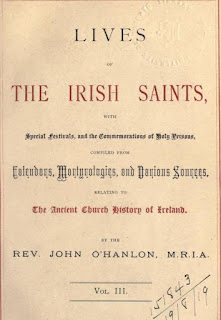
    March 19 is the commemoration of a County Kilkenny saint, Lactean of Freshford. Although no written Life of Saint Lactean has survived, the saint features in the Lives of a number of other Irish saints and thus Canon O’Hanlon is able to present a full account of the miracles ascribed to him. These begin, as is commonplace in hagiography, even before the saint’s birth and continue after his death:
     
    ST. LACTEAN, OR LACTINUS, ABBOT OF FRESHFORD, COUNTY OF KILKENNY.
    [SIXTH AND SEVENTH CENTURIES.]
    Near some of our large modern towns and cities, the thought of death seems to be concealed, even in their cemeteries, under the garniture of shrubs and flowers, or under those refined sentiments, produced by the sculptor’s chisel, and over partial epitaph. Not so, however, do holy persons seek to disguise from themselves, realities of life and death, in a religious course. This saint, called also Lactenus, Lactinius, and Lactanus, is commemorated in Colgan’s work, and in the Bollandists’ great collection. He was a member of Corpre Musc’s illustrious family, belonging to Muskerry, in the county of Cork. An imperfect Life, in which our saint is constantly called Laccinus, was obtained by the Bollandists, from a Dublin Manuscript, and that memoir appears to have been originally of some length, since only the early period of his career is preserved, and written with some degree of prolixity. It states, that while St. Molua lived under the discipline of St. Comgall, at Bangor, an angel appeared to him, and predicted the birth of Lactinusafter an interval of fifteen yearswho was to be his future friend and companion. Afterwards, it was related, that Molua never smiled, until he heard of the infant’s birth. He was lineally descended, from Connor the Second, King of Ireland. The father of our saint is called Torphurus and Torben, by some, according to a mode of speaking, not uncommon among our ancient writers; however, Colgan supposes, that this had been the name of an ancestor of Lactinus, omitted in the genealogy. Elsewhere, this pedigree deduces his origin, from Connor, Monarch of Ireland. According to other accounts, he is called son
    to Corpre, son of Nuachar, son to Carthinn, son of Cannach, son to Corpre Musc, son of King Connor, who was the son of Moglam. 
    Our saint was born some time in the sixth century, and his mother is called Senecha. The Rev. S. Baring-Gould has some account of this saint.
    Before the birth of the infant, and while he was borne in his mother’s womb, a miracle is recorded, as foreshadowing his great sanctity; for a blind old man, called Mohemeth, received light, which gave him a miraculous vision of Rome, and of distant places, on  land and on sea. Thus might the child be compared to Jacob, Jeremias and St. John the Baptist, sanctified in advance of their nativities. At the time of his birth, no river, spring, or water, was to be found near; but, the venerable Mohemeth, taking the child’s hand, made with it a sign of the cross on the dry earth, and immediately a living fountain sprung up from the soil. Then Mohemeth, giving thanks to God, baptized the infant in the water, delivered him to his parent, and then departed with great joy, towards his own part of the country. Either forgetting or ignorant of the fact, that the infant had been duly baptized, some of his friends brought him to Blessed Elpheus for baptism. But, the latter had a revelation, that this Sacrament had been already received, and he properly refused to reiterate it; while filled with a prophetic spirit, he predicted the future sanctity and merits of the child, who was brought back to his parents. During infancy, Lactinus was miraculously preserved from suffering, although he had taken very unwholesome food; he also healed his mother from a dangerous tumour; nor were his miracles confined to human beings, for he was instrumental in removing a cattle plague, which prevailed in his neighbourhood.
    In the fifteenth year of St. Lactinus’ age, his Angel Guardian, called Uriel, gave an admonition, that he should proceed to Bangor, where the great abbot, St. Comgall, had just commenced his religious foundation. The fame of this holy man, as an instructor, had spread to distant parts of Ireland, and St. Latinus was brought by Uriel, who moulded his pious dispositions, to become a disciple. St. Comgall received him, and appointed St. Molua to become his teacher. Under such a guide, the scholar was indefatigable in study, and he became a thorough proficient in a knowledge of the Sacred Scriptures, when he had spent diligently the time, until he attained the thirtieth year of his age. An old Life of St. Molua indicates, that according to a prediction of St. Dagan, the latter prophesied, St. Lactinus was destined to succeed the former, in his well-known seat, at Clonfert Molua.
    Lactean thus received his early education, at the School of Bangor, founded by the illustrious St. Comgall and under the rule of this abbot, he made great proficiency, in virtue and learning. Especially, in a knowledge of Holy Scriptures was he distinguished; so that, at length, it pleased St. Comgall to send him forth with other disciples, to found religious houses, in different parts of Ireland. Among other houses, which he established, our saint founded one, at a place, called Achadh-ur, which lay on the confines of Ossory, and it is supposed to have been identical, with the present Freshford, in Kilkenny County. At this place, a prebend, called Aghour, is yet known;  and this has probably become a corruption of Achadh-ur, Fresh Field, or Green field, as rendered in St. Mochoemoc’s ancient Life. It was so designated, on account of the number of rivulets, which intersected this part of the country. Some curious remains of an old church are to be seen, at this place. A very beautiful and an ancient Irish Romanesque’s doorway is especially remarkable, for its elaborate mouldings in stone. An Irish inscription on it reveals the name of the founder of this church, but not the period when he flourished. A projecting porch surrounds the doorway, and the west gable has pilasters at the angles. Near the ruins is Tobar Lachtin, or Lachtain’s Well,” once regarded as sacred to the saint’s memory, but now deserted.
     
    In the old Life of St. Mochoemoc, we are told, that whilst he lived at Rathen, compassionating the distressed state of his community, our saint brought with him to this place a present, consisting of thirty cows, one bull, two herdsmen and some utensils. Leaving these a short distance from the monastery, which he entered alone; he there asked for some milk to assuage a pretended necessity. The servant told St. Mochoemoc, that St. Lactinus who was infirm, requested some milk. The Abbot Mochoemoc ordered a measure to be brought, which being filled with water, on blessing it, this water immediately became changed into new milk. Having had a manifestation, regarding what had taken place, St. Lactinus received the measure, which again blessing, he converted its contents into the original element, saying to the servant who brought it, “I asked for milk, and not for water.” Our saint was hospitably received by the Abbot Mochudda; but he only partook of food, when this latter holy person consented to receive the present, which he brought. When the cattle were driven to the monastery, St. Mochoemoc said, I did not wish to receive cattle from any person whilst in this place, however through reverence and honour for you, I will receive your gift.” St. Lactinus replied, From this day, there shall always be an abundance of temporal possessions with thy brethren, and a number of religious men in thy city; whence, thou shalt pass away to Christ, but whence thou shalt also be expelled.” On departure, these holy men embraced each other, with most tender demonstrations of friendship. Colgan tells us, that Cumineus of Connor, in his work on the special prerogatives and virtues of some amongst the principal Irish saints, indicates St. Lactinus to have been a strenuous defender of the Munster people, during some contests that took place between them and certain princes of Ireland. The same Cumineus says, our saint was a man, who practised frequent vigils, and who mortified his flesh, in a very remarkable degree.
    Our saint is related, to have wrought many miracles, and even to have raised the dead to life. Besides, its being said, that he ruled over or erected many monasteries, he is likewise called bishop, in different Martyrologies. Thus, the Carthusian Martyrology, that of Ferrarius, of Canisius, and of Joannes Kerkested, have distinguished him, by such a dignity; but, whether he held it, at Freshford, or in some other place, is not easily ascertainable. If he were a bishop, Dr. Lanigan believes, that Achadh-ur must have been his See; for, he is always called Lactinus of Achadh-ur. Besides, the monastery of Achadh-ur, another church denominated Belach-abrat, or Belach-Febhrat, seems to have been connected, in some measure, with our saint, as Colgan remarks.
    The ruins of Lislaughtin priory are to be seen in northern Kerry, This was founded for Franciscans, or Brothers Minor of the Strict Observance, in 1464, by O’Connor Kerry, according to some writers, or in 1478, as others have stated. The steeple, choir and other parts of this priory stood, in the last century. The parish church, at this place, is said to have been dedicated to an Irish saint, named Laghtin, who died in 622. He must therefore be identical with St. Lactean of Achad Ur, according to Colgan. But, it is urged, that he incorrectly confounded our saint, with the Abbot Lactean, who was a neighbour to St. Senan of Iniscathy, and with a Lacten, who succeeded St. Molua, at Clonfert Molua.
    St. Lactinus departed this life, on the 19th day of March, and in the year 622 according to our Irish Annalists, and Martyrologists. Thus, St. Aengus the Culdee, the Martyrology of Tallagh, the Calendar of Cashel, the Martyrologies of Marianus O’Gorman and of Maguire, as also that of the O’Clerys refer his feast to this date; while, the Martyrologies of the Carthusians, of Canisius, of Ferrarius, of Florarius, of Father Henry Fitzsimon, and of Herman Greuen, accord. A notice of this saint is in Bishop Forbes’ work. Not only during his life, but even after the death of St. Lactean, miracles were wrought through his intercession. Especially, at a place, called Liosnascaithnow identical with Lisnaskeain the diocese of Cashel, this was noticeable. Here, many infirm persons were cured from various diseases, at a well, which had been consecrated to his memory. Colgan tells us, he had accounts of these miracles, and of other supernatural incidents, from the lips of persons, who had experienced the efficacy of our saint’s intercession. As the special patron of this place, St. Lactinus was often invoked on behalf of paralytics, and of possessed persons, while his merits were found effectual, against incantations and diabolical agency.


    Content Copyright © Omnium Sanctorum Hiberniae 2012-2015. All rights reserved.
  • Saint Commaneth of Kilcomenty, March 18


    On March 18 we commemorate the memory of a County Tipperary saint, Commaneth of Kilcomenty. As you will see below, Canon O’Hanlon in talking of the ‘bed’ associated with the saint believed that Commaneth was a male saint. This was the view of the Irish scholar John O’Donovan who had visited the site as part of his work for the Ordnance Survey. And what an interesting site it is too, not only do we have the saint’s ‘bed’, a ruined church and graveyard but there is also a holy well. I have inserted a couple of the local traditions regarding the well which were in O’Hanlon’s footnotes into the main text. In 1904, the year before Canon O’Halon’s death, a paper was published on the antiquities of the parish of Kilcomenty which established that O’Donovan had been mistaken in attempting to associate the early Irish theologian, Saint Cuimín Fada with this site. The saint Commaneth or Comnaid commemorated on March 18 at Kilcomenty was actually a female saint, although a saint with the male form of the name was also listed on this day in the Martyrology of Donegal. I will start with Canon O’Hanlon’s account of Saint Commaneth from Volume III of the Lives of the Irish Saints, before proceeding to the evidence presented in the 1904 paper by H. F. Berry:

    St. Commaneth, of Kilcomenty Parish, County of Tipperary.

    This almost unknown saint has a traditional fame among the people of Kilcomenty parish, county of Tipperary. Within two and a-half miles of Birdhill railway station, and two and a-half of the town of Newport- formerly called Tullagh—there is to be seen an old graveyard, containing several tombs and graves, the most curious of holy wells, and places of pilgrimage, with the remains of an ancient church. They well reward a visit from the tourist or antiquary. Old men remember the walls of the ancient church standing. A curiously-cut holy water font was taken at a former time, out of the ruins, and brought to Birdhill. In and about the churchyard, there are remains of well-carved mullions, and other work, which show how beautiful was the tracery, and mouldings, in the windows of the old church. It is said to have been dedicated to St. Cummaneth, whose festival is observed, in the parish of Kilcomenty, on the 18th of March. The district is called Kilcommenthy, or the country about the church of St. Commenath. The well is shaded over by an enormous ash tree, which near the base of the trunk divides itself into two great shafts. From these, a quantity of branches project, all covered with leaves in summer, and these shelter numerous pilgrims, who make their “rounds ” of the well, and who pray for the intercession of the local saint, in order to be relieved from bodily and mental ailments. In this well are two of the mysterious trout, said to frequent nearly every holy well in Ireland. [The following is a local legend. A person of the neighbourhood, at one time, scorning to respect the well, took one of these trout home, and made an effort to roast it; nothing but blood appeared, and the rascal had to bring the trout back to the well; but from that day forward, the family have not had good luck.] The water, by which the well is supplied, comes in a rivulet or stream, from Ballinahinch, some two miles off. Various traditional stories are current, among the people about Birdhill. About two hundred yards north-east of the well, in the midst of hawthorn and alder trees, there is a great Druidic rock basin, of brown sandstone, quite unlike stone of the immediate place, which is limestone. The stone is about two and a-half feet in height from the ground, in breath at the top, it is two and a-half feet, and rounding off in form, it becomes broader, until at the extremity, it is about four and a-half feet in breadth. Within a few yards from the stone, the well runs under the ground, for about two hundred yards, and then it emerges from under the great shady ash tree, within a few yards of the churchyard. The stream thence continues to run a considerable distance, until it empties into the bog of Shower. On the top of the stone are two circular basins, about a foot in diameter, always full or half full of water; and, on the top of the stone, there are two perpendicular cuttings, like Ogam characters—the top one, containing six strokes, the lower one, or one about the middle of the stone, eight. This curious stone, according to a popular tradition, had been the bed of St. Cummaneth, and the perpendicular strokes, are regarded, as the marks of his hands, and of his ribs. The period of this saint is not discoverable to us. [There is a curious story told about the well. It is said, that at some distant period, it was situated near the stone, just described, but that the shepherds and herds of the place allowed sheep and cattle to sully the water, and, in one night, the well moved down to its existing site.]
    Rev. John O’Hanlon, Lives of the Irish Saints, Volume III, (Dublin n.d.), 842.

    H. F. Berry in his 1904 paper on Kilcomenty wrestled with some of the difficulties thrown up by Canon O’Hanlon’s account:

    This parish, which is situated in the barony of Owney and Arra, in the south-west comer of north Tipperary, is bounded on the north by the Shannon and the parish of Templeichally; south by the parish of Kilvellane; east by the parishes of Kilmastulla, Killoscully, and Kilnerath; and west by the county Limerick. It takes its name from cille= ‘cell’ or ‘church,’ and Commaneth, the name of the patron saint…

    O’Donovan, in the course of one short letter, speaks of the patron saint of this parish as Cuimin fodha, Cumenad, and Cumenod, while in the Ordnance Survey the name takes the form of Cuminad. With all these variants before us, we must now consider what is most likely to have been the real name of the saint whose memory is still venerated in the district. In the letter indicated above— an Ordnance Survey letter— dated at Nenagh, 13th October, 1840, now in the Manuscript Room, Royal Irish Academy, O’Donovan names Cuimin fodha as the patron saint of Kilcomenty, adding, “The 18th March is still kept holy in the parish, in honor, as it is believed, of St. Comenad, but the 12th is his day, according to the Irish Calendars.” As a matter of fact, 12th November is St. Cuimin fodha’ s day, and the word “November” has been accidentally omitted in the original letter. O’Donovan thinks it probable that the parish was “transferred to some continental saint,” as, he alleges, was frequently the case in different parts of Ireland. This seems straining a point overmuch, as 18th March has been observed from time immemorial in the parish. One wonders why, in two of his references, O’Donovan makes the name end in ad and od, unless it were to retain some abbreviation of fodha. The country people invariably speak of the patron as St. Cummenat; and so much is known concerning St. Cuimin fodha, and his history, that very little consideration will show how unlikely it is that he was ever connected with Kilcomenty. The holy person, who, in addition to a cell, had a “bed” and well at the latter place, was probably a recluse or anchorite. St. Cuimin was Bishop and Abbot of Clonfert, a man of distinguished learning, and one who led a busy, active life, crowds of students being attracted to his famous school at Clonfert, He was the writer of the celebrated letter to the Abbot of Iona, on the Paschal controversy, which about the year A.D. 630 had reached its culminating point in dividing Christendom on the question of the correct computation of Easter. With a view to a proper study of this subject, he is recorded to have gone into strict retirement for a year, and to have chosen “Disert Chuimin in regione Roscreensi ” for his retreat. This place is near Roscrea, and the parish is called Kilcommin. Had St. Cuimin had any connexion with what is now known as Kilcomenty — an ideally lonely and isolated spot — he would naturally have resorted thither; but it seems clear that the cell, bed, and well were appropriated by quite another, one whom Canon O’Hanlon is compelled to speak of as “this almost unknown saint.”

    An additional and very strong reason for differing from O’Donovan is to be found in the fact that the Martyrology of Donegal, under the date of 18th March, commemorates a saint named Coman, son of Ernan. This saint was a bishop, and came of the race of Conall Gulban, son of Niall. Were he the true patron of Kilcomenty, however, one is at a loss to account for the parish name appearing in any other form than that of Kilcoman.

    It seems more likely that the form of the word ‘Kilcomenty’ indicates a female saint. The termination nat or net was anciently used as a diminutive in women’s names, e.g. Killasnet and Kilbegnet. The former represents a saint named Osnat, which signifies little fawn (os = ‘a fawn’); the latter place was so called from St. Becnat (bec = ‘small: extremely little body’). Dr. Joyce gives some other instances; and analogy justifies us in supposing that our saint may have been ‘little Comma.’ The Martyrology of Donegal mentions two saints named Comnat; but neither is commemorated on 18th March. St. Commaneth is not noted in the hagiologies.

    St. Senan’s mother is found to be named Cumaina and also Comgella; and Cum in the former is the same as Com in the latter. The Calendar of Aengus does not mention Comgella as a saint; but Coma, daughter of Comgall, appears on 22nd January, while Comgella is made to be daughter of Ernach. Coman, who is mentioned by O’Hanlon on 18th March, is said to be son of Eman; the accounts of him are rather complicated, but we cannot fail to be struck by the coincidence of this Coman being son of Ernan, while Comgella’ s father was Ernach.

    Some confusion appears to have occurred; but on a review of the apparently contradictory evidence, the truth seems to be that, while in some places a saint named Coman was revered on 18th March, a female saint Comanait was commemorated on the same day in the parish of Kilcomenty. Comanait is the ancient form of Commaneth, and the genitive of Comanait is Comnata; Kilcomenty in Irish, then, is Cill-Comnata….

    Content Copyright © Omnium Sanctorum Hiberniae 2012-2015. All rights reserved.


  • Saint Patrick, Apostle of Ireland, March 17


    Below is an account of our national apostle, Saint Patrick, commemorated on March 17. It was written as part of a series of short lives of the saints which was published in Boston in 1860. The author, Charles B. Fairbanks, was a convert to Catholicism and this work was published posthumously. His account speaks very confidently of the birthplace, burial place and chronology of Saint Patrick, all of which are still very much debated by modern scholars. For further reading on Saint Patrick please visit my other site Trias Thaumaturga which is dedicated to the three patrons of Ireland.
    THERE are few Christian nations which do not venerate the memory of some heroic martyr or confessor, to whose self-denying exertions they are indebted for the priceless blessings of the Catholic faith. Admiration for their virtues and noble works while living, and gratitude for the blessings obtained by their patronage and intercession after they had passed from the scene of their earthly trials, have united to place such benefactors to the human race as far above all mere earthly heroes as the interests of religion are above those of the world. Germany, however deeply she may be ingulfed in unbelief, can never forget St. Boniface; England, deny the faith as she may in her statute books, remembers her St. Augustine and the great St. Gregory; France, through all her revolutions and disorders, is not unmindful of the glory that surrounds the name of her Remy and Martin; and Ireland cherishes with devotion and gratitude the blessed memory of her St. Patrick. Not all the cruelty of her oppressors, not all the sufferings of years of famine, not all the bloody efforts of her persecutors have been able to displace St. Patrick from the Irish heart; rather have they tended to fix him more securely in the affections of a people who are indebted to him, under God, for that faith which has enabled them to bear with their sorrows and misfortunes by keeping their hearts lifted up to Him who said, “In the world ye shall have distress; but have confidence; I have overcome the world.”
    Of the early portion of St. Patrick’s life little is positively known. He tells us in his confession that he was born in Scotland, near Glasgow, on the River Clyde. The most reliable authorities agree in placing the date of his birth in the year 372. St. Patrick calls himself both a Briton and a Roman. His father, Calphurnius, appears to have been a man of good lineage, and some ancient writers say that his mother was a niece of St. Martin of Tours. Though he had been baptized in his infancy, he mourns over his youthful infidelity, and says that he neglected the knowledge of God which was offered to him, and that he was a stranger to the joys of fervent devotion. When he was fifteen years old he was seized, with a number of his father’s vassals, and carried into slavery in the north of Ireland. He was placed by his enslavers in charge of a herd of cattle, and almost without food, or clothing, or shelter, he spent his days and nights upon the hills and in the forests. Amid these sufferings and privations he turned to the God, whom in his prosperity he seemed to have forgotten, and found the relief he craved for. He gathered new strength from prayer and meditation, and the hardships of his lot became sources of heavenly benediction. After six months of captivity he escaped to the sea coast, where some pagan sailors took pity on him, and carried him to the northern part of Scotland. They wandered through uninhabited regions for several days, and suffered much from want of food. At last he reached his home, where he lived several years with his parents. He was, during this period, carried into captivity again, but regained his liberty after a lapse of two months.
    The fervor which had been kindled by his distress during his life of slavery did not abate when he had found rest in the abode of his family. His devotion seemed to increase as he grew older. During his residence with his parents he received from God, in repeated visions, his vocation to the great work of the conversion of Ireland to the Christian faith.
    He spent many years in preparing himself for holy orders, and had to contend with great opposition from his family. His friends threw every obstacle in the way of his ordination, and had he not been miraculously sustained he could never have persevered in his resolution. He triumphed at last, however, over all obstacles, forsook his family and his possessions, and gave himself up to the work to which God called him with a free heart.
    He immediately went into Ireland and commenced his labors among the people, who were in a state of barbarism, and were wholly given to the worship of idols. He despised all dangers, and travelled over the whole island, converting multitudes, establishing convents and monasteries, and leading many to embrace the religious life. His charity to the poor knew no bounds. He never ceased almsgiving while he had any thing to bestow, and towards himself observed the most rigorous rule of religious poverty.
    His success in the evangelization of the land raised up many enemies, who harassed him with frequent and severe persecutions. He suffered much from imprisonment and from the violence of his persecutors, many of whom were men of power and influence. He lived in daily expectation of martyrdom; but was spared many years to continue his apostolic work. He ordained many priests, and held several councils for the regulation of the discipline of the church he had founded. Other bishops were afterwards appointed to assist him, and he became their metropolitan, fixing his see at Armagh. Ireland soon showed the fruits of St. Patrick’s zeal. Not only was idolatry banished from the country, but churches and institutions of learning rose on every side, and religion flourished among all classes of the people. Religious vocations multiplied, and the land became indeed an island of saints. The apostolate of St. Patrick extended over a period of forty years. During this time he repeatedly visited all parts of the island, and illustrated his earnest and eloquent preaching by many miracles and the beauty of his daily life. It was vouchsafed to him to see the work completed to which he had given himself so generously in his youth. He died in the year 464, and was buried at Down, in Ulster. His festival was fixed for the 17th of March.
    Few are called to such a work as that of St. Patrick; but there is no one, from the mightiest to the most humble, from the most learned to the most ignorant, who may not imitate his virtues. We may not evangelize a heathen country, but our lives may be made to reflect the humility, and patience, and all-embracing love of God and man, which made the apostle of Ireland a saint in the Church of God, and embalmed his memory in the hearts of a redeemed and grateful people.