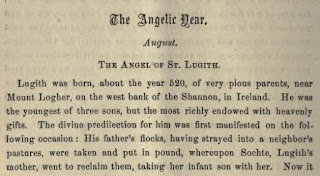
August 4 is the feast of Saint Molua of Kyle. I have previously posted an account of his life here, but today we have a reminder of his many miracles in an 1878 article reprinted from The Messenger of the Sacred Heart of Jesus. The Messenger, official magazine of the Apostleship of Prayer, was originally founded in France in the mid-nineteenth century but quickly spread to the English-speaking world. The article below was part of a series called ‘The Angelic Year’ in which episodes from saints’ lives which featured the presence of angels were highlighted. Our Saint Molua, here called Lugith, was chosen for the month of August. Various versions of the Life of Saint Molua have survived and provided a wealth of material for the article’s theme. Angels are found in the Lives of many Irish saints, most famously perhaps in that of Saint Patrick whose guardian angel is named as Victor. It is also commonplace in hagiography for the saint’s holiness to be apparent from his earliest days and there are a number of miracles from the childhood of Molua cited in the article. Another stock element is the passing by of a noteworthy saint who recognizes the potential in the holy child and either predicts his future greatness or claims him as a protégé. Thus we see Saint Comgall (called Cougall here), founder of the monastery of Bangor in County Down, call the young Molua to be his disciple. Aspects of medieval hagiography can appear bizarre to the modern reader and we may wonder, for example, at the curious episode where Saint Molua equates the presence of sheep with that of women. Yet this is a confirmation that care of sheep was women’s work in early medieval Ireland, with the Life of Saint Brigid, for example, depicting Ireland’s patroness acting as a shepherdess in her early days. But it is the presence of the angel guiding and guarding Molua in life and in death which draws together all of the episodes the anonymous writer in The Messenger has chosen to honour this most interesting saint on his feast day:
The Angel of St. Lugith.
Lugith was born, about the year 520, of very pious parents, near Mount Logher, on the west bank of the Shannon, in Ireland. He was the youngest of three sons, but the most richly endowed with heavenly gifts. The divine predilection for him was first manifested on the following occasion: His father’s flocks, having strayed into a neighbor’s pastures, were taken and put in pound, whereupon Sochte, Lugith’s mother, went to reclaim them, taking her infant son with her. Now it happened that this neighbor had for a long time been afflicted with acancer in the breast. When Lugith entered his house, God permitted him to see the child all surrounded with light. “Oh!” said he, “bring that child here and let him put his little hands on my head.” Sochte, who carried Lugith in her arms, approached the sufferer; but the child being frightened at the excitement and groans of the sick man, began to cry when he saw his arms stretched out towards him; and while his mother, notwithstanding his resistance, was holding him over the invalid, a few of his tears fell on the cancer and immediately cured it. The cattle were restored and Sochte returned home with a joyful heart.
When Lugith was somewhat older he used to go to the fields with other children to watch the sheep. During the winter they would make a fire and gather merrily around it. One day they had lit a fire near the bed of a dried-up stream and were warming themselves by it, when suddenly a torrent, formed by the rains which had fallen higher up the country, came rushing along overflowing the banks, and extinguished the fire. Lugith ran away taking with him a brand to light a fire somewhere else; but the brand, too, went out. While the child stood looking sadly at the extinguished brand which he held in his hand, an angel appeared at his side and made the sign of the cross over it. The brand forthwith blazed up and Lugith and his companions lit another fire and warmed themselves around it.
At another time Lugith disappeared, and for a day and a night no traces of him could be found. At length, his father, Carthach, found him asleep in a field, but did not dare approach him because he saw standing near him a beautiful young man clad in white, and from the spot where the child slept there issued a fragrance sweeter than the perfume of the choicest flowers. Carthach ran to call the priests, and when one of them came, the angel vanished and the child awoke. From that day forth all earthly food lost its savor to this priest, from the impression he retained of the sweet odor embalming the innocent child.
Another day, while charged with keeping the calves apart from the cows, Lugith fell asleep again. It is needless to say that the calves and cows were soon together. Sochte perceiving this ran in all haste to awaken Lugith, and in her anger had raised her hand to strike him, when the guardian angel of the child seized her arm and stayed the stroke. Fainting with fear she fell prostrate to the ground, and Lugith ran to drive back his calves.
Being at another time at a short distance from his father and mother, but without any playmates, there came three youths and began to play with him. Joining their hands together and supporting Lugith on them, the youths, in sight of Carthach and Sochte, ascended to the skies and disappeared from view. For a great part of the day they saw nothing of him; but all of a sudden, while his afflicted parents were lamenting and praying, the three youths laid Lugith down before his mother.
About this time the holy priest Cougall was passing through that country. As he drew near the abode of Lugith’s parents, he suddenly stopped, and pointing towards a certain field, he said to the monks who accompanied him: “Go and see what is down there.” On reaching the field the monks found Lugith asleep in a clump of rushes, and noticed that at every breath he drew the rushes near his mouth were enveloped in flame. They awoke Lugith and brought him to the holy priest. Cougall sent for his parents and asked them if they were willing to let the child go with him, saying that he would rear and educate him. Carthach and Sochte accepted the offer with thanks, and Lugith followed St. Cougall to the monastery. One day while the child was learning his letters, St. Cougall saw an angel seated by his side and helping him to spell and encouraging him with caresses to overcome his dislike for his task.
One day when he was sent to the farm to bring the daily supply of milk to the monastery, the horse stumbled and the milk was all spilled. He was looking at the spilled milk in great distress of mind and not knowing what to do, when his guardian angel appeared and said to him: “Fill the vessels with water at yonder spring.” As the water was poured in it was changed into milk, and that day the monks wondered much at the exquisite flavor of the milk which Lugith brought.
A long time after this it was the will of God that Lugith himself should become a founder of monasteries. Accompanied by some monks and taking with him five cows, he set out towards his mother’s country. Here he was badly received and was considering whither he should next go, when his guardian angel told him to turn his steps towards Rosbilech. The following night an angel appeared in a dream to a rich man of Rosbilech named Bledue, and said to him: “To-morrow a monk will come hither driving five white cows with yellow ears; thou shalt offer him thy possessions, for thou shalt be a religious in his monastery.” But Lugith, having heard the bleating of a sheep in the place, said to his brethren: “We shall not remain here, for where there are sheep there also are women; and where there are women, there also is sin; where there is sin, there is the devil; and where the devil is, there is hell; ” and he sought a more solitary place.
One day while he was looking at a barren mountain near his monastery, his guardian angel said to him: “If thou wish it, that mountain shall become a fertile land covered with harvests and all shall be thine.” “No”, blessed angel,” replied Lugith, “my brethren would then lose their humility.” “Brethren,” he used to say to his religious, “labor faithfully with your hands and nothing shall be wanting to you, and you shall become true religious.”
When Lugith perceived that his end was approaching he went to visit St. Cronan, and at his departure asked for a consecrated host that he might communicate on the way. He had not travelled far when he was obliged to stop from fatigue. Turning to the monk who accompanied him, “Brother,” said he, “if you saw on the one side the inhabitants of heaven and on the other those of earth, to which side would you go ?” “To the side of the inhabitants of heaven, without doubt,” replied the Brother.” Then give me the Blessed Eucharist that I may go to them,” cried Lugith, and shortly after communion, he passed away. His death took place on Saturday, August 4, 602.
It was revealed to the Blessed Fintan that for the seven days following the death of Lugith there was extraordinary rejoicing in heaven, and an assuagement of the pains of purgatory. The occasion of this revelation to St. Fintan was the following: His guardian angel was wont to visit him twice a week, on Thursdays and Sundays; but at this time he did not visit him for seven consecutive days. When Fintan saw his angel again on Sunday, the 12th of August, “Why,” said he, “O angel of God, didst thou not come to me on Thursday?” “During the week just passed,” replied the angel, “the angels have not visited the saints on earth; a great friend of God has come to heaven from the land of Erin, and all remained to greet him: his name is Lugith.” “I see,” rejoined Fintan, “that Lugith singly has done more for the glory of God than all the rest together; find out for me in heaven, good angel, what has made Lugith so pleasing to God and to his guardian angel.” An instant later the angel reappeared and said to him: “Lugith mingled sweetness and love with the rigor of his correctness, and he never humbled any of his brethren that he did not also give him new courage; as for thee, thou art too harsh with thine.”
Lugith, while guardian of his brethren, had imitated the sweetness and charity of the angel who guarded himself. The angels are perfect imitators of Jesus; those who imitate their angels will find themselves at the last day living copies of Jesus.
‘The Angelic Year: August – The Angel of St Lugith’, The Messenger of the Sacred Heart of Jesus, Second Series Vol. 5, No. 8 (1878), 356-358.
Content Copyright © Omnium Sanctorum Hiberniae 2012-2022. All rights reserved.


 OMNIUM SANCTORUM HIBERNIAE