Author: Michele Ainley

  • All the Saints of Ireland, November 6

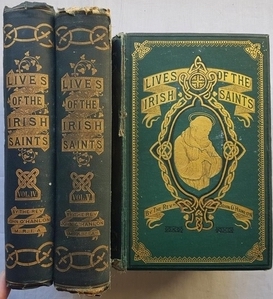
    November 6 is the Feast of All the Saints of Ireland and, since it is the date on which I started Omnium Sanctorum Hiberniae in 2012, is also this site’s patronal feast. As my original inspiration was the monumental Lives of the Irish Saints of John, Canon O’Hanlon (1821-1905), it seems fitting to mark the feast with this splendid tribute taken from the introduction to his very first volume. I would like to thank everyone who has supported the blog over the last decade and wish you the blessings of the Feast. Beannachtaí na Féile oraibh go Léir! Orate pro nobis omnes Sancti Hiberniae!

    By the Irish prelates and religious, vast numbers of sainted persons were inscribed on our martyrologies and calendars; churches were built in their honour, and called after them; their relics were frequently preserved there, and exposed for veneration to the faithful; litanies and hymns were composed in their honour; Masses and offices were celebrated in their name; they were invoked by prayers; while every just title of religious prescription has hallowed their memory, leaving them as our guardians and intercessors in heaven.

    Content Copyright © Omnium Sanctorum Hiberniae 2012-2022. All rights reserved.

  • 'Broken in All Things Save of God': Blessed Thaddeus MacCarthy


    BLESSED THADDEUS MAC CARTHY

    THE high Alps, snow-covered, take on, at sunset in Autumn time, such colours and blends as are to be conveyed only in music, or stored in the secret heart. Pathos and longing in the deep blue auras, magic in the silver slides passing in and out of the lanterns of moon and stars, peace and rest in the purple flowing down like a shawl to cover the beloved breasts of hills; until in the dark from the folded world rise, like breathings of children, turnings in sleep, little sighs and cries, the springs and streams of the lower levels, un-frozen as yet and running on to the Mediterranean with word of the hills and how beautiful they are in their sleep, and how holy this work is of handmaiden to them. So poetry steals out of every thought, such poetry as must have touched his heart. For look at him there, a pilgrim dragging himself on to the Italian gate of the Alps. A young man, 37 or so, but broken in all things save of God. Night is falling as he reaches Ivrea and enters the cathedral. He prays for strength to persevere, for now his heart lifts with an agonising hope. There, up in the valley of Aosta, opens out the fan of snows about the great St. Bernard, from whose heights –  oh, God, if only he can reach them! –  the 19 hills will be visible rolling down to the West and Ireland that he craves for. So he is shaken and exalted by the thousand thoughts, the folly of his adventure, the anguish for home, the phantoms that begin to rise of kinsmen clustering round him at the gates of Cork. “Welcome, welcome back -”  But look! How white he turns! The night grows harder with nipping cold, his blood congeals, his skin tingles and is stung, the nails of the coffin rivetting in – so his mind wandering begins to vision it. He staggers to a gate it is a mile beyond Ivrea on the Aosta Road – the hospice of St. Antonio – they admit him; another rover; pilgrims are frequent, not always to be trusted. He flounders to a bed in the common ward ; neglected, scorned maybe. Vespers ring out. The Brothers are at prayer; the pilgrim gives a little gasp on the floor. Suddenly the mountains topple down, the torrents run living gold, lapis lazuli and silver reef across the peaks, avalanches leap and clash like cymbals. An old feeble fellow stretched near by cries out for help: “That one there – the stranger! He is all on fire!” And the bell clangs the brethren round, and they fall upon their knees, breathless and humbled, till the phosphorescence passes from the face and hair of the departed. Oh, Mary and Joseph! a saint and of noble birth! For look what is here and they searching his coarse pilgrim clothes! A bishop’s ring and the scrip from the Pope himself! And the poor man, so holy and good, and he walking and begging his way from Rome! Fling wide your gates, O Cork, and bid his spirit enter. For this Thaddeus of the royal MacCarthys is such a light of humility and faith as must outshine us all !


     D. L. Kelleher, The Glamour of Cork, (Dublin and London, 1919), 18-20.

    Content Copyright © Omnium Sanctorum Hiberniae 2012-2022. All rights reserved.
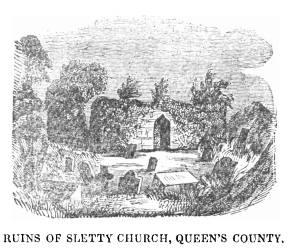
  • The Old Age of Saint Fiacc of Sletty

    October 12 is the feastday of Saint Fiacc of Sletty, a bard converted by Saint
    Patrick and later made a Bishop. A paper detailing his life can be read at the blog here. Below is a beautiful tribute to the saint in his old age when, despite
    his advancing years, there was no lessening of his ascetic discipline:

    …Fiacc in his old age lived a life of extraordinary austerity. At the
    beginning of Lent he usually left his monastery unattended, taking with
    him only five barley loaves, and these strewn with ashes. He forbade any
    of his monks to follow him, but he was seen to go to the hills to the
    north-west of Sletty, a wild and solitary district. In one of these,
    called Drum Coblai, he had a cave which sheltered him. The hill itself
    has been identified with the Doon of Clophook, which is just seven
    miles to the north-west of Sletty. Its eastern slope ‘which is steep and
    beetling’ rises abruptly to the height of 150 feet; at its base is the
    cave thirty-six feet deep by twelve in width. Close at hand there was an
    ancient church and cemetery, doubtless founded there in honour of the
    saint. Local tradition still remembers him; but as he was not seen
    coming or going to his church at Sletty, the wise people came to the
    conclusion that he had an underground passage through the mountains all
    the way to his own church. The fame of his sanctity and austerities
    still clings like the mists of morning to the mountain sides of Slieve
    Margy, where he spent his last and holiest days.

    The poet-saint
    sleeps amid many miracles with kindred dust in his own church of Sletty,
    within view of the spires of Carlow. An ancient stone cross still
    standing is said to mark the spot on the right bank of the river where
    his holy relics rest. He was one of the earliest of our native prelates,
    he led an austere and humble life, he was deeply attached to the person
    and to the memory of his beloved master St. Patrick, and his influence
    has been felt for many ages in all the churches of Leinster. His poetic
    Life of St. Patrick, to which we have already referred, is beyond doubt
    an authentic poem; and if so it is the earliest and most authentic of
    all the Lives of the Saint. In any case it is an invaluable monument of
    the history, the language, and the learning of the ancient Church of
    Ireland….

    Most Rev. Dr. J. Healy, The Life and Writings of Saint Patrick (Dublin, 1905), 399-400.


    Content Copyright © Omnium Sanctorum Hiberniae 2012-2020. All rights reserved.