Author: Michele Ainley

  • Saint Sinell of Moville, October 1


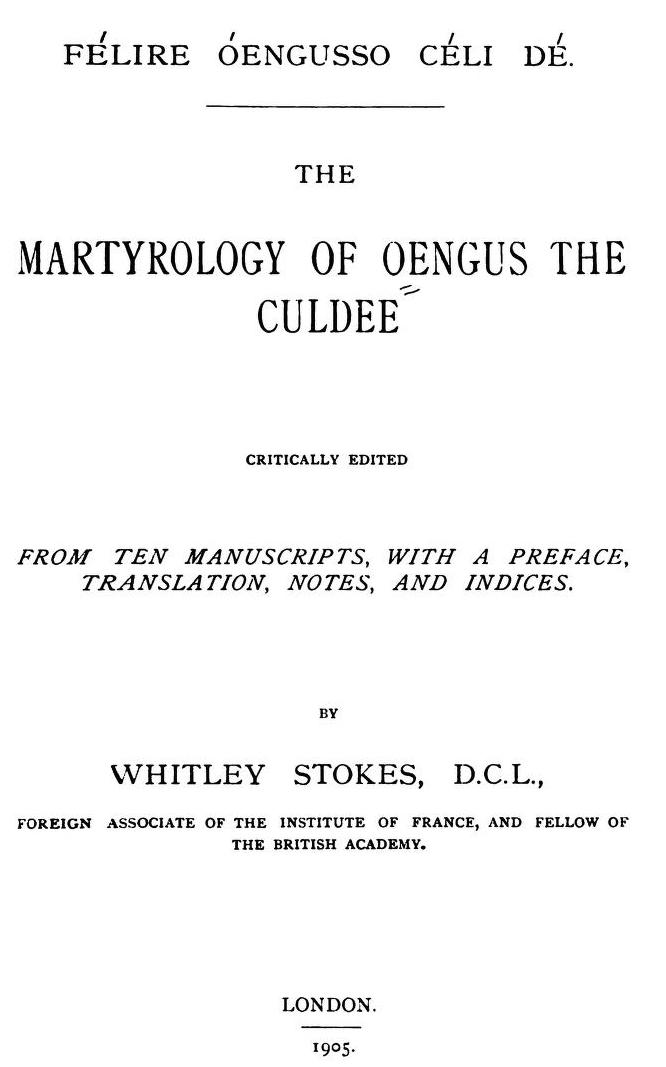
    Today we enter the month of October and I regretfully have to part company from my guide, Canon O’Hanlon. Although he had intended to publish the lives of the Irish saints for the entire year, this was never realized, and although I understand that the archive exists which would make this possible, the remaining volumes were never issued. Complete volumes for the months January to September were published before Canon O’Hanlon’s death in 1905; I am not sure of the exact status of the October volume, I think it may have been published in part and I will have to see if I can track any of it down.  Whilst the Lives of the Irish Saints is perhaps the single most useful and convenient resource, its absence provides an opportunity to explore some of the other sources. So, let’s have a look at a northern saint commemorated today, Sinell of Moville, beginning with a description of his monastery Moville (Magh-Bile, Movilla) in County Down and its founder Saint Finnian:

    Moville, or Movilla, is at present the name of a townland less than a mile to the north-east of Newrtownards, at the head of Strangford Lough, in the county Down. This district was in ancient times famous for its great religious establishments. Bangor, to which we shall refer presently, is not quite five miles due north of Moville…Further south, but on the western shore of the same Lough, anciently called Lough Cuan, were the Abbey of Inch, the famous Church of Saul, in which St. Patrick died, and the Church of Downpatrick, in which he was buried with SS. Brigid and Columcille. And in one of the islands in the same Strangford Lough, now called Island Mahee, quite close to the western shore, was that ancient monastery and school of Noendrum, of which we have already spoken. Religious men from the beginning loved to build their houses and churches in view of this beautiful sheet of water, with its myriad islands and fertile shores, bounded in the distance by swelling uplands, that lend a charming variety to this rich and populous and highly cultivated county.

    …Finnian is said to have returned to Ireland and founded his school at Moville about the year A. D. 540, that is some twenty years after his namesake of Clonard had opened his own great school on the banks of the Boyne. The name Maghbile means the plain of the old tree, probably referring to some venerable oak reverenced by the Druids before the advent of St. Patrick. At present there is nothing of the ancient abbey-school except a few venerable yews to mark the city of the dead, and an old ruined church on the line of the high road from Newtownards to Donaghadee. This old church, which was one hundred and seven feet in length, in all probability did not date back to the original foundation of the place, although it undoubtedly stands on the site of St. Finnian’s original church. The spot was aptly chosen, sheltered by an amphitheatre of hills from the winds of the north and east, and commanding far away to the south a noble prospect of Lough Cuan’s verdant islets and glancing waters.

    St. Finnian died in A.D. 589, according to the Annals of Ulster, at a very great age.

    Insula Sanctorum et Doctorum or Ireland’s Ancient Schools and Scholars by the Most Rev. John Healy (6th edition, Dublin, 1912), 245 , 249, 254.

    The 19th-century Anglican writer, Bishop William Reeves, appended a calendar of saints to his work on the northern dioceses of Down, Connor and Dromore which records the feast day of this successor to Saint Finnian as preserved in the Irish Annals:

    His cowarbs or successors are noticed by the Four Masters, as follows:-

    A.D. 602, ” S. Sinell, Bishop of Moville, died on the 1st day of October.” Tigernach at 603, calls him, “Muighe epscop“: The Chronicon Scotorum, “Maighibile epscop“: The Annals of Ulster (at 602), “Episcopus Campi bili”

    Rev. W. Reeves, Ecclesiastical Antiquities of Down, Connor and Dromore (Dublin, 1847), 152.

    The Martyrology of Donegal lists ‘SINELL, Priest, of Magh-bile’ whereas the Martyrology of Gorman simply lists Sinell, but the notes add ‘priest, of Mag Bile, and bishop of Mag Bile afterwards’.

    Content Copyright © Omnium Sanctorum Hiberniae 2012-2015. All rights reserved.
  • Saint Brigid, September 30

    The very last day of September sees the commemoration on the Irish calendars of a Saint Brigid, who is otherwise left unidentified. Canon O’Hanlon identifies the two main candidates who may claim to be commemorated on this day. The first is a holy woman mentioned in the Life of Saint Senan (feastday 8th March) and the second an unknown female saint associated with a holy well and church at Kilbreedy (literally ‘Brigid’s church’) in County Laois (or Queen’s County as it was called in O’Hanlon’s time). I am not sure that he really proves either case convincingly, but this mystery Saint Brigid is a good example of the large number of Irish saints who are recorded in our martyrologies without any further clues to their identity.

    St. Brigid, of Cluainfidhe, or perhaps of Kilbreedy, Queen’s County.

    In the published Martyrology of Tallagh, the feast of St. Brigitta is thus simply recorded, at the 30th of September. In the Book of Leinster copy, at this day, there is a similar entry. Without any further designation, Brigit is entered in the Feilire of Marianus O’Gorman, at this day. In the Martyrology of Charles Maguire, as in the Martyrologies of Tallagh and of Marianus O’Gorman, the feast of a St. Brigid is entered at the 30th of September.

    Among the holy women, who are recorded as having flourished in the Irish church, there is a St. Brigid, who was daughter to Conchraid, and she belonged to the family of Mactail. Colgan says, this family seems to have been derived, from the Kings of Munster, having issued from the race of Oengus, King over that province. From this line, St. Mactail the Bishop was descended. Or perhaps, the family of Mactail was derived from the O’Brien sept. Cassius, surnamed Tallins, had several sons, among whom were Blodius, Cassius, Sedneus, and Delbatius. Hence it happens, that some one of these, or of their posterity—especially Blodius’ children, who inherited the chieftainship—might be considered as belonging to the family of Mactail. The word itself signifies son of Tallius. If Colgan’s conjecture be correct, those circumstances connected with the family and place of her residence point out St. Brigid, who is venerated on the 30th of September, as the one mentioned in St. Senan’s Second Life. From it we are able to procure the following account of her. We are told there, how St. Brigid, a holy virgin, had established herself in a cell, on the banks of the river Shannon, and at a place, called Clain in fidi, or Cluainfidhe. Whilst there, she had prepared a cloak or chasuble for St. Senan, which she desired sent to him, but had not the necessary means for transport. However, she covered the vestment with hay, and having placed it, with some letters, in an osier basket, which floated out on the river, the result was committed to a providential issue. The letters were directed to St. Senan, and contained a request, that he would send the Most Holy Sacrament to her. By a miracle of Divine Providence, and without any human direction, the basket floated out into the bed of the Shannon, which at this point was very wide; and, at length it landed on the Island shore, near the church of St. Senan. This circumstance, being revealed to the holy man, he called one of his disciples, who was a Deacon. He was desired to bring the basket, which lay on the shore, to the monastery. Having fulfilled such orders, Senan took the vestment and letters contained in the basket. He then placed therein, as we are told, two portions of salt and a pixis containing the Sacred Host. He next ordered, in the name of God, to whom every creature owes obedience, that the basket should return by the same way it had come, and restore to St. Brigid one of the lumps of salt and the pixis it contained ; and that it should bear the other portion of salt, to St. Diermit, who dwelt in the monastery of Inis-clothrand. According to St. Senan’s mandate, the basket returned to St. Brigid. She took out therefrom the pixis, and one of the salt portions. Before she had time to remove the other, the basket was carried off by motion of the water; and it sailed, by a direct course, against the river’s current until it arrived at Inisclothrand. Having understood what had occurred through a Divine revelation, St. Diermit went forth, and brought the basket to his monastery with much joy. He gave thanks to God, for the wonder wrought through his holy servant, St. Senan.

    Of the thirteen saints bearing this name, as mentioned by our Irish Martyrologists, Colgan supposed the circumstance already related can only apply to that St. Brigid, who was venerated on the 30th of September. However, in the Third and Fourth Lives of St. Brigid, such anecdote was transferred to her, with this variation, that the basket or box was entrusted to the ocean, and had to pass over a very great round and extent of sea. Such a transaction—in which there is nothing improbable—was transformed into a marvellous story, which has probably helped to give rise to the opinion, that Senan was established at Inniscatthy before the death of St. Brigid.

    A St. Brighit, or Bride, seems to have been venerated in the Parish of Bordwell, Queen’s County. There had been a pattern at a Bride’s Well, not far from the old church and castle of Kilbreedy, and it was held between the close of harvest and the month of November. Of this I was assured by an old man— in 1870 considerably over 80 years of age— but he could not recollect the exact day on which the pattern had been kept. No other saint bearing the name of Brigid seems so likely to correspond with her to whom allusion has been here made. The old church of Kilbreedy lies about a mile from Rathdowney. Measured outside the old walls, it is 50 feet in length, by 24 feet in breadth. The walls of limestone are nearly four feet in thickness, and were well built, but only the lower portions now remain. The church and grave-yard are evidently very ancient ; but both have been enclosed by a modern and well-built wall, with an iron-gate set up for entrance. Many graves and magnificent hawthorn trees are within the grave-yard enclosure. The remarkable fort of Middlemount rises to a considerable elevation, at some little distance, and on the opposite side of the high road. Concentric and diminishing circular fosses surround it, and ascend to the terminating irregular cone.

    The festival of Brighit is set down, without further clue for identification, in the Martyrology of Donegal, at the 30th day of September.

    Content Copyright © Omnium Sanctorum Hiberniae 2012-2015. All rights reserved.

  • Saint Murghal of Rathlin, September 29

    September 29 is the commemoration of an eighth-century abbot of the monastery on Rathlin Island, County Antrim. Canon O’Hanlon’s entry on the life of Saint Murghal draws on the evidence for his life preserved in the Irish Calendars and Annals:

    ST. MURGHAL, ABBOT OF RATHLIN, COUNTY OF ANTRIM.

    In very remote situations, many of our Irish saints chose to remove from the world, to avoid its temptations and snares. In the published Martyrology of Tallagh, we find simply the entry Murgail, at the 29th of September. A similar entry is in the Book of Leinster copy. The Feilire of Marianus O’Gorman enters Murgal, at this date, and a commentator adds, that he was the son of Uinnid, and abbot of Rechrann. This is now the Island of Rathlin, off the northern coast of Antrim. Sometimes the name of Murgal’s father is written Nenned. Our saint was probably born before or soon after the commencement of the eighth century. At a remote period, and early in the seventh century, a monastic institution had been there established at Rathlin, by St. Segene, Abbot of Iona, A.D. 630, or a little later. The succession of its Abbots has been given by Colgan. There, or perhaps at Iona, our saint had been religiously trained in monastic studies and religious discipline. He appears to have immediately succeeded as Abbot to St. Cobthach, who died A.D. 743, about twenty years before the period assigned for his own departure to bliss. The “Annals of the Four Masters” place his death at the year 764. According to the Annals of Ulster, he died A.D. 768, with which date the O’Clerys agree, and state, that he departed on the 29th of September. Additional particulars are recorded at the same date in the Martyrology of Donegal. There he is mentioned as Murghal, son of Ninnidh, Abbot of Rechrainn.

    Content Copyright © Omnium Sanctorum Hiberniae 2012-2015. All rights reserved.