December 20 is the feast of Saint Fraech (Froech, Froegius, Fraegius), known as Cruimhther or Presbyter Fraech of Cluain Collaing, now Cloone, County Leitrim. The entry in the Martyrology of Donegal records:
20. D. TERTIO DECIMO KAL. JANUARII. 20.
CRUIMHTHER FRAECH, of Cluain Collaing, in Muintir Eoluis. He was of the race of Conmac, son of Fergus, son of Ross, son of Rudhraighe.
The Martyrology of Gorman notes:
Presbyter Fraech the facile [easy], a constant champion.
Saint Fraech was obviously the founder of a monastery in this locality and although no
Life of Cruimhther Fraech survives, he features in the various
Lives of
Saint Berach of Kilbarry, whose feast is commemorated on February 15. Charles Plummer’s translation of one of these Lives of Saint Berach gives us the basic details:
16) Now St. Berach was born in the house of his mother’s brother, Fraech the Presbyter, son of Carthach, in Gort na Luachra (the Close of the Rushes), near Cluain Conmaicne. And in that place there is (now) a mother-church and a cross, and the stone on which St. Berach was born. And Presbyter Fraech subsequently offered this estate to Berach. Presbyter Fraech too it was who baptized St, Berach, and fostered him till he was old enough to study.
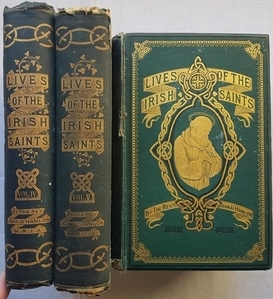
Canon O’Hanlon in his Lives of the Irish Saints expands upon the connection between Saint Fraech and his nephew in his account of Saint Berach on February 15 (Volume II, pp. 536-537):
According to the Irish Life of our saint, his father’s name was Nemnald… Fionmaith, sister to Cruimhther Fraech, of Cluain Conmaicne, in Muinter-Eolais, was his mother…
Their holy relative, named Froegius, or Froech, lived in a certain district, and there he occupied a cell. After reciting matins and lauds, he went out, about the middle of the night, and looking in the direction of Connaught, he beheld a globular and bright luminous halo surrounding the house of Nemnald, and of his wife, Fionmaith. Wondering what such a spectacle portended, Froech said to one of his disciples, “Go to the house of my brother-in-law, Nemnald, and inform me, if my sister hath given birth to a boy: if so, bring him to me.” Obeying this order, the messenger at once set out for the house, where, on his arrival, he found a very beautiful infant with Fionmaith. Having learned from the messenger those instructions, given by Froech, the child was accordingly sent to him. When the latter saw how highly gifted, by nature, his infant nephew was, he directed that baptism should be administered, in the church, so that the neophyte should be washed with the water of regeneration, and that thus he might be presented to Christ.
The first name given to the child was Fintan, until he had been brought to the font, by his uncle, St. Froech who baptized him. The parents had been required to know, what name ought to be imposed on their child, when they replied, it must be Berach. This being agreed to, Froech said afterwards, “Rightly has this name been given to him, for he shall be a saint, and his place shall be in Heaven.” We are furnished with an interpretation, for the name of Berach; namely, that it has the signification of one, who takes a direct and an exact aim, at an object, or as reaching one, so to speak, with the point of a sword… When baptized, the mother naturally desired her infant to be sent home; yet, Froech said to her, “Know you, my dear sister, that no further care of this boy shall belong to you, for with me shall he remain, since God, who created him, is able to cause his growth, without being suckled by a mother.” To this strange request Fionmaith assented, and in a truly miraculous manner, Froech became a foster-father to the child. The latter grew up by degrees, and the Almighty seemed to supply every want, incident to his condition. By Froech, also, was Berach taught the rudiments of learning, when a mere infant. As the child grew up, he evinced the most affectionate regard towards his uncle. His piety and his love for learning were very admirable, so that his time was wholly engaged with prayer and study. His intellectual and pious disposition, even at this early age, boded his future eminence and great sanctity. He laboured to imitate his holy relative, and in the course of time, no other child of earth seemed to equal him, in the practise of good works.
Content Copyright © Omnium Sanctorum Hiberniae 2012-2015. All rights reserved.


 OMNIUM SANCTORUM HIBERNIAE