Author: Michele Ainley

  • Saint Dicuil of Lure, January 18

    January 18 is the feastday of Saint Dicuil, (Desle, Deicola) founder of Lure, a monastery famed for its learning across many centuries. Saint Dicuil was one of the missionary companions of Saint Columbanus, and his story is one of those explored by Margaret Stokes in her book on the remains of Irish saints in France:
    LEGEND OF ST. DEICOLA (ST. DESLE).
    THIS saint was a native of Leinster, and first became a friend of St. Columban at Bangor in Down, where he was distinguished for his learning and piety, and Columban conceived a great love for him. One day he said to Deicola, “How does it happen that your face is always shining with joy, and nothing seems to trouble your soul? ” And Deicola answered, “It is because nothing can ever part me from my God.” Though an older man than St. Columban he followed him on his pilgrimage, and lived with him at Annegrai and at Luxeuil. In the year 600, when St. Columban and his Irish monks were expelled from Luxeuil, St. Deicola hoped to be able to follow his master into banishment; but he had not gone more than a few miles along the valley of the river Ognon, when his strength broke down at a place called Vepras, near the town of Lure. He was an aged and infirm man at this time, and, throwing himself at the feet of St. Columban, he prayed him to let him finish his earthly pilgrimage among the trees of the forest in which they found themselves. The sorrow of Columban was very great at the thought of leaving his oldest friend, and one whom he so honoured, alone in the wilderness; but, setting the will of God before his own, he answered, saying, “May the Almighty Lord, for the love of whom you have left your native land, grant that we meet before His face in heaven.” At these words St. Deicola, knowing that the hour of parting had come, fell upon Columban’s neck, and said, ” May the Lord bless you all the days of your life with all the blessings of Jerusalem.” Then St. Columban went on his way, and St. Deicola remained in the forest alone. It was in a vast expanse of country, only peopled by wild animals; tract beyond tract of marshy and uncultivated ground. Here, without human help, but sustained by his sure faith, Deicola cast his care upon the Lord, and then plunged into the woods to seek a place where he might build his house. He remained without food or drink until the next morning. Kneeling on the ground, he struck it with his staff, and a fresh stream of water sprang forth, from which he drank. He then rose up refreshed, and continued his way until he reached a clear space in the forest, where a herd of swine were feeding. The swine-herd, who was in charge of them, was startled at seeing this old man, of unusual height and noble presence, clad in a strange costume, come forth from the wood. He said, “Who are you, and whence do you come? What do you seek in these wild places, coming thus without guide or companion?” “Fear nothing, my brother,” said Deicola ; “I am a traveller and a monk, and I ask you in charity to show me a place where I may build my cell.” The swine-herd replied that he only knew of one spot, called Lutra (Lure), a very marshy place, where he would have plenty of water. ” But I cannot be your guide,” he added, “for my herd would stray away in my absence.” Deicola looked at the swineherd, and answered, “Here, my son, take my staff, and fix it in the ground, and it will take thy place with the swine, and guard them till thy return.” So saying, he planted his staff in the ground, and the swine crouched in a circle round it. The swineherd followed the old man, and led him to the site he had spoken of, where the saint fixed his tent beside a well. When the swineherd returned to his herd he found them as he left them, grouped around the staff.
    The solitude of the saint was broken one day by a visit from King Clothair II. This prince, now head of the Frankish monarchy, had gone out hunting in the ancient forest of Sequania, and was in pursuit of a huge boar, who sought refuge in the cell of the old monk. The beast, terrified and panting, crouched at the feet of Deicola, as if in search of pity and protection, and the saint, laying his hand upon his head, said to him, “Since thou hast sought charity here, thou shalt find safety also.” He then went and stood at the door of his cell; the pack of hounds came on at full speed, baying loudly, but suddenly stopped before the door, as if they were afraid to advance. The huntsmen hurried to tell the king, who approached that he might see this miracle. When he learned that Deicola was a friend of Columban, whose name he had always honoured, the king left off his hunting that he might sit some while in the cell of the old recluse. He asked, ” What are your means of living, and how do your brethren fare in such a wilderness as this?” “It is written,” said St. Deicola, ” that they who fear God shall want for nothing. We are poor, it is true, but we love and serve the Lord; that is of more value than much riches.”
    Some time after this event King Clothair made a solemn grant to this rising community of all the forests, pastures, and fisheries possessed by the fiscal in the neighbourhood of Lure; to these he added a town named Bredana, with its church and vineyard of St. Antoine.
    When Deicola (Desle) first settled here, he found that there was a church dedicated to St. Martin, on the summit of a neighbouring hill, to which the lord of the district, Werfarius, had appointed a priest for the holy office, and to this sanctuary Deicola went by night to offer praise and prayer to God, and each night that he approached the door was opened by angels for him. But the priest in residence was displeased when he heard this, and said to his congregation, “I will remain here no longer because of this itinerant monk. He lies hidden in the forest all day, and then comes forth at night, and by some unknown enchantment the door of this temple opens at his approach.” The people advised patience, saying, “The truth will come to light some day. If this monk’s power be of God we cannot hinder him ; if it prove otherwise, we shall treat him as an impostor, and drive him pitilessly forth from our land.”
    So Deicola (Desle) continued to pray in the church of St. Martin by night, and the fame of his miracles and holy life inflamed the anger of the priest against him, so that he closed the doors and windows of the church with thorns and branches; nevertheless, the saint kept on his nightly vigil without hindrance. The priest appealed to the lord Werfarius, who was of a cruel and angry temper, and who was then living in his castle of Analesberg, or Lawesberg, near Chalonvillars, south-east of Belfort. He commanded that Deicola should be seized and chastised; but no sooner had the order gone forth, than the prince was seized with a mortal illness and died. His wife Berthilia, seeing the hand of God in this, sent to entreat the saint, whom her husband had unjustly condemned, to come to her aid.
    When Deicola arrived he was weary and heated by the long journey, and seating himself, he took off his cloak. A servant advanced to lay it down, when suddenly it was seen suspended in the air, hanging on a ray of sunlight that had penetrated into the chamber. Seeing this. Berthilda threw herself at his feet, and praying for her husband’s soul she sought to repair his cruelty to the saint by endowing his church with land and with the Church of St. Martin. Thus enriched, a spacious monastery arose at Lure in a few years, where men of one heart and one soul kept up the Laus perennis night and day, and spent their days in labour and in prayer. Two churches, one dedicated to St. Peter, the other to St. Paul, were added to the buildings.
    When all these things were accomplished Deicola, feeling his end approach, called his follower Colombin and his monks to his side, and they took the last Sacrament together; then he spoke to them in wise and touching words, bidding them of all things to remember charity, and with fervour to strive against the difficulties that beset the way to heaven. Having parted from each of his children with a loving embrace, he fell asleep on the 18th of January, A.D. 625, and his disciples buried him with honour in the place where he had died, in the Oratory of the Holy Trinity.
    The saint seemed to live again in his follower Colombin, and the fame of Lure was spread throughout Franche Comte and into the Vosges and Alsace. And thus it was that St. Deicola laid the foundations of this great abbey of Lure, which ultimately became one of the richest abbeys of France, and which twelve centuries later numbered princes of the Roman Empire among its abbots.
    Margaret Stokes, Three Months in the Forests of France – A Pilgrimage in Search of Vestiges of the Irish Saints in France (London, 1895), 41-44.

    Content Copyright © Omnium Sanctorum Hiberniae 2012-2015. All rights reserved.

  • Feast of St. Anthony of Egypt on the Irish Calendars, January 17

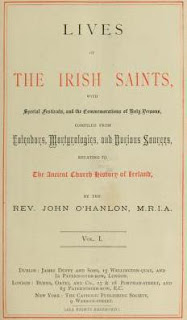
    Pictorial Lives of the Saints (1878)

    In the first volume of his Lives of the Irish Saints, Canon O’Hanlon notes the commemoration on some of the earliest Irish calendars of the Feast of Saint Anthony of Egypt:

    Feast of St. Anthony, Monk and Apostle of the Thebaid in Egypt. [Third and Fourth Centuries.]
    Although this great monastic master had no particular connexion with Ireland, he was specially venerated there, as would appear from our most ancient calendars. At the 17th of January the following stanza occurs in the Leabhar Breac copy of the Felire of St. Oengus. The original Irish and the English translation have been supplied by Professor O’Looney :—
    C. xui. kl. We should often praise
    Though they are not in our conversation
    The band who were crucified without crime
    On the feast of the monk Anthony.
    The Franciscan copy of the Martyrology of Tallagh places him likewise among the native saints, at this date, although no less than twenty-seven foreign saints precede these, according to the generally observed plan in this ancient calendar. Hence we may infer, that the patriarch of eastern monasticism was greatly honoured in the early Irish Church, where his spirit of asceticism was wonderfully emulated by so many self-denying members.
    St. Anthony was born at Coma in Upper Egypt, A.D. 251; when still a very young man he retired to the desert; about the beginning of the fourth century he engaged in the work of founding monasteries; after great labours and mortifications his death took place A.D. 356. The great St. Athanasius has written his life.

    Content Copyright © Omnium Sanctorum Hiberniae 2012-2015. All rights reserved.

  • Saint Dunchad O'Braoin of Clonmacnoise, January 16

    Today we commemorate a monastic saint of the 10th century, Dunchad O’Braoin, abbot of Clonmacnoise, who was also an anchorite and pilgrim. Canon O’Hanlon supplies the details of his life, which includes an account of two of his miracles:
    The acts of this saint have been written by Colgan at the 16th of January. A short life, in the possession of MacCarthy Riabhach, and a still shorter one, in the Chronicle of Clonmacnois, furnished materials for its composition, and he has added some critical notes. Dunchad O’Braoin was a scion of an illustrious family of the Nialls, and he was born in the district called Breghmuine. This is now known as the barony of Brawny, in the county of Westmeath. He was a religious, who embraced the monastic state at Clonmacnois. His love for literature was aided through his zeal. There he made wonderful progress in piety and learning. His humility, too, was most exemplary, for he wished to shun entirely the attentions and applause of men. Secreting himself as much as possible, he lived the retired life of a holy anchorite. He is said to have shut himself up in a sort of prison. Tuathal, who had been both abbot and bishop of Clonmacnois, died A.D. 969. Dunchad was chosen as his successor in the abbacy. Having been brought from his retreat, this humble man was forced to accept the responsible charge, for which he had been selected.
    Among the bishops at Clonmacnois, Harris has placed Dunchad on his list, but only conjecturally, at A.D. 969. Yet, there is no foundation whatsoever,for such an arrangement. Certain words, quoted from Colgan, prove nothing more than that Dunchad had been placed over the monastery as abbot. Throughout his acts, or wherever else he is spoken of, Dunchad is never called bishop. Governing the monastery for some time merely as abbot, he desired a more retired state of life. He withdrew from the management of monastic affairs after some time. By many persons he was much admired in that part of Ireland. The titles of abbot and of anchoret are invariably applied to him. This saint is called a holy and devout anchorite, and he is regarded as a pilgrim. Such designations are applied to him in the Annals of Clonmacnoise, at A.D. 981.
    Through his prayers, Almighty God restored to life the infant son of a woman. This mother left her dead child at the entrance of our saint’s cell. She then retired so as not to be seen, but she hoped that the saint would pray, and procure the infant’s resuscitation. With this request he complied. This miracle is alluded to by Tighernach, author of the Annals of Clonmacnois. This writer lived in the eleventh century. Tighernach says, that Dunchad was the last of the Irish saints, through whose intercession God had restored a dead person to life.
    Another miracle was wrought in favour of this holy man. For one festival day of St. Andrew, the Apostle, when Dunchad had been exhausted from the effects of severe fasting, he began to desire some nourishing diet. He prayed to God for such relief; and then a youth, who served him, went out into a field to collect straw. There two most beautiful men appeared to him, and after a salutation said, “Thy master Dunchad, the servant of God, hath asked the Lord we serve for food and drink, and behold both are here for you to bring him.” Then taking the straw from this youth, they placed nourishing meats, and a vessel, containing mead or beer, mixed with honey, on his shoulders. This load he carefully brought to Dunchad, and related what had occurred. The blessed man gave special thanks to God, who had commiseration on his weakness, and who had relieved him by so evident a miracle.
    In the year 974 or 975, he withdrew to Armagh, where sequestered and unnoticed he hoped to spend his days. His reputation however soon spread throughout that city. So much respect was paid to him there, he was determined to leave it, that he might avoid further notoriety. His intentions being discovered, the principal inhabitants of Armagh deputed some venerable persons of the clergy to request that he should stay with them one year longer. The clergy alone were able to change his resolves.
    He complied with their petition, and continued to reside at Armagh. At the year’s end he again prepared for departure. But a similar request was made. This repetition was annually continued, it is stated, and so he was induced to prolong his stay in that city. St. Dunchad O’Braoin there ended his days, and he died on the 16th of January—corresponding with the 17th of the Calends of February—A.D. 987. The year 988 is said, however, to be more correct. That most distinguished historian of Ireland, Eochaidh O’Flannagain, has allusion to this holy man in an Irish stanza, thus rendered into English by Dr. O’Donovan :—
    ” The seat of Macha [i.e. Queen Macha] the treacherous, voluptuous, haughty,
    Is a psalm-singing house possessed by saints ;
    There came not within the walls of her fort
    A being like unto Dunchadh O’Braein.”‘
    We are told, furthermore, that at the end of his thirteenth year of pilgrimage to Armagh, he passed out of this life. The amiable as well as the humble character of this holy man may be estimated from the disposition he evinced, to yield his opinions to the wiser judgments of virtuous persons, in the order of his living, lest he might seem to be overwise in his own conceits.

    Content Copyright © Omnium Sanctorum Hiberniae 2012-2015. All rights reserved.