Author: Michele Ainley

  • Saint Brigid, Daughter of Doma, February 7

    February 7 is the commemoration of another saint Brigid, this one known as the Daughter of Doma. Although her feast is well-attested on all the Irish calendars, nothing more is known of her life, as Canon O’Hanlon explains:

    St. Brigid, Daughter of Doma or Droma.

    The name of St. Brigid, daughter to Doma, Dioma, Domma, Droma or Drona, as variously written by different authorities, is set down in our Irish Calendars, at this day. Various distinct saints, called Brigid, are noticed in our calendars. In the Rev. Dr. Kelly’s version of the Martyrology of Tallagh, the present saint is called Brigit ingean Droma, on the 7th of February. At the same day, she is mentioned in the Martyrologies of Marianus O’Gorman and of Charles Maguire. It is stated, likewise, that Aengus the Culdee and Geoffrey Keating mention this saint. We read, in the Martyrology of Donegal, concerning Brighit, a daughter of Domma, as being venerated on this day. Her history is furthermore exceedingly obscure.

    Content Copyright © Omnium Sanctorum Hiberniae 2012-2015. All rights reserved.
  • Saint Maelfinnian of Inis Pátraic, February 6

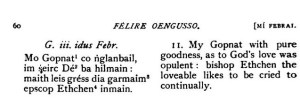
    February 6 is the commemoration of a member of a very special class of Irish saint, for Maelfinnian of Inis Pátraic in County Dublin was a royal saint, a king of Brega who had achived renown on the battle field. I have recently been reading a re-examination of this saintly king by a modern scholar, but below is Canon O’Hanlon’s account. The name, Moel or Mael Finnian, translates as ‘devotee of Finnian’ and although Canon O’Hanlon is unhappy at the description of the king as an ‘abbot’ in the Martyrology of Gorman, modern scholarship is more accepting of this. I hope to post a summary of more recent research into this saint on his feastday next year.

    St. Finian, or Mael-Finnia, of St. Patrick’s Island, near Skerries, County of Dublin.
    [Ninth Century.]

    St. Finian is more generally called by our hagiologists, Moel-Finian, or Maelfinnia. He is said to have been son to Flannagan. He was of royal birth, and his ancestors are distinguished in our Irish Annals. They ruled over the country of the Bregii, and their territory was called Breagh. It extended, it is said, between Dublin city and the town of Drogheda, thus constituting it, in an especial manner, the northern part of Dublin county. It had, however, a much greater extent. In the very early ages of our history, it seems to have constituted a distinct principality. Flannagan, the son of Ceallach, and the father of Maelfinnia, was Prince of the Bregii, and distinguished as one of our old bards, while he was slain at a place called Olbha by the Norsemen, a.d. 891. It would appear, that his son Cinaedh immediately succeeded him, as Tanist of all Breagh; but, he died that very year, at Dun-Brie. We may fairly suppose, that his brother, and the present pious Prince of Breagh, came next, and immediately, in the order of succession, to the territorial chieftainry, perhaps, before the close of the year already mentioned. Mael-Finnia’s virtues are greatly celebrated in our bardic literature, and what gives greater value to his eulogy, it had been proclaimed after his death. Our Annals also recount his warlike and courageous deeds. He appears to have drawn the sword only in generous and noble self-defence, to protect his people and his country from unjust aggression. Thus, when in 892, the Ulidians, under the leadership of Aiddeidh, son of Laighne, made an inroad on Breagh, Maelfinnia met them courageously at Rath-cro,where he fought and gained the victory. Here were slain Muireadhach, son of Maeleitigh, lord of Dal-Araidhe, and Ainniarraidh, son of Maelmoicheirghe, son of Innreachtach, lord of Leath-Chathail, together with three hundred men. Aiddeadh himself escaped, but he was severely wounded.

    During the ninth century, the Danes and Norwegians were a constant source of persecution and annoyance to the Irish, so much divided among themselves. That settlement, which they effected at Dublin, and which seems to have had the protection of fortified walls for defence, retained the advantage, likewise, of a ready communication by sea, for the Norsemen ships and mariners. This was the chief hornet’s nest, whence armed bands issued, to waste the inland territories and religious establishments of the Irish. Accordingly, towards the close of this century, it would seem, that a confederacy had been entered into by Cearbhall, son of Muirigin, King of Leinster and by Maelfinnia, lord of Breagh. The forces of both were united, A.D. 897, and the fortress of Ath-cliath or Dublin was besieged. This was surrendered by the foreigners, after they had sustained a great loss, both in killed and wounded. So many as could escaped across the sea. Yet were they obliged to leave great numbers of their ships behind them. They seem to have fled, in the first instance, to Inis-mac-Nessan, now Ireland’s Eye, a little to the north of Howth. Here, again, they were besieged, and probably they were obliged to surrender at discretion.

    In consequence of these eventful proceedings, the lord of Breagh, Maelfinnia, who is called a religious, devout layman, gained great temporal renown. There appears to be no just warrant for the statement of Marianus O’Gorman, that he was abbot over Inis-Paturic, so far as we can judge. This spot lies off the present maritime town of Skerries, in the county of Dublin. There, for some centuries, a religious establishment existed; and, before the English invasion, it is said Sitric, the son of Murchard, re-founded an abbey for Augustinian Canons. It was dedicated to St. Patrick, and it seems to have been thenceforward known, as the monastery of Holmpatrick. Yet, its situation in the island having been found very inconvenient, Pope Innocent III. confirmed its advowson to the see of Dublin in 1216, and about the year 1220, the parochial church of Holmpatrick was erected on the mainland, by Henry de Loundres, Archbishop of Dublin. Considerable remains of the ancient Holmpatrick Priory yet exist, and these indicate, that they belong probably to the thirteenth century. In the still earlier monastery of the ninth, it may be, that finding his end approaching, the religious prince Maelfinnia, resolving to abdicate his earthly dignity and advantages, retired to the lonely island of St. Patrick, where he assumed the habit of a monk. Although it is mentioned, in the Martyrology of Donegal, that Maelfinden, Abbot of Inis-Patraic, was venerated on this day, the chief authority, for the statement of this holy man becoming superior over the community there, was Marianus O’Gorman. He, probably, had only conjecture to guide him to such a conclusion, or, at best, some unreliable tradition. Other writers, such as Charles Maguire and the Four Masters, without much reflection, followed his opinion. Colgan, likewise, adopts it. Richard Whytford, who treats about St. Finianus, at the 6th of February, styles him a man great in his family descent, yet still more illustrious for his sanctity. The Carthusian Martyrology, also, records him at this date. It appears more correct, however, to call him Maelfinnia, than simply Finian.

    According to our Annals, he happily departed this life, a.d. 898; most probably at Inis-Patric and on a 6th of February, which is the day set apart for his feast. Although, many of our Martyrologists treat concerning this saint, as a man of esteemed sanctity; yet, no further important particulars can be gleaned regarding him, than those which have been already given. From accounts, in the Annals of the Four Masters, and in those of Ulster, we feel disinclined to believe, that Finian became an abbot, at the time of his death. His eulogy has been preserved lor us—at least in part—as some Irish verses were composed to commemorate his fame and his worth. These have been introduced by the Four Masters, when noting down the date for his decease. The following English version is given by Dr. O’Donovan :

    “The son of Dearbhail, battling over Breaghmhach, disperses each meeting without delay,
    The generous Maelfinnia, the great, the fierce, most illustrious, most valiant hero,
    Fit was he to be a king of cloudless reign, high chief over Eamhain of fairs;
    A man, I assert it without fear, who was alone worthy of having all Ireland.

    Maelfinnia, a man without haughtiness, lord of Breagh, a torch over the fortresses!
    He of royal countenance, most highly gifted, a famed just man, a prudent battle-prop.
    The heroic king of heavy blows, even to the sea-shore he won the wage;
    Alas, that the generous Maelfinnia is nota son over the battle of Niall.”

    The Annals of Ulster have a record of this Maelfinnid mac Flannagan’s death, at the year 902; and, by the compiler, he is called a religious laic. We are informed, by Dr. O’Donovan, that the latter date corresponds with A.D. 898 of the Four Masters. The example of this heroic man proves to us, that courage, patriotism, and concern for the public welfare are the duties of a Christian hero; while, most fittingly are they combined in the character of a leader among men, and in one who feels a higher responsibility, when looking to the swift approaches of death.

    Content Copyright © Omnium Sanctorum Hiberniae 2012-2015. All rights reserved.

  • Saint Fingen of Metz, February 5


    Canon O’Hanlon has an account of a most interesting 10th-century saint who laboured in continental Europe, Fingen of Metz. He shares his February 5 feast day with an earlier saint, Fingin, son of Odhran, of whom nothing else seems to be known, but it appears to O’Hanlon that the existence of the earlier Fingin’s commemoration on this day was the reason why the 17th-century hagiologist, Colgan, assigned the 5th of February to his later namesake of Metz as well. Saint Fingen is commemorated in one of the Metz calendars at 5th October, which is most likely the true date of his natalis. At the end of the piece Canon O’Hanlon introduces yet another Finghin, this one an Abbot of Roscrea who reposed in 1005, and suggests that he may have been our saint of Metz but I am not convinced. Fingin of Metz had an illustrious career in Europe as a founder and reformer of monasteries, and seems to have enjoyed secular patronage at the highest levels. He has left an epistle to a nun, the Latin text of which has been published, but Orthodox readers will also be interested to read of the celebration of the Greek Liturgy in the 10th century by the Bishop of Toul in which Irishmen were also involved.

    St Finghin, Son of Odhran Feabhla, or, of Metz, in France.
    [Probably in the Tenth and Eleventh Centuries.]

    In distant countries, as well as at home, the names of many renowned Irishmen are honoured for their merit and virtue. Colgan has some notices of a holy man, called Fingen, inserted in his great work, at the 5th of February. A saint bearing this name, is mentioned, also, by our native compilers of martyrologies. He is entered, in the Martyrology of Tallagh, at the 5th of February, under the title of Febla, Fingin mic Odhrain. There must be some transposition of proper names, in this record; unless, indeed, an entry in a later Calendar be incorrect. Thus, we read, Finghin, son of Odhrán Feabhla, is set down in the Martyrology of Donegal, as having a festival on this day. The account given of St. Fingen is very imperfect, as we find it in Colgan’s work. The Bollandists have omitted this saint, placing him, however, among the Praetermissi et in alios dies relati, for the 5th of February.

    They observe, likewise, that Colgan had not a sufficient reason for giving him the title of beatus, since he had found him called only virtuosus. The chief cause, why Colgan placed his St. Fingen, at the 5th of February, was, for the reason, that the name of a Fingen, the Virtuous, son of Odran Fedhla, happens to occur at this day, in some Irish Calendars. The holy person, thus commemorated, in our fasti, was a very celebrated Irish abbot, who is said to have left Ireland, and to have gone to the kingdom of Lothaire. He is called Fingen, and he must have been born, sometime in the tenth century. It is said he succeeded St. Cadroe, as abbot of St. Felix, otherwise known as St. Clement, at Metz, in or about the year 976. Mabillon, who treats concerning him in his history, did not scruple to consider this Fingen as a great saint, and he often speaks of the abbot, at Metz, as a most religious man. Yet, this Fingen, in all probability, was different from the saint, who is recorded, at the present date, in our native Calendars.Nor did Colgan state, that they were the same, although both were, no doubt, Irishmen. At least, the Fingen, celebrated in connexion with Metz, is regarded as a Scottus, by race, and derived by birth from Hibernia. We are informed, there was a pretty full account of him, in an ancient Life of Thierri I., Bishop of Metz, which unfortunately has not been recovered, if the biography be extant. Besides other mistakes, concerning Fingen and his Irish monks, admitted by Fleury, he calls them Ecossois thus misleading his readers, as to their nationality.

    The old abbey of St. Symphorian had been rebuilt, by Adalbero II., Bishop of Metz, who had a great esteem for Fingen. Over it, this holy man was placed, in the year 991; and, with the assistance of the Empress Dowager Adelhaide, a protectress of Fingen, and of the Irish Benedictines, and grandmother to Otho III., as yet only king, Adalbero obtained from the sovereign a confirmation of the rights and possessions of this establishment. Conditions were imposed, that the Irishman Fingen, its first abbot, and his successors, should not have any other than Irish monks, so long as these could be found, but, in case they could not, the admittance of monks belonging to any other nation was allowed; and, that prayers should be constantly offered there for the king’s soul, for those of his parents, for the existing bishop and for his successors. This deed was signed by the king, at Frankfort, on the 25th of January, A.D. 992, in the ninth year of his reign, and in the 5th Indiction. There is a short epistle of Fingen, still extant, in the library of St. Remigius of Rheims, to Fastradis a nun, concerning a monk, named Guilier. This was found by Mabillon, who seems to have published the letter in its entirety. Fingen was sent to re-establish the monastery of St. Peter and St. Vitonus, now St. Vannes, at Verdun not long after he had been set over St. Symphorian.

    At Verdun, he fixed some Irish monks. Seven of these were there, under his direction, when the celebrated Richard, dean of the diocese of Rheims, and Frederic, who had been Count of Verdun, applied to him in 1001, for permission to become members of this house. It is stated, that they first went to consult St. Odilo, at Clugni, for direction, and he advised them to become monks under the holy Abbot Fingen. The anonymous author of a Life of Richard pretends, that on his and Frederic’s first going to Fingen’s monastery of St. Vannes, they did not find there a very regular observance of religious rule. However, this story, about the defect of regular observance, is rejected altogether by Mabillon, who shows, that Fingen was a very holy man, and that he could not be deficient in enforcing regularity, in the monastery over which he presided. It seems probable, Richard’s and Frederick’s reason for having consulted Odilo was, that on their first going to Verdun, they found another monastery there, lately founded by Bishop Wigfrid, which seemed to them more convenient, although the monastic observance was not as regular, as in Fingen’s, at St. Vannes. This latter was small and deficient in buildings. As they were persons of high rank in the world, Fingen at first was loth to receive them. He was afraid, that they could not put up with the poverty and strict discipline of the monastery. At length, however, he complied with their request.

    The saying of Fleury, that Odilon sent Richard and Frederick back to St. Vannes, under the persuasion, that they would reform the establishment, is quite a mistake; for, they could not be expected to do so, while they remained only simple monks. The Irish abbot instructed and trained his disciples so well, that they became two of the greatest and most useful men of their times. Richard especially was very much distinguished. St. Fingen, three years after he had received Richard, died in the year 1004, and was succeeded by his holy disciple.

    It is singular, that in the Irish annals, the death of a Finghin, or Finguine, called Abbot of Roscrea, is marked, at A.D. 1005. This date comes so near that of the death of our St. Fingen, that it might fairly be suspected they were one and the same person. The day of St. Fingen’s death was probably the 8th of October, at which he is praised in the Necrologium of St. Clement of Metz, as abbot, having been buried in its church. To finish this account of Irish ecclesiastics, who were distinguished in foreign countries, during the tenth century, which is supposed to have been a dark age, we shall add a curious circumstance related, regarding St. Gerard, Bishop of Toul. This prelate, in 986, gave a retreat, in his diocese, to several Greeks, who, mixed with Irishmen, performed the Church Service, in their own language. They all officiated, according to the Greek rite. Hence, we see, that the Irish ecclesiastics still continued to cultivate Greek literature, and, at a time, likewise, when learning had not been in the most flourishing state on the Continent.

    Content Copyright © Omnium Sanctorum Hiberniae 2012-2015. All rights reserved.