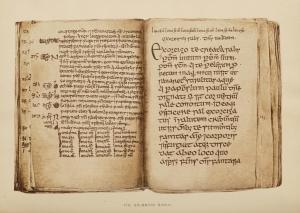
On March 8 we celebrate the feastday of Saint Duthac, a Bishop of Ross in Scotland. Although it seems that there was some disagreement over the exact period in which he flourished, the concensus seems to be that the saint reposed around the year 1068. In his account of Saint Duthac, Canon O’Hanlon provides a good overview of the sources for the Bishop’s career, his links with Ireland and some of his miracles.
St. Duthac or Dubthac, Patron and Bishop of Ross, Scotland.
[Eleventh Century.]
Despising alike the applause of princes and of people, this holy man avoided company, banqueting, and all worldly comforts. Yet, by this course of life, he acquired a just meed of fame, among the people of Britain and Ireland, where his travels produced grace. A Life of St. Duthac was written by Father Patrick Anderson, a Scotch Jesuit, who compiled Lives of the Scottish Saints, which manuscript had been preserved, in the Scotch College, at Paris. He flourished, in the beginning of the seventeenth century. The Rt. Rev. Bishop Challenor, the “Memorial of British Piety”, Rev. Alban Butler and Rev. S. Baring-Gould have their respective notices of Duthac. Also, the Bollandists, and Bishop Forbes, who give an account of this saint, tell us, that he sprung from no ignoble family of the Scoti, and that his wise instructors early imbued him with a knowledge of the Christian Faith. While engaged at his youthful studies, it pleased God to perform a wonderful miracle. His preceptor having sent him for fire to a workshop, snatching up with a tongs some burning thorns, the workman there cast them into the youth’s bosom. His clothes even remained unsinged and unscathed, while Duthac carried the burning thorns safely to his master. By Divine direction, it is stated, that Dubthac crossed over to Hibernia. There, he applied to study the precepts and laws of the Old and New Testament, and on his return to Scotland, he taught these publicly with all gentleness. Shortly after, he was consecrated by his cobishops, as universal and chief pastor. He was remarkable, for his gift of miracles. One of these throws a picturesque light, on the manners of his time. Duthac had been invited to a feast, where one of the company, after drinking, had a sick headache. He had sent a portion of swine’s flesh, with a gold ring, by one of Duthac’s disciples; but, the latter, on passing a cemetery, laid down the flesh and ring there, desiring to offer prayers, for the souls departed. Meantime, a hungry kite snatched them up and flew away across a river, towards a dense wood. Fearing the anger, both of the donor and of his master, the disciple straightway returned, with an account of what had happened. Whereupon, St. Duthac retired for a few minutes, and he prayed; when the kite soon returned, and laid what he had taken, at the saint’s feet. Blessed Duthac accepted the ring, but he restored the flesh to that kite, which anon flew away. Again, in the case of a cake, made with honey and butter, food was miraculously increased, and the remains worked cures. While celebrating the feast of St. Finbarr of Cork, a canon of Dornoch Church caused a fat ox to be killed for the poor. Determining to carry a portion of it himself to St. Duthac, during a dark and stormy night; the spit, on which this food was carried, gave a light both coming and going.
According to Dempster, he wrote a Book, “Meditationes solitariae,” a Book “De Vanitate Philosophorum,” and a Book, “De Dei Nominibus ex S, Dionysio.” While some state, he flourished A.D. 807, others have it at A.D. 1249. The Office and Lessons of St. Duthac or Dubthac occur in the Breviary of Aberdeen, on the 8th of the March Ides, when his death occurred, and when his festival is celebrated. The date for his demise, given by Bishop Forbes, is A.D. 1068. If the supplement to Fordun may be trusted, St. Duthac had another tie to Scotland, in his disciple Malisius or Maeliosa, who, he prophesied, should become Episcopus Scotorum. The Annals of Ulster enter his decease, at A.D. 1065; and, while calling him Albanach, the principal Confessor of Erin and Alban, they state, that he rested at Armagh. He was venerated in Ross, and indeed throughout all Scotland, by princes and people. He flourished during the time of Vilhelmus, or Gulielmus, the ninety-third King of Scotland, according to Lesley. This should bring him into the twelfth century. Again, Hector Boece states the report, that St. Duthac lived, during the reign of Alexander II., and, it is said, he was preceptor to Blessed Gilbert, Bishop of Cathanensis. He is greatly honoured, in the Church of Tayne, in the diocese of Ross, and to this place, great numbers of pilgrims resorted.
Seven years after death, his body was found incorrupt, and his relics were translated to a grander shrine. His shirt, his stock, and his bell, were preserved. The following places in Scotland are named after him: Kilduich, at the head of Loch Duich; Kilduthie, near the Loch of Leys; Arduthie close to Stonehaven, and the Chapel of the Blessed Virgin Mary and of St. Dupthac, at Arbroath. He is reputed to have foretold an invasion of the Danes, which happened A.D, 1263, when they were defeated by Alexander Stuart, the great grandfather to King Robert. In the Kalendar of Hyrdmanstoun, at the viii. Ides, or 8th of March, is entered St. Duthac, Bishop and Confessor. The same entry occurs in the Kalendar of Arbuthnott, and in that of Aberdeen, his feast is similarly noted, with the remark, that he had a Duplex Office, consisting of Nine Lessons. In Adam King’s Kalendar, at the 8th of March, is entered S. Duthake bischope and cofess. in scot, vnder King Alexander 2. Dempster states, that in the town of Thana, Duthac, Bishop of Ross, whose holiness was proved by frequent miracles, had been venerated, on the 8th of March. Also, David Camerarius, at the same date, has St. Duthac, Confessor and Bishop of Ross, renowned for his sanctity, in the provinces of Ross and Moray, in Scotland. We also find this holy bishop noted, in the “Circle of the Seasons,” and in the Martyrology of Cologne.
Content Copyright © Omnium Sanctorum Hiberniae 2012-2015. All rights reserved.

 OMNIUM SANCTORUM HIBERNIAE