Below is a reprint of a short essay on the admiration of the Irish Church for Pope Saint Gregory the Great. I first published this piece on my former blog, Under the Oak and also at the Saint Conleth’s Catholic Heritage Association site. March 12 is the date of Pope Gregory’s death and as such was his traditional feast day. In the modern Church he is commemorated on September 3, the day of his episcopal consecration.

March 12 is the feastday of one of the most revered figures of the early Irish Church, Pope Saint Gregory the Great. In the Leabhar Breac copy of the Martyrology of Oengus the entry for this day reads:
Before arriving in his country,
For Christ he mortified his body,
The slaughter [er] of an hundred victories
Gregory of Rome, the intrepid.
This notice is but one example of the esteem in which Pope Gregory was held by the Irish, and so I will try to draw together some of the other strands to illustrate what an important figure he was for our native Church. Let’s begin with a brief summary of the Pope’s life by Luned Mair Davies:
Gregory the Great… was pope from 590 to 604. Since the eighth century he has been regarded as one of the four Fathers of the western Church. Gregory has been referred to as the master of spiritual exegesis. According to Beryl Smalley, for him ‘exegesis was teaching and preaching’, and it was the didactic element in his works which made Gregory’s strongest impact on medieval biblical study. Gregory was born c.540 in Rome to a senatorial family, and in 573 he was prefect of Rome for a year. He founded seven monasteries in all and in 585 he became abbot of the monastery of St Andreas in Rome, one of his foundations. Pope Benedict I named him as one of the seven regional deacons of the city of Rome and in 579 Pope Pelagius II sent him as apocrisarius to the emperor’s palace in Constantinople, where he remained for six years. In 590 he himself became pope. Before his death in 604 his achievements included organising the Patrimonium Petri, attempting to convert the Lombards and sending a mission to the Anglo-Saxons. [1]
The details of Gregory’s election to the Papacy were recorded in the Annals of the Four Masters:
The Age of Christ, 590. St Gregory of the Golden Mouth was appointed to the chair and successorship of Peter the Apostle, against his will.
to which John O’Donovan, in his edition of the Annals, added:
The memory of this Pope was anciently much revered in Ireland, and he was honoured with the title of Belóir i.e. of the Golden Mouth.
The Irish held the memory of this Pope in such veneration that their genealogists, finding that there were some doubts as to his genealogy, had no scruple to engraft him on the royal stem of Conaire II, the ancestor of the O’Falvys, O’Connells, and other families. His pedigree is given as follows by the O’Clerys in their Genealogies of the Irish Saints:
“Gregory of Rome, son of Gormalta, son of Connla, son of Arda, son of Daithi, son of Core, son of Conn, son of Cormac, son of Corc Duibhne [the ancestor of the Corca Duibhne, in Kerry], son of Cairbre Musc, son of Conaire”.
The Four Masters have given the accession of this Pope under the true year. Gregory was made Pope on the 13th of September, which was Sunday, in the year 590, and died on the 12th of March, 604, having sat thirteen years, six months and ten days. [2]
Not content with turning a Roman aristocrat into a Kerryman, the Irish also applied an epithet more usually associated with the great Eastern saint John Chrysostom to Pope Gregory. That this happened early on is shown by the reference to the golden-mouth in the Paschal Epistle of Cummian, who, writing in the 630s, cited Pope Gregory to help make his case for the Roman computation of the date of Easter:
I turned to the words of Pope Gregory, bishop of the city of Rome, accepted by all of us and given the name ‘Golden Mouth’, for although he wrote after everyone, nevertheless he is deservedly to be preferred to all. [3]
It seems that this Irish tradition of referring to Pope Gregory as the golden-mouth was something that was passed on to Northumbria. Patrick Sims-Williams sees evidence of it in an anonymous Vita of Gregory the Great produced at the Monastery of Saint Hilda at Whitby:
In ch. 24 the Whitby writer asserts that the Romans called Gregory ‘golden mouth’ (os aureum) because of the eloquence that flowed from his mouth
‘Ut a gente Romana que per ceteris mundo intonat sublimius proprie (sic) de aurea oris eius gratia, os aureum appellatur’ (Life of Gregory, ed. Colgrave, pp.116-18). Colgrave translates ‘therefore he was called the “golden mouthed” by the Romans because of the golden eloquence which issued from his mouth in a very special way, far more sublimely and beyond all others in the world’.
In fact, of course, the Romans called Gregory no such thing – ‘golden mouth’ was rather the epithet of St John Chrysostom – and the writer is probably drawing, directly or indirectly, on an Irish source. In Ireland, as early as c. 632, Gregory was commonly styled os aureum; in vernacular texts this is bel óir or gin óir which suggests that the epithet had its origin in an etymological interpreation of Grigoir, the Irish form of Gregorius, which might be associated with Latin os, oris ‘mouth’ and with Irish óir ‘of gold, golden’. In Anglo-Saxon England, however, the epithet only reappears in the Old English version of Gregory’s Dialogi by Alfred’s assistant, Werferth, bishop of Worcester c. 873 – c. 915, who similarly speaks of a stream of eloquence issuing from Gregory’s ‘golden mouth’ (gyldenmup) and says that the Romans call him Os Aureum, the Greeks Crysosthomas. [4]
Irish interest in the writings of Pope Gregory started during the Pope’s own lifetime, as Luned Mair Davies explains:
Gregory’s writings are copious and diverse, although less abundant than those of Ambrose, Jerome and Augustine; some of them reached insular circles at an early date. The 848 letters which he left us in his Registrum Epistolarum are the primary historical source for this period….Gregory also left a collection of homilies, 40 on the Gospels and 22 on the Book of Ezekiel… Gregory enjoyed enormous popularity and prestige among seventh-century Irish ecclesiastics. Columbanus requested the Homilies on Ezekiel in his first letter to Gregory:
Wherefore in my thirst I beg you for Christ’s sake to bestow on me your tracts, which, as I have heard, you have compiled with wonderful skill upon Ezekiel.
In the same letter Columbanus refers to Gregory’s Regula Pastoralis. This work Gregory had written in 591, in response to a communication from Archbishop John of Ravenna, as a directory for bishops and priests. Columbanus also asked Gregory for more of his writings. His letter to Gregory shows how rapid was the dissemination of Gregory’s works in monastic circles.
The Regula Pastoralis was one of the books by Gregory which were especially influential in the Middle Ages. Another was the Dialogi, a collection of popular edifying stories about Italian saints written by Gregory in the years 593-4. In his Vita Columbae, Adomnan, although he makes no explicit mention of the Gregorian Dialogi, in at least three places clearly borrows phrases from the Dialogi to weave into his own narrative.
The evidence of manuscript transmissions shows that of Gregory’s works the Moralia in Job had geographically the widest circulation: this work also was known early, and used early, in Ireland. The earliest known abridgement of Gregory’s commentary on the Book of Job (the Egloga) was Irish, composed about 650 by Lathcen or Laidcend, the son of Baeth, who is most probably to be identified with the Laighden whose obit is given in the Annals of Ulster under the year 661. [5]
Davies has made a particular study of the use of Pope Gregory’s work in the Irish Collectio Canonum hibernensis (CCH). The CCH is a collection of excerpts from biblical and medieval sources, divided into over sixty books which cover the behaviour appropriate for a Christian under various subject headings. It survives in a number of manuscripts and a Breton version attributes it to Ruben of Darinis and Cú-Chuimne of Iona. Both of these reputed authors are known to history, the Annals of Ulster record the death of Ruben in 725 and Cú-Chuimne, called sapiens died in 747. Davies continues:
Five of Gregory’s works are quoted in the CCH. They are: the Pastoral Care (Regula Pastoralis), the Homilies on Ezekiel (Homiliae in Hiezechihelem), the Homilies on the Gospels (Homiliae in Evangelia), the Registrum Epistolarum and the Dialogues (Dialogi)… Of the extracts in the CCH from the Dialogi, five are introduced as in vita patrum, four as Gregorius, one as in vita monachorum and three as De dialogo Gregorii et Petri. Of the eleven other extracts from Gregory the Great in the CCH, four are introduced as by Gregorius Romanus and seven as by Gregorius. The epithet Romanus used for Gregory the Great may reflect the fact that the Romani party in the early Irish Church, who followed Rome’s directives in the dating of Easter, looked to Gregory the Great for guidance. [6]
The Pope’s homilies were also influential as Davies explains:
Gregory’s Homiliae were a collection of homilies on selected passages from the Gospels written down in the last decade of the sixth century. They were addressed to Roman audiences on various feast-days of the Roman Church. The texts of Homiliae 32 and 37 were quoted in another sermon, the bilingual Old-Irish-Latin Cambrai Homily, which was copied into one of the manuscripts of the CCH. The Latin parts of the homily contain the scriptural quotations and the patristic authority; they are paraphrased in the Old-Irish part to clarify them for an Irish audience who perhaps did not understand Latin. The Cambrai Homily has been dated to the seventh century. How soon after their composition Gregory’s Homiliae reached Ireland is uncertain. In the first decade of the seventh century Columbanus used them on the continent. [7]
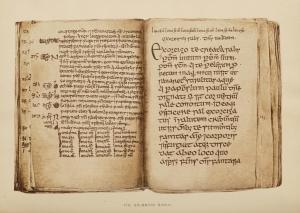
In addition, the Pope’s works are cited in the collection of sermons known as the Catechesis Celtica. The Irish Liber Hymnorum contains a collection of extracts of the Psalms of David which are attributed to Gregory. His work is also referred to in The Book of Armagh and the Codex Maelbrighde.
Finally, the Irish regard for Pope Gregory is also reflected in the hagiographical record as the lives of a number of saints seek to associate their subjects with the great Pope. Saint Findbarr’s tutor, Mac Cuirb, was described as a pupil of Gregory in the Vita Sancti Barri. The formidable seventh-century Irish theologian, Cummian Fota, was likened to Gregory in the list of parallel saints. The entry in the Annals of the Four Masters recording Cummian’s death in 661 includes a poem which says:
” If any one went across the sea,
To sit in the chair of Gregory the Great.
If from Ireland no one was fit for it,
If we except Cummian Fota.”
Cardinal Moran has written of another Irish saint, Dagan, a disciple of Molua, who also claimed a link to the Pope:
St. Dagan is designated in our martyrologies by the various epithets of the warlike, the pilgrim, the meek, and the noble. He was one of the most ardent defenders of the old Scotic computation of Easter, and as such is commemorated by Bede, in his Ecclesiastical History. About the year 600 he visited Rome, and sought the approbation of the great pontiff St. Gregory, for the rule of his own master, St. Molua, in whose life we thus read –
” The abbot, Dagan, going to Rome, brought with him the rule which St. Molua had drawn up and delivered to his disciples; and pope Gregory having read this rule, said in the presence of all: ‘the saint who composed this rule has truly guarded his disciples even to the very thresholds of heaven.’ Wherefore St. Gregory sent his approbation and benediction to Molua.”
St.Dagan, however, was not the only one of our sainted forefathers that sought the sanction of the Holy See for the religious rule which they adopted. In the Leabhar-nah-Uidhre, it is incidentally mentioned that “St. Comgall, of Bangor, sent Beoan, son of Innli, of Teach-Dabeog, to Rome, on a message to pope Gregory (the Great), to receive from him order and rule.” [8]
Even if one is sceptical about the historical value of hagiographical accounts, one Irish saint we can be sure had a demonstrable link to Pope Gregory is Saint Columbanus. John Martyn has published a most interesting paper on Pope Gregory the Great and the Irish in which he examines the correspondence between the two. Columbanus, like Dagan, was a committed supporter of the Irish Easter and didn’t hesitate to let his illustrious correspondent know it. In the nineteenth century, some Protestant scholars tried to argue that the robust style of Columbanus was proof that the Irish did not hold the Papacy in high esteem. Martyn, however, feels they rather missed the point:
Pope Gregory the Great’s apparently close links with Columban and the Irish clergy between 592 and 601 are revealed through five of his letters: 2.43 (July 592), an encyclical sent to the Irish clergy, almost certainly including Columban; 4.18 (March 594) about an Irish priest valuable to the Pope in Rome; 5.17 (November 594) about Columban’s reception of Gregory’s ‘Pastoral Care’; 9.11 (October 600) praising Columban; and 11.52 (July 601) about an Irish Bishop Quiritus. My version of Columban’s letter to the Pope follows, with brief analysis of his irony, word-play and literary style. It shows how the Irishman’s erudite and very rhetorical letter would have tickled the Pope’s fancy rather than offend him. [9]
Thus there can be no doubt of the very high esteem in which Grigoir Belóir, Gregory of the golden-mouth, was held by the early Irish Church.
References
[1] Luned Mair Davies The ‘mouth of gold’: Gregorian texts in the Collectio Canonum hibernensis in Próinséas Ní Chatháin & Michael Richter, eds., Ireland and Europe in the Early Middle Ages: texts and transmissions (Dublin, 2001), 250-251.
[2] John O’Donovan, ed. and trans. Annals of the Kingdom of Ireland by the Four Masters, Vol. 1 (2nd edition, Dublin, 1856), 214-215.
[3] Maura Walsh and Dáibhí Ó Cróinín, eds., Cummianus Hibernus, De controversia Paschali, 83. Online version at http://www.ucc.ie/celt/published/T201070/index.html
[4] Patrick Sims-Williams, Religion and Literature in Western England, 600-800 (Cambridge University Press, 1990), 186-187.
[5] Davies, op.cit., 251-252.
[6] Ibid.
[7] Ibid.
[8] Rev. P.F. Moran, Essays on the Origin, Doctrines and Discipline of the Early Irish Church (Dublin, 1864), 148.
[9] John R.C. Martyn, ‘Pope Gregory the Great and the Irish’ in Journal of the Australian Early Medieval Association, Volume 1 (2005), 65-83. Online version at http://home.vicnet.net.au/~medieval/jaema1/martyn.html
Content Copyright © Omnium Sanctorum Hiberniae 2012-2015. All rights reserved.
 OMNIUM SANCTORUM HIBERNIAE