Author: Michele Ainley

  • Saint Eoghan, March 15

    March 15 is the feast day of a Saint Eoghan, about whom no other information seems to be known. As the Bollandists note, this is a common name although the scholiast on the seventeenth-century Martyrology of Donegal tried to suggest that he may be Eoghan, the son of Saran, to whom the monastic rule of Saint Ailbhe was addressed, as Canon O’Hanlon reports below:

    St. Eugenius or Eoghan.

    The Martyrology of Tallagh enters a festival for S. Eugenius, simply, at the 15th of March. The Bollandists have merely the name, with an observation, that it is one often met with in the Irish Calendars. The Martyrology of Donegal this day records, Eoghan. “I think,” remarks the writer, “this is Eoghan, son of Saran, of Cluain Caolain, for whom Ailbhe, of Imleach lobhair, composed the very hard rule, which begins, ‘Say for me to the son of Saran,’ &c. For every other person of the same name, that is in the Martyrology, has some title, or church, which he possessed, except the Eoghan, who comes at this day.” In a subsequent page of the Martyrology of Donegal, Dr. Todd places Cluain  Coelain, in the county of Tipperary.
    Content Copyright © Omnium Sanctorum Hiberniae 2012-2015. All rights reserved.
  • Saint Flannan of Cill-Ard, March 14

    March 14 is the commemoration of Saint Flannan of Cill-Ard. As Canon O’Hanlon explains below, identifying both the holy man and his locality is difficult, as all we have to rely on is the recording of both in the Irish calendars, beginning with the earliest, the Martyrology of Tallaght:

    St. Flannan of Cill-Ard.

    On the 14th of March, in the Martyrology of Tallagh, we find the name of Flanan, Cille aird. Many places, called Killard, are known, in different parts of Ireland. The Bollandists, who barely notice St. Flannanus, at this date, also assert, that, probably, his Kill-aird—formerly called Druimard—was at Hy-Garchon, in Lagenia. For this statement, however, they quote Colgan’s authority, in his Acts of St. Aidus. Under either name, it is not to be found on the Ordnance Survey Maps for the county of Wicklow; although, it was called Killaird there, in the time of Colgan. There was a Cill-airidh—said to be known at present as Killerry, in the barony of Tirerrill, county of Sligo—where there appears to have been an ecclesiastical establishment, in the middle of the fourteenth century. The ancient name for Kilworth, in the county of Cork, is said to have been Cill Uird. Marianus O’Gorman and Cathal Maguire have notices of this saint, in their respective Martyrologies. Flannan, of Cill Ard, is mentioned in the Martyrology of Donegal, on this day. The time when he flourished does not appear to have been ascertained.

    Content Copyright © Omnium Sanctorum Hiberniae 2012-2015. All rights reserved.

  • Saint Conchenna of Killevey, March 13

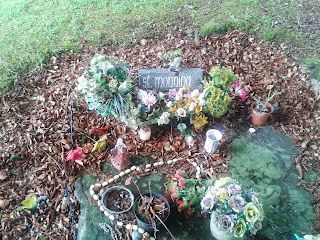
    Grave of St Moninne at Killevey (2013)

    On March 13 the Irish calendars commemorate the memory of Saint Conchenna, a holy woman of the monastery founded by Saint Moninne at Killevey, County Armagh. Her death is noted in The Annals of the Four Masters:

    The Age of Christ, 654, “Coincenn, of Cill-Sleibhe, died.”

    Not much more appears to be known of her life, but Canon O’Hanlon’s account notes that Conchenna was said to have been a sister to Saint Fintan Munna and the subject of one of his miracles. He also wonders if Saint Conchenna was abbess of the community or merely a member of it, but having raised this question he goes on to answer it by noting that the Annals usually only mark the passing of the superiors of religious houses:

    St. Conchenna, Conchend, or Coincheand, Virgin, of Kill-Slebhe, or Killevey, County of Armagh. [Seventh Century]

    Colgan endeavours to evolve some incidents regarding this holy virgin, at the 13th of March. The Bollandists have only a short notice of St. Conchenna. This saint was daughter to Tulchan, and her mother was Fethlemidia. She was a sister to St. Fintan Munnu, who is venerated at the 21st of October. Thus was she descended, from the noble Hy-Niall race of Ulster. This holy virgin embraced a religious life, in a nunnery, which had been founded by St. Monenna, at Kill-Slebhe, now Killevey, at the foot of Sliabh Cuilinn, or Slieve Gullion, in the southern part of the county of Armagh. Here she lived a very holy life, and illness which caused her death happened. But she was brought to life again, by her holy brother St Munnu, and at the request of their mother. There seems to be a doubt, as to whether she was abbess over the community, at Kill-Sleblie, or a simple member of it. She finally departed this life, A.D. 654; and, although the Four Masters give her no distinctive title, yet, Colgan remarks, they scarcely ever note the death of holy persons, not distinguished as presiding over religious houses. The Martyrologies of Tallagh and of Marianus O’Gorman register the name Conchend, at the 13th of March. Also, on this day, the festival of Coincheand was celebrated, as we read, in the Martyrology of Donegal.

    Note: This post first published in 2014 has been revised in 2022.

    Content Copyright © Omnium Sanctorum Hiberniae 2012-2015. All rights reserved.