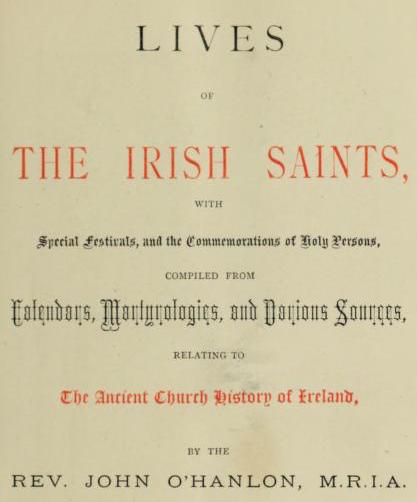
On July 21 the Irish calendars record another of those interesting groups of saints, in this case seven bishops. It often happens that we do not have the names of the individuals who make up these sorts of groupings but the seventeenth-century hagiologist, Father John Colgan, suggested that our septet were brothers and preserved Latinized names for them. Canon O’Hanlon starts off his account by explaining the sacred significance of the number seven before getting into the details preserved in the sources of The Seven Bishops of Tamhnach Buadha:
The Seven Bishops of Tamhnach Buadha.
The mystic number of seven in relation to our Irish saints and ecclesiastics has been as frequently recorded in our ancient books, as it has been found so often noted in the Sacred Scriptures. When Noe was commanded to enter the ark with his family, God said to him: “Of all clean beasts take seven and seven, the male and female.” Pharaoh, in his dream, saw “seven kine, very beautiful and fat, come up from the river” and ” other seven also came up out of the river, ill and lean fleshed.” Again, God ordered Josue to go with his army in procession around Jericho during seven days, and on the seventh, “the priests shall take the seven trumpets,” etc. Then with reference to sacrifice, we read that Balaam said to Balac, King of Moab: “Build me here seven altars, and prepare as many calves, and the same number of rams, and they laid together a calf and ram upon every altar.” Again, when Ezechias purified the temple of God, profaned by the wicked King Achaz, “they went into the house of the Lord, and they offered together seven bullocks, and seven rams, and seven lambs, and seven he-goats, for sin.” Examples of the same kind could easily be multiplied, but we have now to deal with an instance of seven Bishops in the Irish Calendars, and united on the same day for popular veneration. A festival, to honour Secht n Eps. Tamhnaighe, appears in the Martyrology of Tallagh. There were seven bishops, named respectively Saints Aidus, Diermit, Foebarchuo, Maclasrius, Manchinus, Tarchell, and Tinius, while these are said to have been seven brothers. They were sons of Muredac, son to Fochern, son of Dichull, son to Crimthann, son of Armedac, son to Senach, son of Aid Loga, son to Oscuon, son of Mienach, son to Lugad, son of Imchad, son to Fidchur, son of Eochod, son to Ennius Monchaoin, son of Ros, surnamed Rig-Foda, son of Fiacha Suighde, son of Feidhlemid Reachtmhar, founder of the Desies family. Colgan thinks those may be the seven bishops venerated at Tamnach-Buadha, on this day. Selbach enumerates twenty-three saints descending from Fiach Suighdhe, and venerated in our different Calendars. At this date, the Martyrology of Donegal records the Seven Bishops of Tamhnach Buadha [Bishop Tedda of Tamhnach.] We find seven bishops, the sons of one father, adds the Calendarist, while their names and history are among the race of Fiach Suighdhe, son to Feidhlimidh Reachtmhar, son of Tuathal Teachtmhar. There is an almost incredible number of Irish townlands, denominated Tamhnach—Anglice Tawny or Tawnagh either singly or in composition; yet, among these, it appears no easy matter to identify Tamhnach Buadha with any one of them. The ancient etymon probably has become obsolete among our modern local names. Under the head of Tamhnach Buadha, Duald Mac Firbis enters the seven bishops from Tamhnachbuadha, at July 21st.
Content Copyright © Omnium Sanctorum Hiberniae 2012-2015. All rights reserved.
 OMNIUM SANCTORUM HIBERNIAE