Author: Michele Ainley

  • 'Mary the Virgin: your own holy mother': Devotion to Our Lady in the Early Irish Church

    Our Lady of Dunsford, Co. Down

    As May is the month traditionally dedicated to Our Lady, I have been enjoying some of the early Irish sources which pay tribute to her.  It is worth reflecting on the fact that the year 431, the year in which Pope Celestine sent Palladius as the first bishop to the Irish believing in Christ, is the same year in which Saint Cyril of Alexandria was defending Mary’s claim to be Theotokos, the god-bearer, at the Council of Ephesus. So, what evidence is there of devotion to Our Lady in the centuries following Christianity’s arrival up until the year 1200?

    I will begin with the Irish calendars which refer to both the person of the Blessed Virgin and to her feast days. The Prologue to the ninth-century Martyrology of Oengus draws a contrast between Pilate’s haughty queen ‘whose splendour has vanished since she went into into a place of mould. Not so is Mary the Virgin..Adam’s race…magnifies her, with a host of angels.’ Saint Oengus often describes Christ in relation to His Mother as the ‘Son of holy Mary’ or as ‘Mary’s great Son’, and he begs God in the Epilogue to his Martyrology to ‘heal my heart for sake of Mary’s Son’. He is no less enthusiastic when recording Marian feasts. February 2 is ‘The reception of Mary’s Son in the Temple’, August 15 the ‘great feast of her commemoration, very Mother of our Father, with a host of kings, right splendid assembly!’, September 8 is the day ‘Thou shalt commemorate Mary’ and at December 25  he declares ‘At great marvellous Christmas, Christ from white-pure Mary was born’. We can find the idea of Our Lady as Queen of All Saints reflected in the Irish Martyrologies too. In the Epilogue to the Martyrology of Oengus, there is a description of the various companies of heaven being grouped around important figures of the universal Church. Stanza 249 begins with ‘the troop of martyrs around Stephen’ and ends with ‘the troop of holy virgins around Mary.’ The later martyrologist, Marianus O’Gorman, whose very name is a Latinization of the Irish Máel Muire, meaning someone devoted to Our Lady, records at November 1 ‘On the venerable day of Allhallowtide behold ye the Lord Himself, the angels, a mystical band and all the saints of heaven, hosts with clear white purity, around great honourable Mary.’

    Irish monastic poems, hymns and devotional texts reflect the same understanding. A Litany to Christ known as the Scúap chrábaid ‘The Broom of Devotion’, ascribed to Colcu úa Duinechda, an eighth-century scholar and lector from Clonmacnoise, includes this petition “I beseech you by all the holy virgins throughout the whole world, with Mary the Virgin, your own holy mother’. Later the author begs to be heard ‘For the sake of the pure and holy flesh which you received from the womb of the virgin’ and ‘For the sake of the holy womb from which you received that flesh without loss of dignity’. Also from the eighth century are the two poems of Blathmac, son of Cú Brettan, published in 1964 by Professor James Carney, having been re-discovered as a neglected seventeenth-century manuscript of Friar Michael O’Clery’s in the National Library of Ireland in the 1950s. The poet addresses both of his works to Our Lady and the first poem is all the more remarkable because it begins with Blathmac wishing to join with Her in keening Her son:

    Come to me loving Mary that I may keen
    with you very dear one.
    Alas that your son should go to the cross,
    he who was a great emblem, a beautiful hero.

    The image of Our Lady of Sorrows is something we associate more with the later Middle Ages, with Saint Brigid of Sweden, with the Servites etc., yet here this Irish poet centuries earlier wishes to compassionate the sorrowful mother. He ends his poem saying:

    Come to me loving Mary,
    head of pure faith,
    that we may hold converse with the
    compassion of unblemished heart. Come.

    Blathmac also uses a particularly Irish form of endearment when seeking Our Lady’s intercessory power, asking:

    Let me have from you my three petitions,
    beautiful Mary, little bright-necked one;
    get them, sun of women,
    from your Son who has them in His power’.

    Another eighth-century work of special interest is the hymn composed by Cú Cuimhne of Iona, Cantemus in omni die, ‘Let us sing every day… a hymn worthy of holy Mary. I have previously published a Victorian hymnographer’s translation of the text here, but below is a more recent and literal translation:

    Let us sing every day,
    harmonising in turns,
    together proclaiming to God
    a hymn worthy of holy Mary.

    In two-fold chorus, from side to side,
    let us praise Mary,
    so that the voice strikes every ear
    with alternating praise.

    Mary of the Tribe of Judah,
    Mother of the Most High Lord,
    gave fitting care
    to languishing mankind.

    Gabriel first brought the Word
    from the Father’s bosom
    which was conceived and received
    in the Mother’s womb.

    She is the most high,
    she the holy venerable Virgin
    who by faith did not draw back,
    but stood forth firmly.

    None has been found, before or since,
    like this mother –
    not out of all the descendants
    of the human race.

    By a woman and a tree
    the world first perished;
    by the power of a woman
    it has returned to salvation

    Mary, amazing mother,
    gave birth to her Father,
    through whom the whole wide world,
    washed by water, has believed.

    She conceived the pearl
    – they are not empty dreams-
    for which sensible Christians
    have sold all they have.

    The mother of Christ had made
    a tunic of a seamless weave;
    Christ’s death accomplished,
    it remained thus by casting of lots.

    Let us put on the armour of light,
    the breastplate and helmet,
    that we might be perfected by God,
    taken up by Mary.

    Truly, truly, we implore,
    by the merits of the Child-bearer,
    that the flame of the dread fire
    be not able to ensnare us.

    Let us call on the name of Christ,
    below the angel witness,
    that we may delight and be inscribed
    in letters in the heavens.

    In addition to these devotional texts, we also have an Irish apocryphal text, the Transitus Mariae, the Passage of Mary, which deals with the traditions surrounding Her Assumption into heaven. Scholars believe these traditions reached Ireland, possibly from Syria, in the seventh century. Here is how the Transitus Mariae depicts the end of Our Lady’s life:

    24 Thereupon Christ, son of the living God, came with the angels of heaven, who were singing heavenly harmonies for the Saviour, and in honour of Mary. Christ greeted the apostles, and Mary saluted him, saying: “I bless you, son of the heavenly father. You have fulfilled all your promises, and have come yourself [for me]”.

    25-27 When Mary had finished saying these words, the spirit of life departed from her, and the Saviour took it in his hands with reverence and honour. The archangels of heaven rose up around her, and the apostles saw her being raised up by the angels, in human form, and seven times brighter than the sun. Then the apostles enquired whether there was any other soul as bright as the soul of Mary. Jesus answered and said to Peter: “All souls are like that after baptism. When in the world, the darkness of bodily sin adheres to them. No one else in the world is able to avoid sin as Mary could, therefore Mary’s soul is brighter than the soul of every other person in the world”.

    Finally, we have the tradition of regarding our national patroness Saint Brigid as Muire na nGael, the Mary of the Irish, a type of the Virgin Mary.  This tradition can be traced through the centuries beginning with the early seventh-century prophecy preserved in genealogical sources relating to Leinster. It tells of the great saint to come ..’who shall be called, from her great virtues, truly pious Brigit; she will be another Mary, mother of the great Lord’. Various of the Lives of Saint Brigid describe her in similar terms, and she is equated with Mary in the List of Parallel Saints, which compares Irish saints with important figures of the universal Church. And I can think of no better way to close than with the ending to the hymn of Saint Broccán Clóen, published by the seventeenth-century hagiologist, Father John Colgan, in his Trias Thaumaturga which says:

    ’There are two virgins in heaven who will not give me a forgetful protection, Mary, and Saint Brigid. Under the protection of them both may we remain’.

    Amen to that.

    Sources and Resources:

    The two major historical studies of devotion to Our Lady in Ireland I used are(1) Helena Concannon’s  The Queen of Ireland: An Historical Account of Ireland’s Devotion to the Blessed Virgin (Dublin, 1938) and (2) Peter O’Dwyer, O.CARM., Mary: A history of devotion in Ireland (Dublin 1988).

    Translations of the Irish martyrologies are available through the Internet Archive at https://archive.org

    For the poems of Blathmac see James P. Carney [ed.], The poems of Blathmac, son of Cú Brettan: together with the Irish Gospel of Thomas and a poem on the Virgin Mary, Irish Texts Society, 47, London: Irish Texts Society, 1964.

    The ‘Broom of Devotion’ is one of the texts included in the collection edited by Oliver Davies and Thomas O’Loughlin Celtic Spirituality. Classics of Western Spirituality (Paulist Press, 1999).

    The translation of Cantemus in omni die can be found in the anthology edited by T.O. Clancy and G. Márkus O.P.,  Iona: The Earliest Poetry of a Celtic Monastery (University of Edinburgh Press, 1995).

    The Transitus Mariae is among the texts included in M. Herbert and M. McNamara MSC., Irish Biblical Apocrypha: Selected Texts in Translation ( Edinburgh, 1989).
    Sources for Saint Brigid can be found in Noel Kissane, Saint Brigid of Kildare- Life, Legend and Cult (Dublin, 2017).

    Finally, the photograph shows the medieval stone statue of Our Lady of Dunsford taken on a visit to Saint Mary’s church in Chapeltown in 2017.  Local historian Duane Fitzsimons has written a book about the statue’s rediscovery and the parish which houses it called Under the Shade of Our Lady’s Sweet Image – The Story of a Unique Coastal Parish in the Diocese of Down and Connor (Killyleagh, 2016).

    Content Copyright © Omnium Sanctorum Hiberniae 2012-2023. All rights reserved.

  • The Old Irish Litany of Our Lady


    May is the month traditionally dedicated to Our Lady and below is the translation of an Old Irish Litany in her honour. It has been taken from a work in the public domain, which includes not only the Irish original but also a Latin translation to enable its use by Catholic religious communities. Professor Eugene O’Curry, who first drew attention to the existence of this text, described it on page 380 of his 1861 Lectures on the Manuscript Materials of Ancient Irish History, as:

    A beautiful and ancient litany of the Blessed Virgin Mary, differing in many ways from her litany in other languages, and clearly showing that, although it may be an imitation, it is not a translation. I believe it to be as old, at least, as the middle of the eighth century. It consists of sixty invocations, beginning: “O great Mary! O Mary, greatest of all Marys! O greatest of women! O Queen of angels,” etc., and it concludes with a beautiful and eloquent entreaty that she will lay the unworthy prayers, sighs, and groans of us sinners before her merciful Son, backed by her own all-powerful advocacy for the forgiveness of their sins.’

    Not everyone agreed. Fellow nineteenth-century scholar and translator Whitley Stokes questioned O’Curry’s decision to describe the prayer as a litany and felt that the form of the Irish used suggested it was more likely to be a twelfth-century composition. Irish Jesuit, Father Patrick Bartley, published an article on the subject in The Irish Monthly in 1919. He too questioned the text’s description as a litany, saying:

    In 1862, the Rector of the Catholic University, Monsignor Woodlock, petitioned Pope Pius IX to “attach Indulgences to the following Prayer, or Litany of the Blessed Virgin”, i.e. the Old Irish Litany. In the brief granting the Indulgence, the Pope never uses the term “Litany”. He speaks twice of a “Prayer” and once of a “Pious Prayer or Form of Supplication”. This cautious phraseology seems to indicate a doubt as to whether the prayer is really a litany.

    Various continental clerics added to the debate. A German priest, Father Joseph Sauren, in his 1895 study Die Lauretanische Litanei, accepted O’Curry’s view completely and declared that this Irish prayer was the oldest known Litany of the Blessed Virgin, pre-dating the Litany of Loretto by centuries. Italian Jesuit, Father Angelo de Santi, writing two years later on the Litanies of the Blessed Virgin strongly disagreed, saying:

    We cannot accept as a litany properly so called a composition totally lacking the essential form of a litany. There is no question here of anything more than simple praises of the Blessed Virgin, praises followed by a beautiful and charming prayer. We may add that these laudatory titles closely resemble invocations frequently found in the ‘Praises of Mary’, which were so common in the middle ages.

    Father Bartley’s sympathies were with his Italian confrère, saying:

    A litany, as usually understood, consists of a series of invocations, to each of which a petition is attached.  The beautiful prayer at the end of the Old Irish Litany contains a long list of petitions… but there is nothing to show that any of these petitions were repeated after the invocations in the way characteristic of litanies. Neither is there any evidence that a petition such as “Pray for us” was repeated after each title of Our Lady. There is, therefore, no positive proof that “the essential form of a litany” was observed in the case of the Old Irish Litany. In the absence of such proof, its claim to rank as a true litany cannot be established.

    Rev. Patrick Bartley, S.J., ‘The Old Irish Litany’ in The Irish Monthly, Vol. 47, No. 552 (June, 1919), pp. 293-300.

    Father Bartley went on to discuss the possible sources on which this Old Irish Litany may have drawn,  concluding that two medieval sermons known as the Sermones Dubii of Saint Ildephonsus, which share about half the titles given to Our Lady in the Irish text and in the same order, were the most likely candidates. In addition, both Litany and Sermons had probably borrowed from a common source, most likely a hymn. But whatever its source, status or dating, there is no doubt that what remains known as the Old Irish Litany of Our Lady is a beautiful song of praise in Her honour:  

    O GREAT Mary,
    Mary, greatest of Marys,
    Most great of women,
    Queen of the angels,
    Mistress of the heavens,
    Woman full and replete with the grace of the Holy Spirit,
    Blessed and most blessed,
    Mother of eternal glory,
    Mother of the heavenly and earthly Church,
    Mother of love and indulgence,
    Mother of the golden light,
    Honor of the sky,
    Harbinger of peace.
    Gate of heaven,
    Golden casket,
    Couch of love and mercy,
    Temple of the Divinity,
    Beauty of virgins,
    Mistress of the tribes,
    Fountain of the gardens,
    Cleansing of sins,
    Washing of souls,
    Mother of orphans,
    Breast of the infants,
    Refuge of the wretched,
    Star of the sea,
    Handmaid of God,
    Mother of Christ,
    Abode of the Godhead,
    Graceful as the dove,
    Serene like the moon,
    Resplendent like the sun,
    Destruction of Eve’s disgrace,
    Regeneration of life,
    Perfection of women,
    Chief of the virgins,
    Garden enclosed,
    Fountain sealed,
    Mother of God,
    Perpetual Virgin,
    Holy Virgin,
    Prudent Virgin,
    Serene Virgin,
    Chaste Virgin,
    Temple of the Living God,
    Throne of the Eternal King,
    Sanctuary of the Holy Spirit,
    Virgin of the root of Jesse,
    Cedar of Mount Lebanon,
    Cypress of Mount Sion,
    Crimson rose in the land of Jacob,
    Fruitful like the olive,
    Blooming like the palm,
    Glorious son-bearer,
    Light of Nazareth,
    Glory of Jerusalem,
    Beauty of the world,
    Noblest born of the Christian people,
    Queen of life,
    Ladder of Heaven,

    Hear the petition of the poor; spurn not the wounds and the groans of the miserable.
    Let our devotion and our sighs be carried through thee to the presence of the Creator, for we are not ourselves worthy of being heard because of our evil deserts.
    O powerful Mistress of heaven and earth, wipe out our trespasses and our sins.
    Destroy our wickedness and depravity.
    Raise the fallen, the debilitated, and the fettered. Loose the condemned.
    Repair through thyself the transgressions of our immorality and our vices.
    Bestow upon us through thyself the blossoms and ornaments of good actions and virtues. Appease for us the Judge by thy prayers and thy supplications.
    Allow us not, for mercy’s sake, to be carried off from thee among the
    spoils of our enemies. Allow not our souls to be condemned, but take us to thyself for ever under thy protection.

    We, moreover, beseech and pray thee, holy Mary, to obtain, through thy potent supplication, before thy only Son, that is, Jesus Christ, the son of the living God, that God may defend us from all straits and temptations. Obtain also for us from the God of Creation the forgiveness and remission of all our sins and trespasses, and that we may receive from Him further, through thy intercession, the everlasting habitation of the heavenly kingdom, through all eternity, in the presence of the saints and the saintly virgins of the world; which may we deserve, may we enjoy, in saecula saeculorum. Amen.

    Rev. John Greene, S.J. ed., Ancient Irish Litany of the Ever Blessed Mother of God in the original Irish with translations in English and Latin (New York, 1880).

    Content Copyright © Omnium Sanctorum Hiberniae 2012-2023. All rights reserved.
  • Saint Fíonán Cam of Kinnity, April 7

    April 7 is the feast of an interesting saint, Fíonán (Finan) Cam, of Kinnity, County Offaly but also associated with various locations in County Kerry.  The Martyrology of Oengus records on this day:

    7. Finan the squinting,
    of Cenn Etig,
    around whom is
    much of clamour :

    There is a gloss on this entry, added by later anonymous commentators, which reads:

    Finán the Crooked of Cenn Etig. Of Húi Luchta was he, i.e. of Corcu Duibne, and of Ciarraige Luachra was his mother. That crookedness was in his eyes, i.e. he looked crookedly at his fosterfather when he was asking something for his guests. “Thou hast leave to be thus, semper,” says the foster father, even Brenainn son of Findlug.
    Fíonán Camm, i.e. crooked was his eye, of Cennetig in Sliab Bladma. Of the Corcu-duibne was he.
    A salmon of red gold came: it went in the west after sunset, against the womb of white Beccnat, (Finan’s mother) so that it became her husband, (i.e.) when she was bathing in Loch Lein: ut dicitur: Now thou hast no earthly father: the Holy Ghost has saved thee, has fostered thee.
    Inde alius dixit:
    Becnat, daughter of vast Idgna, the precious stone that was not scanty: like the Son of the Virgin, Finán Camm was born of her.
    In Becnat’s womb thou wast for a while, for thou wast conceived thro’ God’s word: an earthly father thou hast not, the Holy Ghost has saved thee, has fostered thee.
    Finan Camm brought wheat into Ireland, i.e. the full of his shoe he brought. Declan brought the rye, i.e. the full of his shoe. Modomnóc brought bees, i.e. the full of his bell and in one ship they were brought.
    Finan is entitled to true circuits, a measure of wheat for every household, the full of his brazen shoe: a tribute that no great saint had taken.
    Well, there is certainly much to unpack here! Let’s begin with his title of ‘The Crooked’. The Irish word cam means bent or crooked and when applied to an individual usually signifies some sort of curvature of the spine or limbs. In the case of Fíonán Cam, however, the bend is in his eyes, hence his title of ‘Fíonán the Squinting’. The commentator references Fíonán’s foster-father, Saint Brendan in relation to this and the Latin Life of Saint Fíonán confirms the relationship between the two. It tells us, in a trope typical of hagiography, that Saint Brendan predicted the future greatness of their son to Saint Fíonán’s parents, who as a child undertakes seven years of study of the monastic life with his saintly mentor. Brendan later directs Fíonán to the place of his resurrection at Kinnity, where he establishes his own monastery.
    Then we pass to the extraordinary conception of Saint Fíonán, which the commentator tells us involved a salmon. This too is upheld in the surviving written Lives of the saint, although in the opening to the Latin Life, translated by Pádraig Ó Riain in his 2018 collection Four Offaly Saints, the fish does not approach Fíonán’s mother while she is bathing in the lower lake at Killarney, but rather descends upon her during a vision:
    Holy Fíonán belonged to the family of Corca Dhuibhne; his father’s name was Mac Airdhe and his mother was called Beagnaid. This is how he was conceived; his mother saw a fish of reddish colour airborne from the direction of the rising sun, which entered her womb through her mouth, and she conceived from it. She told this to a wise and religious man who said to her: ‘The child in your womb will be a holy man, and he will have grace from God’.
    Wherever his mother went, for as long as he was in her womb, not a drop of rain, snow or hail touched her garment; her spittle cured every illness and feebleness, and whatever she served of food, however little or poor, it was enough for one and all.

    P. Ó Riain, Four Offaly Saints- The Lives of Ciarán of Clonmacnoise, Ciarán of Seir, Colmán of Lynally and Fíonán of Kinnitty (Four Courts Press, 2018), 81.

    It seems that the object of this episode is not to glorify Beagnaid, the expectant mother, but to show that the miracle-working power of her saintly son was present from the very beginning. The idea that his conception does not involve a human father, despite the fact that the name of Saint Fíonán’s sire is one of the first things the writer of the Life tells us, is perhaps designed to emphasize the purity of the saint as well as his likeness to Christ.
    The final section of the commentator’s annotations claims that Saint Fíonán is responsible for the introduction of wheat to Ireland. Daphne Pochin-Mould in the entry for Saint Fíonán on page 159 of her 1964 book The Irish Saints, makes this observation:
    The gloss on the entry for Finan Cam in the Martyrology of Oengus records the curious tradition that “Finan Camm brought wheat into Ireland, i.e. the full of his shoe he brought. Declan brought the rye, i.e. the full of his shoe. Modomnóc brought bees, i.e. the full of his bell and in one ship they were brought. Finan is entitled to true circuits, a measure of wheat for every household, the full of his brazen shoe: a tribute that no great saint had taken.” This recalls the shrine of Brigid’s shoe in the National Museum, and makes one wonder whether at one time a shoe of Finan Cam was similarly enshrined and venerated, and carried on the due collecting circuits.

    I haven’t encountered this tradition of shoes and dues collections before and would like to know more about it. The most recent thinking on the shoe shrine of Saint Brigid though is that it dates to the early eighteenth century.

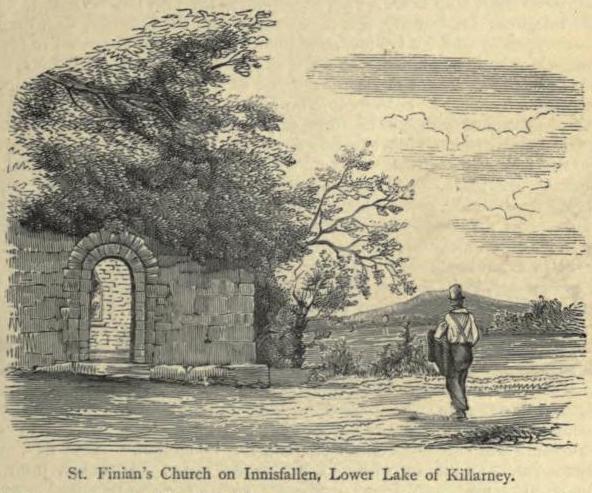
    As we have seen, the Martyrology of Oengus associates Saint Fíonán with Kinnitty alone but the Latin Life places him at various locations in County Kerry. The List of Homonymous Saints preserved in the twelfth-century Book of Leinster records eleven saints who share the name Fíonán, so perhaps it is not surprising to find that Saint Fíonán Cam has become entangled with Saint Fíonán Lobair ‘the leper’ of Swords, County Dublin. Fíonán Lobair is credited with the patronage of the church at Innisfallen, which may be because, according to Pádraig Ó Riain’s Dictionary of Irish Saints, in south Kerry Saint Fíonán’s feast was celebrated on 16 March, the feast day of the leprous one of Swords. Modern scholarship suggests that despite this confusion over the feast date it is the Kerry native, Saint Fíonán Cam, who is the true patron of Innisfallen.

    Content Copyright © Omnium Sanctorum Hiberniae 2012-2023. All rights reserved.