Author: Michele Ainley

  • Saint Maignenn of Kilmainham, December 18

    December 18 is the feast of a County Dublin saint, Maignenn (Maignan, Magnenn) whose name is still recalled today in the placename Kilmainham. Saint Maignenn is a fascinating saint whose Vita contains many weird and wonderful episodes which rather shocked some of the 19th-century churchmen who wrote about the lives of the saints. He had, for example, a ram which used to carry his prayer books, as the Martyrology of Donegal explains in its entry for the day:

    18. B. QUINTO DECIMO KAL. JANUARII. 18.

    MAIGHNENN, Bishop and Abbot, of Cill-Maighnenn, near Athcliath. He was of the race of Colla-da-crioch. Sinell, daughter of Cenannan, sister of Old Senchell the saint, was his mother. He had a ram which used to carry his psalter and his prayerbook. There came a certain robber and thief, and stole the ram. Maighnenn, with his thrice nine clerics, went after the robber to his house. The robber denied having stolen the ram by oath on the relics, and on the hand of Maighnenn himself. The ram was cut up in quarters in a hole in the ground, after the robber had eaten what was in his belly. The ram spoke below in the hole. Maighnenn and his thrice nine persons looked up to heaven, and gave thanks to God for this miracle. But the robber was deprived of his eyesight, and their strength left his feet and his hands, and he said in a loud voice, “For God’s sake,” said he, “O Maighnenn, do not deprive me of the light of heaven for the future.” When Maighnenn heard the repentance of the sinner, he prayed fervently to God for him, and he recovered his eyesight again, and he was eminent in religion as long as he lived. And the name of God and of Maighnenn was magnified by that miracle.

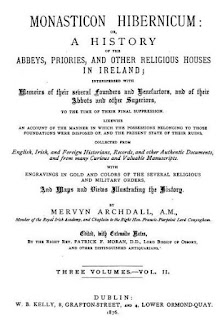
    In his notes to Archdall’s Monasticon Hibernicum, the then Bishop of Ossory P.F. Moran lamented “It is a pity that such a ridiculous fable should usurp the place of more authentic history about this holy man.” Yet modern scholars would readily recognize a number of hagiographical motifs from this story of the ram and the robber. First, there is the slight done to the saint’s honour by the robber, who compounds his sin by swearing his innocence not only on the relics but on the very hand of the saint himself. That cries out for punishment and it is duly delivered as his perjury is exposed by the miraculous cries of the ram. The thief is then deprived of his eyesight, and this is a motif which operates on more than one level, denoting spiritual blindness for example and recalling the encounter between Christ and the blind man in the Scriptures. Then there is the fact that this ‘ridiculous fable’ is actually a vehicle for conveying the mercy and sanctity of Saint Maignenn whose actions lead to a sinner being turned around and to the name of God being magnified. I think, therefore, that Bishop Moran perhaps missed the point of this hagiographical account with all of its rich symbolism – the three times nine clerics in attendance on the saint, the fact that a beast is subject to his will and the ability of Maignenn to successfully intercede for a sinner such as this – all tell me quite a lot about this holy man and in a much deeper way than ‘authentic history’ might have done.

    Content Copyright © Omnium Sanctorum Hiberniae 2012-2015. All rights reserved.

  • Saint Crunnmael of Iona, December 17

    The Martyrology of Oengus has a beautiful entry for December 17:

    17. May Victor’s host protect us
    after the triumph of a deed of valour,
    that we may attain splendid bliss
    Jesus, Mary’s great Son.

    The scholiast’s notes, however, point to a number of other saints who may also claim to be commemorated on this day:

    17. Victor, i.e. a martyr; and Senchaid of Hui Aeda in Bregia, Lazarus and Moliac, and Crunnmael (abbot) of Iona, and Maedoc son of Mursan here.

    The Martyrology of Gorman reads a little differently:

    The noble translation of Ignatius: Lazarus and Martha, gentle ones, chaste relatives of Christ: Senchad along with them, my Liacc. Crundmael the vigorous whom I mention, my beautiful Aedoc whom thou entreatest.

    whilst the latest of the Martyrologies, that of Donegal, omits the mention of Lazarus in favour of a quartet of Irish saints:

    17. A. SEXTO DECIMO KAL. JANUARII. 17. 

    CRUNNMAEL, Abbot of Ia Coluim-cille.
    MAEDHOG, son of Mursan.
    SENCHADH.
    MOLIAG.

    I found it interesting that the Martyrology of Gorman had identified Lazarus as the biblical Lazarus of Bethany, the man whom Christ raised from the dead after four days in the tomb. I wondered if he had a feast day in his own right and wasn’t surprised to see Wikipedia claim that:

    No celebration of Saint Lazarus is included on the General Roman Calendar, but his memorial is traditionally celebrated on December 17.

    I haven’t been able to find out any more about the other Irish saints mentioned on this day, but the succession of the abbots of Iona is mentioned in the sources. The succession at Iona, initially at least, tended to remain within the wider family of Saint Columba. It has been estimated that of the first thirteen successors of Saint Columba, at least ten were related to the family of the founder. Our saint is listed as the tenth abbot of Iona, immediately succeeding Saint Adamnan, Saint Columba’s most famous biographer. In an appendix to his 1874 edition of Adamnan’s Life of Columba, Irish Anglican Bishop, William Reeves, quotes the Chronicle of Iona:

    X. CONAMHAIL, 704-710.
    707. Dunchadh principatum Iae tenuit.
    710. Conamail mac Failbhi, abbas Iae, pausat.

    If I am correct in assuming that this Conamhail is our saint, and his is the only name from the list of abbots which fits, then his abbacy would have taken place at the time when Iona was dealing with the debate on the Paschal Dating Controversy. Indeed, earlier scholars were puzzled by the fact that the annals appear to show that there was more than one person claiming to hold the abbacy of Iona at the same time. In this case Conamhail is listed for the period 704-710, yet in 707 his successor Dunchadh is listed as having already been abbot, and Dunchadh too shares his tenure with other abbots. Nineteenth-century scholars speculated that this may reflect some sort of ‘schism’ at Iona between those who favoured the Roman Easter dating versus those who did not. Alternatively, or additionally, the split may have concerned dynastic, familial rivalries between various branches of the wider family of Saint Columba and thus led to two different individuals both claiming to be abbot of Iona. Modern scholar Richard Sharpe, however, is not convinced that the evidence is there for any kind of schism, pointing out:

    If the situation here were one of different parties recognizing different abbots, it is hard to understand why the annals should enter all of them impartially and without explanation…Rather than conjecture a schism, we should admit that it is impossible to interpret how the abbacy was occupied during this period.

    Richard Sharpe, ed and trans, Life of Saint Columba, (Penguin Classics, 1991), 75.

    Obviously this is one more area of the history of the Irish Church that would repay further study.

    Content Copyright © Omnium Sanctorum Hiberniae 2012-2015. All rights reserved.
  • Saint Mo-beóc of Loch Garman, December 16

    The Irish calendars agree in commemorating the feast of a Saint Mo-beóc or Bean on December 16. His precise identity though seems to be something of a mystery and the subject of some confusion with that of a later Scottish namesake. The prefix mo meaning ‘my’ regularly occurs in the names of Irish saints -Molua, Molaise etc – and indicates an affectionate or diminutive form of a proper name. The Martyrology of Oengus first commemorates a Bishop Valentinus and then:

    the feast of my excellent Beóóc,
    from lustrous Ard Cainroiss.

    The scholiast’s notes do not add much:

    My-Beóóc, i.e. of Loch Carman. Or my Beóóc of Loch Derg in the north.

    The 12th-century Martyrology of Gorman also honours this saint as:

    my Pióc a strong ingot(?).

    and the notes there add:

    from Ard Camrois on the brink of Loch Carman in Húi Cennselaig and from Ross Cain in Cluain Fergaile in Delbna Tire [da locha]

    The later Martyrology of Donegal has a fuller entry, but one which only serves to deepen the confusion, as it introduces a Scottish Bishop Beanus of Aberdeen:

    16. G. DECIMO SEPTIMO KAL. JANUARII. 16.

    MOPHIOG, of Ard-Camrois, on the margin of Loch Carman, in Ui-Ceinnsealaigh ; and of Ros-caoin, in Cluain Fergaile, in Dealbhna of Tir-da-loch.
    [Mobheog in Aengus, i.e., Beanus;(see in the Roman Martyrology; vide Usuard, Molanus,) first bishop of Aberdeen or Ardon, i.e., from Ard, whence the error, as if from Ard-bishop, i.e., from Ard, and from this Abardonensis.]

    The translator of the Martyrology adds in a footnote:

    The note within brackets is in the later hand. It is intended to account for a supposed error of the Roman Martyrology in styling Beanus bishop of Aberdeen. That Mophiog, Mobheoc, and Beanus, are the same, requires no proof ; but the supposition that espug Arda was read episcopus ab Ardo [ bishop of Ard ], and this then corrupted to episcopus Abardo or Abardonensis, is scarcely admissible. The case is this. Molanus text of Usuardus has, at this day, “In Hybernia, natalis Beani, primi episcopi promotus est.” Scotichron. iv. 44. (Vol. i. p. 227, ed. Goodall.) The foundation charter of this church, granted by Malcolm ii., A.D. 1010, “Episcopo Beyn de Morthelach” is preserved in the Register of the Diocese of Aberdeen (vol. i. p. 3, Spalding Club), and though called in question by the able editor, Professor Innes, (Pref. p. xiii.) is, at least, a collateral evidence as to the existence of Bishop Beyn or Beanus in the neighbourhood of Aberdeen. It is to be observed that the St. Beanus or Bean of the Scotch Calendar, whom the Breviary of Aberdeen and Adam King commemorate at the 26th of October, is a different person, being venerated at Fowlis in Stratherne, and probably identical with S.Beoan of Tamhlacht-Menan, who appears in the Irish calendars at the same day. Camerarius correctly assigns “Sanctus Beanus episcopus Murthlacensis dioecesis” to the 16th of December, (De Scotorum Fortitu-l p. 202). See Collections of the Shires of Aberdeen and Banff (Spalding Club) vol. i., p. 142.

    Thus it appears that some sort of confusion has entered into the preservation of the memory of an Irish saint Beóc commemorated on December 16 with a saint of the same name whose feast fell on October 26 and who was further confounded with an 10th/11th-century Scottish bishop of Aberdeen. The Martyrology of Oengus written about the year 900, of course knows nothing of this later bishop, the scholiast though is uncertain as to the locality in which our saint Beóc may have flourished, although all the calendars have preserved Loch Garman (County Wexford). Neither do we know at what date this saint may have flourished.

    Content Copyright © Omnium Sanctorum Hiberniae 2012-2015. All rights reserved.